HUBS (Humans Uniting for Better Sustainability) is a resource-sharing system first introduced in 2022 to help camps plan and share resources to support Burning Man Project’s goal to handle waste ecologically, be regenerative, and be carbon negative by 2030.
HUBS is built to co-locate camps who have partnered to efficiently share resources such as water, power, tools, and transportation. HUBS applicants will be evaluated to ensure adequate resource sharing. The HUBs process is not a way to request your friends as neighbors. If you mainly want to be next to your friends or to just co-program events, do not apply for HUBS and simply request each other as neighbors in your Placed Camp Questionnaire.
Being a camp in a hub is also not a guarantee of receiving placement. All camps will still go through the same Placement Process, meet Placement Criteria, and be selected upon independent review. Only camps who are selected for placement will be considered for the hub.
How Can You Find a Partner Camp?
- You may already be friends with other camps or might have befriended some on playa — building on those relationships can lead to the best pairings. If you had a great experience with a previous neighbor and their email address you sharpied on your arm is long washed away, email us at placement@burningman.org and we can help with re-introductions.
- The Camp Listing Archive is searchable by year, by camp name, by hometown, and by keyword. If the camp has submitted a public URL or email address, you can use that to contact the camp.
- Global Regional Directory lists Regional Contacts whose role is to help local Burners connect with each other. There are contacts in almost every continent and many host happy hours where you can meet Burners near you!
Steps to Form a Hub
- Decide which of the camp leads who are filling out a Placed Camp Questionnaire will be the HUBS Liaison for your hub. This person will notify us that they are accepting this role through the Placed Camp Questionnaire.
- Fill out the Placed Camp Questionnaire by the 3rd Thursday in March for both your camp and your hub!
- Lay it out! We need a map of how camps wish to be positioned in relation to each other. The HUBS Liaison won’t be able to complete the questionnaire until they’ve uploaded your hub layout. Read about layouts below for instructions on this.
- We’ll review and follow up with any additional information we may need.
Sizing Considerations
We have noticed that larger hubs have had challenges on playa. Please consider keeping the size of your hub manageable so that you build solid trust with each other and have supportive campers that understand how you connect. We may reach out to if your hub is over 180,000 square feet to discuss options to resize or split into smaller hubs.
Our recommendations:
Average square footage in BRC
- Esplanade: ~200,000-240,000 square feet
- 250’ depth block (A-E): ~250,000 square feet
- Double wide block (E-F): ~450,000 square feet
Ideal size limits we’ve seen in successful hubs
- < 50-60% of the block size
- < 30-45% for double wide blocks
HUBS Timeline
- Third Thursday in March by 12 PM (noon) PT / 3 PM ET / 9 PM CET: Placed Camp Questionnaire due for all theme camps. Deadline includes any support camps (art, mutant vehicle, work) that wish to form a hub.
- Support camps in a hub must also complete the Placed Camp Questionnaire by the theme camp deadline rather than April deadline for support camps that are not in a hub.
- May: Placement maps Black Rock City and determines hub locations
- June: Placement notifies camps and hubs of their approximate locations
Important Things to Consider When Forming a Hub
Take care in deciding who you want to form a hub with and make sure it’s for the right reason: to share resources between camps to lower costs, create efficiencies for your camps, or to further the sustainability efforts of our temporary city.
Best Practices for Great Hub Partnerships
Compatibility & Capacity: choose partners not just because “we like them”. Try to vary the type of interactivity as well.
Clarity: put commitments between camps in writing
Communication: maintain a consistent communication cadence & shared channels for both leadership and general camp members
Conflict: establish a real process for resolving conflicts or issues
Daily Check-in: have a scheduled check-in each day on playa
Rectangularize: layout your hub as rectangular as possible, use similar depths for all the camps and adjust camp frontages to match (make sure you can fill your frontage still!)
Expectations: make expectations explicit about what each camp is contributing and receiving (scope, boundaries, “what good looks like,” labor, finances)
Finances: keep financials of shared resources transparent (shared budget, cost tracking, clear who pays what)
Plans: build in redundancy & contingency plans if something goes wrong with a shared resource
Debrief: do a post-event debrief and carry lessons forward
Common Challenges to Avoid
Similar Interactivity: avoid homogeny, Placement likes diversity on each block and varied interactivity.
Overhead: adds bureaucracy or administrative burden
Lack of Leadership: absent or weak leadership in a partner camp
Balance: unequal commitment or an imbalance in effort
Vacancy: Last-minute withdrawal, a hub camp is not placed, or significant late changes
Unclear Expectations: misalignment on scope or responsibilities
Conflict: interpersonal conflict or cultural mismatch between camps
Unknowns: external stressors exposing a weak hub structure
Size: hub grew too large or overextended leading to confusion or lack of awareness of how to work together
Resources Shared in HUBS:
- Power (Generator)
- Power (Renewable/Solar)
- Waste/Grey Water Containment and Removal
- Fresh Water
- Shower
- Kitchens/Food
- Transportation (Cargo)
- Tools/Equipment
- Heavy Equipment
- Fuel
- Access or Fire Lanes
How Placement Will Map Hub Requests
The Placement team thinks about how camps of different shapes and sizes fit together, interactivity throughout the day and night in each neighborhood, and how it all flows together. We will do our best to offer the layout in a hub as you have requested, but may need to change the form of it to best fit what’s available.
Hubs are one more factor for the Placement team to consider and may influence where your camp is placed in BRC. If your camp is used to being on Esplanade and your united camps don’t warrant the same location, your hub may be placed in a lower profile area of the city. This can also work the other way around — you may prefer being back on H street, but your hub’s combination of camps may warrant a Plaza, for example. Make sure to talk about these possibilities.
Keep in mind that once placement locations are announced, it is very difficult to move camps around. Moving one camp is hard, and moving multiple camps is even more difficult. Please alert Placement ASAP of any changes that occur to your hub (such as if a camp decides to separate or an additional camp wishes to join). We will do our best to accommodate, but may not always be able to.
Hub Layout Requirements
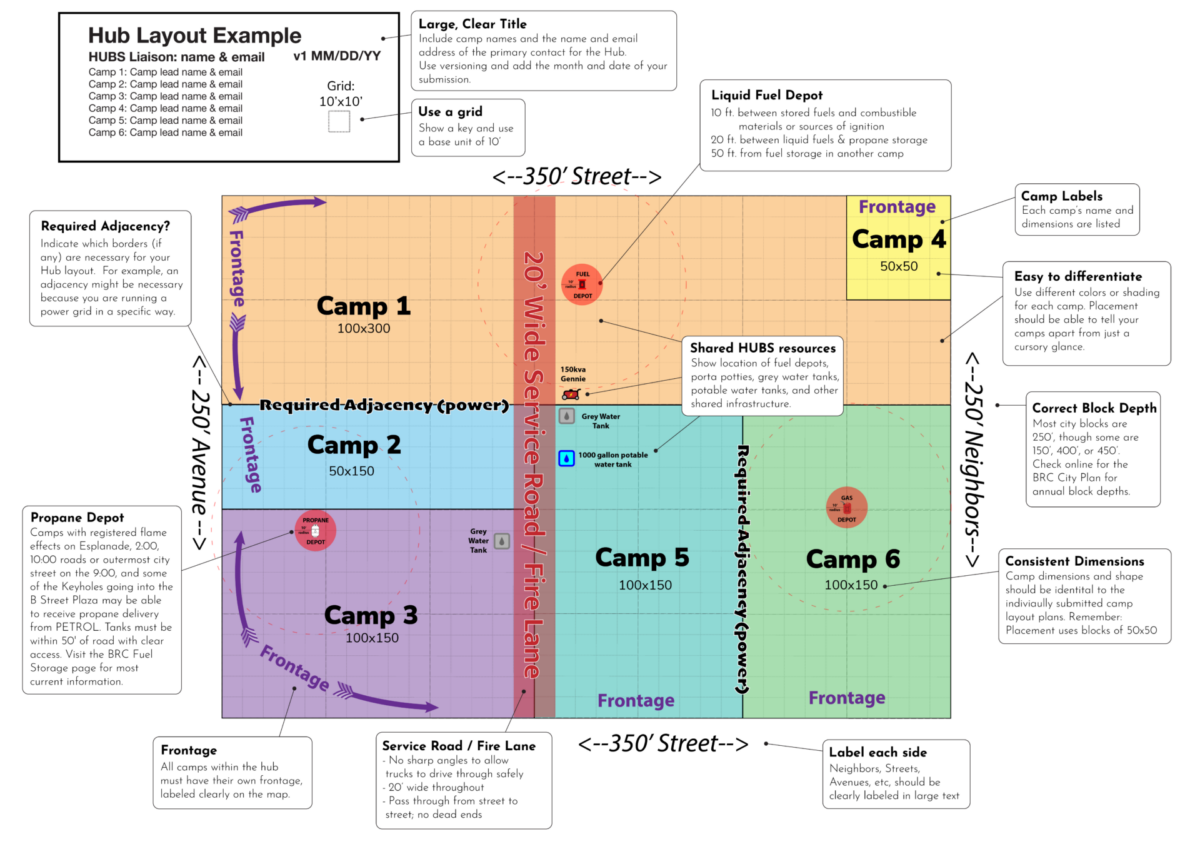
The Placement team needs to understand how the camps within each hub are physically configured. It’s important for the hub layout your HUBS Liaison submits to detail the orientation of the camps to each other, indicate the frontage of each individual camp within the hub, and illustrate/label what your camps are sharing that require the configuration (such as a power grid).
We recommend your hub fit as much as you can within a rectangular shape with 4 corners. While we will try to work with your requested shapes, we may need to modify the configuration based on available space. Most BRC blocks have a depth of ~250’. Esplanade to A is ~400’ deep and E to F is ~450’ deep. The length of full blocks ranges from 700-1000 feet.
Note: Hub layouts are not your individual camp layout, which has its own requirements and specifications. Please review the Camp Layouts page for more information on how to create a camp layout.
Layout Specs
- The HUBS Liaisons name and email should be at the top left
- The date or version should be at the top left
- List each camp in the hub and include the camp lead and email address
- Include the total dimensions of the hub
- Include the dimensions of each of the borders of the individual camps
- Indicate camp frontages for each camp
- Indicate fire and access lanes in your layout. Fire and Service Access Lane Requirements for each camp in your HUB can be referenced above.
- Indicate the location of fuel storage
- Indicate where adjacency between specific camps is necessary
- The camps should be easy to differentiate, use different colors or shading
Fuel Storage (for all camps) and Delivery Requirements (for camp receiving fuel through Burning Man’s Fuel Program)
- Camps Must keep a clear path to generator(s)
- 10 feet between liquid fuel (diesel, gasoline) or propane storage areas and combustible materials or sources of ignition (cars, trailers, etc.).
- No fuel storage within 50 feet from other designated fuel storage
- A minimum of 20 feet between liquid fuel storage and propane storage
If your hub plans to receive fuel delivery from the BRC Fuel Program this year (delivery is only available for dyed diesel generators of 30+ gallons per delivery and drums of fuel) please include your generator location on your hub layout. Your generator should be no more than 20 feet away from your frontage street with a straight access for the fuel hose to reach it from the road. If you are approved to have your generator on an access lane or you have a pre-flagged Service Alley, parameters must be at 20’ fire/servicing lane requirements from the access road or Service Alleys in order to be fueled. Fire/servicing lanes must not include any sharp turns or corners, trucks must be able to pass straight through to the street. There must be clear unobstructed access to the generator from either the street or access lane.
File Requirements
- Maximum file size: 10 MB
- Accepted file types: .jpg .jpeg .pjpeg .png .pdf
- You must convert .heic format photos to jpeg before uploading. There are many free websites that offer this service
- You must have JavaScript enabled. If you need help with that, see: enable-javascript.com
File Name Requirements
- Limit file name to 20 characters or less
- Please place underscores ( _ ) between words, not spaces.
- The file extension (i.e., .jpg) must be included
- Use the HUBS Liaison’s name, month and day, e.g. firstname_lastname_mm.dd.jpg
Hub Layout Example