
The Black Rock City (BRC) Greenhouse Gas (GHG) Emissions Inventory is an important tool to understand the impact of decarbonization efforts, to measure progress towards Burning Man’s sustainability goals, and to explore opportunities for positive impact both in and beyond Black Rock City.
Background
In 2007, the Cooling Man Project estimated BRC’s 2006 greenhouse gas emissions at 30,305 MT CO2, which included round-trip travel to BRC. In 2021, a new BRC GHG workgroup estimated BRC’s 2019 emissions at 54,241 MT CO2.
In 2025, Burning Man Project’s Regeneration Department implemented a fuel consumption survey, conducted the emissions inventory project, and underwent a limited assurance review through an independent third-party verifier. Round-trip travel was excluded due to data collection and processing constraints.
Read the full 2025 BRC GHG Emissions Inventory Report or continue below for a summary.
2025 Black Rock City’s Emissions
BRC’s 2025 fossil fuel emissions were estimated at 2,850 MT CO2e. Biogenic emissions contributed an additional 1,300 MT CO2e and was reported separately in accordance with the World Resource Institute’s Greenhouse Gas Protocol, as biogenic emissions are generally considered carbon neutral. Emissions were measured between July 25, 2025 (the day before the Golden Spike Ceremony) and October 10, 2025 (shortly after Playa Restoration). The totals represent BRC’s operational infrastructure and community footprint.
Black Rock City’s Operations accounts for 38% of BRC’s total emissions. Participants and Government contribute 62%.
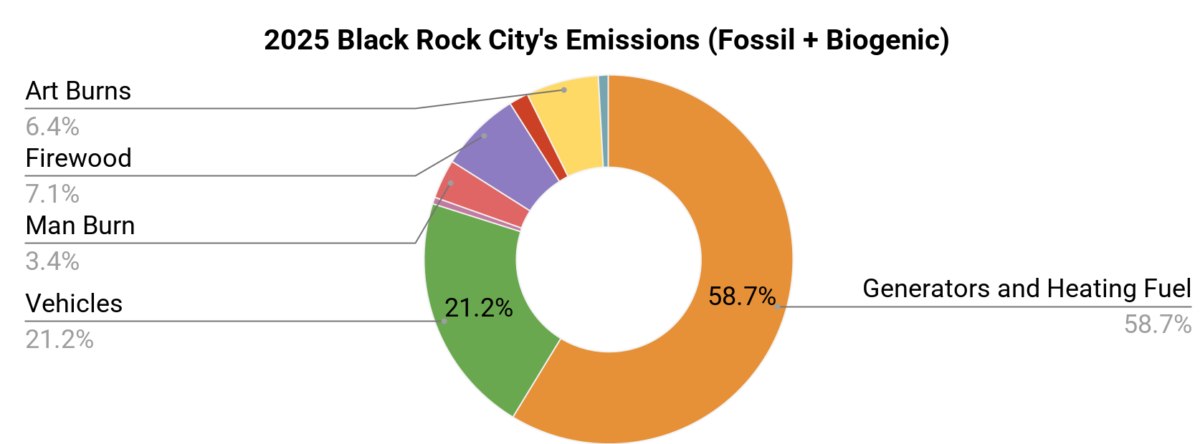
At a glance
- Generators and Heating Fuel comprise 59% of total emissions.
- Vehicles represent 21% of emissions.
- Of that, mutant vehicles account for less than ~3% of total emissions.
- The Man Burn accounts for ~3%, while participant Art Burns adds 6%.
- Scenic flights originating and landing at the 88NV airport contributed 1%.
- The remaining 10% is attributed to firewood, flame effects, and heavy equipment.
Fossil vs Biogenic Emissions
Emissions from biogenic sources (wood and renewable fuels) are tracked and reported separately outside of standard reporting scopes, as biogenic emissions release carbon that was recently drawn from the atmosphere in the natural, short carbon cycle. To ensure compliance with the GHG protocol, the subsequent reporting sections have separated biogenic emissions from fossil emissions.
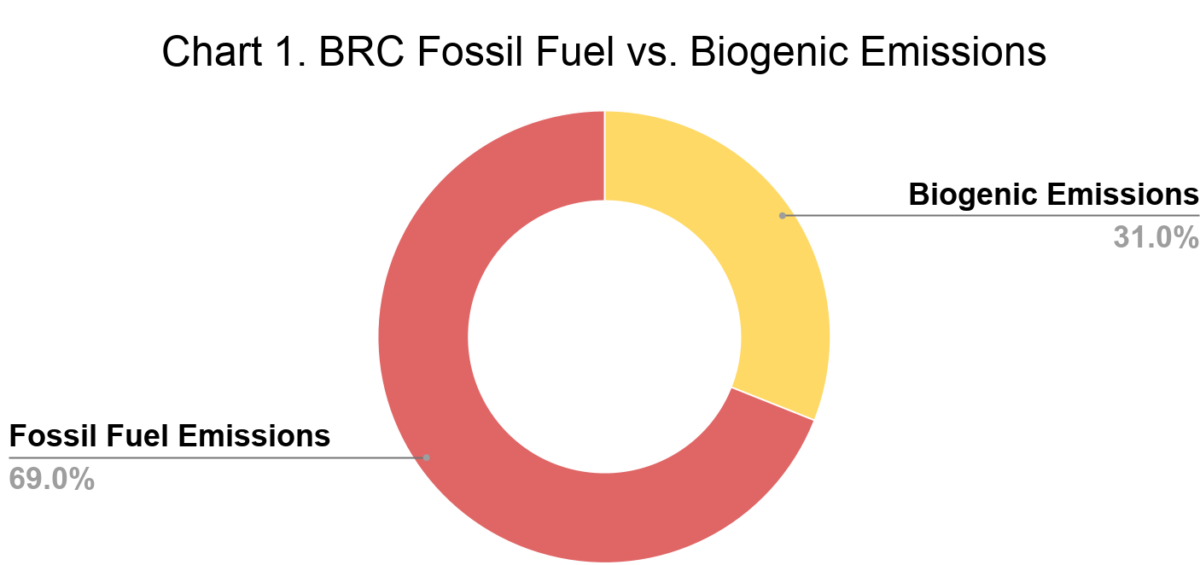
Of the biogenic emissions:
- 54% are from burning wood
- 46% are from renewable fuels, including renewable diesel (R99) and renewable propane.
Scope 1 Emissions: Black Rock City Operations
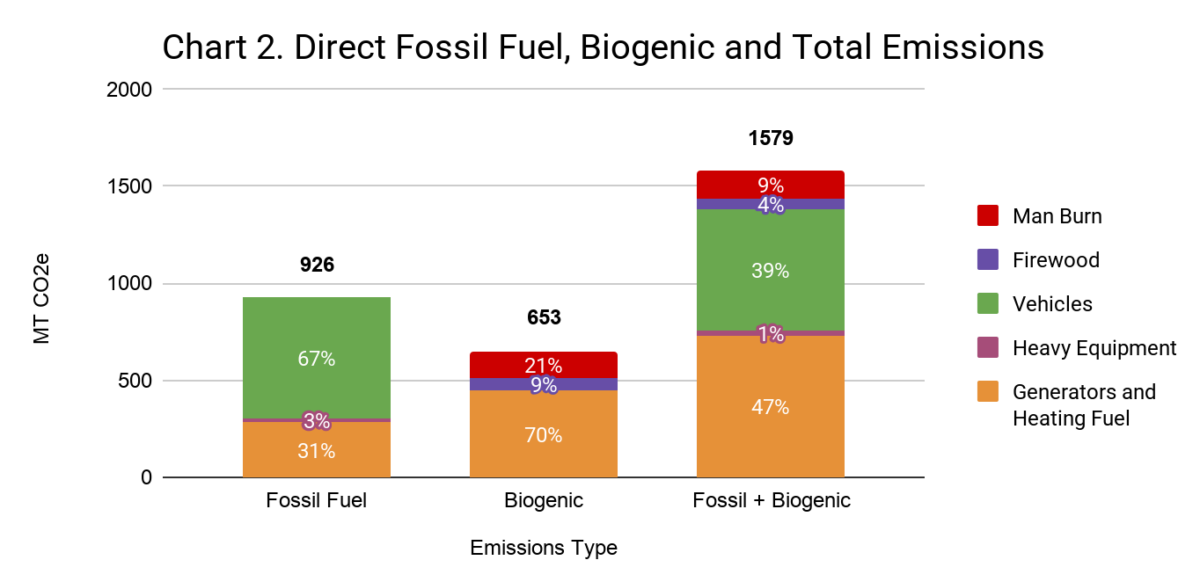
Black Rock City’s direct fossil emissions are estimated at 926 MT CO2e. Generators and Heating Fuel, and Vehicles are the primary sources. Biogenic emissions contribute 653 MT CO2.
Scope 2 and 3 Emissions: Participants and Government
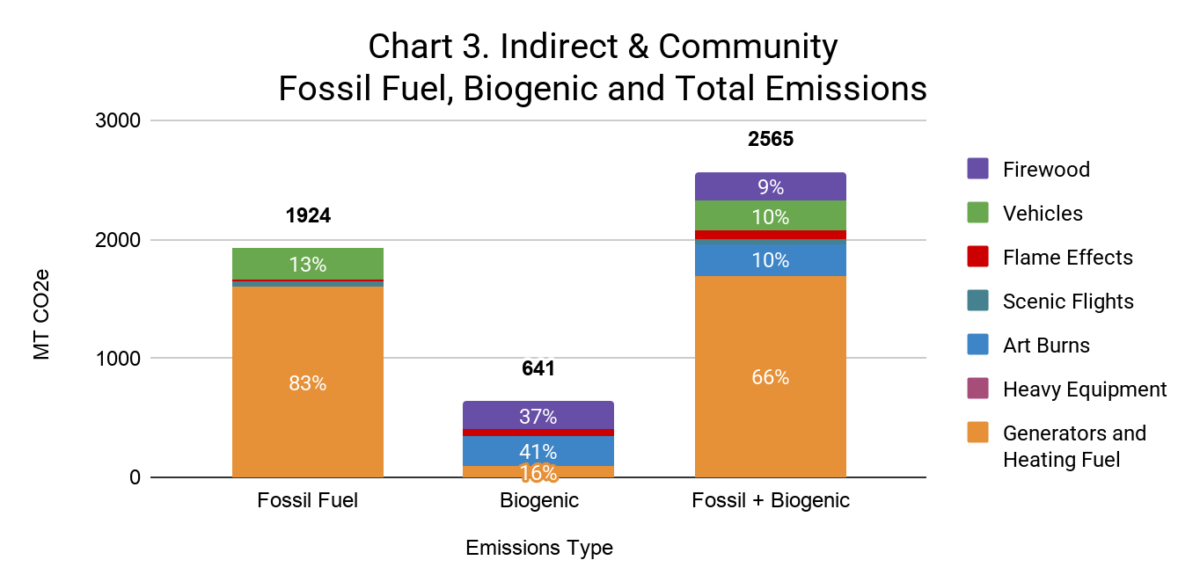
Black Rock City’s Indirect and Community fossil emissions are estimated at 1,924 MT CO2e. Biogenic emissions contribute 641 MT CO2. Round-trip travel is not included in the inventory.
Indirect and Community emissions includes:
- Government Agencies
- Placed Camps
- Open Camping
- Art Burns
- Outside Service Providers
- 88NV airport
Similarly to Direct Emissions, Generators and Heating Fuels are the primary driver of emissions, indicating Black Rock City’s reliance on on-site fuel rather than purchased electricity and utilities.
Fossil Emissions Reductions
Citywide fossil emissions were held to 2,850 MT CO2e, a 25% reduction compared to a business-as-usual baseline. Burning Man Project’s operations led this transition by slashing its own operational fossil fuel emissions by 48% against baseline projections. Without investments in sustainability projects, BRC’s total fossil footprint would have reached an estimated 3,825 MT CO2e.
Avoided Fossil Emissions. BMP’s key initiatives, including battery-generator integration, expanded solar programs, and renewable fuels avoided an estimated 1,005 MT CO2e of fossil fuel emissions.
Fossil Fuel Gallons Displaced. By scaling up BRC’s renewable fuels program, 68,612 gallons of fossil fuels were displaced across BRC. BMP successfully displaced 40% of its operational fossil diesel use with renewable diesel (R99).
Aside from renewable diesel, 100% of propane distributed via the BRC Fuel Program and for BRC’s operations was renewable propane.
It is important to note that fossil fuels were involved in the processing and transportation of the renewable fuels and these upstream emissions are not included in the analysis. However, making this switch resulted in a dramatic decrease in Black Rock City’s overall carbon intensity and represents a significant step forward in achieving a Net Zero Black Rock City.
Want to dive deeper? Read the full 2025 BRC GHG Emissions Inventory Report.