



A speech by Larry Harvey at the Cooper Union
in New York City
April 25, 2002
Hi everybody. Thank you. I usually talk about the flamboyant aspects of Burning Man. These are what attract attention. Black Rock City, as many of you know, is a hyper-connective environment. It’s full of interactive art. It’s very antic and it’s a lot of fun. But I’ve decided to talk to you tonight about ecomomics, about the dismal science, because, in the end, doesn’t everything come down to economics — economics, at least, of one kind or another? I will begin by quoting Richard Jefferies. He is an almost forgotten author. His writings belong to a British literary genre called “country writing” that flourished during the industrial revolution in the 19th century. The piece I am reading from is titled The Absence of Design in Nature. More suggestively, it’s subtitled The Prodigality of Nature and the Niggardliness of Man.
Jefferies talks about the law of natural increase. This describes the propensity of living things to reproduce themselves at exponential rates. “There is no ‘enough’ in nature,” he says. “It is one vase prodigality. It is a feast. There is no economy, no saving, no penury, a golden shower of good things forever descending.” Contrast this with the material economy of our world, in which each individual is compelled, in order to exist, to labor, to save and to compete with other people for control and possession of scarce resources. This is the iron law of economics in our world: the suberabundance of nature and the utter niggardliness of man.
This is the contrast he draws. It is as if we’ve fallen out of some happy Eden into a world where we must hoard and struggle to wrest what we can from the universe and one another. But I am more hopeful than Jefferies. He was writing about both nature and society in the midst of the first great phase of the industrial revolution, a time of massive social dislocation and widespread poverty. Think Dickens. The folkways of rural England and the networks of communal obligation that once sustained it were being brutally uprooted by the marketplace. An anonymous mass society with all of its attendent bills was taking form, and Jefferies came to feel that factories and the enormous cities of our industrial age represented a principle of evil and selfisheness. But I have had the opportunity to observe a very different kind of city with a very different kind of economy, and I’ve come to see that there is more of nature in the social world of human beings than he or any of us today have yet to fully understand.
I’m speaking, of course, about Burning Man and Black Rock City, the civic entity we annually create in the Black Rock Desert. I would like to start by describing the most radical and under-reported aspect of our city. It is under-reported because it’s so anomalous. It’s so very foreign to our current way of life. Reporters simply can’t perceive this most of the time, because it just doesn’t fit with what we’re used to. They see a vitally creative world, it’s filled with a superabundance of art, it’s animated by an electric spirit, and it’s full of a whole lot of eccentric and entertaining behavior; and that’s a big story, and that gets reported.
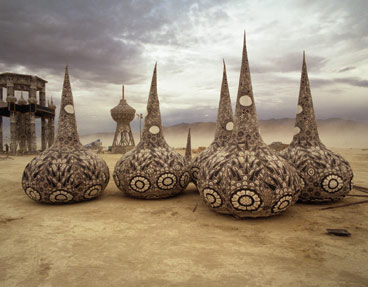
But if they look at the little lower layer, if they peel off the onionskin and peer a bit closer, there is another story they are only just beginning to report. They find that Black Rock City is one of the most public-spirited places on Earth. We have, for instance, an incredible rate of volunteerism. We did a poll on the Internet recently. It was a 10% sampling, so it’s pretty indicative, and the results were even more astonishing than we anticipated: 84.7% of our citizens contributes some form of volunteer service to our city. I challenge anyone to find another city in America that can equal that. We’re the seventh largest city in Nevada for eight days, and our crime rate is negligible. Think what the police blotter in New Orleans during Mardi Gras must look like. And Black Rock City is a party that’s certainly equal to that in intensity.
I understand you have some problems with solid waste disposal in New York City. I’ve heard that the mayor is even thinking about getting rid of recycling. Let me tell you how our civic entity has dealt with this problem. Black Rock City is built upon the pristing surface of a prehistoric lakebed. There is more nothing there than you will ever see, and in that context any little figment leaps to the eye like the rock of Gibraltar. It’s noticeable. You see litter there. It’s really obvious. And we’re committed to a Leave No Trace effort. We say Burning Man is a disappearing act. We miracle up an entire city, it lasts for one week, and then it absolutely disappears. And I mean everything disappears: every sequin, every boa feather, every cigarette butt, and especially those damn pistachio nutshells. [laughter]
This wouldn’t be possible, of course, if we didn’t put great effort into it. Our clean up crews work hard. They grid the space once people leave. It takes them weeks to get it all. But our organization couldn’t possibly cope with this task if it wasn’t for the public spirit of our citizens. There are no trashcans in our city. Think about that: a city with no trashcans. We have actually told people that they should take all of their garbage and put it in plastic bags, cram it in their car and take it out of there. Pick up your own garbage. And they do it! Well, what would happen if you gave a wild party in your apartment? What would happen if your guests were dancing on the end tables and people were doing imitations of celebrities and somebody had their skirt over their head and the booze was running… Do you think they’d pick up afterwards? [laughter] I mean, do you think that when it was all over that they would leave your apartment cleaner than it was before they came? [laughter] That’s almost inconceivable, but that’s what happens in Black Rock City.
And that’s one of the problems reporters have. Burning Man is this wild and abandoned party on the one hand, and it’s the most public-spirited city in America on the other. And this leads to a kind of cognitive dissonance. How do these two facts fit together? It doesn’t make any sense to them, and that’s because reporters often don’t understand the really big story: the story that lies behind all of this, that is the cause of these two things conjoining. And the reason that this doesn’t get reported is because it’s so profoundly foreign to our current way of life.

The essential cause of all this is the giving of gifts. We’ve intentionally designed Black Rock City to foster what we call a gift economy. We allow no vending, no advertising, no buying or selling of anything. We discourage bartering because even bartering is a commodity transaction. Instead, we’ve originated both an ethos and an economic system that is devoted to the giving of gifts. This is a radical departure from the marketplace that we’re accustomed to, because, of course, the marketplace invades every crack and corner of our lives today. A gift economy is founded on principles that are diametrically different from those that dominate our consumer culture.
Let me draw a contrast between the market and a gift economy. I will begin with the marketplace. The value of a thing in the market is based on its scarcity in relation to demand. And capitalism itself is based on the competition to aquire the scarce resource of money. The great utility of this system is that an organized market supremely serves individual desire. A simple act of purchase allows me to command the resources of the world. With a single expenditure, the magnesium of South Africa, the oil of Arabia and the labor of China can be fetched from around the glove and delivered into my hands as if by magic carpet. All that’s required of me is a sum of money that contributes to this process. There has never been a better method for the productive allocation of wealth and the distribution of goods and services. As a result, we live today in a large-scale global economy that continues to expand into every area of human activity. Adam Smith, many years ago, rightly regarded this as a kind of miracle. The market, mated today in our modern system of mass production and mass distribution, has produced more wealth and distributed it more widely than in all other epochs of human history. This has liberated us from toil, but more importantly, it has freed us to independently pursue uniquely personal visions of happiness.
This is the version of our modern market that is constantly extolled in our society. But I would like to point out that this economic revolution that has occurred so recently in human history has a darker side. The social contract we have signed contains a hidden clause, and we have failed as a people to read the finer print. And this is because the very virtues of our system represent its liabilities. The great efficiency of the modern marketplace depends on the fluidity of value as it flows in one form of commodity to another. If I should buy something from you, no relationship and no moral connection is left to relate us to one another. The value of the money I have spent speeds on to take new form as further goods and services. This is the fuel that powers our economy and produces a flow of never-ending capital around the world.

But what this transaction does not necessarily produce is connections between people. It does not produce what Robert Putnam and other writers have described as “social capital.” Social capital is a very different concept. Social capital represents the sum of human connection that holds a society together, and it is fostered by networks of personal relationship. It is social capital that a culture is made of. In a recent book aptly titled Bowling Alone, he objectively charts what all of us intuitively know. During the last forty years, and particularly during the last twenty years, the social capital of American has begun to disintegrate.
Putnam talks about two kinds of social capital. First, there is “bonding” social capital. This consists of our intimate ties with our family and friends. These are communal relationships: that close circle of people around you whom you know well. Usually, it doesn’t consist of more than 100 people because you can’t keep up intimate rapport with over 100 people… nobody can. And these circles tend to be exclusive. Not intentionally, but when you are huddled with your friends, you turn your back on the world and it’s hard to let the stranger in. So they tend to exclude the stranger.
He also talks about another form of social capital called “bridging” social capital. This refers to looser ties within a broader social circle, and it encompasses larger social networks. It could be people you meet at parties or work, people you exchange cards with. Here’s the difference: if you get sick and you need chicken soup, you’ll call someone you are bonded to because they’ll care. On the other hand, if you get fired and need a job, you are probably not going to talk to your brother or your close pal. You’re going to talk to someone who is part of that bridging network because you know they are connected to a circle of friends beyond your circle, an extended network that moves out into the world. If you’re looking for an opportunity in that world, this is whom you’d go to.
This might be a group of people who get together to play cards or hold softball games. More formally, it might consist of civic organizations or other sorts of clubs. As a rule, these groups are inclusive. If you belong to a club that is devoted to some kind of transcendent ideal, anyone who is interested can gain entry. You don’t have to have an intimate tie with other members. If you’re interested in making ships in bottles, then anyone is welcome because every member is really excited about building ships in bottles.
Putnam is a sociologist. He’s looked at these two forms of social capital, and he deals in a lot of statistics. I find these statistics fascinating because you can use them to ask questions. Here’s what he’s found. In America today, bonding social capital is beginning to erode rapidly. The average American household spends seven hours a day watching television. They are not necessarily watching it, but it is turned on. A lot of people just turn it on to listen to the laugh track so they feel that they are not alone. The average American household possesses 2.4 television sets. And that means that husbands, wives, teenagers and toddlers are all watching television independently of one another. If you could take the roof off the average suburban houes and witness what is going on there, you would see each separate family member in a separate room watching a separate TV that has a separate set of commercials on it hawking a separate lifestyle. And if you looked more closesly, you’d see that they’re surrounded, barricaded, by all this stuff they’ve bought to support these lifestyles that are being sold to them. This is hardly connective. 81% of Americans say they spend most eveninsg watching TV, but only 56% report that they talk to family members.

There are more cars in America than there are drivers, and 90% of our citizens drive to work alone. In 1992, we spent 19 hours per year stuck in traffic jams. We spent 40 hours stuck in traffic in 1997, and I’m sure it is much more than that now. So here you have a whole nation on the freeway, trapped in the metal carapace of an automobile, completely isolated from everybody around them. I think I’m an affable guy. I think I bond with other people. But when I get into a car I become demonic. “You jerk! Cut me off?!?!?” You know what’s pathetic? He’s found that people report that they like being in their car during these long commutes because it’s a time to think. To think, as they sit in these isolation booths cursing their fellow citizens! [laughter] Here’s another statistic: Putnam has found that each additional 10 minutes of daily commuting reduces involvement in community affairs by 10 percent.
This leads us to an even darker picture. For when we get to bridging social capital, we find that membership in clubs and civic organizations has fallen by half since 1975. Half! He calls his book Bowling Alone because bowling leagues, which are a form of bridging social capital, have declined so precipitously that, if you follow the curve, in another ten years everyone — even though there is a retro fashion in bowling — everyone will be bowling alone. This applies to informal social activities; card games, picnics. But it particularly applies to more formal organizations: organizations that address some kind of transcendent principle, the ones that do good works in the world. It could be the Lyons or the Kiwanis. And at the back of the book he features charts that are really quite interesting. Chart after chart, he has, and they crest at the height of civic involvement in America in the last century, around 1950, and then it starts a fairly steep decline until it reaches a point about twenty years ago, and then it makes a beeline for the drain. It resembles one of those mass die-offs when asteroids hit the Earth, and that is what is happening to the civic tissue of our country.
Now, toward the end of his book, he talks about some of the causes of this and objectively charts them. But I think we all intuitively know what some of these are. Certainly cars have changed the social landscape. The growth of metropolitan sprawl has transformed America. In a land of mega-malls, cineplexes, gated communities, anonymous fast food outlets and retail chain stores spread our serially on four lane highways, it’s difficult to connect with anyone or anything. If you live in Los Angeles you probably drive your car to the grocery store a block away. TV has also had a huge impact. Television is essentially a solitary and passive recreation. I was born in 1948, and I have seen all of these changes over the span of my lifetime.
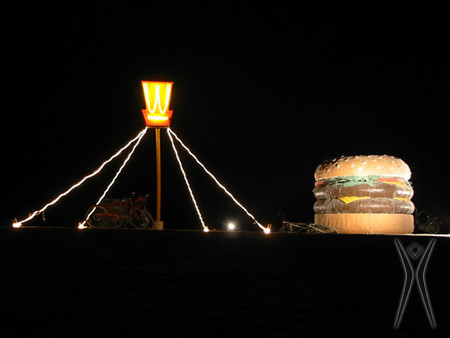
But I think if we take a larger view and look at the character of modern day capitalism, we can diagnose an even more essential cause for this. It is in the nature of our modern system of mass marketing to cater to the desires of the individual. Indeed, it’s not surprising that the social ills Putnam describes have accelerated during the last twenty years, because it is during this period that capitalism has perfected many marketing techniques that isolate us even more radically from one another. They represent a late-blooming and monstrous flower of our capitalist system. During the last two decades, while marketers have identified thousands of new market niches, manufacturers have learned to gratify each sector of the population. In other words, we have been sorted by age, class, income and other demographic categories much as cattle might be herded into stalls within a feedlot. And the best minds of the generation aren’t writing books like Putnam’s, they’re doing market research and working for ad agencies. This is applied science.
If mom and dad, teenagers and toddlers are planted in front of different television sets, it is also certain that they are each watching a different set of commercials. And each of these commercials is designed to represent a lifestyle, a customized way of being in the world. Of course, these artificial visions that we watch in a hypnoidal trance do not provide us with a way of life. They merely offer us commodities that are presented in such a way that they simulate states of being. It is the sin of simony: an unhallowed trafficking in sacred things. The only thing I know of that is sacred in this world is being. I am an iconoclast by nature. But the only thing I know that is sacred is the immediate experience of being, of belonging to your self, belonging to others, belonging to the world, belonging to the cosmos. This is a sacred thing [applause] And all this stuff that we acquire in place of our being, and all of these images that stand between us and our deepest needs and our innate capacities. They stand between us and a world beyond ourselves. They muffle our being. The spiritual damage that is caused by living this way is difficult to document in statistics, but this is what has worked the greatest evil in our world.
In a final statistic, Putnam finds that Americans born and raised in the seventies and eighties are three or four times more likely to commit suicide as people of the same age were at the middle of the century, but that’s not surprising. If you are a latchkey kid and you’re watching TV in your separate room, and your only way of belonging to other people is through stuff that simulates your being, and you’re feeling really lonely, you might be willing to kill yourself. That’s when people commit suidice, when they feel absolutely isolated. Their being becomes unreal and then they are willing to take their lives.
Well, having painted for you a rather dismal picture of what is wrong with our world, let me now return to the gift economy of Burning Man and Black Rock City. You see commodities are not very good conductors of social capital. But gifts are very good conductors of it. Let me illustrate. If I should give you a gift, this represents a very personal gesture. This is a bonding experience, unlike buying something from someone, where the great convenience of it is that we aren’t connected. In a market transaction, value flows on to produce more things in the economy, and the people who are party to it feel no further sense of human obligation. They have received what they wanted. But interactions that are based on gifting operate quite differently. In the words of Lewis Hyde, who wrote a wonderful book called The Gift, “When gifts circulate within a group their commerce leaves a series of interconnected relationships in its wake, and a kind of decentralized cohesiveness emerges.”

What he’s saying is that everybody begins to feel like they belong to one another. You see value in a capitalist system is transmitted through commodities. It passed from thing to thing, from hand to hand. But value within a gift economy passes from person to person, from heart to heart. It is as if it draws on the soul, on some unconditional, some inexhaustible source of value. To put this another way, gifts are bearers of being. Think about a gift that you loved giving. Didn’t it feel as though it already belonged to the person you gave it to? Didn’t it feel as if it was just flowing through you? And when you saw it in the store, wherever you found it, didn’t you say to yourself, “That’s him! That’s her!” It is the gift as it consumes you, not as you consume it that matters.
Now Black Rock City is devoted to the giving of all sorts of things, the sharing of survival resources, interactive artwork, all of our public service roles. The whole tissue of our city is one vast gift. In fact, if you look at our budget, our little bit of hoarded wealth, it amounts to five million dollars. That was our budget last year. But if you want to understand what makes our city come alive as a civic entity, then look at the gifts that all our people give to us. It would run into the millions. I cannot begin to estimate it. That city is created out of gifts, and we’ve actually created much of our civic infrastructure out of gifts. We have people who volunteer to greet every person who comes into our city. The policing of the environment, the work of the Black Rock Rangers, is done by volunteers. The lighting of the lamps that illuminate Black Rock City, another public utility: that’s a gift that is donated to our city.
But I particularly want to call attention to a special kind of gift that we call a theme camp, because it best illustrates the gift giving process. In Black Rock City, this begins with a concept that we call radical self-expression. We ask participants to commune with themselves and to regard their own reality, that essential inner portion of experience that makes them feel real, as if it were a vision or a gift, and then project this vision out onto the world. Now artists have been doing that for a long time. And it is an almost irresistible impulse out there in the Black Rock Desert because the environment is a blank slate. It’s like a screen whose context is no context. There is nothing to contradict you there. You can create your own world… quite plausibly. You can project your inner vision out onto the world as if you were projecting a movie. And that is what makes radical self-expression so radical: it reaches deep, it ventures wide.
And, along with radical self-expression, comes radical self-reliance. Most of our citizens pool survival resources – and they have to. This means they must prepare to survive in really drastic wilderness conditions; 100 degree temperature, hundred mile-an-hour winds. And what tends to happen naturally is that people respond communally. That is, they form organized groups and someone says you bring the shelter, you bring the food, you bring the boa feathers [laughter], and we’ll survive together. And we didn’t tell them to do this. They realized that they had to get communal: that is, they had to form bonding social capital in order to survive. That’s how cultures developed originally, you know. They developed an ethos and a sense of belonging over long spans of time because people had to share resources and struggle to survive together in the world — not quite like the economy of convenience that we live in today.
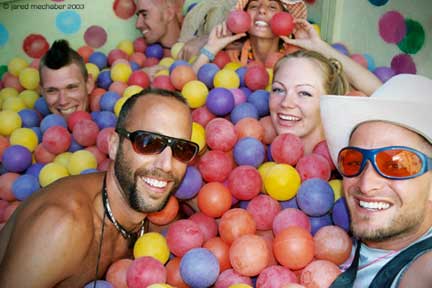
And again, what has organically evolved out of that is what we call a theme camp. People begain to create extensions of their living quarters that embodied some creative idea, some kind of art project that they were willing to share with everyone else. Now we have never dictated the content of radical self-expression because only the individual can determine what his or her true gifts might be. But we have done another thing. We don’t create the culture, they do, but we create the societal vessel that helps to contain this creative, interactive, utterly uncontrollable process that simply happens in human populations when people are able to relate to each other for any length of time. So we’ve created a social context, created a few simple rules – and this is after observing how it really works best. We’ve said a theme camp must function as a public environment that is accessible to other people whom one doesn’t know, and that it must result in some kind of social interaction. Now, I don’t know if you notice what I’m saying here, but that’s bonding social capital turning into bridging social capital.
Before I go further, let me describe a theme camp because it’s hard to imagine in the abstract. I’ll describe to you one of my favourite theme camps to show you how this works. I think my all time favorite theme camp, even after all these years, was Camp Fink. Camp Fink, I remember, I encountered by chance. I walked into this tent and it looked like a seedy sportsman’s bar. There were crossed tennis raquets on the wall, and it had all these portraits of famous finks. They had Roy Cohn, Joe McCarthy, they had Richard Nixon — because he finked himself out. [laughter] Well that was funny, but here’s the intereactive aspect: Anyone could go in, so it was open to the public, it bridged the gap between their little communal group and the public world. But here’s the interactive part. They had an ancient Corona typewriter out in front with an endless spool of paper, and they invited you to rat out your friends. [laughter] And you’d be surprised, it got really interactive, because everyone wanted to read what everybody else was saying! [laughter] Now that was a simple theme camp, and I like the little things. I spend a lot of time planning big things, that’s why I like little things.
But, in recent years, many of these theme camps have become increasingly ambitious – and that’s only a natural tendency because in a space where there aren’t any physical limits your imagination just begins to grow larger and larger, and, well, what’s to contradict what you’re doing. I sometimes like to say a vision is not defined by the context of the world around it, but that it radiates reality outward: it defines the surrounding world. And people get these visions and they start to radiate mightily and end up incorporating two or three hundred people in some cases. Now all of these people are collaborating to produce a public service or an expressive theme of some kind. And they form large communal networks in which everyone is co-operating toward a common goal and this, as I’ve said, is what Putnam calls bonding social capital.
But observe what we’ve done. We’ve told people: okay, you’ve got your tight little world of your mates and your friends, and you’re bonded together — that’s like a lot of sub-cultures in our world — but we’ve said don’t close the circle. You cannot close the circle. You’ve got to leave it open so you can bridge out to a larger world, so that you can credit the world outside your circle with as much reality as you see in those around you. And, indeed, so that you can feel that the great world has the same reality, the same sense of inner reality that you feel in yourself. And the shape of our city is like that. It’s planned as a huge semicircle and the Man is at the geographic center and the streets come out like this [gestures in an arc], and one time they said “Larry why don’t you just close that circle,” and I said, “Good God, we’d go psychotic. Don’t close the circle!”

So, theme camps are essentially collective gifts, collaborative acts of self-expression that are given to a civic world, and this, in turn, begins to generate gift-giving networks. I’ll tell you how this works. We’ve found that when people join together for the purpose of producing a gift whose scope extends beyond the limits of their little bonded world it produces a kind of social convection current. It’s as if the larger the gift, the more transcendent the chimney at the center, the greater the convection current. The hotter the flame, the more oxygen it will suck in. And these networks suck in a whole lot of resources. This begins in simple ways — and no one plans this — let me make that clear. This just happens because we are culture-bearing animals and we are adapted to do these kinds of things. Someone in a camp, for instance, always seems to know someone else — a friend outside the group who possesses some needed resource — and soon this person is drawn into the circle. You may not know him. You may know him. You may know him through two intermediaries. But if he’s willing to give to the gift you don’t exclude him, you say come on in. That’s the principle of radical inclusivity we discovered many years ago.
And as the greater gift imagined by the group begins to grow, this process starts to ramify and spread outward through networks of acquaintance. When everyone is giving to a greater gift and not merely to one another, this process will accelerate, connections will multiply, and a new kind of superabundant wealth begins to assemble itself. A metal grate left disregarded in a basement would be the perfect device to create a dragon’s jaw, and some ancient string of Christmas lights forgotten in the attic forms the perfect accent for its tail. Manifold resources stream in, only to be reassembled for new and productive purposes. It’s a super-conductive social process, and it’s precisely the opposite of what happens in a capitalistic society in which a struggle for scare resources produces relentless competition. And what’s interesting is that this process can actually rival the capabilities of mass production. Such social networks tend to grow on an organic principle. They can expand exponentially.
I’ll give you an example of how we are growing. A group of New Yorkers came to our event last year. They are responsible for SEAL, the non-profit organization that, with the Black Rock Arts Foundation, is co-sponsor of our event this evening. Burning Man occurs over Labor Day, so that, of course means that when this group returned from Black Rock City in 2001 they encountered the events of September 11th. For days afterward a pall of dust and smoke drifted over the island of Manhattan as police manned emergency checkpoints all over the city. Now this group had lived communally at Burning Man, and so their most immediate instinct was to seek comfort in one another.
But they had also observed the process I’ve been describing to you tonight. They had seen their bonding world become a bridging world at Burning Man, and so they responded to this public trauma in a unique way. They began to craft burn barrels. These are oil barrels into which we cut designs. These objects are beautiful — they look like jack o’lanterns — and serve as fireplaces that protect the desert surface. They line our boulevards and public plazas and they create public space. So this group began to manufacture burn barrels — and this didn’t stop within their little group. They put the word out among their friends and acquaintances — because they understood about forming social networks — and soon they were joined by other people — many of whom they hadn’t known — and all of them began to create designs, and they donated several of these beautiful pieces to the New York City Police Department. Now, emergency workers had a place to warm their hands during the long winter nights. There is a picture on SEAL’s website: two burly policemen flanking a barrel. They are grinning like jack o’lanterns, and there’s a Burning Man logo on it! [applause] And this is only one example. As I say, gift giving networks can produce massive amounts of social capital, and the rate of return on social capital is a lot better than the rate of return on normal capital investment in the market world. [applause]
This is the good news. All over this country, people are starting to organize. They’re starting to form networks, and we’re organizing to help them. We didn’t tell the people in New York to do this. We don’t dictate the content of radical self expression. That can only come out of you, from deep within you. But we are organizing to help people create the social circumstances that will sustain an ethos of gift giving. And I can tell you what’s going to happen next because I have watched Burning Man grow from 2,000 to 4,000 to 8,000 participants in the span of three years. In fact, it only stopped growing at this rate because we slowed it down. We didn’t want it to grown too fast. When you reach a certain scale you get overwhelmed by numbers in a city, so we took measures to slow down its growth so that we could culturally assimilate people, so they wouldn’t just come looking for a party, they’d realize what our ethos was and that it really was about giving, it wasn’t about consuming. We knew that they’d destroy us if we didn’t slow it down. But what this growth represents is a rate of natural increase; it’s how things grow in nature. And the next big story is that networks and little nucleus’s all over this country are about to rapidly expand in scope. There have now been burns in several states, we have regional contacts in every place except Mississippi. [laughter] There’s even been a burn on a boat in the Baltic Sea and one in Antartica.
But I don’t expect people to go out and form cities of their own — they will define the activity and it will spread by a rate of natural increase. And this returns me to Richard Jefferies who I started with and his essay on the prodigality of nature and the niggardliness of man. He said there is no enough in nature. It is all one vast prodigality. And he contrasted this with a capitalist economy in which each indivicual is compelled, in order to exist, to labor and save and to compete with other people to acquire scarce resources. But I believe that human culture — as distinct from social institutions that surround it — is a pure phenomenon of nature. Social institutions have the power to protect it and sustain it, much as any vessel — a petrie dish or ceramic pot — might help or hinder the growth of any living thing. But the innate vitality of culture belongs to the world of nature; it occurs spontaneously, it is without a plan, and when it is allowed to grow it has a power to effect our world in ways that dwarf our normal estimate of our resources.
I think that the essential lesson that we’ve learned is, in a way, very simple. People don’t have to go out into the world and create a great city. We’ve only made our city as large and as civic as it is in order to create a sufficiently persuasive model of the world to show people how things could be. I still want it to grow larger, frankly. I mean it won’t be New York, but I want it to feel like a complete model of civilization so that people can go back home with the confidence that they can change the world — that they don’t have to be defined by the context that surrounds them — that they can defined by the context that surrounds them — that they can define the world by the vision that’s inside them, they can share that vision with other people and they can attach to it some transcendent principle. That is why the Man stands at the center of our city.
This process begins with radical self-expression: the feeling that your inmost vital self is real and that you can project a vision of this sense of your own being onto the surrounding world. I mean all these ads say be all that you can be, buy this car and you’ll be free, but they’re just substitutes. You’re not going to be unless you can project a spiritual reality out onto the world. But most people just don’t have the confidence anymore because they’re too isolated; they’re too passive. So it starts with this, and I’ll call it “I Am.” And it proceeds, as in a theme camp, to a feeling that you are united with others, that you are linked in a bonded circle and that together you can share the same experience through an act of giving, because the value of a gift is in its flow — not as you consume it, but as it consumes. And I’ll call this, “We Are.” Finally there is the feeling that somewhere outside this circle there exists some greater gift that everyone is joined together by as they give to it, and I’ll call this “It Is.” And I have come to believe that whenever these feeling states can be strung together like pearls on a string, as if they were parts of one spontaneous gesture, you will then generate an ethos, a culture, that leads, in Jefferie’s words, to a “boundless shower of good things forever descending.”
Now I’ve told you things are getting a bit bleak in our world. We’re just so accustomed to this state of things that we don’t notice. But I don’t think I’ve told you just how bad they can get. So I’m going to tell you a story. It’s like A Christmas Carol. This is where the ghost says to Scrooge, “This is Christmas future.” I’m going to tell you about Christmas future. This is where we’re going.
Some time ago, I went to a dinner that was given for an artist friend who was leaving for a journey up a river into the jungle of New Guinea to confer with some tribal sculptors. And it was a lively party. It was a bunch of my more louche bohemiam friends, and it was held in an Italian restaurant that I’d never been to. I was just given an address, and when I got there I was astonished, because it was located on the edge of our city’s financial district. I mean all these hi-rises and condos, and it was very apparent to me that this was a small family enterprise and that it had been there for years, and I wondered how the hell it had survived. There were family pictures on the walls, mementos, and we went downstairs through a narrow corridor to a very special room that was obviously precious to them. It was naively decorated in primarily colors and we were taken into the place of honor, and there was a big round table and within that round table was a giant Lazy Susan. It felt really communal. It was so cool that everyone could share. And at the center of this thing, at the center of this communal circle, was this transcendent object. It was a bust of the Pope. In fact, they’d surrounded it with a big square Plexiglas cube, so it looked like a miniature Pope-mobile. [laughter]
Now this is what I call a sympathetic bistro! The food was robust, the cuisine of southern Italy, and the waiters were to a one all very jolly. I love this kind of restaurant, I love family places. They brought in bottle after bottle of Chianti. And, of course, we were using this Lazy Susan, so the bottles went round and round, and pretty soon the room was spinning round and round as we got drunker and drunker. As I say, these were bohemians and never noted for any inhibition, and they became increasingly rambunctious, and at a certain point one of the guests by the name of Kaos Kitty climbed up on the table as if it were a rotating state. I remember she was wearing multiple petticoats for some reason, and she had a certain look in her eye. She sidled to the center of the table, which by now was in an uproar, and she removed the Plexiglas cube and proceeded to do things to the head of the Pope that I really don’t want to describe to you — let’s call it radical self-expression. [laughter]
This is, of course, the kind of scandalous story that’s often better in the telling, something you read about in a memoir of the lives of the artists. There was a lot of laughter, shocked looks from people in the adjoining room, [laughter] and my friends, on the whole, were thrilled by their audacity. But I will confess to you tonight that I was inwardly chagrinned. Think about it for a moment. here we were in the bosom of this family place around the altar of their simply Catholic piety… desecrating it? And I left the restaurant that night feeling a pang of guilt and a flush of shame on my face, I really did. I thought about apologizing as I went out, but I was too ashamed, and for weeks afterward I was burdened by this feeling of guilt because I’d sat by… I’d laughed too.
Well, some months later I found myself in Minneapolis. Earlier that evening I’d delivered a speech at the Walker Art Center, and my girlfriend and I were walking through the slushy streets of Minneapolis in the middle of a mid-winter thaw. There was fog filling the air and we were looking for some place to eat at a late hour. We went around a corner and across the street I saw this nimbus of neon light in the air. We crossed over and, sure enough, it was a neon sign and, sure enough, it was a sympathetic bistro — on fact it was the sympathetic bistro. It was the same place I’d encountered in San Francisco! And I thought, well gee; did a cousin, a nephew branch out to Minneapolis?
We went inside and the atmosphere brimmed with familiar sentiment. Family pictures lined the walls, and they’d painted the exposed plumbing… and then it really dawned on me. This was not a sympathetic bistro. What I’m saying is this was not a communal thing, this was not a bonded group. This was not a family restaurant. The pictures and the keepsakes on the walls had been purchased by the lot at auction. And when I looked at the other diners, all of them white, pretty Anglo-Saxon looking and undoubtably Lutheran, the full implications of this began to sink in. Most of the tables were for large groups. This was the demographic. A waiter came in with a lighted cake, there was a birthday party, and suddenly I understood what this was. It was an R.E.D. R.E.D. is an acronym that stands for Retail Entertainment Destination. This is the fastest growing trend in retail, and it’s remaking our world. R.E.D.s are the finest flower of our marketing system and it’s commodification of our lives. You see most of our desire and addictions are really projections of our need to be. And they’ve become really good at finding out what our desires are, and they’ve learned to create stuff — both goods and entertainment — which we then consume as substitutes for being.
In the case of the jolly bistro, some entrepeneur had determined — using demographic studies and psychographic profiles — what WASP’s really need in their lives. And I can tell you from personal experience what WASP’s really do need in their lives. Family members often live in different states, and family dinners and gatherings can be awkward. You don’t have anything in common with anyone because bonding social capital has broken down a little. So you go to these gatherings, and you find yourself wistfully and secretly wishing that things were, oh, a little warmer, a little more sympathetic, a little more… well, Mediterranean. [laughter] If only we could be Italians! [laughter] And this environment, this bistro, was designed to fill this gap. Art blended with science. If people want to feel that they belong to one another, then it’s wholly feasible and very profitable to manufacture the illusion of this feeling. I had really enjoyed the food at the original restaurant back home, but sitting there with my girlfriend I picked indifferently at my meatball. I kind of herded it around the plate and, as I did so, I forgave Kaos Kitty for her performance. In fact, on the whole, it seemed very appropriate. [applause]

Let me give you a little profile of retail entertainment destinations. They’re usually located in metropolitan areas, and they’re devoted to the proposition long understood by marketers that it’s more lucrative to sell a state of being than a product. There’s nothing new in this. Sell the sizzle, not the steak. That’s what they used to say, but R.E.D.’s in this late stage of capitalism are based on much shrewder and more sophisticated insights. They’re not just selling attractive and desirable sensations; they’re selling a lot more than that. The cream of social scientists have gone to work, and they’ve identified a more complex, a more basic stratum of psychological need that exists in human beings. They’re probing now with their tools right at your soul. And, furthermore, they have designed these retail entertainment destinations to exploit a kind of primal yearning.
R.E.D.’s come in different shapes and sizes. I’ve described the little restaurant, but it works up into larger complexes. These typically combine dining, shopping and entertainment attractions. In the trade journals this is called — I’ve been reading a lot of trade journals — the “trinity of synergy.” Because they know if you’re eating and you’re shopping and you’re being entertained, you’ll spend a lot more money. It grows up into very large-scale complexes, and these are being built at a tremendous rate. You know what I’m talking about: Disneyland and the Strip in Las Vegas, and, in case you haven’t noticed, here in New York, Times Square has become a retail entertainment destination — state of the art.
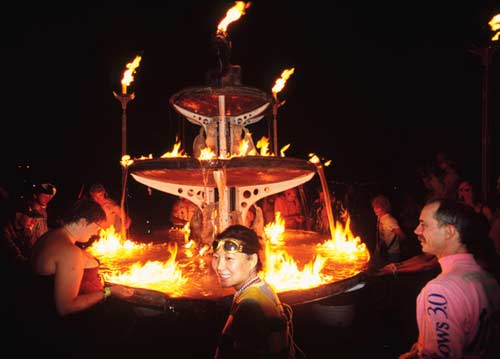
Another constant feature of these places is an air amenity and authenticity. They often feature monumental architecture, open-air loggias, colonnades, fountains, vaulted ceilings, and decorative plasterwork. And even the old fashioned shopping mall of the 70’s and early 80’s, is rushing to cloak itself in these neo-classical facades. It’s all part of what’s come to be called the “experience economy.” These places are designed to appeal to our need for community and identity. At times they almost seem to waft a sense, albeit rather cheapened, of classical civilization. At least it seems so superficially at an aethetic level, but when you descend to ground level, to the place where humans interact, the place where culture’s roots should grow, it is a very different story.
After my experience with the jolly bistro, I became fascinated with these places. So two years ago at Christmas time I decided to go to Las Vegas. I wanted to see the great mother of them all and learn something from it. Now I’ll admit to you that I dislike the Yuletide season. This great orgy of spending and consumption and forced giving seems to me like the ultimate perversion of what giving should be. So I engage in whatever activity feels like the opposite of Christmas. So it was that in late December of 2000 my girlfriend and I embarked on a holiday and we decided to call it our Viva Las Xmas tour.
We stayed at the home of a friend who was out of town, and one day an acquaintance of his called, and I picked up the phone, thinking it was our friend. It turned out this person was the proprieter, or had been the proprieter, of Las Vegas’s last and only artist’s coffee house and it has just gone belly-up. It couldn’t compete with the casino’s, to say the least, and he sounded like a man who had just lost his daughter to diptheria — I mean he was depressed. But, at the same time, the Guggenheim announced its plan to open a gallery as a magnet attraction at the Venetian. That’s an example of what the trade journals call edutainment. And later, on TV, a young woman representing the museum described this venture as a noble form of democratic outreach to the hoi polloi, to the unwashed masses — and, I might add, a very lucrative proposition for its gift shop. And an art critic was featured looking like he’s just downed a snifter of quinine water. He was actually wearing a turtleneck, and he talked about the postmodern implications of this daring move and how it was ironic… and so forth. [laughter] And the actual developer was on TV, too — he was my favorite, though, I kind of liked this guy. He was clad in a hard hat, he was working class — in sensibility anyway, I’m sure he had a lot of dough — and he said, “This project is classy, classier, classiest… one of those!” [laughter]
You see in the last 20 years Vegas has re-invented itself as a thoroughgoing R.E.D. It used to be this sleazy place where guys went for action, but ah, not anymore! It’s now a center of edutainment, infotainment, eatotainment — every kind of tainment you can think of. They’ve torn down all the old facades and, in their place, they’ve erected palaces that offer up the Holy Trinity of market synergy. We wandered through these great complexes. We loitered in the shadow of animatronic sculptures. We witnessed the musical fountains and beheld the Pharonic mysteries of ancient Egypt at the Luxor. At Caesar’s Palace I actually bought an ashtray, I admit it. [laughter] It was irresistible. But my favourite place was the Rio, because there we discovered a riverboat that they’d mounted on the ceiling on a curvilinear track, and it was filled with performers who, like performers on Broadway, were dancing and singing their hearts out. It actually was interactive, and I got kind of excited about that. They kept coming around and they were waving at us and we were waving at them. It was better than the animatronic sculpture. [laughter]
In fact, this kind of interactivity is typical of R.E.D.’s. This is my favorite quote from a trade. It explains that interactivity is a key component of immersion environments. That’s what these are immersion environments. It says, “Free street performances, another form of ambient entertainment, strive to replicate the spontaneity of the archetypal, if not mythical, marketplace. Yet because they work independently, their performance can be unpredictable making them potentially disruptive to both visitors and tenants. Thus authentic performances are not commonly allowed on the private property of destination complexes.” Instead they hire performers and typically these performances are of short duration. You see the reason R.E.D.’s create these faux civic spaces, and the reason they’re filled with such apparently civilized amenities, is to cause consumers to linger in a retail environment. They’ve studied this and found that maximum spending is reckoned to take place during a period of 3-4 hours. And this is why the ersatz interactions, and this is why they hire these performers and why the performances are so brief.
We did witness the great speaking statue of Neptune at Caesar’s Palace. It was set in a courtyard, and, in a weird kind of cartoon way it might have been Florence. It could have been a northern Italian hill town; a public square, a very civic setting. This robotic Neptune spoke to us for about 7 minutes, it attracted a large crowd, and then it stopped and everyone dispersed — and where did they go? Right into all these shops that strategically surrounded it. And every one was a brand name high-end retail outlet selling goods at a 200% mark-up! And I’ll make an even more embarrassing confession. I went into one and bought a pair of Gucci’s. [laughter] Even knowing what it was, I was caught up in the trance.
You see these settings are engineered with the precision of a hermetically sealed engine. Though they may look like urban spaces, you’ll find no posters pasted to the lampposts, as you would in my hometown, in my neighborhood in San Francisco. You’ll not discover any pocket parks that have been hidden away as true amenities of leisure. No, you will experience none of the spontaneous encounters that are the lifeblood of culture. No clinging tendrils of association mar these perfectly hardened surfaces. You will see people trudging forward in a Day of the Locust sort of way, giving nothing of themselves to the world that surrounds them and receiving no inspiration from it.
What you will discover is what we discovered: the people chute. This is the last aspect of the R.E.D. that I’ll describe to you. My girlfriend and I became fascinated by this. In the process of reinventing itself, Vegas has built an elaborate system of pedestrian transportation. They’ve located large parking complexes on the periphery of the Strip and people are funneled through casino environments by an integrated system of escalators, bridges, elevators, tramways, and a variety of other mechanical devices. These are essentially designed to keep people moving, whirling along this slalom ride. And, as we did so, we realized we were never more than ten feet away from an opportunity to buy something. It was virtually impossible to escape this. The space of one casino bled seamlessly into the next, and so we decided for relief to amuse ourselves by looking for some crack, some break, some fissure in this plumbing. And at last we found one, got out of the chute and fled gleefully across the street holding hands, running through the traffic of the Strip like giggling children.
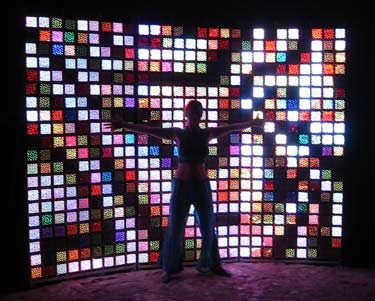
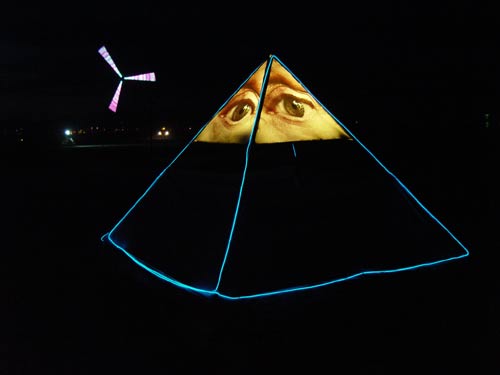
At the very end of our stay we took the elevator upstairs at the Rio, walked into a restaurant and went out on the terrace, and there, spread out before us, was the Strip: this great evil drive train glittering in the desert night. And I thought to myself, this is just like Burning Man! We, too, create a scene, a fantasy environment. Each year we creat an annual art theme because we believe that stories and myths are one way that people belong to each other and one way that you can get artists to collaborate, to co-operate with one another, and it leads to a re-telling of the story that embodies identity — we do that, we are a themed environment! What is more, we fill it with interaction and ambient entertainment. Well, we don’t participants do, but the space is furnished with art. It’s a little better than the art of Vegas, but still, the theme camps and art are magnet attractions. We even have our own Electric Parade every year! Spread out on the desert floor, our glittering city is a capsule world that obliges people to linger and loiter and totally immerse themselves in an environment. It’s an immersive environment. The only difference is that you cannot buy or sell anything. The only difference is that you must struggle to survive. The only difference is that you are seldom more than ten feet away from opportunities to interact with art and other human beings. The only difference is that you must give of yourself. The only difference, finally, is that it is real.
You see the great irony of this is that the creators of these R.E.D.’s have almost inadvertently reinvented a model of classical civilization. Pursuing a path of market research, they’ve learned that human beings crave something greater than themselves to which they can belong. They’ve learned that we need myths and stories that can tell us who we are. They’ve learned that we need unities of time and place, a coherent theatre in which to act out life’s drama: a place you can belong to. The prospect of such things, this idea of a greater home on earth, is extremely attractive to human beings.
And yet, pre-eminently, marketers also know that in our modern world the public craves variety and choice. The Palladium facades and the Venetian palaces that they conconct allude to an older order in which traditions shaped and governed everything. They nostalgically summon up a past in which people belonged to history, in which great civic spaces and the political and social life they signified were a reality. They have invented a kind of replica of that sort of civilization, that societal vessel that once contained, protected and symbolized the process of culture, this sense of belonging to one another. But underneath it all, beneath the plaster facades and the faux marbling, they know that in today’s consuming world the individual and individual’s desires are king. It is, in fact, our desires as individuals disassociated from history and disassociated from place and disassociated, at last, from any sense of a surrounding community that drive our economic system.
Judged by any civilized standard, the mass culture of an R.E.D. is an oxymoron. Yet I think there is much we can learn from it. I’ll return to this idea in just a moment, but let me first confront the peculiar nature of the problem we must face if we are to change the world. I mean, listen, I’ve been inveighing against consumerism, and I could preach a Jeramiad about materialism and the need for collective values and the need for self-sacrifice, but I believe that there’ve been enough sermons on this subject, and, furthermore, I don’t think they’re doing a damn bit of good.
On both the left and the right of the political spectrum, critics of consumerism call for self-restraint. From the Left, we’re told that we should curb our appetite for goods, our endless desire for material things. We should stop consuming oil, we should protect the environment, we should adopt solar energy, we should wear hemp clothing, we should eat more tofu, we should bask in the glow of multi-culturism and accept the dictates of a liberal Nanny-state. I’m from California, so… [laughter] But from the Right, we’re urged to return to those values that nostalgically symbolize the nuclear family. Let’s bond. We should attend church, outlaw abortion and self-indulgent homosexuality. We should get tough on crime, repress our civil liberties and adopt the values of a theocratic state.
Well these are plans for creating a collective identity, I suppose, but, really, neither of them has much social traction in our world. And I will tell you why. A man named Gary Cross recently published a book called An All-Consuming Century. And he suggests that these political agendas and their forms of social ideology are doomed to failure. He tells us that the ideological wars of the 20th century are over. The great political upheavals that characterized the last hundred years now seem reather quaint and out of date. The final battle has been won, he tells us, and it’s not been won by Communism or Fascism. It’s been won by consumerism, and consumerism does not bear with it a political ideology. This is a lower case phenomenon, not a social movement with bands and banners and marches in the street in which people are asked to believe in some great collective political ideal. It’s a pervaseive economic process that’s penetrating every crack of our globe. And he argues that collective ideologies cannot correct the ills brought on us by consumerism because they ignore consumerism’s great appeal.
And this goes back to where I began. I said the great value of our modern system is that it uniquely caters to the individual. We are in the forefront of this consumer revolution, but all around our globe traditional societies that once housed cultural processes, that formed social vessels of belonging, are beginning to shatter. We used to call these societies the Third World, but now they’re called emerging economies — you’ll notice that they’ve changed the terminology. We, as a people, have tasted the fruits of a more individualized way of life than that of the past. We are the inheritors of a long tradition of Western history that began in Asia Minor, crossed the Aegean, went through Rome, spread through Europe, leaped over the Atlantic, and every stage in its development has elaborated and glorified and refined the supreme value of individuality. We are now, today in America, the most individualized and the most self-conscious people that have ever existed on the face of the earth. And I don’t think we are ready to return to a simpler life or the type of society that once sustained culture.
That kind of vessel, that kind of society, has been shattered. There is no way on earth we can put it back together again, and any political system that asks us to subordinate our individuality for the sake of the collective good will not avail. Demands for self-restraint will not be heard because we demand choice, we demand freedom, and we value our individuality more that anything else. Nor do I think we can reconstruct the kinds of societies that once helped culture to thrive. They depended on the fact that people had to struggle together, that circumstances held people together over long periods of time. We want to change our jobs, we want to move freely through the world, we want to redefine ourselves continually: we have exploded that ancient world of tradition.
I’ve talked of a continuum of being tonight. I’ve spoken of an I am, a We are, and an It is. But if you look at all previous ages of human culture, the order of this continuum was different. It started with It is, with gods and myths of supernatural origin, progressed in long-sustained traditions among people who struggled to survive in a challenging world, We are, and it ended somewhat tenuously with the experience of the individual. Today this sequence works and must work in reverse. It must necessarily being with I am, at the level, radically fathomed, of each individual’s experience.
So let me return to my comparison of Burning Man with retail entertainment destinations. I know, of course, that I’ve portrayed these institutions as a form of cultural abomination. But if we hope to create social contexts that can actually regenerate our culture, I think we must be ready to employ new tools that are adapted to the kind of world we really live in. I mean, like an R.E.D., Black Rock City forms a kind of social envelope that imitates amenities that typified cultures of the past. Look at these lampposts here [gestures to wooden lampposts at the edge of stage]. They’re part of a civic architecture that we create in the desert. Something that’s larger than you, a great civic entity that you can belong to, that symbolizes our common life together.
Furthermore, the essential appeal of Burning Man is to the individual, just like R.E.D.’s, just like consumerism. We’ve achieved an ethos, and we have a few basic rules, and God knows I’ve got a lot of ideas. But no one is required to subordinate themselves. Instead, they are invited to expand themselves. Burning Man is available on their terms: anyone can engage in radical self-expression. Everyone is free to do and be. The great difference between us and the consumer marketplace, however, is that we have inverted the essential nature of the capitalist system. We may be like Disneyland, but we are like Disneyland turned inside out. Because at the heart and center of this thing you will not find a commodity to be consumed. You will encounter a gift and, in so doing, you yourself, your unique spirit will itself become a gift and be consumed like fire in its passage to the sky.
I’d like to conclude my talk tonight by telling one last story. 17 years ago, I started Burning Man on a beach in San Francisco. This is frequently the first thing that people ask me about. They want a myth, and I was once incautious enough to tell a reporter that it corresponded to the anniversary of a lost love affair. That story has now circles the globe, and it’s been interpreted and reinterpreted as myths often are. I’ve been told that I was burning myself, that I was burning my ex-girlfriend, that I was burning my ex-girlfriend’s new boyfriend, that I was burning my ex-girlfriend’s lawyer — actually, I started that one just to stir the pot [laughter] — but none of these stories are true. They’re factoids. They’re myths in the modern sense of the word: distortions of the truth. And yet people keep asking me this question, and I think it’s because they’re looking for a myth in the older and more profound sense of the term. You see myths are the souls of our actions. They’re not about historic circumstances or personal contingency. We moderns think that if we add all these things up we can explain what happens in the world by a rational process. But myths are not about chains of causation or rational reasoning. They contemplate an unconditional reality. They tell us that the essence of things is contained in first causes, and that everything, as in any vision, emanates radically out of this. That’s what people are asking me to tell them. That’s the nature of the story that they need to hear. So I will tell you that story.
One day in 1986 I called a friend and said, let’s build a man and burn him on the beach. I did this on impulse. There was really nothing on my mind. [laughter, applause] I’ve thought about it over the years, because they keep asking, and the best I can say is that some passionate prompting, some immediate vision just had to be embodied in the world. Call it radical self-expression… I Am. We built our man from scraps of wood, then called some friends and took it to the beach. We saturated it with gasoline and put a match to it, and within minutes our numbers doubled. [laughter] That’s actually when Burning Man began as an institution, you know. We were so moved by that we knew we had to do it again. If we’d done it as a private and personal thing, I’m sure we wouldn’t have repeated it. And I remember holding my son in my arms, and I looked at each fact illuminated in the firelight. They had formed a semi-circle about it, and I thought — no, I didn’t think it, but I felt it, I was so moved — We Are. They’d all come to see this gift. A woman ran over and held its hand. I didn’t know who she was. The wind was shunting the flames to one side, and someone took a picture of it — it’s the only recorded instant. She just had to touch it. She wanted to belong to it. And then, of course, there was the Man himself. Standing there against the limitless horizon of the broad Pacific, it seemed to belong to the ocean, to belong to the sky — to exist in some realm immeasurably beyond us. It formed a fireball, a second sun brought down to earth, a sudden, uncontrollable and completely spontaneous emission of energy. It Is… and when I look at Black Rock City today, I notice that its curving streets are like that semi-circle of people so many years ago on Baker Beach. Our city seems to reach out to the Man as if it could capture him, but can never quite possess this gift at its center. I Am… We Are… It Is.
What more is there to say, except that I believe there is a way that all of us can be together.
Thank you.