

A lecture by Larry Harvey at the Walker Art Center in Minneapolis
February 24, 2000
I was born in 1948, at the beginning of the baby boom, and my lifetime has spanned the last half of the 20th century. One of my earliest memories is a trip my family took to visit my uncle in LA. There I discovered three things: smog, TV, and Velveeta cheese.
I grew out of my taste for Velveeta, and I’ve chosen to live in a place that has very little smog. But the effects of television have been less avoidable. I remember standing on my uncle’s deck and gazing out across the rooftops, and mounted on each roof was an antenna. Together they formed a kind of haze, a solid substrate beneath the polluted air. It stretched as far as I could see all the way to the horizon, and each of these antennas represented a TV. The great national seance had begun.
I was too young to know it, but the last half of the century in America represented a time of momentous changes. The war effort of the 40s had gradually increased our countries industrial capacity, and with it buying power had increased among the masses. The war produced other changes too. Bureaucrats and businessmen alike learned to plan on a continental, indeed an international scale. A vast market for goods and services was being created, and as this post-war economic expansion progressed, as freeways spanned the countryside, and automation boosted productivity, a new kind of consumer society was born.
The new economy was based on marketing, and television was its medium. Television made it possible to reach the masses on a massive scale. Television employed moving images. A more seductive stimulus than radio, it supplanted the mind’s eye. It was capable of inducing among millions of people a kind of hypnoidal trance which left the viewer uniquely receptive to the power of suggestion. It gave new scope and potency to advertising. This power to communicate was creating not only a quantitative difference in the amount of advertising produced, it was creating a qualitative change in the type of messages conveyed. Marketers had discovered what is now a truism. It’s more profitable to sell the package than the product. It’s far more effective to sell the yearned for affect that attaches to a product than to tout the actual advantages conferred by any good. It is an excellent tactic for producing immediate sales, but more importantly, it engages a limitless appetite.
I play a game with my son. I turn off the sound of commercials on TV, and then we guess what is being sold. The results are oftentimes astonishing. Images of security and happiness, pride and potency, community and love glide smoothly across the screen. Very typically it’s only at the end that you discover that these imagined mental states are attached to a brand of cheese, automobile or an oil company.
This wondrous alchemy whereby spiritual values and materials things are transmuted into vicarious experience, an experience of spectacle, is the byproduct of a process we call commodification. Now I looked up the word commodification in my old edition of Webster’s Collegiate as I prepared for this speech, only to discover that it was not in common usage in 1973, which isn’t surprising. For it is only in the last 25 years or so that we have had enough perspective to discover what has overcome us.
The commodification of our culture, as representing a final phase of late 20th century capitalism, has only gradually become apparent, and even now the scale of its effects on our society are not well understood. Had I known this when I scanned that sea of television antennas many years ago, I would have realized that beneath each roof in every house, there existed people held in isolation from the world at large. Like those famous prisoners in Plato’s cave, these internees are given only spectral shadows to experience. They stare steadily at entertaining images and by degrees mistake them for palpable things and real experience. Gnawed by an incessant appetite, a boundless hunger for spectacle and it’s ambiguous promise of satisfaction, they endure this vicarious state from day to day, from year to year, now throughout entire lifetimes, in a state of isolation from the sunlit world and from one another.
Modern demographics have also affected the subtlety of this image making. It wasn’t until the 1970s that I seem to have heard the word lifestyle being used. A lifestyle, with its panoply of status coded goods, is a commodified version of what we used to call a way of life. Marketers have learned to sort us into separate stalls like cattle in a feed lot. Using focus groups, it’s endlessly possible to invent new and appealing lifestyles which give us the illusion we are making lifestyle statements and are members of imaginary peer groups. That these fashions require no participation in the life of a community is not the concern of the merchant. We have become a nation of posers. It’s not a life that’s lived or shared, but an imitation of life, a kind of commercial for self. It’s as if we ourselves are now TVs and broadcast images. Politicians are purveyed to us by means of focus groups and polls, and in our political and social life, the personal and private realm, the specific realm of consumption, is displacing the public world altogether. Neighborhoods that once formed public meeting grounds and centers of community are now engulfed by sprawl, and in reaction we take refuge in the security of gated communities. Our entire public environment, in fact, is being redesigned for the sole purpose of facilitating anonymous acts of consumption. Multiplexes and mega-malls now stud the urban landscape, and commercial advertising proliferates like a virus. It pervades and fills every gap and leisure moment of our lives. It speaks to us from the sides of buses and in classrooms. It is inserted into movies and it dances at the corners of computer screens. “What will you do next?”, we ask our heroes in their shining moments of glory, and they tell us, “I’m going to Disneyland.”
America is now wealthier than at any other time in its history, yet all around us and within us a feeling of lurking anomie persists. Like that scratchy sensation at the back of your throat, that shudder down your spine when you feel the flu coming on, and symptoms of this deep unease pervade our society. The spread of materialistic values has contributed to a moral coarsening and a growing cynicism in our country. Within a manipulative world all motives seem venal, all efforts illusory. But at a deeper level, it is the commodifying of imagination itself, the moral passivity, the social isolation, the angst that is generated by living in a solipsistic world of fraudulent satisfactions that is producing the greatest evil.
When children addicted to video games slaughter other children with automatic weapons, and do this in the style of video games, we know that something tragic is occurring. Critics call for better values, as if values were something that could be advertised and sold. And yet to even entertain a moral value one must first be someone in a world beyond one’s self. We’re suffering the symptoms of narcissistic injury. The vital here and there of spiritual experience is disappearing from our world. It’s dissolving into vicarious spectacle. The world, in some nauseating fashion, no longer appears to belong to itself.
We need some deep and drastic therapy to break this spell. We need to reestablish contact with our inner selves. We need to reinvent a public world. We need immediate connection to the natural world of vital need. And this is where my work and the experiment called Burning Man comes in.
Imagine you are put upon a desert plain, a space which is so vast and blank that only your initiative can make of it a place. Imagine it is swept by fearsome winds and scorching temperatures, and only by your effort can you make of it a home. Imagine you’re surrounded by thousands of other people, that together you form a city, and that within this teeming city there is nothing that’s for sale.
These challenging conditions represent the chief appeal of our utopian experiment. Since its founding in the Nevada desert in 1990, Black Rock City has grown from a hamlet of 80 people into a five square mile civic entity complete with a fire department, two daily newspapers, over 20 radio stations, a department of public works. [whistles] In 1999 its boulevards and avenues were thronged by a population of over 23,000 people. This elaborate urban infrastructure has been described by the London Observer as a, “beautifully zoned tentopolis designed with a precision of which the Renaissance city state idealists would approve”.
This city that arises annually and disappears without a trace occurs in an extraordinary setting. The Black Rock desert is an empty void. Not a bird or bush or bump disturb its surface. It is a place that is no place at all apart from what we choose to make of it. Think of it as a vast blank slate, or better yet, think of it as a sort of movie screen upon which every citizen of Black Rock City is encouraged to project some aspect of their inner selves. This novel use of nothingness elicits a superabundant production of spectacle. But it is spectacle with a difference. We have, in fact, reversed the process of spectation by inviting every citizen to create a vision and contribute it to a public environment. We call this process radical self-expression. What makes this self-expression truly radical is its reintegration of the private and personal back into a shared public domain. [places aside prepared text]
Now, I want to talk a little bit about the deep background of Burning Man before I describe the festival itself or, rather, the community. We really don’t call it a festival.
So let me take you back for a moment to those halcyon days of Ronald Reagan’s America. The 1980s, when so many of us felt like remaindered products on the great supermarket shelves of America.
It was in the last year of the Carter administration, I think ’79, when the funding for public art peaked in the NEA’s budget. Thereafter the great move to privatize government functions took over. The NEA’s been under continuous onslaught ever since, until today its budget is just a fraction of what it was then. At the same time, I think around ’75, the first big corporate show occured in San Franciso. It was sponsored by Philip Morris, as a matter of fact.
Since that time, of course, corporate money has surged into this arena. Corporations have made some signal discoveries. They’ve found out that investing in art is good for business. They operate on the familiar principal that the package is more potent than the product, and that is why you see this orgy of museum building going on all over the world. They invest in museums and they invest in the international art tourist attractions called biennials. More than anything, they’ve made one really important discovery. Art is good for real estate.
Now, if you take these two curves, the one descending from the great heyday of the NEA, and the ascendant curve of corporate investment in the arts, which now overshadows anything the NEA contributes, the two lines cross somewhere in the mid 1980’s. And that is an interesting date, because Burning Man was founded in 1986, and I would like to tell you something about the immediate background of that. I want to talk about a history that has never really been chronicled, the history of art that has existed outside the system during all of these years.
It started with the punks. You remember the punks. The punks were laden with “tude”. They specialized in a kind of puckish truculence. [laughter] It began in the UK, and there it was associated with a lot of class resentments. People in dead-end lives at the bottom of the social pyramid, and then it moved into the US, and it changed a little here. In the late 70s and early 80s it began to turn into a movement that espoused two very basic ideas. The first one was, “we will never sell out, no, we won’t sell out!”.
Now, it’s not surprising that this would be so paramount. You’re talking about a generation that had seen everything it ever loved taken away from it. You’re talking about a generation that, as it sat around the great American table, wanted to spit up. Throughout their lives they’d endured the same recurring experience. Something would be invented in the context of community, and culture would be generated spontaneously out of the interactions of individuals who felt that they belonged to a thing, and that it belonged to them, and out of that ethos they would begin creating things that embodied their identity in the world, and as soon as that happened, someone would come along, a market scout, and it would be appropriated, and it would be marketed as a lifestyle, and it would be turned into an image, and it would be completely denatured of any meaning that it ever had for anyone.
So the punks, responding, perhaps, a little crudely at times, made it their first tenet that “we won’t sell out!”. And then they had another idea. The other idea was “make your own show”. Never sell out, make your own show. Now, San Francisco is an interesting place. It has a long Bohemian tradition. This goes back to the time of the miners when, on impulse, they’d start marching down Market Street brandishing their pick axes. And it extends through the beat era and to the hippies, and the punk scene was very alive and well in San Francisco through the late 70s early 80s. And during this period it morphed and spawned some interesting art. There is an organization called Survival Research Laboratories that you might be aware of. [cheers]
Now this was punk art essentially and it was hardcore. They wouldn’t sell out. The only way you’d find out about an SRL show… well, what they would do is put posters on the concrete pylons under the freeway, and if you were in the know and knew, you’d spot these posters and you’d go to the show, and that is how it was advertised. They wouldn’t sell out. I mean they were really laden with tude. They wouldn’t sell out — they’d throw dead rats at the audience!
I do an impression. We called that whole school the motorheads, and I used to do a motorhead impression. This is my impression of one of those shows. It goes something like this. [turns his back to the audience, then turns back around] “You still here?” [laughter]
You’d assemble in a warehouse and inhale diesel fumes as your body temperature dropped, and there you’d watch the boys play with their toys. The notion was that, “We’re making our own damn show here, and we’re really not going to cater to you! We won’t to sell out!”.
There is a fellow, a friend of mine named Chicken John. He’s probably the last living punk saint, who still, at a late date, as late as, oh I don’t know, two years ago, would book shows in places like Bismarck, North Dakota, and then he’d go there with the Circus Ridiculous, and the whole point of the Circus Ridiculous was that it required no talent whatsoever. They had acts like the man-eating chicken, which was him eating chicken. Now this is tude with a capital T. The idea was. “Well, hey if you don’t think it’s entertainment, then make your own show. I made a show!” Now these guys wouldn’t sell out!
For awhile during the punk era there existed this whole underground network that spanned the country, and you could book a venue in a garage or virtually anywhere, and it didn’t involve the system. It was completely outside the system. These were outsiders, and the idea is that they were fiercely protecting their autonomy. They were, in a way, doing what Bohemians always do, and that’s trying to create a world by projecting their own inner vision onto the world.
During that same era other variant strains developed. You might have heard of the Cacophony Society, which started in San Francisco and has since spread to several cities. We would do collaborative events. One of my favorites was a party called “The Atomic Cafe”. It was held in an abandoned toothpaste factory, and this was quite illegal. People met in a parking lot and a truck came by and hauled us to the party like braceros. It was an interactive scenario premised on the notion that a nuclear war had occurred. The idea with Cacophony was always that you were the entertainment. You make your own show.
So everybody dressed as if the great Armageddon was at hand and we had been suddenly plucked from our stations in life and were there in this ruin of a warehouse, which was a wonderful labyrinthine space, and we had come to attend the nightclub at the end of the world. Everyone brought cans of food which had to have a minimum shelf life of 20 years. It was Twinkies, canned okra, you name it, and people would really get into their roles. One woman came as a half-dressed society matron and continually complained about the quality of the company. Several people wore bathrobes, as if they’d just emerged from the shower. I remember bumping into an acquaintance who had got completely beyond speech. He grunted and he’d paw you in the dark, and when you came away, you realized you were covered with slime. He had a tube up his sleeve, and he played that part like a trooper all night. A very talented artist, Kimric Smythe, who now does our pyrotechnics for the Man, had made a full-scale model of — it’s either “little man” or “fat boy” — the original atom bomb. It was a perfect replica, and they would blindfold people, give them two-by-fours, and they would try to smash it like a pinata — it was filled with toy soldiers — and there was just something delicious about seeing someone, a blind man, trying to destroy the bomb with a stick.
Here was the scheme with Cacophony. They had a newsletter, and it was Drop City. Anybody could propose an event. You make your own show. You couldn’t charge for an event — don’t sell out — and this would circulate, and whatever anybody proposed, if they could get a taker, they could create a show. You could make a spectacle. Make a spectacle of yourself. Make a spectacle for others — and that is how you would escape the great American spectacle. Now, a lot of this was very subversive. Around the fringes of this were billboard defacements. They’d appropriate billboards and subvert the advertising. I remember that LA Cacophony, led by Reverend Al Ridenour, did a wonderful thing. They did a show in which they went to a Chuck E. Cheese and Al was bandaged like the mummy. Obviously a man who had suffered a terrible and traumatic injury, and he was surrounded at a long table by all of his commiserating friends who were trying to cheer the man up. He sat there like this. [drops head despondently] Finally he began to weep. Mothers began to clutch their children. Chuck E. Cheese came over and he grabbed Chuck E. Cheese and he wouldn’t let go of him! [laughter]
Now this was guerrilla theater. They had appropriated this mass consumption outlet and turned it into theater. They’d made it their own. A lot of the underground art of that era , the motorhead art, a lot of the SRL stuff, involved a kind of appropriation of the expropriated. They had a doctrine. Not only did they recycle, they precycled — which meant that they’d grab anything that wasn’t nailed down — and they would comb through the industrial detritus of our society and recycle it as art.
The idea was essentially that you would take the elements of mass culture that had been expropriated from real culture and denatured of their meaning and you would appropriate it back and invest it with new meaning by making your own show.
All of this activity forms the immediate background of Burning Man. It forms a whole series of these anti-consumerist utopias that people were trying to create. The theoretician that people were always citing, they talk about him still, was Hakim Bey, who originated the notion of TAZ, the “Temporary Autonomous Zone”. This was anarchist theory. The notion was that the only way you could subvert the system, the all encroaching juggernaut created by a centralized system of mass production adjusted in these last waning years of the century to commodify every possible experience, was to seize ground like guerrilla soldiers in a jungle. You could commandeer some part of the public environment and make your own show, create your own rules, and then, before the authorities showed up, you’d melt away back into the jungle. It is an anarchist notion. It partakes somewhat of the paranoia of anarchism, too. Because, really, underlying it is the fundamental assumption that it’s hopeless, that all that you can do is fight these little guerrilla battles, because who could confront the organized army that’s besetting us?
Now, Burning Man started in ’86 when we took the man down to the beach and set it on fire, and it developed to be a very ambitious endeavor after awhile. We were Bohemians, and Bohemias are interesting. Bohemia is a world that artists create. They’re made by people who live by their gifts and live for their gifts and live to give those gifts to others. The Bohemians have a kind of erotic sense of property. They share with one another. They cooperate with one another. They collaborate with one another. What Bohemias reflect is the natural life of artists, how they behave in their authentic environment. And these were the principles we followed. We didn’t worry about getting a venue or asking permission. We started out guerrilla. We were illegal, going down to the beach to burn this thing. And we depended for our resources, not on grants, and not on sponsorship, and not anybody’s funding, but on our own communal efforts undertaken together.
Now, if I may digress for just a moment, I must say that this presents a lively contrast to the position of the putative artist of today in an institutional context. I spoke to some art students in Chicago yesterday, and I sympathized with them, frankly. You know back in the 1950’s the educational system in America became adjusted with everything else to fit the mass system, and universities suddenly became mass job placement bureaus. They trained you for a new career in the new mass society, with the effect that as art is taught today it’s mostly governed by a regime defined by bureaucratic rules and managerial imperatives. So much so, that artists are taken so completely away from their natural bent, taken so far away from their native temperament, that they are confronted with a ghastly prospect. They’re asked to walk a strange kind of tightrope. They must straddle two fears. [poses with arms outstretched, as if walking a tightrope] On the one side, they’re afraid that maybe they’ll look derivative, that maybe their work is going to look too much like the crowd and they won’t distinguish themselves. Because the key thing is to be chosen. “Choose me! choose me!”, because they’re working in a realm of very scarce resources. There are never enough gallery berths. There are never enough grants, and they’re fewer and fewer. The grants are laying really thin on the ground anymore.
Artists all over the country, especially art students, are waking up at 3am covered with flop sweat thinking “God, what if I’m derivative?”. And on the other side of this tightrope, they’re constantly conscious of the need, the imperative, to make sure that their work will be perceived as aligned with the great cavalcade of art history, so that it can be defined as theoretically advancing the progress of art. Because, if it isn’t , they’re not going to be recognized by the academy, and they might not get into the museum. And at the end of this tightrope they’re walking, what do they find? They find a star system. I mean, I was sympathetic with them. I said, “Well I know what it’s like. When you graduate, you’ll — I don’t know — if you can find a studio, I guess you’ll keep up the work. You’ll work at a straight job for awhile and you’ll hang out in a coffee house with your friends, and if you’re lucky maybe you’ll get a show in a coffee house, and, if you’re really lucky, maybe you’ll work in a coffee house and you can watch people looking at your work!” [laughter]
It’s an economy of scarcity, and it’s very competitive, and it pits artists against one another. Very few will be chosen, and those that are chosen these days will be chosen by corporations. Maybe you can do the sculpture for the mall that will do so much for real estate values. You can be the next Keith Haring and they’ll put your work in the gift shop.
What’s funny about that is that in Bohemia, in the natural world of the artist, there exists an economy of creative abundance, because this is a world of gift giving.
Now, when we finally left San Francisco and went out to the desert in 1990, we brought with us the ethos that we had learned in an underground culture, and one of the first ideas is that you don’t sell out, and if you want to get a little more positive, a little more optimistic than the punks ever managed to be, you can turn that around and convert it into a gift-giving ethic. If you’re making your own show, then, instead of watching television, you take your own vision and you project it onto the world with the notion that you can change it. Now if you’re living in a world where all your prospects have been curtailed, and you are depending on someone or something outside yourself, then you’re not going to do that, but we didn’t know any better. We were BoHos.
So we founded a city, and one of the rules that we observe in Black Rock City is absolutely stunning. You can’t buy or sell anything. Now that’s simple, but let the consequences of it sink in for a moment. Have you ever been in a city of thousands of people where you couldn’t buy or sell anything? I mean it seems so strange that it’s hard for most people to imagine because our world is so permeated with commodity transactions.
Now the difference between giving gifts and the world of commodity transactions is really rather striking. The great thing about dealing with commodities is you don’t have to be connected to anybody. I mean all that’s required of you when you buy something in a marketplace is a sum of money, and your inner resources are beside the point, have nothing to do with it. It’s non-connective. And that’s good, in its way, because it lubricates transactions. It means that the rubber of Brazil or the resources of the world can be efficiently conveyed to you by the miraculous workings of this market. But it’s very non-connective.
As a contrast with that, when you give a gift or receive a gift from someone, it creates an immediate moral bond with them, this feeling of human connection. In some sense, their life energy enters into you, and that, of course, is where community begins. Of course, we live in a world where opportunities for that sort of experience are becoming rare. You know, at one time in the history of the West this wasn’t so. Half of the economy was a gift economy, and this was enforced by cultural norms. In tribal societies, gift economies are virtually a norm. But in our world, the giving of gifts has dwindled down, if it exists at all, maybe into the realm of the family. If your mother asks you to get a quart of milk, you probably won’t charge her, nor will you tote that up because of course you’re connected to her.
What we learned out of our experience of Bohemia is that when you start giving gifts to one another it opens up this magnificent resource to people. Not only is it connective, not only does it generate cultural interaction, it is actually remarkably efficient in a lot of ways. In the Black Rock desert people undertake all these expressive projects, and they discover, after awhile when they get ambitious, that somebody always knows somebody who knows where you can get something for free. You get excited about an idea or what you’re doing and that excitement is then communicated personally out through this ramifying network of acquaintances, and somebody you didn’t know gets roped into it, and pretty soon they’re your friend and they’re involved in it, and not only are they spiritually connected to you, you actually have a new resource. It generates wealth that you didn’t have, things that you couldn’t afford if you’d depended only on money and your own individual buying power.
Now we’ve been told in America that the market system is wonderful and that we command the resources of the world. The only trouble is that Mom and Dad are holding down full time jobs so they can afford quality day care for their kids. What is wrong with this picture? It turns out that our system that is so spiritually non-connective is actually materially very wasteful as well!
People come out to Black Rock City and they’re exposed to a hyperconnective environment. It touches them on so many levels, because the distance of the marketplace has been abolished, and their first response is to quit their job, dump their girlfriend, or find a new boyfriend — life changes of one kind or another — and a lot of them, amazingly, stick. But, if they get ambitious and persist in participating, then they discover many lessons about the material benefits of living this way. I would put to you that, if just a quarter of our economy were based on the giving of gifts, it would be a very different world. Perhaps, in the future, something like this might be possible, but I’ll touch on that later. It is part of the later history of Burning Man.
Now, I would like to walk you through a tour of what it’s like to come to Burning Man. You arrive there and go through our gate, and the next person you’ll meet — he, she, or it, — it could be a giraffe, or a fat guy in a thong, or whatever — will be a greeter. It is entirely up to them how they present themselves, and that’s the point. We’ve created an entire civic infrastructure by such artful means. We have told people there are chores that have to be done in society, but not to look at it as a job, look at it as a role, and imbue that self-created role with your spirit and give as a gift to others — and this has actually been very productive.
We have lamplighters who illuminate our city. I believe you saw a picture of the lamplighters out front as you come in. These people design and make their own costumes, they craft their lamp lighting tools, and they practice together for months ahead of time. They perform this task at our event as a sort of a ritualized display, and they find it very gratifying. You see, they’re not just holding down a job. By investing themselves in a communal effort and by making it expressive, they transcend the functionality of work. They become lamplighters.
In the video we saw a moment ago, the DPW, which is our Department of Public Works… [ applause] Let’s hear it for the DPW!
That little parade you saw in the video, which started out with the Bobcat rearing back on its wheels, was our Labor Day parade. These guys, when they get going, become really expressive. That parade had a crane that was driven backwards, it had the Bobcat, and at one point they took a big horse trough and turned it into a hot tub which they towed that around the city — and this was in their leisure time! They started playing with their tools, because in this environment, the boundary between work and play, which in industrial societies has become very rigid, starts to blur.
At the same time, we’ve taken the playfulness of art and defined it in terms of social utility. We’ve always sponsored and encouraged forms of art — this is my particular and personal passion — that convene society around themselves. The chief tool for organizing society in Black Rock City is art. It’s art that is meant to be played with, leaned against, reacted to. Its art , in a lot of cases, that is so contrived that it requires that you assume a role that puts you in a relationship with your fellow citizens. And a more potent organizer of human communities is hard to imagine.
I have some slides I’d like to show you now. These are just a few particular works, some of which I’ve been involved in.
Can you start the first slide?
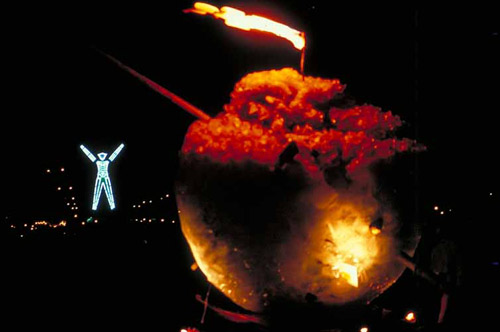
This was done by an artist by the name of Jim Mason. We helped him with this, helped him finance it. We give out grants every year, a few, and they’re always either for art that is part of our yearly theme, or art that appears in prominent public places. We do a theme because it encourages artists to collaborate and cooperate, and because it gives our participants something to share. And our first tenet, what we nearly always require, is that it be interactive.
You will see two upright poles in the back of this view. They actually had ice on them and formed four ice obelisks. The diagonal pipe that goes through the ice ball itself also had a function. It helped form a giant sundial. Now, Jim made this ice ball out of — I don’t know how many — tons of ice in the middle of a barren plain hundreds of miles from the nearest power grid, and it is filled with clocks. This piece is about the processes of geologic time, and it melted, finally, over the course of several days. It was sort of a high concept work, very expressive, and something that would probably be a big hit here at this museum if you put it in the courtyard. It was a brilliantly conceived work.
But the interesting thing, for me, about this piece is that people interacted with it throughout the event. It being Burning Man, of course, people didn’t worry about permission. They were rubbing up against it with their naked bodies the entire time. There was also a project to make snow cones out of it with ice scrapers, so you could eat the art.
Now, I was just in the exhibit upstairs, and they have this, I don’t know what it was, but it’s an installation with a monitor and a carpet stretched out on the ground, and, for a moment, I forgot myself. I thought I was at Burning Man, and so I stepped on the carpet. It was a very modest interaction. I put two inches of the sole of my shoe on it, and, of course, the guard was there in an instant. Because, you know, museums in our day are sort of a cross between a laboratory and a church, and have the least attractive qualities of both. But, I won’t bite the hand that feeds me, so we’ll pass on. [applause, laughter]
Let’s see the next slide.
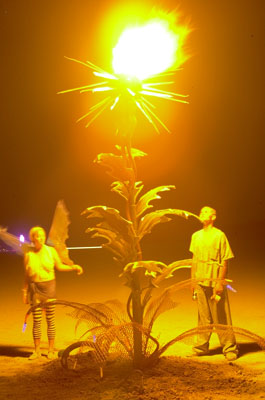
I included this slide because I don’t know who did this piece. It’s 15 feet tall. It is an art weed. I mean, I’d like to know who the artist is. Anyone who knows, I wish they’d tell me. But, this is typical of our experience out there. For all I know, it grew out the ground. An artist just did this. He or she wasn’t after us to get credited, and they didn’t put their name next to it. It was a gift to the community, and a beautiful one, too.
Let’s see the next one.
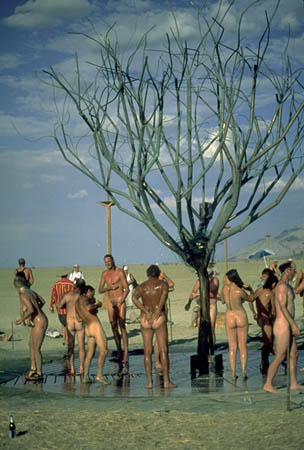
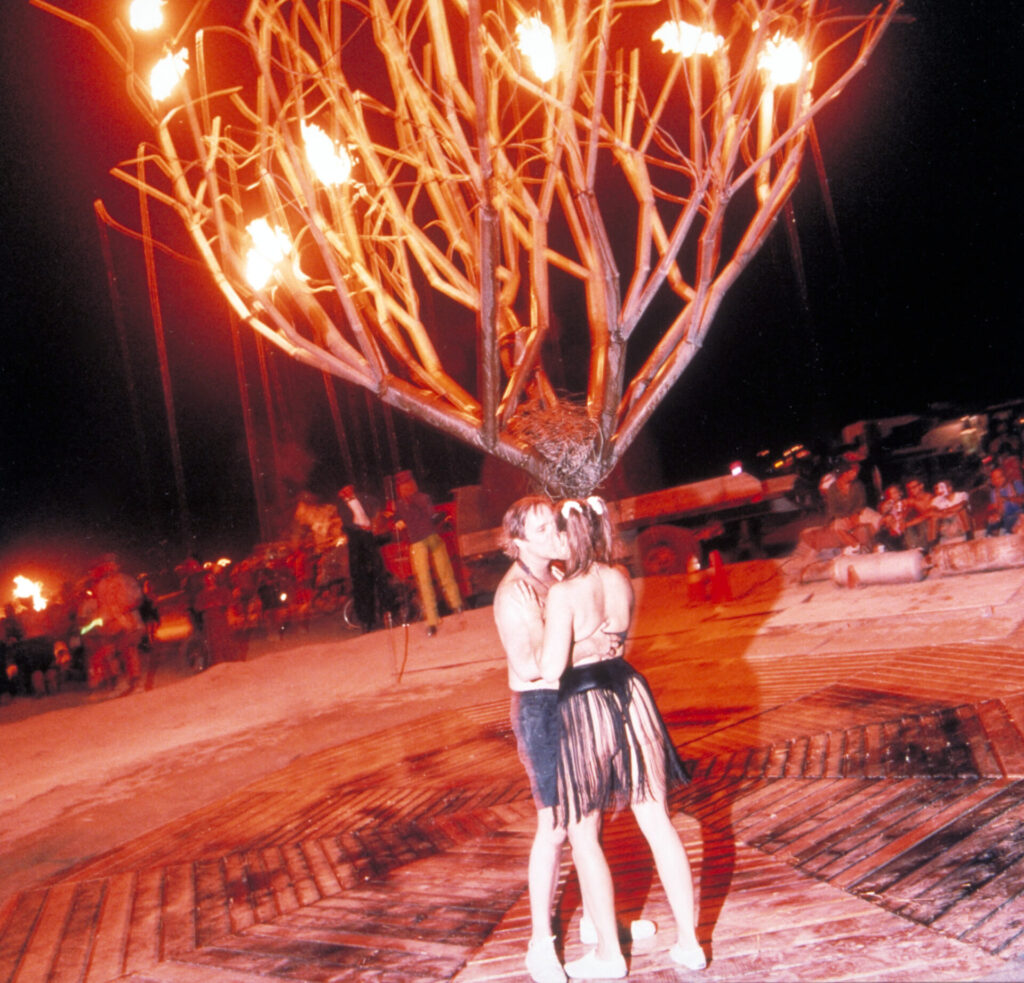
This is the One Tree. This is public art. You can see people interacting with it. It generated society around itself. It put people in a relationship to one another. It dripped water through those branches and people bathed in it. It also generated steam, and, if we look at the next slide, you’ll see it sprouted leaves of flame. This was by Dan Das Man, a brilliant artist, and if you come to the event I’m sure you’ll see more work by him.
The next slide, please…
This is my baby. Now, we called this the Nebulous Entity because I didn’t want people to know what the hell it was. We were very insistent on ambiguity. The Burning Man’s famous for our never having attributed meaning to him, and that’s done on purpose. He is a blank. His face is literally a blank shoji-like screen, and the idea, of course, is that you have to project your own meaning onto him. You’re responsible for the spectacle.
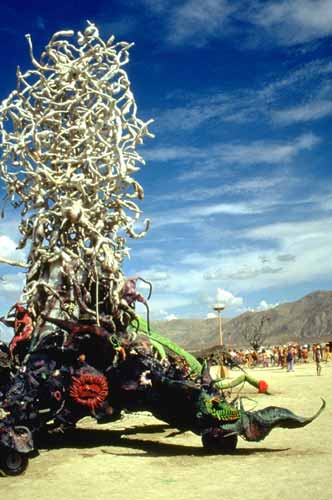
So this was the nebulous entity, and we made it as nebulous as you can imagine. A brilliant artist, Michael Christian, created the sculpture, and Dr. Aaron Wolf Baum designed a system that absorbed ambient sounds from the environment, fractalized them, and then broadcast them back to people. It continuously talked to people in a sort of burbling dialect. You’ll notice also that it is mounted on airplane wheels. When we were designing it, one of the artists said, “Let’s put a motor in it!” This being America, someone was bound to say that. [laughter] I said, “No. No, this has got to require people’s effort. They should expend some calories to make it move! They need to invest themselves in its motion!”.
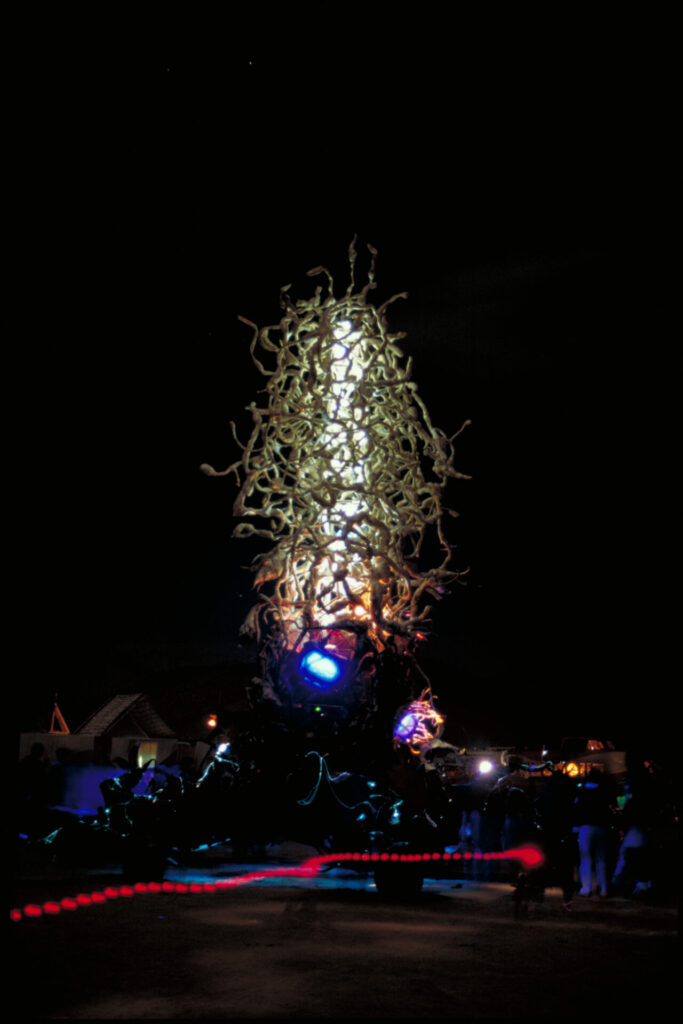
You know, if you take people and scatter them like grains of sugar, or imagine them as ants on a sidewalk in a perfectly blank featureless environment, you’ll find that they’ll spontaneously begin to create certain kinds of order. It is in our nature. The first thing they’ll do is surround any focal point of activity. They’ll form circles. You will see this happen naturally. They never form a square, — I’ve never seen a rectangle — always a circle. Then, if you take that focal point and move it, you’ll create a vector, and that forms a parade, a procession.
So the idea in this flat environment was to take advantage of the flat plain and make a work of art that only people could move, a giant plaything, and then permit it to move about, as if animated by its own impulse, and it generated parades and processions throughout the city.
Here, at its base, you see speaking tubes. People could talk into those apertures and it would distort their voice. We painted it white, so it would be reflective, and we didn’t move it during daytime, only at night.

This was meant to maximize the mystery. It had a light source which created this molten flow that moved and shimmered up and down, and made its tentacles appear to writhe. And the idea was that this great corporate organism absorbed information. It was like a living version of the internet. It was a nebulous entity, and it roved, and it came into contact with everybody. I was trying to design the most interactive piece of large-scale sculpture I could imagine.
Next slide, please.
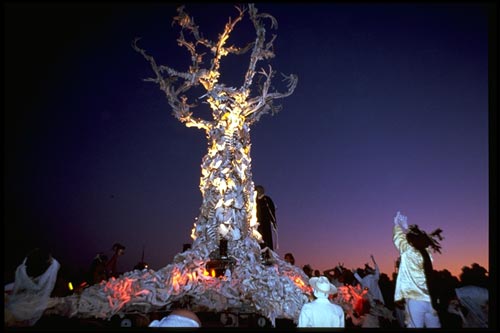
This is that same mobile platform, stripped down, and outfitted with a new work of art. This is “The Tree of Time”. It was created by an artist named Dana Albany, and this is another typically BoHo project. It necessitated this huge network of people cooperating and collaborating with one another. She had people fanned out all over eastern Oregon looking for bones — they met a lot of ranchers in the process, — and I’m not sure how you’d pay for such a service. Only a community would have the sort of resource to accomplish this. They found a lot of cattle bones, generated several unlikely friendships, and it circulated throughout Black Rock City just as the Nebulous had.
Next slide please.
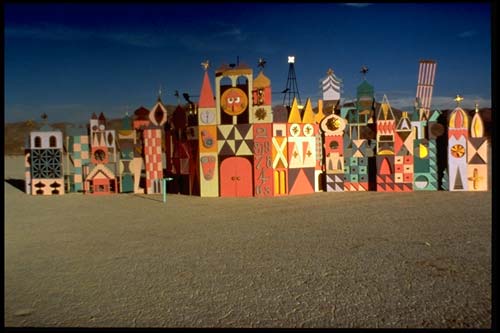
This was created by Rev. Al Ridenour, who I mentioned earlier, and the LA Cacophony Society. It was a perfectly scaled replica of an attraction at Disneyland called “It’s A Small World”. They renamed it “Small After All World” to avoid prosecution. The original was created in the 50’s or 60’s, I think, and children of that era were taken there in droves. Al says it frightened him out of his wits.
The premise here is that this recreated version is ruled by Chairman Mouse and his New World Order, and they have come to the desert to create enforced world solidarity. It featured a large cast of “ethnic” characters. A milkmaid from Switzerland and a Swahili chieftain were handcuffed together in front of it. All the while, this incessant theme music played, “It’s a small world after all…”, the sort of tune that sticks and rankles in your brain. They had German helmets with mouse ears sticking out of them, and they goose-stepped around like storm troopers. At the climactic moment, a beautifully rendered effigy of Death sprang from a concealed spring in the back of the great bell tower, and all hell broke loose. The whole thing just blew up, and that was that. [laughter]

Needless to say this was a ritual with some cathartic intent, especially for denizens of LA. Obviously, it’s about anger, about the emotions of those who’ve been conditioned to experience in a world that has been alienated from them and commodified as a distanced spectacle designed to make them passive, a system that relies on social isolation to achieve its ends.
Next slide.
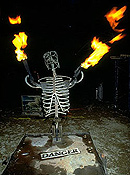
This is some of the machine art I was talking about. It came out of the punk milieu, late 70s. You know, in the old days at the SRL shows, hey really were throwing rats at people, and this was kind of alienating.
Kal Spelletich, the artist whose work you see pictured here, came out of that school, and his work took a different course. However, it’s also worth noting what Mark Pauline, the guy who founded and directs SRL, accomplished. He taught artists the way they used to be taught. It wasn’t apparent at one time in the world that you needed academic and essentially scholarly training, or that you had to become skilled in critical exegeses to become an artist.
People would look at art, they lived in a world that was filled with art, and they would apprentice to an artist, and then they would branch off and become artist themselves. And that’s what Pauline did. He ran a shop like that. These guys were really gruff, and they looked real tough. But if you could do something, you were there. If you would help, collaborate, cooperate, if you would share resources, you were there, you were one of them, like that.
And cycling through the SRL shop, artist after artist was created. Well, that is the best way to train artists, if you really want to know the truth. And Kal went through that college. He took the SRL idea, which was the punk idea, which was — not to put too fine a point on it — “Fuck shit up”, that was the tenet, the creed, and he made it interactive. He got involved with us — I mean, this was out of his own genius, but it all came together — and he started making machines that the audience could operate. So, instead of saying, “You still here?”, he said, “Come on in! Interact and make the show yourself!”
Last year [1999], he created an entire field of these devices, and let the audience — audience? — I mean, participants — loose to play with it. Here you see a someone operating a figure that burns as it moves.
And this completes the slides. Let’s have a hand for the artists! [applause]
Now, I want to talk about the most recent phase of Burning Man’s history. We went out to the desert, we created an artistic utopia on Bohemian principles, and maybe it was about 1994 or 95 that what we now call “dot com” people began to show up. And I just couldn’t figure it out. I didn’t have a clue. I’m not good with technology, and I couldn’t see any correspondence between the internet and wilderness camping. I didn’t get it until I began to navigate cyberspace myself and began to talk to these people. And what I discovered is that in their imaginations our desert seemed a lot like cyberspace, and this is a really a compelling analogy when you start to think about it.
We were in this severely abstracted space in which anyone could generate a kind of virtual reality. With a few props and a little imagination, you could create whole worlds, because it was a decontextualized environment. There was nothing there to contradict your vision, and so it was absolutely convincing. Whatever was, was more intensely so, and you could summon up these compelling visions aided by not a lot of resources.
Well, that seemed a lot like the revolution brought about by the internet. You could create a concrete version of a website in the desert. Thousands of people could visit it. You didn’t need much money, just a lot of application and some imagination. It particularly corresponded to what we call a theme camp. I haven’t touched on that so far, but, in addition to all the forms of participation I’ve described, we have what we call theme camps, and these came about spontaneously.
I think it was in our second year in the desert that a fellow out the Cacophony Society, Peter Doty, created this interactive scenario, which was the kind of thing Cacophonists did constantly to entertain themselves. He called it Christmas Camp. The man dressed up in a Santa Claus outfit for about five days in hundred degree temperatures. They hung colored lights and played Christmas carols 24 hours a day, and everybody moved away from them. [laughter] It was the most irritating thing you could imagine.
But it was meant to be cathartic, of course, because Christmas is the most irritating holiday you can imagine. And so, he turned the great consumer holiday on end. If you walked past, they would practically drag you over and offer you eggnog, which had alcohol in it. But to get to the eggnog, you had to eat the fruitcake. [laughter] They had created this whole interactive scenario that was very socially coercive, and it was the greatest, most cathartic, Christmas I’ve ever experienced.
At the end of it, — our town was so small in those days that you could literally interact with everyone in the population — at the end of it, they exchanged gifts at Christmas Camp. And, as it happened, Santa didn’t get a gift. So he went to every single camp on that playa, because he was just relentless, and complained bitterly about it and made everybody feel really guilty. [laughter] He had created a fantasy premise that turned into social interaction. It finally involved everybody. You know, 300-400 people, one way or another.
Well, that’s a little like the internet. As I began to consider it, as ’95 and ’96 came along and our numbers began to swell, I began to see other aspects of comparison. The internet is a radically egalitarian medium. Burning Man is a radically egalitarian society. I remember a woman who came out from LA some years ago and said, “I just love this event. It doesn’t even matter what kind of car you drive!” [laughter] Both the internet and Burning Man are level playing fields. We have dot com millionaires. We have starving artists. We have dot com millionaires meeting starving artists — and this really interests me!
Moreover, we have created a society that has one other crucial thing that the internet conspicuously lacks. Our event is based on radical self-reliance, since, of course, you need to bring everything required to survive. We are accustomed to a consumer society that insulates us from the realities of nature and our own inner needs. We live on this fantasy plane of desire within a vicarious spectacle. But by preparing to actually survive in a place with 100 mile-an-hour winds — and I’m not kidding — you have to commune with your inner needs, you must face immediate outer realities. It will just shock you out of the seance, out of the spell.
You see, the internet is inherently a non-hierarchical medium. It has landmarks and sources and centers, but it is not a top-down system. Information flows through it, but spreads out horizontally through networks of communication. Information no longer travels in only one direction, no longer moves from a controlling center toward a dispersed population of passive consumers. It moves more freely and flows back and forth. It is, in other words, a vastly magnified version of word of mouth, and it’s extremely useful for gathering together dispersed resources. Sometimes, I say that Burning Man is a sort of space station. It’s an outpost in cyberspace, and we use it to precipitate people into a real time and a real space where they can begin to make contact with one another.
Getting back to where I began, I talked about TV. Now, I’ve been talking to my TV for years, but it doesn’t say anything back to me. It doesn’t care about me. It pretends to care about me. It pretends to be my soul, and it pretends to be your soul. But the internet, by contrast, is a much more interesting proposition. Oh sure, it can be a vicarious and anonymous medium, and you can lose yourself in that as you can with any drug or any refuge in this world, but the highest and best use of it, and the most intriguing part of it, is that there is somebody on the other side. And that is where we’ve made our greatest discovery, because more half of our people are now connected to us through the internet.
Over the years, we’ve been obsessed with connectivity, and we’ve found that the most connective communications tool ever invented is the internet. If you went to a Springsteen concert, it is not likely you’d go home and build a stage in your backyard and throw a concert in response to that experience, because you would have already consumed the spectacle. But people go to Burning Man and they go home and say, “Gosh, this connected me to myself, and this connected me to other people. It connected me to things even much larger than myself.” And, of course, those are the three things culture is meant to do for us. And, beyond that, suddenly they see all these people working cooperatively and collaboratively together and they don’t want to stop. All their lives they’ve been telling themselves, “I’d realize my heart’s desire if I knew the right people, if I had the right connections, if I had the education, if I had the money”. And it is easy to do that, to blame circumstance, because, really, the system does seem arrayed against you.
But, suddenly, out there in that environment all those excuses just sort of fall away. People see what others achieve and how they achieve it, and suddenly they don’t have an excuse anymore. They go back to their homes and say, “I’m gonna do something!” So, then, we say to them, “By the way, there are a hundred people in your region who have been to Burning Man. Would you like to talk to them?”, and they begin communicating.
We are no longer staging an event, we’re coordinating a global community. People who are beginning to generate their own events in the UK, in America, and in Europe. There are a couple of them that are growing pretty fast, and I guess if we were a normal business we would regard this as competition and we’d sue them. But we’ve come from a Bohemian perspective, an economy of creative abundance, and it’s plain to us that what is more is more. Burning Man is now a movement, a phenomenon that extends itself organically, and it is growing on an exponential scale.
So, I suppose my last thought is this. I started out talking about the TV. I started out talking about the nature of a centralized industrialized economy. Well, I think the long reign of TV as we’ve known it is beginning to end, and I think the inevitability of the centralized industrial economy and the kinds of society that it’s imposed on us is beginning to falter. And when I look at this new medium, I seem to see all these hierarchies that exist in our world as great highrises. But, you know, if they begin to tilt a little, if they just lose a couple degrees, as these waves of change lap steadily at their foundations, many of them are going down.
A new world is being created, a world of networks, and it will alter things profoundly. Now, I don’t want you to kid yourselves. The internet is not some quick substitute for a community. It is a tool for communication. Really, it’s no better than a barroom if you try to find your society on an email list. But as a tool for engineering a communal process in this vast mass Diaspora that we’re all lost in, trapped in our separate little stalls in the consumer feed lot, it is unparalleled. It has delivered into our hands the means generating a new kind of world.
I’ve come to believe there is hope for the future. As you sit before your computer screen, it’s now possible to go into it and through it, and I’ve been through it and out the other side. I’ve been to the Black Rock Desert. I’ve seen a new heaven and earth, and I invite you all to come out and experience what is possible.
Anyway, that is my talk. Does anybody have any questions? [applause]
Question: Burning Man’s supposed to have no spectators and all participators and earlier you showed a video. Wasn’t that video made by a spectator?
Answer: Hell no. Listen, you know I’m glad you brought this up. You know what people have tried to do? There is this growing bigotry in our community, and I’m going to preach about it this year. It’s participation as a lifestyle. “I’m a participant because I painted my butt.” Well great. That’s nice, and we all see it. But you can’t tell me the photographer who is taking a picture, who’s creativity exists in that stop bath back in the studio, isn’t being as creative. That’s a lot of crap. It doesn’t have to take place in real time. The guy at the cafe scribbling away in his journal may be writing the novel of the century that he’s setting among us, that’ll make us famous for lifetimes. You can’t measure participation by cheap sign boards, you know. People in our society are always trying to come up with lifestyles, which aren’t ways of life. It is a form of commodification. It’s all image. So I’m going to recommend a broad tolerance in this department. Frankly, I don’t wear costumes out there. I’ve never worn a costume at Burning Man. But I’m participating. I can guarantee you of that. I’m participating. It is my way. So, there are different ways, that’s all.
Q: Are you going to ride up on the living room car again this year?
Questioner: No, I didn’t.
A: Well, the interesting thing about those art cars is that people think, “Oh, can I get on?”. Well of course you can get on. It’s a public gift. It reminds me of a cartoon I saw in the New Yorker years ago. People are rioting out in the street, and this guy turns to somebody else and says, “You mean I could be one of the rabble?”
Q: What is the theme for this coming year? And what are the bathroom facilities like at Burning Man?
A: Actually, our toilets have improved steadily over the years. There was a year when they were notorious. But actually we have got pretty good service. We call the guy who does it the turd burglar over our radios.. He’s our contractor, and the turd burglar has gained a lot of science. Its interesting. We’re running a city, so we have to look at things as if we were civil engineers. There are peak periods and men and women use hem differently, and we’re doing pretty good, I think.
Chorus from audience: The theme? The theme?
Oh, the theme! [laughter] Well, every year the notion is to create a theme that has a certain primal aspect, that is so close that it’s closer than close, that has an immediacy to it that everyone can spontaneously embrace, because it’s meant to be a source of community. So this year… actually when I first told somebody about our new theme, they were embarrassed for me. They said, “Well, what is it going to be, Larry?”, and I said, “I want to make this big man”, and they said, “Well, okay, old duffer, you’re the man! Whatever you want to do!” [laughter] But this is a really big man. This is one will be about a mile long.
You’ve seen our logo with the inverted arch and the figure standing in the cusp of it, and that’s literally what it’s going to be, except that inverted arch is our city. What I did is, and this is interesting, I just said we’re gonna do this thing. Which is fun. I get to say things like that. And I didn’t know a lot about lasers, frankly, except I knew it was a dusty environment, you could probably throw them that far, and you’d have to use a tower, I guessed. And suddenly, at one of our events in San Francisco, this fellow named Russell Wilcox glides up to me and says, “So, you’re gonna use lasers, are you?” It turns out he is an engineer at Lawrence Livermore, and he gave me an art proposal such as I’ve never seen before. It’s got decision-making flow charts. It’s got go/no-go dates. It’s rocket science! [laughter] It’s this thick! I’ve never seen anything like it, every part scheduled, analyzed and costed out. I’m gonna show this to the other artists just to intimidate the hell out of them. You know, “This is the kind of proposal that…” They’re not going to know what to do! [laughter]
It’s going to be a very grand project. It’s going to be quite beautiful. If you go to our website you’ll see the computer graphics he did. It being such an abstract space, these drawings actually register the visual impact of what it will be like. And then, we will make the spine of this giant figure into an art gallery. We’ll populate the interior of this body with themed art. It will extend from the groin to the top of the head. I’ve actually told artists, “If you want know what’s appropriate for any part of the figure, just touch your body and then walk around for a few minutes living in that spot and just do ordinary things and it’ll suddenly become apparent to you.” That’s an old method acting technique, and it works.
Burning Man will be the solar plexus of this figure. And, from the air, it will be magnificent. I think it will be the most immediate and engaging theme we’ve ever produced. It’s so available and people will be able to do endless riffs off this thing. There is no limit to the way you can conceive and conceptualize it.
Q: Speaking of what to do next, are there problems with the growth?
A: Growth? Well, it’s interesting. Certain things change with growth. Certain things change inevitably. There was a day in the life of Black Rock City when you knew everyone. Those days are gone. In fact, I can walk around the city for two hours and not see anybody I know, and I know a lot of people. That’s just size, and it’s true of any big city. I personally love big cities, but people have said to me, “Well, that’s alienating.” What I say to them is, “If you want the cocoon of a smaller community, if you want a closer group around you, I would suggest you do a project. If you organize a group to do something ambitious, you’ll soon find yourself surrounded by a close community. But you have to put effort into it. If you’re just a scenester, you’re outta luck, pal!” You see, the thing about Burning Man is people go the first year, and they’re just ravished by it. It seems to be provided mystically for them. It’s just absolute narcissistic gratification, and it’s wonderful and very affirming. But as you keep going, you have to invest more effort to get a return. This is a kind of moral law.
Other people tell me, “It’s not cool anymore!” These are the hipsters. You know, I preach the virtues of Bohemia, but I know the vices. The vices, the two greatest fears that motivate the arch hipster, are, one, that they won’t get invited to the party, and, two, that they’ll get lost in the crowd. And, if that’s your issue, I can’t help you there. I think when anyone participates they’re cool. Any other standard is a form of affectation. We’re radically inclusive. Far too much time is wasted in subcultures feeling superior to outsiders. I’ve never felt comfortable with in-groups or with the secret totems and subtle signs that are used to exclude people.
But our city is bigger, it’s true. And people are afraid that when things get big, they’ll be denatured. Because, in a mass society, whenever anything gets big it becomes commodified, right? It’s taken away, and then it’s not real anymore. So we have this superstitious dread that it’s gonna happen to us again. That’s what the punks thought. That’s why they were so emphatic, so angry about that. But I don’t agree with their anger, and I don’t agree with Hakim Bey’s paranoia about the system.
I think that can be overcome. Listen, in the history of mankind, there have been vibrant, living cities and networks of culture that connected people and things on a grand scale. It’s called civilization! We’ve just been living in a mass culture so long that we can’t believe in civilization anymore. And I frankly confess to you it’s one of my goals to prove to people that civilization is possible.
Now, this will only work if it is in the context of community, because community is the crucible that creates culture, and a civilization only works if it’s ordered by culture. So what we’ve done is focus on ways of creating social structures that foster connection. You see, it’s not really a quantitative problem, it’s about the quality of relationship between people. We’ve found if you can just create such context for this interconnection, people will begin to self-organize. And once they do that, you’ve got social fabric. And it can get really big, and it doesn’t have to be alienating.
Q: How much does it cost, and what’s that money go for exactly?
A: It costs a lot. This year [2000}, we’ll spend over 3 million dollars before it’s over. The BLM, our federal landlord, has just raised our rent by about 450 percent! Now, I live in San Francisco, and I’m used to rent increases, but this one shocked me. So this may go from about $67,000 to, you know, a half to two-thirds of a million dollars. Our monthly overhead is also going up. The last time I checked it was nearly $60,000 a month. We rent an office in San Francisco and we have 12 full-time employees, and many more part-time people. We have hundreds of volunteers, but we have employees, and that’s always where a lot of money goes, because it’s expensive to keep a human being alive. We also invest in an entire urban infrastructure at our site. People come out there and say, “Well, you’ve got toilets, but what else?”. They notice the toilets because the toilets mean something to them. The two most meaningful things at that festival are Burning Man and those toilets. In fact the toilets are there before the Man’s there, and they’re there after he’s gone. So the toilets are a big deal to people and they notice them. They don’t notice the miles of fencing, because we have a perimeter, and we can’t let people drive in and run over other people. Like any community, we have a boundary. Nor do people notice that we have an 80 acre ranch. We don’t own much, we rent things, because we don’t have the money to buy. But we rent 80 acres where we run shops and store materials and service the equipment that we use build the city.
What else does the money go for? Well, we pay for insurance and we pay a lot for fire protection, which may seem ironic, but we don’t want the city catching on fire. We also hire an emergency medical service. We have got response times that are better than a normal city. We also partially fund theme art, and this year we’re contributing a quarter of a million dollars to artists. You have to remember, we’re building a city! It has monuments and avenues and public works, and, after it’s over, we do what no other city does. We remove everything, every last hairpin, every bottle cap, every ash, every trace of our presence. Most of these efforts go entirely unseen. They’re eclipsed by all the creativity, but they cost a lot of money.
In fact, we are building both a city — an urban entity — and a year-round community. So we spend a lot of time communicating with people, and that takes a lot of management, a lot of time and labor. Somebody recently emailed me and said, “Now that you’re bigger, aren’t there economies of scale? Why isn’t it cheaper?” I said that if we were making widgets, this would probably be true. But such economies of scale are an industrial concept. As our community grows, social interactions increase exponentially, and we spend more and more time facilitating this, and this requires people, and many will have to be paid. It’s what we work at most throughout the year.
Q: With the growth in size, do you have much of a problem with violence and things like that?
A: Well, you know the interesting thing is, when we came out there we were dubbed a bunch of hippie hooligans by the local politicians. And this is by Reno, you know. It’s kind of hard being called immoral in Nevada. It’s hard. No, the incidence of violent acts is way below any urban norm. That’s because… but it’s obvious isn’t it? Crime occurs when people are anonymous. If you have a lively neighborhood and there are eyes on the street, then crime doesn’t happen because someone’s there to say, “We don’t do that!” As anonymity is created, as alienation sets in, then obviously the crime rate goes up.
This is a city in which people have immediately invested themselves to such an intense degree that there is remarkably little crime. Our one big problem is stolen bikes. That’s our number one crime problem. Because people will get out there, and they’ll say, “Oh cool, Burning Man!” And they’re used to jumping on these motorized art things, and they lose perspective. I’m gonna try to lecture them about that.
My solution is this. If everybody had the sense, and they should, because this is a vast city in a very taxing place, they would bring a bike. We won’t allow people to use their cars, so you’re crazy if you don’t bring a bike. You’ll get sunstroke if you don’t bring a bike. So, if everybody had a bike, we can all steal each other’s bikes, and it would be okay. [laughter, applause] Just don’t bring a good bike! Bring a beater, and that’ll pretty much solve the problem.
Q: How do you join Burning Man? How do you get a say in what’s done?
A: Burning Man started out with me and my friend Jerry James, and then it was me and a little band, and then it was me and a little band and a group underneath them, and then it’s a group underneath them. You have to have hierarchy, because someone always has to get up and look down at the big picture. But at every level we operate by consensus. Now, everyone in Black Rock City is thought of as a citizen, and when you arrive you gain certain rights that you don’t get in a normal place, and you assume certain responsibilities, because we have some rules. There are only ten official rules. That was enough for Moses, and that’s enough for us. But then sometimes people say, “Well, I bought a ticket, and I’m a citizen, and I’m gonna tell you how to run this!” Well, it’s not that easy. No one ever bought a decision-making voice in Burning Man. It’s not for sale.
You have to do something. If you see a civic need, and begin doing something to supply it, you get incorporated into the project — the project is different from the event — you get incorporated into our organization. We absorb resources that way. And when that happens, at every level of this endeavor, we work by consensus. That means you have a voice, and if you know what you’re talking about, and you actually do something, then you will acquire an authentic voice. If you accomplish much, then you’ll gain a greater voice. That’s how it works in communities.
Q: Have you had corporations that wanted to capitalize on it unfairly, and also have you had people that honestly were genuine donors to it?
A: Well, normally, an enterprise like ours would fund itself through corporate sponsorships or investments or advertising or vending. But we don’t do any of those things. Everything comes out of the ticket price, from what participants directly contribute. And we have had emergencies. One year, when local sheriffs took all our money at the gate, people gave us $50,000 going out. Now, I’ve never seen an event where people paid going out, but they did, and it was very touching. Beyond that, we’ve had individuals come forward and make donations of 10 and 20,000 dollars, yes. And there’s a fellow right now, who just loaned us $60,000 interest free, and said, “Are you sure you don’t want a hundred?”
Wasn’t there another half to that question? Oh, yeah, commercial exploitation. Every once in a while it comes up, but, of course, we go back to our old ethic about not selling out. I can tell you that MTV cost us $10,000 recently, because they’re sleazeballs, and they came to us and said, “We want to do a show”. Now we’re not anti-media, but what we’ve learned to do is create a lot of context for them. And they actually write intelligent stories anymore. They used to write terrible stories. Now we make them go to our website, and we test them on it, and we talk to them for weeks and weeks to establish a connection. And then we make them come and live there for several days. They can’t just come in and, you know, do their thing. And, after they go through this process, they’re okay.
But MTV didn’t want to do that. They said, “Oh yeah, we got a top guy, good stuff, don’t worry, the youth market, you’re gonna like this!”. And we said, “There’s no time, we can’t talk to you, and maybe next year”.
So, they went down the hall and they found this guy they knew who’d worked for them and sent him out as an independent. And then they started hyping it on the air. You know, what these people never understand is that we’re everywhere, that we usually have somebody in their office. Because this is a populist phenomenon, and that means it’s really diverse and inspires immense enthusiasm. So, somebody called us and said, “My sleazeball bosses are doing this.” And so, $10,000 later, with threat of law, we stopped them. And I think Jim Beam wanted to do an ad once. Liquor companies tend to think that we’re their demographic. You know, it looks like a frat party to them. But, really, we’ve seen surprisingly little of that.
Q: Was cleanup a problem last year [1999]?
A: Cleanup was a problem, but like a lot of adversities, it actually ended up being rather inspiring.
A new guy came into the district office of the BLM and decided to hold us to our word: “No Trace”. And so he was looking at it with a finer comb, and we found out that at a macro level it looked real empty, but when you really focused on smaller portions at a time, there was stuff. So we engaged in an archaeological effort. We gridded that environment, walked it at seven-foot intervals with plastic bags. We inventoried pistachio shells, cigarette butts, flip top rings, everything. You know those little clips they use for tents? People were cutting them when they left and letting them fly. Because, I mean, in our normal environment, who thinks? We live in a consumer society. Mounds of waste everywhere.
But this is interesting to me, because it forces you to confront the implications of being a consumer. Doing that grid was lot of labor, but it was also kind of fascinating. This year, we’re going to organize a cleanup effort ahead of time. We will encourage people to grid their own camps, and by that act they’ll claim their space. You know, when you’ve gone over every inch of it, like a lover’s body, you know it, it’s intimately yours. And then, once you’ve invested yourself in this territorial way, it doesn’t take a lot of imagination to regard your block in the same fashion.
So we’re going to turn it around. When communities are motivated they can do things with great efficiency. This is how we’ll solve the problem. If we had to hire everyone to do it it would cost too much. Really, I welcome the challenge. This year there were people there a month until it was over, but I think we can compress that into two weeks. In fact, we have a display that will allow you to find out what you left at your campsite, because we GPS’d the entire area. We are getting very serious about this, and you may get a phone call from us, “…and what about those pistachio nuts, pal?” We know where you live!
I guess that’s the end of our time tonight. I’d like to thank all of you for coming. [applause]
This lecture was delivered at the Walker Art Center in Minneapolis on February 24, 2000.