Welcome!
Thinking of bringing a Mutant Vehicle to Burning Man? This page will guide you through the criteria and licensing process. Remember, all vehicles driven at the event need to be licensed by the Department of Mutant Vehicles (DMV). To be eligible, your vehicle must be radically mutated, offer an interactive experience, operate safely, and be well-lit. The MV Statement of Intent (MVSOI) opens January 14, 2026 and closes February 6, 2026. The application opens in mid-February and closes in mid-April each year.
Looking for info about Accessibility Vehicles? Find everything you need to know
TL;DR Summary
Alright, so you wanna bring your awesome Mutant Vehicle to Burning Man? Sweet! Here’s the lowdown on getting it licensed by the DMV, for those who want to cut to the chase:
- Make it Radically Different: Your vehicle needs to be seriously mutated and unrecognizable from its original form. Think “wow” factor!
- Offer an Experience: It should offer something interactive, like rides or entertainment.
- Keep it Safe: Steady speed (5 mph or less), good brakes, sturdy railings, no sharp edges.
- Light it Up: Well-lit at night for safety and visual appeal.
To get it licensed:
- First: Fill out the Mutant Vehicle Statement of Intent (MVSOI)
- Before Applying:
- Read all of the Mutant Vehicle criteria carefully (this page).
- Read the DMV FAQ (Mutant Vehicle Operator’s Handbook)
- Review the DMV Gallery to see examples of vehicles that were NOT invited.
- Apply Online:
- Fill out the Mutant Vehicle Application with photos/sketches, describe safety features, and agree to the driving guidelines.
- Make sure your application is complete, and the images provided show a clear indication of the vehicle you intend on building/bringing.
- Put your best foot forward:
- Read and answer all questions thoroughly.
- More information and images is better
- The DMV does not accept appeals once we’ve reached a consensus on your vehicle, so if you have questions about the criteria or the application, reach out to us first, before applying.
- Read The Manual (Again): Read the Mutant Vehicle Operator’s Handbook. This gives you a full guide to bringing your Mutant Vehicle to Burning Man.
- Final Inspection: If invited, bring it to the DMV at Burning Man.
- Licenses: Separate licenses are given for day/night. Vehicles with Trailers, Flame Effects and Lasers need specific approvals with additional considerations.
The goal is to share your creation and be inclusive. Offer rides whenever you can!
Why do Mutant Vehicles need to be licensed?
Burning Man’s permit from the BLM stipulates that all participant and staff vehicles driven at the event must be licensed by Burning Man. The Department of Mutant Vehicles is the department responsible for licensing Mutant Vehicles and Accessibility vehicles at the event.
How many Mutant Vehicles do you invite each year?
With 80,000 participants, mainly on foot and bicycle, roaming the streets and open playa in and around Black Rock City while intermingling with Staff, Mutant, Accessibility and Law Enforcement vehicles, there is a threshold where having more than a certain number of vehicles driving would be a safety hazard. To address these safety concerns in consult with the BLM, the target for the number of Mutant Vehicles licensed to drive at the event is 650 or fewer. To meet that goal, we limit the number of vehicles the DMV invites each year to 800. This number takes into consideration that we have a very consistent 21% “no-show” rate among invited Mutant Vehicles so the number of vehicles we end up licensing falls under the 650-vehicle threhold.
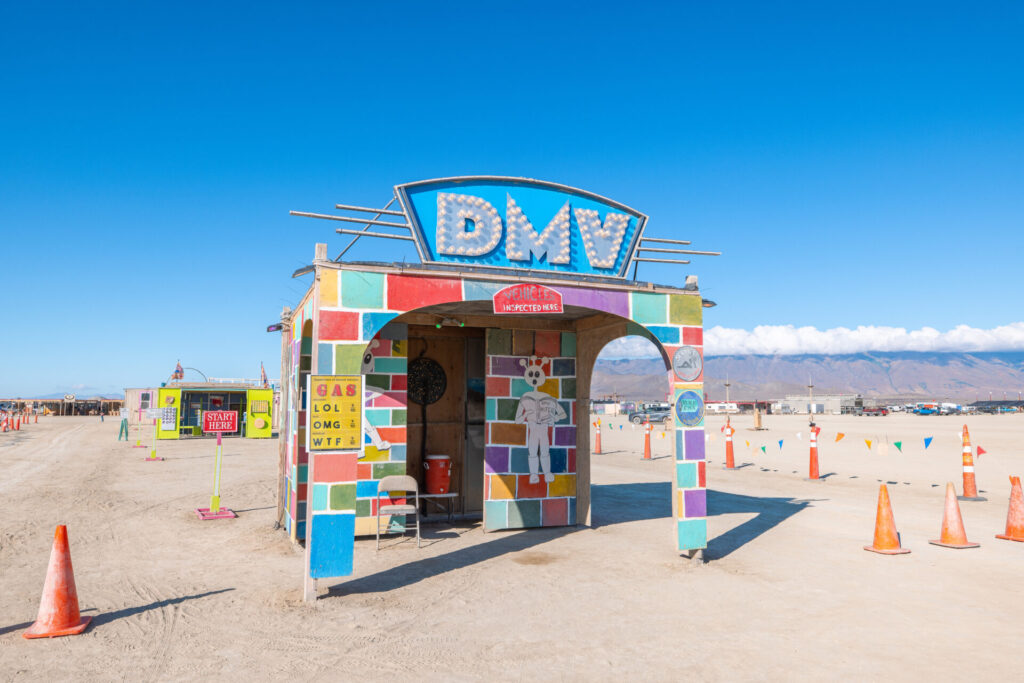
How do you get a Mutant Vehicle license?
- Create or plan a Vehicle that meets the DMV’s Mutant Vehicle Criteria (below).
- Fill out a Mutant Vehicle Statement of Intent (MVSOI).
- Fill out a Mutant Vehicle Application using your Burner Profile. All Mutant Vehicles must apply through this form to be considered for on playa licensing (you can’t just show up at the event with your vehicle and get licensed).
- If your vehicle is invited, Bring your Mutant Vehicle to the DMV at Black Rock City for final vehicle inspection. Final inspection and licensing are required before you can drive your vehicle at the event.
Mutant Vehicle Statement of Intent (MVSOI)
The Mutant Vehicle Statement of Intent (MVSOI) form is our initial check-in for Black Rock City. Just as the Placement team uses their Placement SOI to understand the plans of placed Theme Camps, The MVSOI helps the DMV better gauge the needs and intentions of all Mutant Vehicle projects, both new and returning.
The MVSOI form is available from mid-January through mid-February.
The Mutant Vehicle Statement of Intent (MVSOI) is for all Mutant Vehicle teams who plan to bring their vehicle to Black Rock City, those who may want to take a year off, or those who seek access to purchase tickets in the spring Stewards Sale. NOTE: If you do not submit an MVSOI, you may still apply to bring your Mutant Vehicle, however you will not be considered for Stewards Sale tickets.
The MVSOI is a planning tool that helps the DMV understand:
- Your Vehicle’s Intent: What vehicle you plan to bring and its current status.
- Stewards Sale Ticket Needs: The total number of tickets your Mutant Vehicle team and associated support camp members will require to get to the playa.
- Placement Needs: Does your team intend to request placement as a Mutant Vehicle Support Camp (as opposed to being part of another type of Placed Camp). The MVSOI does not replace the Placed Camp Questionnaire.
Stewards Sale Ticket Access
The Stewards Sale takes place before the main public sales and is designed to support the teams actively building and supporting projects that significantly contribute to Black Rock City. We know ticket access is critical, and we aim to supply tickets to all MV teams to meet the essential needs of their team and support camp.
What to Expect
The form will ask you about your vehicle project, the total size of your Mutant Vehicle crew and support team, whether you require a Mutant Vehicle Support Camp, and your anticipated ticket needs. It should take less than 10 minutes to complete.
Please be thoughtful and realistic when estimating your total team/support camp size and its corresponding ticket needs. Your careful planning helps us manage resources effectively for all teams.
A Few Key Notes
This form Does Not Replace Your Mutant Vehicle Application!
This MVSOI is for initial planning and ticket access only. You still need to submit a separate, full application for your Mutant Vehicle to be considered for an official license. If requesting a placed Mutant Vehicle Support Camp, you will need to fill out a Placed Camp Questionnaire. Mutant Vehicle Registration and the Placed Camp opened Mid-February, 2026.
Inclusion in the Stewards Sale Does Not Guarantee your Mutant Vehicle’s invitation or camp placement.
Because the Stewards Sale happens before registration opens, completing the form and participating in the sale doesn’t guarantee your Mutant Vehicle will be invited this year or that you will receive Placement for a Mutant Vehicle Support Camp.
If you have any questions while filling out the form, please don’t hesitate to email us at dmv@burningman.org.
Mutant Vehicle Criteria
To be eligible for a Mutant Vehicle license, you must satisfy ALL of the following criteria:
There are five main points the DMV considers when reviewing your vehicle.
- Level of Mutation / Visual Presentation
- Mutate or create your vehicle to the point that it is not recognizable as a street or stock vehicle. A radically mutated vehicle will not resemble or represent a car, truck, golf cart, or any other readily identifiable street or stock vehicle. In most cases, little or none of the base vehicle should be visible.
- Beyond just changing, covering, or hiding the base vehicle (if any), the mutation should aim to be visually compelling, providing “wow factor” for the other participants of Black Rock City. When a person sees this vehicle, their reaction should be “Wow! Look at that!”
- General Considerations:
- If a vehicle maintains its stock form (i.e., it keeps the shape of a bus, golf cart, or street vehicle), it may not be sufficiently mutated to meet the Mutant Vehicle Criteria.
- A vehicle primarily covered with fabric, fur, or other material, without significantly changing the vehicle’s shape, may not be sufficiently mutated to meet the Mutant Vehicle Criteria.
- A vehicle where the Mutation is primarily art or mutation on top of an unmutated vehicle may not be sufficiently mutated to meet the Mutant Vehicle Criteria.
- A vehicle primarily stripped to the engine and/or frame may not be sufficiently mutated to meet the Mutant Vehicle Criteria.
- For visual examples of vehicles that applied but did not meet Mutant Vehicle Criteria, please see: DMV GALLERY.
- Consideration may be given to vehicles that are presented outside of their normal context.
- The DMV will be looking to invite a balance of different types of vehicles on the playa: large-scale sound vehicles, flame effects focused vehicles, small artistic vehicles, large transport vehicles, highly participatory vehicles, etc.
- We are dedicated to licensing vehicles from projects of all budget levels, not just the most expensively built ones.
- We primarily look for vehicles that meet the criteria above AND demonstrate good execution of their design concept.
- We also consider the originality of a vehicle. There are already quite a number of bar-cars, furniture cars, and boats, for example, and the DMV may choose only to invite some of the vehicles that are similar or identical in design. The same applies to groups of identical vehicles, ie, fleets, herds or swarms of similarly designed vehicles.
- TRAILERS – Any trailer attached to a Mutant Vehicle must also meet the criteria for Mutation as well as the Trailer SafetyRequirements (see below)
- Interactivity
- Provide an interactive experience for participants of Black Rock City. Interactivity is defined as an opportunity for any BRC citizen to participate in some activity offered by your vehicle. The theme and/or size of the vehicle are considered here. Do you entertain a crowd? Does your vehicle have room for riders? Does your vehicle provide a service to the community? Does it include an interactive element?
- Interactive aspects alone are not a replacement for the Mutation Criteria above, but are considered more like “extra credit”.
- Safety
- The safe operation of a Mutant Vehicle at the event is the Registrant’s responsibility. Depending on the size and style of your vehicle, some or all of the following may apply:
- The vehicle must be able to maintain a steady speed of five MPH (the speed limit in Black Rock City) or less.
- The brakes must be in good working order.
- The vehicle should have sturdy side Guard railings and stair railings. Guard railings should be a minimum height of 36-48 inches above the floor surface. Allowances may be made for ingress and egress zones no more than 36″ wide.
- There should be no sharp or protruding objects.
- Having a fire extinguisher and First Aid kit on board is highly recommended.
- The vehicle should have a safe access area and procedures for loading and unloading passengers.
- For safety requirements of lasers mounted on Mutant Vehicles, please see Mounted Lasers.
- Vehicles with trailers must have Trailer Barriers protecting the space between the vehicle and the trailer. For details on trailer safety requirements, please visit this page of the MV Handbook.
- Important notes
- The DMV does not do Safety Inspections. There are specialized teams that do Fire Effect and Laser Inspections for Mutant Vehicles.
- The DMV may decline a license to a vehicle if there is a demonstrable safety concern such as sharp objects that protrude from a vehicle or some other dangerous aspect to the vehicle.
- Lighting
- There are two fundamental requirements for mutant vehicle night illumination:
- Safety: People need to see your vehicle, and you need to see them.
- Your vehicle must have front headlights or equivalent that illuminate at least 30 feet to the front.
- Your vehicle needs to be illuminated from all angles (front, sides, and rear) to clearly show it as a continuous vehicle.
- Radical Visual Stimulation (The “Mutant” Factor): Mutant vehicles are licensed not just for transportation, but because they contribute to the event. For most mutant vehicles, this requirement is met through radical visual stimulation. The more your vehicle makes people say, “WOW! What an awesome car!” the more likely you are to be granted a license. At night, this can be achieved in two ways:
- The lighting itself is the art: This applies when the vehicle isn’t fully mutated or obscured during the daytime, but at night, the lighting becomes the primary visual element (for example, like the “Big Giant Head” vehicle).
- Illuminating a well-crafted mutant vehicle: This applies if your vehicle is already worthy of a day license and its existing design is enhanced by significant lighting.
- Safety: People need to see your vehicle, and you need to see them.
- In both cases, the lighting should be significant enough for the vehicle to be easily seen from all sides and from a distance.
5. Sound
- There is a Sound Policy for Mutant Vehicles. It is important that you know it. Please, review the sound policy. All vehicles driving in Black Rock City must follow the sound policy.
What is NOT Considered a Mutant Vehicle?
- The following are not considered Mutant Vehicles:
- Vehicles only stripped to the frame and engine.
- Street/stock vehicles with minimal changes or temporary decorations.
- Vehicles that too strongly resemble the original form or where too much of the base vehicle is unmutated and still visible. For example: A fur-covered golf cart or street vehicle that keeps its original shape.
- Vehicles that may be unusual but are stock/mass-produced (military, industrial or foreign-made vehicles). Examples of this that have previously applied include an MK 48, Swamp Buggies and Tuk-Tuks
- Low riders, classic cars, custom cars, monster trucks, dune buggies, rat rods, and hot rods (there are other venues for these vehicles to be appreciated)
- Vehicles that are primarily unmutated but have art placed on top, unless the base vehicle underneath the art is well-obscured and incorporated into the overall art. The underlying vehicle should be unrecognizable as its original form.
- NO EMERGENCY VEHICLE LOOK-ALIKES
- Burning Man does not permit vehicles that resemble emergency services vehicles, including any vehicles decorated with red, blue, or amber rotating/flashing lights or vehicles with sirens. During an emergency, participants MUST be able to differentiate between an actual emergency vehicle and a Mutant Vehicle or other vehicles.
Mutant Vehicle Application Review
Once you have filled out a Mutant Vehicle Registration form, the DMV will review your application and notify you once we have reached a consensus on whether and how well your vehicle meets the Mutant Vehicle Criteria and whether it is invited to Burning Man.
For more details on the DMV Review process, please see the DMV FAQ/MUTANT VEHICLE OPERATOR’S HANDBOOK
The DMV’S Decision Model – How We Choose Vehicles
The ART of Facilitating Art:
How the DMV uses a Consensus Model to choose which Mutant Vehicles to invite to Burning Man
“Consensus is a process for decision-making that strives for higher ideals than other types of decision making processes.” – Tim Hartnett
How do you decide what art should be viewed by a particular audience? When there are many unique items to choose from and you can only choose a limited number, what’s the best method for choosing?
This is the challenge the Burning Man Department of Mutant Vehicles faces each year as we assess the hundreds of applications we receive. Over the years, we’ve evolved into a consensus model for our decisions that has been pretty successful.
Facilitating the decisions using a consensus model can be challenging, as it involves more time and effort than other methods, but using consensus can lead to better choices with more broad-based support.
Mutant Vehicles have become an indelible part of the visual fabric of Burning Man. Over the years, often inspired by the vehicles they’ve seen at previous burns, more and more people have created Mutant Vehicles and applied to bring them to the playa. We’ve reached a point where participants submit nearly 1,000 applications each year. The DMV aims to license around 650 vehicles on the playa, which means that to stay within our limit, in some years, up to one half of the vehicles that submitted applications to the DMV could not be invited.
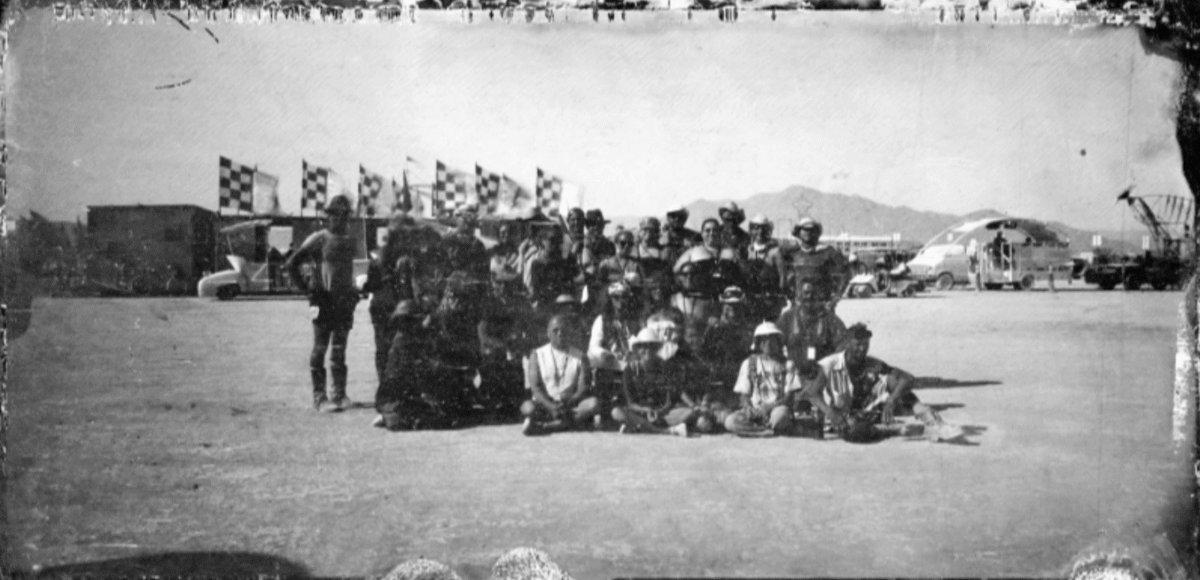
Who Is The Department of Mutant Vehicles?
The DMV is the group within the Burning Man organization that oversees the licensing and operation of Mutant Vehicles and Accessibility Vehicles at the event. It is made up of over 125 including an oversight group called the DMV Council. One main focus for the DMV Council has been to try to find the best method for choosing which vehicles are invited to the event, with an eye to fairness and consideration of all aspects of each vehicle, and with the goal of inviting the vehicles that will add the most to the experience of the other participants at the event.
The rest of the DMV Volunteers begin their work in the spring, reviewing applications, and then work on-playa helping run the on-playa DMV, inspecting and licensing the Mutant and Accessibility Vehicles.
A Little History
In the early days of Burning Man, people could drive around the event at will. A small group of people began bringing their Art Cars – cars that had been modified or decorated in some way.
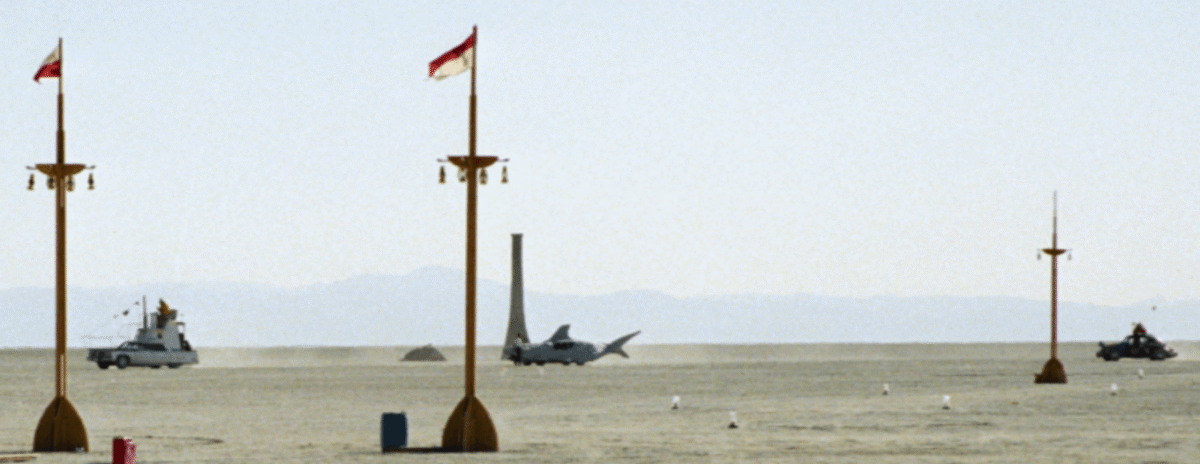
As the event grew in size, driving had to be restricted for safety reasons. In 1997, after some vehicle-related injuries at the 1996 event, all non-essential driving at the event was banned, with the exception of the Art Cars. If you were driving an Art Car things were fine and if you were driving something else you were asked to stop and park it in camp.
But this “after-the-fact” oversight wasn’t really effective, so in 1999 the Department of Mutant Vehicles was formed. The Department asked anyone with an Art Car to come to an onsite kiosk where the DMV would take a look at their vehicle, determine if it was “arty enough” and then give them a “license,” basically a bumper sticker (later with a license number on it) confirming that this vehicle was allowed to drive at the event.
As the number of people wanting to bring Art Cars to the event grew, it eventually became larger than the Black Rock City could support. At that point the DMV refined the criteria of what would now be called “Mutant Vehicles” – art cars that were more significantly ‘mutated’. The DMV also began pre-registration: having people apply BEFORE going out to the event, so that DMV could review the vehicles and confirm they met the criteria before they were brought to the playa.
For the first few years, the DMV Review and Invitation process was fairly straightforward. Five or so volunteers would get on a conference call, review the applications, then decide whether the vehicle met the key criteria: “Mutated to the point it doesn’t represent a street vehicle.” While this criteria did not have a lot of nuance, it was intended to keep the DMV out of the position of having to “judge people’s art.” The review team fairly quickly decide if the vehicle met that criteria, or not, and decide whether or not to invite the vehicle.
As Burning Man continued to grow, so did the number of Mutant Vehicle applications. From 613 in 2004 to an all-time (so far) high of 1,032 in 2011.
Ch-Ch-Ch-Changes…
During this time the Mutant Vehicle criteria continued to evolve, not in major ways, but each year there was more nuance and guidance added. As more people were applying, the average level of “mutation” of the vehicles increased and some vehicles that had previously been invited were now considered less worthy of an invitation as compared to the more involved, and more mutated vehicles. The Mutant Vehicle creators, on the whole, were raising the bar.
Finally, in 2015, the number of Mutant Vehicle applications that met the base criteria began to exceed the number of invites the DMV could bestow. In addition to this, we had some years when we reached the limit to the number of vehicles we could invite before we reached the end of the applications. And some of those later applications, the ones that were left out, were objectively “great” vehicles – ones that were really compelling, well-executed mutations.
Something had to change.
At first, the DMV considered “tightening up” the criteria – but the problem was, we couldn’t find a way to do so that didn’t have the unintended consequence of also excluding some vehicles that we felt SHOULD be invited. We also didn’t want to exclude smaller or simpler (or less expensive to produce) vehicles.
We also wanted to avoid a “First Come/First Considered” process, as that made it too random – it would favor the vehicles that got in line first and wouldn’t ensure that we were giving each application its due consideration, or picking the “best” vehicles. It could mean a “so-so” vehicle that barely met the criteria might end up getting a slot when a “great vehicle”, which just happened to apply a few minutes later, might not.
What we did instead was to change the overall process of review: Rather than the “First Come/First Considered” model where we make a final decision on EVERY vehicle the first time we look at it, we began reviewing the vehicles in separate “rounds,” In each round we would review ALL the applications in the order received, but not always make a final decision on each vehicle at that point. As we reviewed each application, if we felt the Mutant Vehicle described was a “no-brainer” – a well-mutated, well-executed vehicle, it would get an immediate invite. If we felt it met the minimum criteria, but was not in the top 50%, we would push it to the next round. This meant that we would be able to see ALL of the applications at least once, BEFORE we ran out of invites. Once we reached the end of the applications, we started again at the beginning, reviewing the remaining applications and again, considering them and inviting the top half (approximately) of what remained.
Skimming the Cream
This method of “skimming the cream off the top” involved more discussion during the review sessions. What was the cream? How do you determine the top XX% when you haven’t seen all the vehicles? Great questions and ones we tried to figure out as we went along.
Along with the other changes in 2015, we had a problem of too many DMV volunteers wanting to take part in review sessions. We sometimes had as many as 50 people reviewing applications on the conference calls. This became a bit unwieldy, and it became difficult to get to decisions on some of the vehicles, so the DMV capped the number of participants to 25, but the challenges in reaching decisions drove us to change the review process even further – to one that not only both considered input from the review participants, but also achieved more broadly accepted decisions than a simple voting process could achieve.
Voting VS. Consensus
The next key change was that we began focusing more on discussing the aspects of each vehicle, rather than simply voting. We soon found that when we had a structured discussion – one where the facilitator asked for opinions, then asked follow up questions – not only did it become easier to reach a broader consensus, but people were happier with both the outcome and the process itself. Part of the facilitators-follow up questioning involved specifically asking WHY someone felt the way they did about a vehicle. This helped others in the discussion better understand the person’s reasoning and they were then more accepting of an opinion if it differed from their own. Team members also noted that the process seemed more “fair” than it had in the past and that they felt their opinions were heard and considered more.
The gradual shift to the consensus model meant adjusting how much time we took with each application. Rather than making quick, 1-2 minute decisions, the average time spent on each application grew to 5-10 minutes. With particularly challenging vehicles, if consensus could not be reached after 15 minutes, we would table the review until another session (which would have a different makeup of volunteers), or push the vehicle to the next round.
The Quaker Method
In seeking out additional ideas and information on how we could improve our decision-making process, I came across some interesting information about our flavor of consensus-building: Even though we at the DMV had come to this model organically – by seeing what worked and what didn’t and changing things to align with our goals for the outcomes – the process we had developed closely mirrored a model of decision making known as the “Quaker Method” developed by Quaker communities.
In the “Quaker Method,” there is a neutral Facilitator called the Clerk who “…is theoretically a recording officer, but in practice he must frequently assume the duties of a presiding officer. He must be sensitive to all trends of opinion, including those not well expressed.” This is basically the role that the facilitator (usually me) has assumed in the DMV Processing meetings. While there are some differences between the “Quaker Method” and the “DMV Method,” the methods are strikingly similar, and our method has produced results similar to those reported by observers of the “Quaker Method.”
“It is surprising…how often real unity is reached, even though the discussion in its initial stages shows a wide variety of opinions, or a pronounced cleavage arising from strongly held convictions. As the consideration proceeds, unity gradually emerges and is finally reached. The decision may be along lines not even thought of at the beginning. This procedure takes more time and patience than the voting method, but the results are generally more satisfactory to all concerned.”
-Howard Brinton, Reaching Decisions: The Quaker Method.
In our newer process, we sometimes found that if we took a vote at the beginning of reviewing an application, after 5-10 minutes of structured discussion, when we took a subsequent vote, the tally was the inverse of the first vote – a 15-5 vote against a vehicle might become a 15-5 vote in favor of the same vehicle. The very act of discussion and consideration (and folks pointing out aspects of the vehicle that others might have missed) made a fundamental difference in people’s consideration of a vehicle.
Previously, we would have just stuck to the voting and if there was a majority for inviting, we would invite, and the discussion would be kept to a minimum.
As noted about the Quaker Method: “Key to this approach is the concept of dialogue, the creation of common meaning through an interactive process of listening, exploring assumptions and differences, and building a context for thinking together.” Malcolm Burson, Finding Clarity In The Midst Of Conflict: A Quaker Approach To Facilitating Dialogue.
This is what I see at play in the DMV process. Not always, and not perfectly, but in general. I think the key difference between simply voting and talking through to consensus is that when you just vote, you don’t really know why others voted the way they did, and why they didn’t see things your way. In the consensus model, everyone has the opportunity to voice their reasoning, and participants have the opportunity to understand WHY folks voted the way they did, not just THAT they voted that way. This seems to help folks accept the end result, even if they don’t agree with the majority.
Feedback from the DMV Volunteers (from our 2018 DMV Volunteer survey) seems to support that conclusion:
- 83% of the volunteers surveyed rated the DMV Application Review process “Very Good” to “Excellent.” The remainder rated it “Good.”
- 97% of the Volunteers felt the process was “Effective” to “Very Effective” in inviting the “best” vehicles to the event.
As for how participants view the outcome of our decisions, generally the feedback has been pretty positive. Of course there are always folks who don’t like one vehicle or another, or sometimes we have let something pass through that might not have shown up on playa as well-executed as their design plan, but overall, when it gets to be Wednesday night at Burning Man, and I look out across the playa at the illuminated kaleidoscope of amazingly mutated vehicles, I think we’ve done a pretty good job.
While the “DMV method” may be a little more involved, take a bit longer, and require more emotional investment than other methods, we tend to end up with better, more considered choices that better represent the community we’re choosing for:
You.
We hope you think so too.
And if not, email us at dmv@burningman.org and let us know how we could do better.
Cheers,
Chef Juke
For more on general consensus building, see:
Consensus 101 Tim Hartnett
For more on the Quaker Method as it relates to consensus see:
Finding Clarity In The Midst Of Conflict: A Quaker Approach To Facilitating Dialogue
Mutant Vehicle Licenses
Mutant Vehicle licenses are issued by the DMV on-playa. All licensed Mutant Vehicles will be given a Day and/or a Night license. Licenses will also be designated for Street or Playa driving, based on the size of the vehicle (see more below). Day or Night designation is based on many factors, including what purpose the vehicle serves, lighting, and how it is implemented.
Standard/Playa-Only Licenses
- A Standard Mutant Vehicle License allows a Mutant Vehicle to operate on city streets (with the exception of pedestrian-designated streets) and on the open playa of Black Rock City. To be eligible for a Street License:
- The vehicle must be less than 13 feet in width, and less than 45′ in length,
- The vehicle must be able to safely navigate a right turn on a typical BRC intersection while remaining within one lane of the street.
- Operators must be able to safely monitor all segments of the vehicle while in operation.
- A Playa-Only/City Restricted License allows a Mutant Vehicle to operate PRIMARILY on the open playa of Black Rock City. Mutant Vehicles with a Playa-Only License may NOT be operated on BRC streets except on their way to the playa from their camp (using the most direct entry). Playa-Only vehicles may require walkers/spotters.
Day/Night Licenses
- DAY licenses allow Mutant Vehicles to move around Black Rock City during the daytime.
- NIGHT licenses allow Mutant Vehicles to move around Black Rock City at night. To receive a night license, Mutant Vehicles must be FULLY and RADICALLY illuminated (see above).
- Some vehicles may receive both a DAY and a NIGHT license.
Trailer Licenses
Trailer licenses are required for any trailers that are attached to Mutant Vehicles. These are licensed separately from the Vehicle.
Flame Effects
Mutant Vehicles that incorporate flame effects must include flame effects information in their Mutant Vehicle application and also must be inspected on-playa and be granted a Flame Effects license from the Fire Arts Safety Team before the flame effects can be operated. Learn more about Flame Effects on Mutant Vehicles.
Important details for MV’s with Flame Effects
In order to protect your passengers from danger, the height of the first point of fire must be at least 10-feet above the last place a person could possibly stand on your vehicle. This allows plenty of height above heads and a little extra in case the wind presses it down a bit. This rule has been in place all along and this year we are going to be strict with this rule. Please take action to correct this pre-event if your MV flame effect is lower than 10-feet.
Questions about Mutant Vehicle flame effects should be sent to dmv-flame-effects@burningman.org.
To Register Your Vehicle
First, submit your Mutant Vehicle Statement of Intent (MVSOI). This form is open from mid-January until the end of February.
Later, submit your Mutant Vehicle application. This form is open from mid-February until mid-April each year. The application page of your Burner Profile will have the exact dates.
If you have any questions contact the DMV by emailing dmv@burningman.org.
DMV Process & Timeline
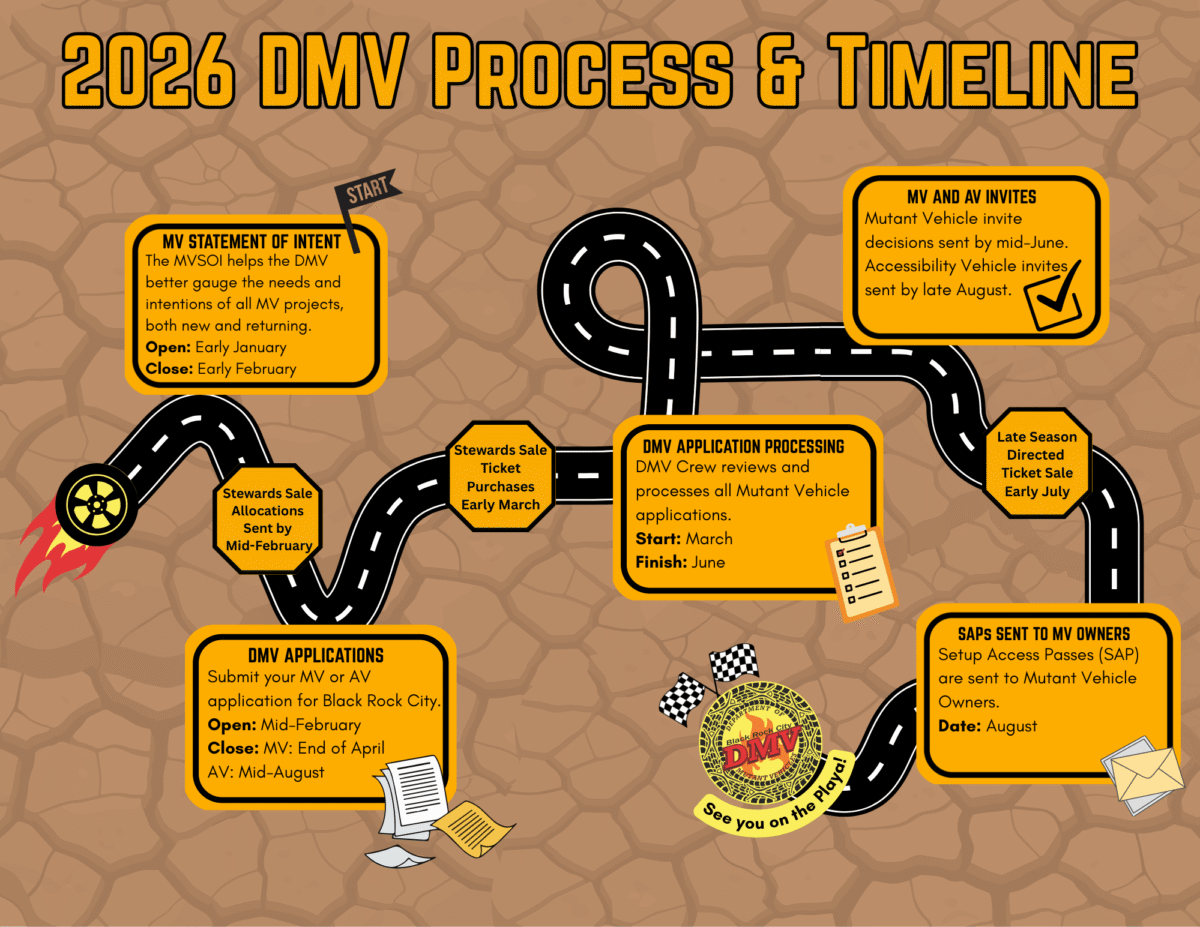
2026 DMV Key Dates
- MV STATEMENT OF INTENT
The MVSOI helps the DMV better gauge the needs and intentions of all MV projects, both new and returning.
Open: Early January
Close: Early February - Stewards Sale Allocations
Sent by Mid-February - DMV APPLICATIONS
Submit your MV or AV application for Black Rock City.
Open: Mid-February
Close: Mutant Vehicle: End of April, Accessibility Vehicle: Mid-August - Stewards Sale Ticket Purchases
Early March - DMV APPLICATION PROCESSING
DMV Crew reviews and processes all Mutant Vehicle applications.
Start: March
Finish: June - MV AND AV INVITES
Mutant Vehicle invite decisions sent by mid-June.
Accessibility Vehicle invites sent by late August. - Late Season Directed Ticket Sale
Early July - SAPs SENT TO MV OWNERS
Setup Access Passes (SAPs) are sent to Mutant Vehicle Owners.
Date: August