



Burning Man co-founder and Chief Philosophic Officer Larry Harvey (1948-2018) was the culture’s original instigator. With his friend Jerry James he led the first Burn on San Francisco’s Baker Beach in 1986. In the ensuing years he designed the now-iconic Burning Man effigy, dreamed up each year’s event theme, and art-directed the Man base for every Burn until his death in 2018.
He authored Burning Man’s 10 Principles to help guide the emergent Burning Man Regional Network, and founded the Philosophical Center in order to nurture the ideas and values unlocked at Burning Man, instill them in our culture, and share them with the wider world.
Larry wrote and spoke frequently about Burning Man, both under his own name and occasionally in the guise of his anagrammatic alter ego Darryl Van Rhey. He wrote for and edited the community’s early print newsletters, Building Burning Man (1991-1999) and the original Burning Man Journal (2000-2007). More of his writings can be found in our Historical Publications archive and our blog, the Burning Man Journal.
Remembering Larry Harvey
Selected Essays
Introduction: The Philosophical Center — 2013
How The West Was Won: Anarchy Vs. Civic Responsibility — 2013
Commerce & Community: Distilling philosophy from a cup of coffee … — 2013
Consensus, Collaboration, Hierarchy, Authority and Power — 2014
Equality, Inequity, Iniquity: Concierge Culture — 2014
Following the Money: The Florentine Renaissance and Black Rock City — 2016
Radical Ritual: Spirit and Soul — 2017
Selected Videos
[metaslider id=”12032″]
Articles & Interviews
Interview with Larry about ritual, community and Burning Man — Burning Man archives, 1994
“Burning Man and the Art of the 90s” — Burning Man Publication, 1997
“The Man Behind Burning Man” — Time Magazine, 2000
“Burning Man’s Founder Looks Ahead” — Wired, 2005
“Burning Man: A Conversation With the Founder (VIDEO)” — Commonwealth Club, 2011
“Larry Harvey and JP Barlow on Burning Man and Tech Culture” (ARTICLE & VIDEO) — Tech Crunch, 2018
Larry Harvey Obituary — New York Times, 2018
Speeches
La Vie Boheme: A History of Burning Man — Speech at Walker Art Center, Minneapolis, 2000
Burning Man and Cyberspace — 9th Annual Be-In, 1997
Viva Las Xmas — Speech at Cooper Union, New York, 2002
Larry Harvey Hualapai playa speech — Crowd address at Burning Man, Hualapai Playa, 1997
Larry Harvey Center Camp speech — Center Camp Stage – Black Rock City,1998
Matt Gonzalez endorsement speech — Rally at Civic Center Plaza, San Francisco, 2003
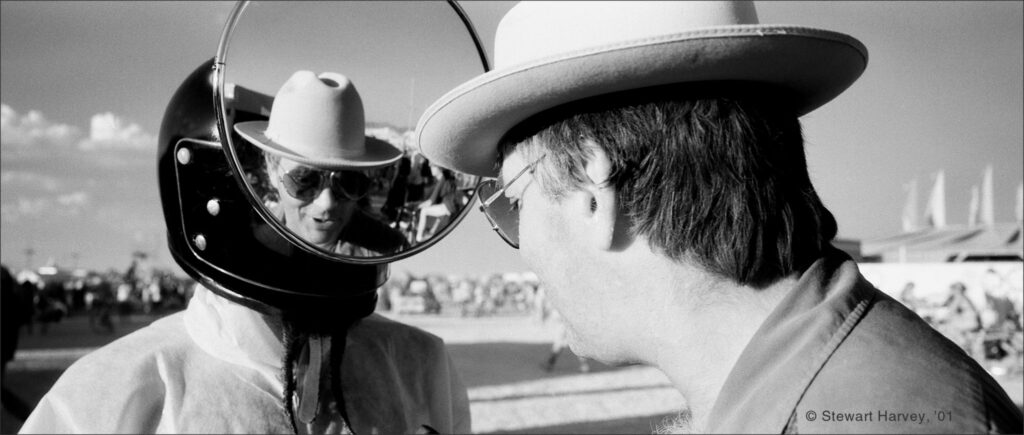
Selected Quotes
“Authentic culture is disappearing faster in this world than the tropical rain forests.”
“It seems to me that, given the problems we’re facing on every front—economical, environmental, political—what’s needed is a kind of ethical, cultural revolution.”
“I think the things that people seek can’t be purchased. The things that matter most in life have an unconditional value. You can’t buy them. You can’t buy a friend. You can’t buy a lover. You can buy the semblance of those things—and you’ll live to grieve over that.”
“All real communities grow out of a shared confrontation with survival. Communities are not produced by sentiment or mere goodwill. They grow out of a shared struggle. Our situation in the desert is an incubator for community.”
“If all of your self worth and esteem is invested in how much you consume, how many likes you get, or other quantifiable measures, the desire to simply possess things trumps our ability or capability to make moral connections with people around us.”
“I’ve learned never to expect people to be better than they are, but to always have faith that they can be more.”
“I don’t believe in supreme beings as religion does, but I think being is supreme—and that has become my spiritual attitude. I see creativity as a way to achieve a sense of intensified being, and therefore identity.”
“Community doesn’t mean that everyone’s kind, really, or that everyone has to love everybody else. But if you think that I’m just as real as you are, it’s possible to be charitable and decent and kind. And out of that can grow love, and out of that can grow trust.”
“At most festivals, there is social engineering that takes place—and it’s designed to increase consumption. The producers make their money by featuring headliners, targeting demographics, vending at scale, and through commercial sponsorships. We don’t do those things. What we’ve always done is form the context of society. And all of this is not in service of the bottom line, but is aimed at generating greater social interaction.”
“I’ve always discouraged people calling me a visionary, because that’s one step away from saying that you’re head’s in the clouds and you don’t really know what you’re doing; that you just spout ideas.”