
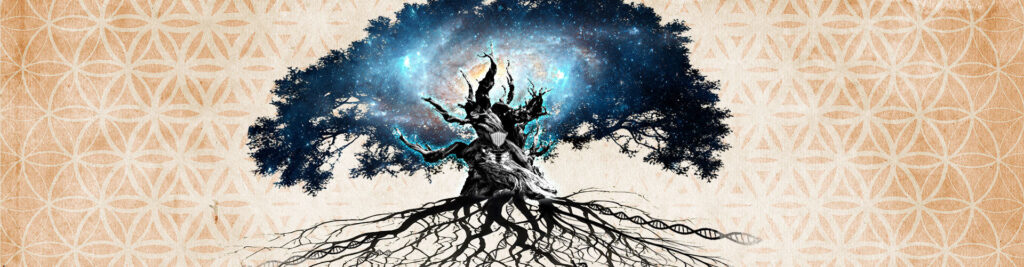
Burning Man 2026: Axis Mundi
“The World Tree rises at the center of the cosmos, its roots in the underworld, its branches in the heavens, its trunk in the middle world of men.”
— Mircea Eliade
In nearly every culture on Earth people have imagined a center point for their existence, a celestial column that connects us with powers greater than ourselves. To the Maya it was the Ceiba tree, to the Norse Ygdrassil, to the Celts the Crann Bethadh. The ancient Greeks called it the cosmic pillar, and the Slavs knew it as the Great Oak. Siddharta’s Bodhi tree, the sacred cottonwood of the Lakota, and the Iroku of the Yoruba can all be seen as manifestations of the same deeply rooted idea.
In some cultures this pathway between the worlds stands in a specific location, a sacred spot defined by myth and memory. In others it is wherever human intentions position it, like the totem poles of the Pacific northwest or the churinga pole of native Australian peoples, carried in nomad’s kit and erected at each camp along the way, to anchor the group to their history and cosmology. In his book The Sacred and the Profane, Mircea Eliade tells the story of one such group, who lost their churinga and collapsed in collective grief, unanchored from the cosmic tree and suddenly unmoored in the world.
The Burning Man can be seen as our version of the cosmic tree, a Jacob’s Ladder connecting us to the unseen and unknowable. It functions as the axis mundi of our far-flung world, around which we all spin at 1,000 miles an hour, clinging to each other to keep from flying off into space. Each summer it rises from the ancient lakebed of the Black Rock Desert, and throughout the year its sibling effigies are planted at regional gatherings around the world.
To say that intention creates reality is for the most part magical thinking, but social realities are indisputably brought to life through group imagining. Few would argue that intangibles like money and nation states are unreal or illusory. We make them real through belief. Likewise, our shared ethos gains substance in our collective actions and forms a social reality. As Larry Harvey wrote in the 10 Principles, “we make the world real through actions that open the heart.”
A human being is a part of the whole called by us universe, a part limited in time and space. He experiences himself, his thoughts and feelings as something separated from the rest, a kind of optical delusion of his consciousness. This delusion is a kind of prison for us, restricting us to our personal desires and to affection for a few persons nearest to us. Our task must be to free ourselves from this prison by widening our circle of compassion to embrace all living creatures and the whole of nature in its beauty.
—Albert Einstein
The world tree is also the tree of life, with every species on Earth related to every other species in the tangled bank of evolution’s roots and limbs. On one branch, countless genetic lines of homo sapiens all trace back through DNA to Mitochondrial Eve, the mother of us all. As special as we like to believe we are, we are but one branch of the great tree; to acknowledge this is not a rejection of humanism, or a denial of individual agency, but an admission of humility in the face of our undeniable interdependence.
And yet, through the magical constructs of social reality, we imagine ourselves as standing apart from the natural world, and increasingly apart from each other as well. Divided by borders, and further fragmented by custom and belief into tribelets of ideology, each suspicious and distrustful of the other. And further still, divided into content feeds in a social network, one human to a screen, connected only by dubious proxy.
If Burning Man can be said to have meaning in this fractured world, it is to remind us through our collective actions that we are not alone, that we are part of something larger. Every day, on every continent, people are coming together to experience forms of creativity, generosity, and togetherness that are our birthrights as members of the human family. For some, the simple act of living outdoors for a few days, immersed in the majesty and occasional perils of nature, is the path to reconnection with the natural world of which we are all a part.
When I look up in the universe, I know I’m small but I’m also big. I’m big because I’m connected to the universe, and the universe is connected to me.
—Neil Degrasse Tyson
Burning Man 2026 in Black Rock City and beyond will celebrate the interconnectedness of our global community, the new social realities we are creating together, and our enduring ties to the natural world. Creative interpretations of the cosmic tree of life will send their roots into our collective past, and spread their branches into a sky of possibility.
As always, art installations are welcome and encouraged in Black Rock City, whether embodying this year’s theme or not. To learn more about having your art placed at the event, consider these guidelines. Review the information about the 2026 Honoraria Art Grant program, which opens with a call for letters of intent on October 15, 2025.
Text by Stuart Mangrum, illustration by Tanner Boeger