

Insightful. World-Building. Spit-take inducing.
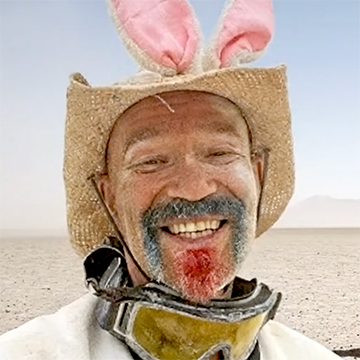
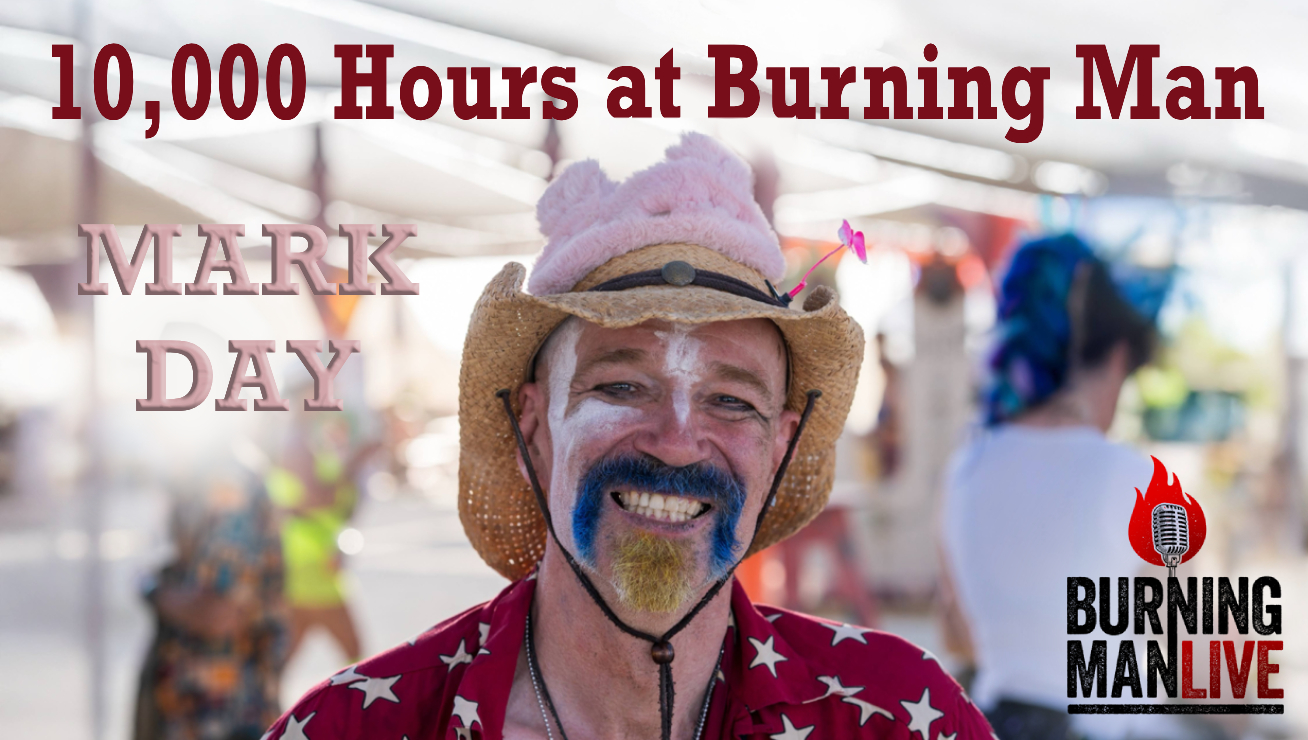
Mark Day’s videos serve as a digital gateway for many thousands of Burners, capturing that blurry edge where the default world ends and the playa begins.
From his early days building tripper trappers and doing stand up comedy, to his controversial tinkering with AI art (think Dalmatians made of donuts), Mark has put 10,000 hours into his “24 Hours at Burning Man” videos.
Andie Grace talks with this unique content creator to explore thresholds and multitudes. They discuss how to capture the moment and also experience it. They dive head first into the touchy subjects of consent, the ethics of documentation, and how “acculturation is an everybody thing.”
He shares his sociology of being a Greeter in BRC. He talks creative process. He brings clever curiosity to open-ended self-expression and the freedom to be your favorite version of yourself.
https://journal.burningman.org/author/mark-day
Transcript
MARK:
It’s that sense of play. Just going to Burning Man for so long, I have a very weird and interesting and funny experience at Burning Man, because you don’t have to be me to get to talk to a lot of strangers, but it certainly makes it weirder!
I get to be my favorite version of myself, because I can be playful in a space where that kind of improvisational lightness of touch is understood, and is part of the experience.”
ANDIE:
Welcome back to Burning Man LIVE from deep in the heart of the Philosophical Center of Burning Man Project. I’m your girl Andie Grace, Action Girl. I’ve spent the better part of two and a half decades in Black Rock City, and most of it in a place we call Media Mecca. Our job has always been a little bit of a balancing act, protecting the privacy of our citizens and their self-expression while helping storytellers capture this lightning in a bottle that is Black Rock City, if they’re going to tell the story of Burning Man.
For almost as long as I’ve been doing that, I’ve seen the work of our guests today, Mark Day. Mark is a long time Burning Man videographer, and this is the important part: he’s also been a Greeter.
Our technical producer, Michael Vav, was pointing out that the role of a Greeter is a lot like the role of a psychopomp. Now, if you’re not a mythology nerd, a psychopomp is a soul guide. They stand at the threshold of two worlds, and they usher people from one reality into the next. This is what Greeters do at the Gate. But I’d argue this is what videographers do with their lenses, too, and what Mark has been good at.
For so many years, his 24 Hours of Burning Man videos were the portal for people who’ve never set foot in the dust. And lately, he’s been using AI to layer a sort of dream logic over some of his footage, capturing the weird blurry edge, that 4am feeling where the physical world ends and the playa begins.
Today we’re going to talk to Mark about being a guide at the gates of both Black Rock City and the digital world, and how other people perceive that, and the role of AI in all of it… And he’s going to mansplain me the patriarchy, too, but it’s adorable and you’re going to love it!
Here’s Mark.
Mark Day, I’m here with you to have a nice conversation.
MARK:
Excellent.
ANDIE:
I’m a big fan of what you do.
MARK:
That’s nice to hear. I can never tell.
ANDIE:
I want to start with how you found your way to Burning Man.
MARK:
That is an awesome question and someday I will find out the answer. I first went to Burning Man in 1997.
ANDIE:
Class of ‘97!
MARK:
Class of ‘97!
So my desire to go was quite strong, but I don’t remember the specifics about what was the immediate catalyst.
I have a vague memory that I don’t think is made up of going to an art gallery, and there being a car full of bullet holes and a VCR and a TV sitting on top of it, showing clips of a drive-by shooting gallery type thing, which, to be perfectly honest, not having grown up in America is not the kind of thing that would make me run towards guns. That is just one of the things that I remember about that time.
ANDIE:
Were you already a videographer at that point?
MARK:
No. I mean, I’ve always wanted to make things, but also kind of came from a place… I don’t know if you can tell by the accent but I’m actually from Scotland.
ANDIE:
Oh, ya know!
MARK:
I also kind of came from a place where people like me didn’t really make things. So I’d always kind of made things, but not necessarily thought of myself as a person who made things, so much, which is all sort of moving towards my kind of metanarrative of:
Decided to bring a video camera next year
Made a video of our camp
In 1999 we went back with a… just some young kids and a dream! And our dream was to build a tunnel of light out of PVC pipe, and Christmas tree lights, and a generator about the size of a toaster oven. Somehow we were on the Esplanade and there was a line of people outside our camp.
ANDIE:
It was magical.
MARK:
Our camp was called Magic Glasses Camp, and we would give people these light diffracting glasses to walk through this, you know, short tunnel full of lights and come out the other end transmogrified by the power of…
It was a very basic early tripper trapper, is what I’m saying!
ANDIE:
Tripper Trapper
MARK:
Shout out to Christopher Schardt, I’m very impressed by your Mariposa, but, you know, PVC pipes and Christmas tree lights and all of that.
ANDIE:
And the glasses.
MARK:
And the glasses…
And the idea was just, okay, you kind of just build an experience that people walk through.
We had an amazing time, and had that sort of “it all just clicked” Burning Man experience of: We are not just a bunch of idiots who have driven this out to do a thing. We are a camp now, and we have a name, and that is our rationale, and that is what we identify as, and all of those things.
And yet at the same time, if somebody was standing next to us and turned around and said, “Are you the artists?” we would have looked at them like they were crazy. We’re not artists. Other people… We’re not artists. Don’t be silly.” I’ve kind of come round to the other side of that.
But, you know, at the time, that was just an experience in making things. And then I took the video home and then stuck it in the VCR one night. And of course, going to Burning Man has the perfect narrative arc. First you have to go to a large box warehouse store.
ANDIE:
Spend some money.
MARK:
Spend some money. Buy a bunch of stuff. Drive. Get there. Build a thing. Run around for a bit. There’s a Burn; go home. That was all there. So just…
My first video, there was no editing. It was just straight off the tape, and looking at it, and being like, wow, I have this little time capsule of a thing that we did with a beginning and a middle and an end. And ever since then, I’ve gone out of my way to make it as complicated as possible, with flashbacks and cut outs and side quests and all of those things.
This all predates YouTube. There was no real audience for it, per se. And then I’ve probably cycled through different ways of telling stories, or making videos, or visually compiling things together in different ways ever since then.
I came back the next year, by which point the thing was already out of control. By this point, I’m making funny little sketches and illustrations, and filming them as part of the story.
And then our friend at the time said to me… I’d go like “I’ve made this video, we should watch this video now,” and then him going, “Actually, I would like to remember it as I remember it, not how you remember it,” Which was a fair point I wasn’t ready to hear at the time.
At the risk of being very self absorbed by my own creative process, but I like talking about creative process….
ANDIE:
That’s what I came to ask you about.
MARK:
Yeah, yeah, yeah. There’s a very clear line for me through to, oh, I don’t have a scene of this guy Glenn doing a thing. I’m going to draw it in pen, and film it as if it happened.
Another pivotal moment for me creatively was, I think, just being at Burning Man 1999. My wife had wandered off somewhere, there was another guy, Curtis, sitting there, and I was like, “Curtis…” I can’t even remember: had he put on her hat, or had I told him to, and then interviewed him as if he was her. And immediately I went to, oh, the fun of filmmaking is: Here is the canvas. You don’t have to represent things as they are. You can have fun with it. You can play around with it. You can view it as a baseline reality that you can add to, as much as you are taking away from. So, yeah.
ANDIE:
It sounds like you came to see that form of expression as art.
MARK:
Yes. The building the tunnel thing, it would be a while before we would have accepted that that was anything other than, we were just building a fun rave tunnel.
ANDIE:
More craft than art, perhaps.
MARK:
Um. Let’s be careful! I would like to say now, Andie Grace, if we have time, I will mansplain the patriarchy to you.
ANDIE:
I can’t wait.
MARK:
But for now, let’s always remember that craft and art are the same thing.
ANDIE:
Thank you.
MARK:
And we cannot use the word craft to corral off… whether it’s quilting or forms of self-expression, that one might view as gendered.
Do I pass? Do I get a pat on the head?
ANDIE:
Hell yes.
MARK:
Am I a woke middle-aged man horrified by his previous behavior?
ANDIE:
No, I completely agree with you on that front. And even I have come to think that the acts of service in creating experience out there, those are just as much art whether it’s visual, whether it’s experiential, interactive, theme camps.
MARK:
One project that I did, there was a media project talking about the Regionals and the Regional Network. I just distinctly remember some guy, somebody was talking to him about making art, and he was like, “I am not an artist. I’m a computer programmer who made a thing.” And there was just a second where his voice caught for a second, and I was just like, wow, that’s a moment. That’s a moment in time that I was glad to be able to see. And that, to me, is a big part of the magic of Burning Man acculturation.
One of the nice things I have discovered is that some of the storytelling that I have done, which is very self centered and very silly, is also, for some people, part of their Burning Man acculturation process. And that’s nice.
One of my favorite things at Burning Man is literally anybody recognizing me and wanting me to do stupid catchphrases. I will do it to the point that they’re walking away. There are a lot of people with stories that go, “I saw Mark Day at Burning Man, went to talk to him, and then had to back off 20 minutes later when he wouldn’t shut up!”
ANDIE:
Verbosity.
MARK:
Someone’s like, “There’s someone I want you to meet.” And I’m like, “Oh, go ahead! Who is it?” And they’re like, “This is my dad. I wanted to bring my dad to Burning Man. He didn’t think it was for him. I sat him down and made him look at a bunch of stuff, including your videos, and that got him over the line.” If I did that for anybody, that is… job done. And every stupid thing I’ve done to annoy everybody else fades into nothingness as compared to that.
ANDIE:
Is that often the “24 Hours of Burning Man” video?
MARK:
Yeah. Yeah.
Basically, I made videos and was showing them to friends…in the early days of the internet maybe there was a website somewhere with a bit of information about not making too many major life decisions immediately after Burning Man. But relative to what there is today, there wasn’t like, you know…
ANDIE:
There was no history for that.
MARK:
And there’s a lot more of that today.
We actually took a few years off, and I know in my heart of hearts that for some people that’s hard because I found it hard. We had kids, and I sort of went back as I just like, I’m just gonna… “Just a tiny taste, I promise that will be enough. I promise.”
And when I look back at the footage of that, I realize I’m kind of hiding behind the camera, which honestly, a lot of people with cameras are people hiding behind cameras.
ANDIE:
I’ve worked with a lot of photographers and videographers. I can’t disagree with you there. It’s not an insult. It’s just an observation.
MARK:
No, no, no. In that time, YouTube had become a thing. I had content to put on YouTube. I was going to the BrainWash in San Francisco.
ANDIE:
I used to work there!
MARK:
Well, there you go. Stand up comedy open mic at a launderette in South of Market, where you could wait behind 40 other people for two minutes of ranting.
ANDIE:
So funny.
MARK:
Or I could stay home and just record it and stick it on the internet, and “What? Wait? 5000 people saw that? Why am I taking the bus all the way to the open mic launderette?” So I was making online video…
ANDIE:
You’re making kind of comedy.
MARK:
I was doing the same thing everybody else was doing, as we were all just figuring out what to do.
Philosophically, people at YouTube would say it was the democratization of media to some degree. And for a period of time, anybody with minimal… limited… access to a video camera and limited inhibitions were just making weird shit and throwing it on YouTube. It was kind of like the Wild West. And it’s a lot more of a, much like Burning Man, it’s a lot more of a codified experience now than it was then. But it was like a desert landscape where you could put up your own little – um – camp of ideas and play around and imitate what other people were doing, and so on.
By 2012, we had a second kid at home, and…and I really wanted to go to Burning Man, still, despite the fact that a responsible adult should have been, you know… I am not the hero of this story, is what I’m saying. My wife is the hero of this story.
I, by that point, was working at YouTube. I was on their curation team, staring at the live feed of Burning Man that was already happening, Tuesday or whatever, of 2012. And I’m looking at the live feed, which is just like a fixed camera of somebody walking from the Temple to wherever. I’m just staring at that.
And this guy says to me, “Mark, what are you doing?”
And I’m like, “I have such a sense memory of what it feels like to do what that person is doing, to just walk from point A to point B in this place that’s like no other place, that just looking at that is almost like being there.”
And he said to me, “Interesting, because to me it looks like you’re torturing yourself.”
And I was like, “You’re absolutely correct.”
And then I had to decide, okay, I could be there this time tomorrow if I had a ticket. And I’m not supposed to be going. How do I make all of these things work together?
So I got home, and I said to my wife, “I’m thinking of going, I don’t really have a ticket, but if I seem a little bit pouty, it’s because that’s what’s on my mind.”
And she sort of went, “If you want to go, just go,” not “Woo hoo! High five. You do you, Mark. You need this. You should go for you!” I think it was more of a sort of resigned sigh.
ANDIE:
Sure.
MARK:
You know, Craigslist 2012, somebody selling a Burning Man ticket; it’s a whole thing!
ANDIE:
Yes.
MARK:
And somehow I got the ticket, and on the way there, I decided – try and leave 24 hours after you got there, because now it’s not a day trip, it’s a project. What was really going on was, it was to prevent me from staying on too late, driving home in the dark. I have done this thing where you’re driving a rental truck and a fucking cow comes over the, you know.
ANDIE:
Suicidal rabbits and cows.
MARK:
Right. And driving home in the dark in an exhausted state. I just wanted to make sure I didn’t do that. So I told myself if I left after 24 hours, that was the smart thing to do. And that is why my videos are called 24 Hours at Burning Man!
Acculturation!
ANDIE:
I want to talk about acculturation in the context of consent and filming, and your observations about that evolution.
MARK:
The first thing I want to say is, any answer I have will be very unsatisfactory to a significant number of Burners, and for that, I apologize.
ANDIE:
I’m here for it.
MARK:
If your goal is absolute consent at Burning Man for all documentation, I kind of plead the fifth.
In respect to all things in life ever, the one thing that has been a game changer for my life, and this is very true about creativity, it’s very true about making things in the age of AI, it’s really straightforward, and it is that:
Two things can be true at the same time.
ANDIE:
You can hold two ideas at the same time.
MARK:
And it’s annoying because, there is a part of me, and it’s a part of me that I don’t like, but it is a part of me, that enjoys nothing more, in an online conversation, than telling somebody that they are wrong using their own words.
ANDIE:
I think that’s half the traffic on the internet!
MARK:
There is nothing more delicious than the empty calories of explaining to someone their own hypocrisy!
ANDIE:
Heard.
MARK:
However, an interaction on Facebook:
I took this picture of people getting married from like, they were on an art thing, a vantage point, years ago.
One person: I would like to track them down.
One person: Oh my God, that is our friend who has since passed. Please send me that picture. One other person: Did you get permission before taking that picture!?!
Now both of these things can be true.
ANDIE:
And yet which one is more cogent and more poignant?
MARK:
And these are challenging waters for us all to navigate. They are situational moments. I would say that your expectation of total privacy at Burning Man is situational. If you are in Center Camp, that is different to a polyamorous basket weaving workshop off a thing taped to the back of a door on the porta potties (God, we have a lot of workshops.) and it explicitly said “no cameras,” and, you know, “must be comfortable with nudity.”
We’re all learning to navigate the world as it is, not the world as we would like it to be.
I’ve been to see comedians where they ziploc your phone and threw it in a bag, and all of that.
Is that scalable to Black Rock City? No?
ANDIE:
I don’t think so.
MARK:
Is it situationally possible? 100%.
Do you want to be the change that you want to see and create spaces within Black Rock City that are camera free? Then I absolutely encourage you to do that.
I am not a social anthropologist, but that I were – I’m interested in things like in-group and out-group language, and the idea of in-groups need out-groups to measure themselves against.
ANDIE:
Define the boundaries.
MARK:
Burning Man in 2012, the census data would suggest that the vast majority of people, including the people who trashed the porta potties at the end of your block, have been here all week.
On social media, mysterious weekender fairies arrive and trash everything. Now, that is not to say that under-acculturated people may not just make a weekend of it. Obviously there are people who are simply behaving as they would in any normal space, and who may not see this as a different space.
An interesting thing that goes on in the kind of Burning Man conversational meta-space of social media or whatever you know is…
And again, I’m off on a tangent.
ANDIE:
I love a tangent.
MARK:
The people most drawn to policing the boundaries of in-group and out-group might not be the people that are best equipped to police those boundaries. Some of the people who may wish to police those boundaries from a genuine sense of preserving things that are important to them, may also be sometimes sanctimonious tools. Sometimes not all, not all! Some.
The consent thing, let me try and address that. I think where you are in Burning Man matters in terms of what your level of expected privacy is. I’ve seen discussions online where people have said, my friend wants to go but can’t risk going because they don’t want anyone at work to….
ANDIE:
Job or custody…
MARK:
And I’m like, well, that’s never going to be a 100% safeguard against it. That’s not a binary thing. That’s not to say that, so we should just have open doors. I think cultural norms are important. I think we are seeing valuable corrections in that. We are also seeing overreach., and all of these things are happening at once. And they’re in messy conversations with each other, because there are often on the internet where nobody’s changing anybody’s mind.
Photographers who come through Media Mecca, I think, have a good sense of what those expectations are.
ANDIE:
So, a performer is up on stage. You’re not going to interrupt to ask them permission. You know, you can’t get permission from everybody in a group shot.
MARK:
I have mixed feelings about photobombing influencers. I may have done a tiny little funny little running around somebody trying to make some shots myself for my own video.
One thing I do believe, and this goes back to the whole thing about somebody asking me in 1999 if we were the artists and me rolling my eyes. You have no idea where anybody is on their own journey of creativity. I see a lot of Instagram content about Burning Man. And yes, sometimes just by looking at it can be like, “Did you go anywhere other than Mayan Warrior?”
Too many tangents, but they all kind of come back to this idea of creativity for me. I make a lot of things with AI. I have displeased some members of the Burning Man community online through doing that, and I try to be as thoughtful as I can about their feelings, sometimes. I understand the anxiety.
I am not a trained video editor. I’m mostly self-taught. But let’s see for a minute that I had learned the right way. Today you can open your phone and stick five things from your camera roll into a video, and it will make algorhythmic but somewhat intelligent choices as to how to make a video from that.
I am as happy for the person who now has a thing that helps them tell their story, as I am feeling like I’ve lost something because I learned over a long period of time a skill that now technology can do.
That doesn’t mean to say that you would have got the same video out of me that you would have got out of your social media app. But I think that, again, these things can be true, that you can be anxious about the loss of your skills and, hopefully at the same time, able to — and this is the thing I’m trying not to say, because I’m sure it will infuriate people — recognize self-expression in as many forms as you are capable of accommodating, which may not be complete.
And if your idea of self-expression is murdering of people, I am not for that! But beyond that, it’s a little bit like your support for free speech is not your support for the free speech you agree with; it’s your willingness to accommodate the free speech that you won’t agree with. Your belief in self-expression can have limits, and you can decide where to draw the line for yourself. And you could, for example, talk about the paradox of…
ANDIE:
intolerance
Intolerance. And you maybe feel like, you know, you have to draw a line somewhere. To the same extent I do not approve of people murdering each other, I am not a self-expression absolutist. But I am, I hope, able to see self-expression in people who may not even yet think of themselves as self-expressing. And that is a very generous policy. And it certainly includes people who may go no further than ‘give me five things off my camera roll…’
A lot of people might say to me, “Mark, I really don’t like the AI thing, but you seem to be doing something interesting with it.” And I will say “Thank you!” I would also say that if somebody wants to see a Dalmatian made of bananas or donuts or whatever, and typing that in and seeing it brings them joy, I don’t really have a problem with that.
Yes, for a lot of people, that might be as far as it goes, but you just don’t know somebody for whom that is a stepping stone to something else.
ANDIE:
I’ve heard you use the term ‘permission engine’ to describe Burning Man, and this feels kind of like the same thing.
MARK:
One of the other things that I really enjoy about Burning Man is working at the Greeter Station. Shout out to this guy Steve, who encouraged me to do it for several years. And I was always a little bit like, “I’ve signed up for four hours. What if it’s boring after one? What am I going to do?”
ANDIE:
I’m stuck there.
MARK:
Right!
I did it. And it was awesome. I do two back to back because I can’t drag myself away after the first four hours.
Sunday morning, the gates are open and every car is a sociology project. And I should preface this by saying I fully understand the exasperation of people who have been to Burning Man alone. And I get it. You just want to get through. If it’s my lane, and things are looking backed up, I will absolutely say, “Do you just want the booklet? Go with my blessing!” I also think that it can be if you want, like a shift. This year I actually took my consent monkey stick because I’m quite a big believer in drawing a line in the sand. It’s the dust, but I’m a big believer in drawing a line and asking people to think about crossing over. Now, that’s not the Instagram moment, that’s not making Dust Angels, and…
ANDIE:
It’s just a step.
MARK:
People want that experience. And one of the interesting things about being at the Greeter Station, you got a carload of people and you’re like, “Whose idea was this?” And suddenly you’ve got one person who has nagged their friends to go to Burning Man, or wants them to have this experience really badly. And that’s fun because you’re like, “Well, savor this moment because nothing has gone wrong, yet.”
There’s so much going on at that moment. There are people who don’t know what to expect. There are people who have waited a long time. There are people who just want to get inside.
And I’m just a big believer in drawing a line in the, in the dust, and being a guy from Scotland this sounds ridiculous and is exactly not the person I ever imagined myself becoming. I am the guy at the Greeter Station going, “I don’t know if you’re a setting intentions person, but if you want to set an intention, now would be the time to do it.” That’s what I’m doing. I find usually by the time I’m done, the people on either side are doing it as well.
There’s a guy, Aaron. (Hi, Aaron), a photographer from Hawaii who I’ve been doing it with last year, and he was like, “I didn’t realize at the time what you were doing, like the Zone Trip thing.” And I was like, “This has a past.” And I think it gets’ lost…
The thing that I would say to anybody thinking of doing the Greeter Station, if you care about a culture nation, if there is a place where you can be part of the acculturation process.
ANDIE:
A perfect spot.
MARK:
It is not, in my opinion, a place to grill people about the Principles. Or give them pop quizzes about porta potty etiquette or stuff like that. We can contain multitudes. You can do that and invite people into a transformative experience. It’s hard to hold space for both at the same time. I said, “hold space,” who have I become?
ANDIE:
Holding space!
MARK:
I really try at the Greater Station to meet people where they are. You know, the window in the car rolls down, and you look in, and a couple of years ago I looked in, and I just looked at someone and went, “Are you okay?” And this woman burst into tears. And I don’t mean this as a gendered thing at all, but it was just she was really stressed.
ANDIE:
Sometimes they’ve been driving for 24 hours or…
MARK:
But. I think this was not just exhaustion. It was the sense of, I don’t know what’s in there, and I’m scared. And being able to lower the temperature as much as bring it up, and not just be like, “Whoa, you’re a Burning Man, give them a hug!” is to me, part of what the greeting can be.
Sometimes there’s no time for this, but, you know, if you figured out who’s in that vehicle… I like to deputize people and make them the Greeter for their own car, and say to them, “Is there anything you want to tell your friends now?” And sometimes I cringe when it’s like, “Say yes to everything!” And I’m like, “You do not have to say yes to everything.” And sometimes it can be really beautiful, and sometimes it’s a parent saying to their kid or the kid saying to the parent, “I love you.” You can create that moment at Burning Man just by being the first point of contact.
And I know it’s easy to laugh at the Greeters for being all like, you know, tutus and glittery and silly and, you know, but it can be a moment to be like, okay, you’re going to cross a line and some things will be different there. And I always say, “if you want them to be, and are willing to put in the work to make it happen.” They aren’t just gonna happen.
Both these things can be true. You really want to get in, and you don’t want to have to deal with those fucking Greeters, but you also want people to be better acculturated to the Burning Man experience. Then let the Greeters acculturate.
ANDIE:
And frankly, if you’ve been doing it for a while, you might also need that moment to remember that you should also reset.
MARK:
Exactly. And honestly, there are people who like, you’re like, “Do you want a hug?” and they’re like, “Fuck yeah!”
Have I dodged ‘round the consent thing?
ANDIE:
No, that’s actually exactly what I wanted to get into about that, and that membrane between the outside world where consent with cameras specifically, but also a lot of interactions, is very different. And it’s hard to hold the line of permission for photography. But there’s something bigger there.
MARK:
I mentioned this earlier, but like, you can’t acculturate the people in the places you would like to acculturate them. You have to acculturate them in the places they are.
ANDIE:
Where they live. Yep.
MARK:
Are we willing to accept that people have different learning styles? We have to teach people in the styles that they are most likely to learn from. And some of those styles may not be our preferred methods of talking about ourselves or showing up or whatever.
ANDIE:
Right.
MARK:
And certainly social media is a place that people’s expectations of what the Burning Man organization should be doing in that zone evolves over time. We have to be pragmatic about what that looks like, or you just cede ground to all of the influencers that you’re also worried about.
ANDIE:
You do things that merge real footage and AI, and you talked about Dalmatians made out of donuts, or what have you, but how much fidelity with collective memory do you think is owed?
MARK:
That is a fair question. My relatively self-serving answer would be: There are a ton of easily accessible stories at this point, online. When I was making my first few 24 Hours at Burning Man videos I consciously and unconsciously may package things in ways that I think will do well in the places that they show up.
ANDIE:
Why would you bother, if not? Right.
MARK:
Algorithms optimize for certain things.
ANDIE:
But the algorithm is neutral. It does what it does.
MARK:
Well, it does what it does, and it will surface things for a variety of reasons. So my life has become this thing where I go to Burning Man, I document the experience, and now I’m going to try and assemble it in a way that has things in it that are like little memes and tropes for my own amusement. But I want things that represent artists. Talking about, you just don’t know where anybody is on their kind of creative journey: It took me many years before I ever made a video where I just thought to point it at somebody I didn’t know and go, “Tell me about this.”
But in terms of should you represent the event as you experienced it, not as you wanted it to be? Everybody’s Burning Man is different. There are a lot of commonalities, but you could absolutely go to Burning Man and experience it in a way that the Venn diagram has no overlap.
ANDIE:
Sure. That person ten feet from you is having a completely different time.
MARK:
As Burners we overindex on social media to explain to you that there’s one packing list; there’s one way to load a truck…
ANDIE:
Your rebar has to be… Yeah.
MARK:
Right. And that’s both good in some ways, because those people do move the ball forward, but also sometimes lose sight of that, you know, the way in which we all… It’s a fucking city, not a camp.
ANDIE:
Right.
MARK:
And now people who would come back to camp and go, “I think I saw some ‘weekenders’ doing an ‘influencer’ by the ‘trash fence!’ Did I say all the right words?”
ANDIE:
Am I a Burner yet?
MARK:
Am I in the tribe because I said the right things?
You know, somebody will go on Reddit or Facebook and go “Going for the first time: Should I go with a camp or camp solo?” You will get very impassioned, absolute, ride-or-die opinions that there is only one answer to that!
ANDIE:
Right.
MARK:
Perhaps those of us tasked with stewarding culture through the world that we live in, not the world that we wished we lived in, maybe recognizing that for a generation of people who are a different generation (Boomers, or Gen X, even), um…
ANDIE:
Guilty.
MARK:
How do you accommodate that? How do you make that work?
This is one of my hot takes! Your mileage may vary. I think the international superstar DJ ship has sailed. It is more in line with the experience that we are hoping to co-create that you do not release your DJ lineup.
We now have this phenomenon of the sunset session. And for those of you who are unfamiliar with the sunset session…
Firstly, don’t be in camp eating meals at sunset! For the love of… This is the hill I will die on! If someone in your camp wants to play mom, or dad or whatever, and really likes having a meal plan, and really likes having everyone back in camp at sunset. That way you don’t have to take a watch because everybody will know that it’s sunset; we should all come back and stare at the back of someone’s RV and eat vegetarian chili… That’s like sitting through a movie, and then you’re at like, the third act, and it’s getting really good, and someone’s like, “We should go outside and get popcorn now; there won’t be a line.”
What I’m saying is, get the fuck out of camp!
What I’m saying is, stay in camp. I don’t care!
You know, I’ve already said you can have different experiences, and then I’ve turned into this zealot for being out of camp at sunset.
However, it is evidence-ually true that there is nothing more beautiful than the playa just after sunset. Mark, what about after sunrise? No, because after sunrise it’s full of cracked out looking people.
ANDIE:
Yeah. They’re all just realizing that the evil day star has returned, and they’re cringing. Yes.
MARK:
I do not sleep well at Burning Man if I’m honest. I’m not a big daytime napper.
ANDIE:
I don’t know anybody who sleeps very well out there.
MARK:
Initially I was like, oh, this is cool. You can experience the incredible objective experience of the things that the Mayan Warrior has created. It’s like a fucking Formula One racecar that has been tuned for one very specific race course; or Robot Heart and what Robot Heart represents. This is nice that this gives people access to this without having to schlep all the way out to the Trash Fence or whatever.
I was out cycling with a guy and we just hit a piece of playa that was covered in cigarette butts because apparently cigarettes are having a renaissance. And after a while we were, oh, this must have been where one of the sunset sessions took place last night, because you have a big crowd of some non-acculturated people. Well, that set’s over… getting on the mic and asking people to pick up trash is the stable door, the horse, all the things, gone, gone, gone, gone on e-bikes, on those funny Tulum hats, to go and get ready for the next thing.
Some of the onus of acculturation has to be placed at the feet of the people who are bringing the least acculturated people with them. And frankly, I do not see it happening in any meaningful way, any meaningful way. And if you have the resources and you have, ah, platforms with an audience…
This is not specifically about Robot Heart.
ANDIE:
Yeah, this is not a call out.
MARK:
I’ve spoken to people who say that what Robot Heart has done at The Loom in Oakland shows them really kind of getting what Burning Man is about.
ANDIE:
Oh, it’s been beautiful. It’s amazing.
MARK:
So, just as an easily understood example.
Long Feng art car, I hear the sound system on it is amazing. It’s certainly visually spectacular. I was looking at their social media after Burning Man, and they were talking, as they should, about what a wonderful community they’re creating. I don’t question that. But what I would like to do is see that in the weeks running up to Burning Man, they were saying:
If you’re coming to Burning Man
Here are some things you should know
Here are some things we are asking of you
Here are some ways in which you can keep this thing going.
I probably could have emailed some of the people at some of these things, and I probably still should, but I think that I would love to see more acculturation coming from that side of Burning Man, because I don’t think you can put it back in the box. It is a thing. It is part of the experience. It’s part of how people learn about the thing, just in the way that me seeing a car full of bullet holes in a gallery was a way into it.
ANDIE:
Or people seeing your videos.
MARK:
Yes, or people seeing my videos which are awesome, and I feel I should plug them more… Ahh.
That’s a very pragmatist approach of somebody who kind of will take Burning Man in the format it currently exists in, and has a hard time imagining that it would become so unpalatable that I wouldn’t. I think the magic is there.
You know, one of my favorite moments was being at the Greeter Station this year, and there was a crowd of people, and this young woman is just kind of holding back from her friends. She was just looking at them and going, “I don’t want to do that.” And I’m like, “Nor should you. But what I would like to do for you, if you’re okay, is draw you a line and talk to you about crossing it.” And she came up and she’s like, “Thank you for doing that.”
I was talking to my buddy Mike this morning and he was talking about his first Burning Man experience. He was the kind of guy who went because he knew a person who had gone, and fell into it and has learned a lot of good things from it, and it has been a life changing experience. And he’s like, “At the end somebody said, ‘And now your job is to do the same for someone else.’” That is still possible. That is still possible, as is this notion of helping people see themselves as creative and as artists.
Should I preserve the fidelity of the event as I experienced it? I’ve always just viewed it as a canvas to be drawn on. It’s that sense of play.
And when people say to me, “What do you get out of it?” I always say, I get to be my favorite version of myself. And then they say “Why?” And I go, “because I can be playful in a space where that kind of improvisational lightness of touch is understood, and is part of the experience.”
At the same time I’m learning, just going to Burning Man for so long. I have a very weird and interesting and funny experience at Burning Man, because you don’t have to be me to get to talk to a lot of strangers, but it certainly makes it weirder, especially when people are like “We were watching you last night while we were packing,” and I’m like, “Well, wait a minute. First off, I would like your full attention. I’m not background TV while you’re packing. I appreciate that. I would like both views.”
But also like, I don’t know what you’re learning about going to Burning Man from my videos because my tent’s a disaster. I put it in because it’s a disaster every year. Somehow a tiny neurodiverse part of my brain thinks that it’s funnier to just show people it’s a disaster than it would be to tidy it up.
Where was I going with this?
ANDIE:
Fidelity between reality and…
MARK:
One of the other points I wanted to make is:
When I talk to people who are coming to Burning Man now, and this is where I think acculturation is, again, important is: For every one person who’s come because DJs, or that, I find there are a lot of people who have come because they want to have the experience of going to Burning Man, because they have gone through a breakup, or because they want to push themselves. What I’m saying is that for every slightly overexcited person who wants to know where Mayan Warrior will be parked, there’s somebody who has come with a fuck ton of intentionality. And creating space for that, I think, is important. Again, just from the Greeter Station and being like “You could set an intention now.”
Of course cameras change things, and for some people, in a way where that becomes a dimension of how you interact with the thing. You know, I do respect the idea of policing, but not over zealously policing people’s memories in the Temple, for example.
Consent is an interesting topic to talk about for people who document, because what we do has become conflagrated, and I am not suggesting for a minute that they are not part of the same spectrum, but it is a spectrum that at one end is not at all pleasant. And there are certainly, I don’t even want to say bad actors with cameras, but there are people for whom a camera equals an aesthetic. I wouldn’t say that it was primarily the output of male gaze or anything like that. There is that, baked into photography, and there’s no getting around that.
I guess the point…
As I mentioned earlier, if I could for a moment just mansplain the patriarchy. I’ve learned some shocking things that I would like to explain to ladies in short words, because I don’t want to…
ANDIE:
Do tell. Do tell.
MARK:
In explaining this story to women who, thankfully for me, have been socialized to put up with men taking up too much space. If you see it, it’s like you can then keep doing it. It’s amazing. Um. I’m so self-aware! Um.
When I’ve talked to other people about that, as often as not, there will be a woman who has gone to Burning Man who will have some sort of nod of recognition about just having to just ignore someone’s… I’m not limiting it to mis-managed neurodivergence. There are bad actors, and there are people who the community should be keeping out, and all of that. But even with no ill intent, there are people for whom every day is “Talk like a Pirate Day.”
And if you’re going to a place where you are living in odd, cramped circumstances with people you don’t even necessarily know, and some of you are altered, and you’re not altered on the same schedule, and some of you are coming in, and some of you are going out at the same time, and all of that is going on, make sure that you’re not excusing behavior that creates a semi-hostile environment.
And I’m not trying to wrap Burning Man in bubble wrap, but the point I got to with this was, I’m still at the start of my being able to recognize not excusing people’s behavior because ‘that’s just them being them.’
ANDIE:
Yeah.
MARK:
And that’s a hard one.
Acculturation may also include recognizing that the world has changed quite a lot in all of these years. And we can go through MeToo, for example, and then, you know, not recognize that it is possible to unintentionally create spaces where some people may just feel a little uncomfortable. And that’s not about, “Oh my God, you can’t say anything anymore!”
ANDIE:
Right. Right.
MARK:
And I think that kind of gets back to:
Can you create a camera free zone? Absolutely. And you should.
Can you create spaces which are more inclusive of other people? Perhaps.
But I think it starts at camp, and I think it starts with that being the space that should be, on some level, the safest space you are in for the whole week should be your own camp. That seems like a reasonable thing.
ANDIE:
Yep.
MARK:
Where I’ve jokingly-not-jokingly said to people, the problem with consent education at Burning Man is it’s too sex positive, is that it isn’t a numbers game and it isn’t, “Hey look, I asked 17 people before I finally got a hug from a topless lady.” You don’t get a cookie for that and a badge.
Consent education also involves for every person who can chant back “It’s not just consent, it’s enthusiastic consent.” It’s also reading the room.
ANDIE:
Self-awareness.
MARK:
Self-awareness. And that’s as much true for documentation as it is for how much you do or do not talk about how cool someone’s glittery boobs look in camp.
ANDIE:
Yeah.
MARK:
You know?
And maybe you feel somebody in camp has more “cute guy privilege” than you and gets to say these things that you don’t, and that sucks, perhaps. That’s like a different conversation. But at the end of the day, we all have areas we can work on in acculturation, whether it is consent, bringing in new people, or even just taking a minute to think about how we treat each other, how we talk to each other, how we as idiots gather together at sunset for meals. I mean, it opens the playa up for the rest of us who know better, but it’s, you know. Yeah.
So there you go. My grand unified theory of something is:
Acculturation is an everybody thing.
We are all on our learning journeys.
I don’t necessarily want to get into the whole ‘creating things with AI’ thing around the philosophy of, “But what about the training data?” My copout answer is: I’ve been making YouTube videos for years. I’m in the training data, I’m just taking some back for me!
ANDIE:
There you go.
MARK:
I’m just… a lot of disclaimers, but I do also understand how deeply discombobulating some of this is for people. But at the same time, it has really forced me to interrogate whether or not I even have a creative process. It turns out I do.
Going from being a person who documents things to really kind of making things that are just about my ideas, can I extrapolate the ideas out to be their own thing? Is that… in making things… things show up. This is not an original thought. This is like, get your copy of ‘The Artist’s Way’ out that you bought at Goodwill once. And when I sit down and make something, I may have an idea in my head. And I now have the tools to visualize that very quickly. So I don’t have to make a storyboard and then make an animatic. I can go straight to the animation. And then when I lay out the animation, I will very quickly think, oh, what would be good? I have a framework!
ANDIE:
A Dalmatian made out of donuts.
MARK:
Right. And I can now add to it. And the real ideas are what happens once I’ve made the foundation. The real ideas can’t show up if I don’t make the foundation, I mean they do. It’s shower thoughts and taking the dog for a walk and thinking, “Oh!”
I would say that a lot of people in the creative industries are very focused now on friction, as the one way to make things. It’s like “Friction’s important because that’s how you learn.” Blue-sky brainstorming is another way, and both of these things are valid. Just what if …what if this, what if that, and what if has never been closer. You are now so close to what if, even if what if it’s just, “I want to make a Dalmatian made of donuts.”
And eventually, after you make so many Dalmatians made of donuts… I mean, the real metaphor I give for this is, I was talking to somebody who’s an art director who was very much about “What happens to us as creative people in this new world?” And I was like, well, I don’t know, but I think our ability to have creative direction – tastes, we are tastemakers I guess – we are people with, you know, aesthetic opinions that are refined over time. But also play is important. And I was kind of saying to her, you know, “Your daughter likes sea turtles, so then make sea turtles, make big sea turtles, make small sea turtles, make sea turtles out of diamonds.” I’m talking about in generative AI. “Make sea turtles out of old plastic bottles and make a point about pollution, and eventually you will either tire of it, or never leave the lane of making sea turtles, or perhaps an idea will show up that wouldn’t have showed up if you hadn’t been just having this practice of making this thing.”
So if you can make something by the simplest means and look at it and go, I can make things, I am an artist, then you can think bigger, or you can go back to that place, or you can use that as a launchpad for something else.
To be perfectly honest, the dark secret to my content is that I just ended up making a lot of things about and around Burning Man. It’s not hard to make Burning Man interesting, and that’s that. The foundation is already there. I’m just building a slightly smaller foundation on top of it, and then I’m piling ideas on top of that.
And I’m in conversation with a community that I understand. And by making jokes, I create a sense of recognition in the person who’s like, “Oh, I don’t like AI things, but this guy made an AI action figure of the camp spreadsheet mom. And that’s you! And I’m sending you it!”
So, that’s where the fidelity and then the truth of the work, Andie – It’s the truth of the work! – but also in the just the making. Whether or not you choose to do that in AI, and I wouldn’t say it’s for everybody, the practice of making things and trusting that process that something will show up.
Once I can get the ideas out of my head and see them and play with them like clay, it’s like sculpting something with clay.
And I think one of the things that helps for me is even though I’m not a trained video editor, I understand the basics. I understand these days making things about a subject that you are passionate about, I know all those little tricks, but there’s also just the practice of “What if?”
There was a sweet spot where I was like, if I can have an idea and I can make it in an afternoon, I should just do it. And now the ideas come in so thick and fast,
ANDIE:
Right.
MARK:
And the technology has got that much better that the time and the scope gets larger, but it’s an interesting journey in terms of just making things.
I do think there is something in being able to see what you are capable of, even if it’s via shortcuts, because as a person who has wrestled through my entire life with ADHD, the worst projects are the projects that blossomed in your mind and nowhere else. That’s the real friction for me. Ideas that show up in my head and never leave my head, or I’m not a ‘read the manual’ guy, so I kind of want to do something, but not at the cost of learning how to do a tool.
For me, it’s an unlock. It’s the ability to get straight to the idea, and then build on the idea. So there is absolutely a place for make something and get away from it and come back, but fast iteration of ideas is like a warm up. My philosophy on creativity is just make stuff.
Have you read Rick Rubin’s book on creativity?
ANDIE:
I haven’t read it, but I want to.
MARK:
Basically, it’s like Rick Rubin by the foot. It’s like The Artist’s Way read gently by Rick Rubin.
ANDIE:
I love it!
MARK:
He talks about things like “the audience comes last.” And I think as somebody who makes things that are inherently comedic, it’s like, the audience has to be in there somewhere. I do do a lot of things just to make myself laugh, but there is an overlap.
It’s a very nicely printed book about creativity being for everyone, and being gentle with yourself about it, and being open to your own possibilities, and all of those beautiful things.
Can I put my big fake Rick Rubin beard on? I got a big beard so that could be Dollar Store Rick Rubin and go say things like:
“Whether you think you can do something creative with AI, or you think you can’t do something creative with AI, you are of course correct.”
The playfulness of making art at Burning Man has never been closer, in some ways. I’m very just pro everybody trying to self-express, and whatever the tools are available to you, you should use them. And if you’re feeling ethically compromised about them, then get off them as quickly as possible or don’t use them at all, or just subvert them for your own reasons.
ANDIE:
There you go.
MARK:
But above all, I feel absolutely blessed to have had the experience of being somebody who people run into at Burning Man and go, “You helped to get my dad here,” or something like that. And to have made things that have become part of the lore and fabric of other people’s Burning Man experience is absolutely amazing. I do not take it for granted.
Not everybody is going to like everything I make, but if somebody dragged their dad to Burning Man and got him to silkscreen a T-shirt and made him feel like an artist for ten minutes, and up to that point, he’d only ever thought himself as an engineer, job, rant, podcast, DONE!
And God knows what this is going to be like by the time you’ve edited all of my tangents out!
MICHAEL VAV:
Whoa. Wow.
This has been the official delivery of a conversation through Burning Man’s podcast, brought to you by Burners and Burner-curious listeners who donated small, medium and large amounts.
MARK:
‘And now your job is to do the same for someone else.’ That is still possible. That is still possible.
MICHAEL VAV:
DONATE.BURNINGMAN.ORG
On our new website that page is quite an adventure.
DONATE.BURNINGMAN.ORG
Thanks to Andie Grace for opening her home to Mark Day.
Thanks to Mark Day for opening himself to Andie Grace.
I’m the producer, Michael Vav. Thanks to kbot, DJ Toil, and the whole Philosophical Center and Communications amalgamated conglomerate consortium at Burning Man Project.
And thanks, Larry. Look what you’ve done!