

Transcript
JOHN JENNIFER:
My favorite playa gift… I’ve gotten some really wild things! My favorite, it was a random playa gift, it was a clothespin, a wooden clothespin. This guy, he painted it green, he put glitter on it, and he put two eyes, and it looks like an alligator. He was from Florida. And the reason that I, because the object is not the thing, the reason I love it was the look in his eyes when he gave it to me. Those two things together is what I remember, that humanity exchange, and that’s to me what art should be.
When money gets involved… It’s not that that can’t exist, that that shouldn’t exist, but we’re ignoring this wonderful thing that Burning Man is giving us the window to: What could humanity be?
STUART:
Hey, everybody. It is Burning Man LIVE, somewhat live from the Black Rock Desert in northern Nevada for Burning Man 2025. I am your host Stuart Mangrum.
I’m here today with a super-interesting cultural instigator, longtime member of the Burning Man community. He is an architect. He’s a poet. He is… you know, I’m very judicious about throwing around the term Renaissance Man, but I think he kind of comes maybe close. And I think that’s especially apt because we met talking about the DaVinci’s Workshop theme a few years back with our friend Larry Harvey.
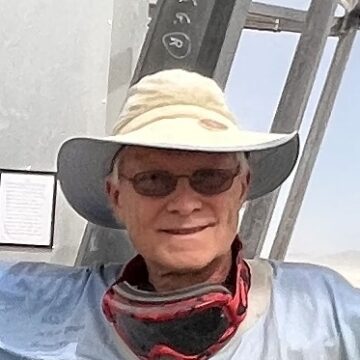
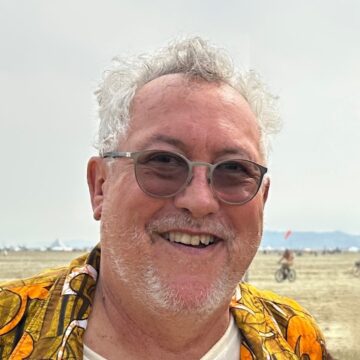
My guest is John Jennifer Marx.
Welcome, John.
JOHN JENNIFER:
Thank you, Stuart. I’m very happy to be here, and just kind of see what things we can conjure up.
STUART:
Yeah. This is great.
Why don’t we start at the beginning? I always like to start there. No, I don’t always like to start there. Sometimes I like to start in the middle, work out to the ends. But…
JOHN JENNIFER:
Yeah, change it up again when you can.
STUART:
How did you get to Burning Man? What compelled you to go to Burning Man? And what compelled you to stay?
JOHN JENNIFER:
First, it was just a vague notion, right? Living in San Francisco, you hear about Burning Man.
I bought a book on Burning Man, a picture book. And my daughter looks at the book and she goes, “Dad, you know what they do there?” And I said, “make art.” And she goes, “But do you know what else they do there?” And so we started talking about that. Now, she was 33 at the time. So we decide that we’re going to go. So we try to get tickets, and we try to get tickets. This is back in like 2012: hard to get tickets.
So I’m hanging out with a friend of mine who you may know: Matt Chaney, Black Rock Solar, Black Rock Labs, Green Man, the whole thing. We’re talking about ‘what are you doing this summer?’ And he said, “I’m going to Burning Man with my daughter.” And I said, “My daughter and I’ve been trying to go for two years, and we can never get tickets.” And he goes, “You’re coming with me.”
He’s a solar guru. He’s really good at what he does, but you never know what he’s going to do. So until we actually got in the RV and were on the road, I wasn’t even quite sure if we were going to actually get there, and everything was going to work out, but we did.
And we get in at five in the morning on the fringes of First Camp with all the stuff that goes on, with Media Mecca and The ARTery and all this kind of stuff, and the NOC, and it’s quite a bit of an adventure. And there in 2015, which was our first year, Larry was still alive. All of the cultural founders except for Danger Ranger were in the camp. So it was a very interesting experience. So, we were only there for four days. But four days was enough to get the essence of what Burning Man was about. But not all of it. I mean, it takes time. It does. You can’t… I don’t think anybody gets the whole thing just like that.
STUART:
Sometimes it takes 30 years!
JOHN JENNIFER:
Sometimes it takes 30 years.
And, you know, I had an interesting group. I had my first feeling about what it was, and what the 11th principle was, which is a game we all play — a great game!
So for me, I’ve been a lifelong artist and architect. And like you said, poet. And for me, the normative epiphany, the normal epiphany is you fall into this art world that you never knew existed, and all the things that go with art. And so since that’s been my background, I didn’t have that epiphany. But the epiphany I had, which was delightful and very powerful to me, was seeing 70,000 people, let’s say 95% of 70,000 people, being self expressive in ways that I had no idea would really be possible.
And that notion and how people changed in that environment was both fascinating and really heartfelt. Because, you know, you don’t experience that. You could experience that, you know, in little tiny groups and different things with people. But to just have it, almost everybody you meet be in this ‘state of mind’ was amazing.
STUART:
So what does that make you want to do the next year at Burning Man?
JOHN JENNIFER:
The next year, Nikki and I… Nikki, my wife didn’t come with me the first time. She wanted to see what it was all about. She doesn’t like dust. She doesn’t like heat. She doesn’t like camping.
STUART:
It’s not for everyone.
JOHN JENNIFER:
But she’s come eight times now. This is her eighth year.
So, I was so fascinated by what I thought the power of art, and the power of culture could do. And to create this, not just the self-expression, but all of the things that go with it. So from a philosophical standpoint, you know, the wheels just started turning in ways that I just didn’t even think of before that. I’d heard of different things, you know, read different things, but to see it live in the flesh.
And then you look at the state of humanity and you say, what does humanity need? It needs a variety of things. But one of the things is it needs a Burning Man-like culture to break it free of the last 40,000 years of what we’ve been doing.
STUART:
So did it inspire you to want to bring art out here?
JOHN JENNIFER:
Well, I was absorbing for the first couple of years; it was absorbing. But in ‘15 Matt didn’t tell us what to do. So I was dressed like a tourist, basically, you know, so I didn’t know what to do. T-shirts, clever t-shirts, but nothing else.
So then the second year in ‘16, I brought some more creative outfits.
In ‘17 I made eight what I called ‘visual poem based art ponchos.’ So what I say is I’m a walking poem on the playa.
So the idea is to have people look at it and go, “What the hell is that?” And then I explain it to them and I work them through philosophy. In this case, it’s Epiphany which is actually the poncho.
STUART:
You’re wearing Epiphany. Okay.
JOHN JENNIFER:
I’m wearing Epiphany today!
By then I’m thinking: I’m an architect, you know, I like to design structures. And I want them to have quirky philosophies and all this kind of stuff, but I’m not a builder. I draw it. I wave my hands. I just don’t do the hammer and the nail. Now, fortunately, Burning Man is a community, so you don’t have to do everything. Although on some projects that are small enough, you can do everything.
But then in 2018, I meet a really interesting young man named Poindexter. When he learns I’m an architect, he gets all excited, he gets very interested, because he’s been twice, I think, and he’s directly inspired. In fact, he’s going to devote himself to art, and he specifically wants to build an art project for Burning Man. He shows me his design. My intention was not to design something, not to get too involved, but to help him because, you know, we became friends.
So we start walking through it, and after about three hours he says, “Well, I can see I’m out maybe a little bit in over my head. Would you be the lead artist? I will take care of everything else?” And so we forged that bond on a project called Andromeda Reimagined, which was a little five sided pyramid shade structure, 26 feet tall. And it was a female empowerment piece, but it was also a gender expression piece. Before anybody knew that I was twin-gendered. So that was a sneaky almost ‘coming out’ in 2019.
STUART:
Coming near.
JOHN JENNIFER:
Coming near. I like that. Coming near.
But the first part was female empowerment. And we had a 17-year-old African-American Quaker girl, who is the daughter of a very close friend of mine. She painted four paintings that went inside that told the story of Andromeda Reimagined. She painted that, and then I wrote a poem and put the poem in the back of it. That was the first art project. That was a team of about 30 people, and we had to raise only $30,000 to get it here.
That then led to, I’ve kind of got the itch to do something else, but I don’t have a focus for it — just serendipity.
The Artumnal comes a few months later.
STUART:
This was the arts benefit that Burning Man…
JOHN JENNIFER:
The gala they used to do.
STUART:
It was pretty splendid.
JOHN JENNIFER:
Well, I think it’s like a community event. It’s more than a fundraiser.
So at the Artumnal, my wife Nikki made these necklaces, which are these little domes, glass domes as gifts; little necklaces. And inside was a tree. And so Eleanor Prager – gave her one – and Nikki had given away all of them by then. And Eleanor rushes over with Absinthia, and she says, “Absinthia is just obsessed with these things. Are there any left?” And I said, “No. Nikki told me like, she gave away the last one, but,” I said “Here!” and I gave her the one I was wearing.
Then she was like, “You’re so sweet. Let’s talk.” So we end up talking for like half an hour. And so we find that we have a lot of common ground on a bunch of different things. So we exchange information, and a week later, and at this point now we’re getting into… we’re snarkin’ about things, you know…
STUART:
As old Burners will do.
JOHN JENNIFER:
Yeah, as old Burners will do.
STUART:
Absinthia has been a member of this community about as long as I have, a long time.
JOHN JENNIFER:
Oh, yeah. And she’s done some admirable pranks over the years.
STUART:
We’ll keep her secret.
JOHN JENNIFER:
Yeah, it’s her secret to share if she wants to. She has the spirit, especially the old Burner spirit of…
STUART:
Jackassary?
JOHN JENNIFER:
Jackassary. Also compassion. And, you know, all the things that go with it.
STUART:
Sustainable jackassary.
JOHN JENNIFER:
Sustainable…well, there’s this whole issue about: what was the original meaning of Leave No Trace….
STUART:
To begin with, it’s leaving no trace. It’s a process, not a command.
JOHN JENNIFER:
Oh, sorry. Yes, I like that.
STUART:
‘Clean your shit up’ was what the original intent was.
JOHN JENNIFER:
Was it? I thought it was “Don’t get caught punking that billboard, leaving evidence behind.”
STUART:
Yeah, yeah. Okay. You want to invoke the Billboard Liberation Front? Yes. We were very scrupulous about leaving the job site clean.
JOHN JENNIFER:
Admirably.
STUART:
We’d always leave a six pack for the sign men who we’re going to have to redo it…
JOHN JENNIFER:
And generosity. Yeah.
STUART:
One time, we even left an extra power box because we didn’t have enough power to run the neon for the Joe Camel board.
JOHN JENNIFER:
So you had to help them.
STUART:
They ended up with substantial capital improvements to their board.
JOHN JENNIFER:
For years, I had always admired that work before I knew who was responsible for it. You know, as a San Franciscan, it was just like, YES! Once again, the force is stricken and something really interesting and provocative has happened.
I did have the occasion to ask John Law about that, and he said 50/50. 50/50 sustainable, 50/50, you know, don’t get caught, don’t get caught doing bad things.
The thing about Burning Man is, with the Ten Principles, one of the things that I found incredibly delightful was, they’re contradictory and I believe…
STUART:
Well, complimentary.
JOHN JENNIFER:
No, no, no, they’re both.
STUART:
There are tensions between them. Just say that, please.
JOHN JENNIFER:
Yes, creative tensions. I’m what I call a paradox embracer. So I think that we are very often confronted with a number of binaries, whether it’s gender, or whether it’s rich versus poor, all these different things, and we tend as humans to make them two. Sometimes they’re ternary, sometimes they’re quadranaries, however one would pronounce that. They’re complex! So two makes it a little bit easy.
But the thing is we try to navigate… In the West I think we try to resolve paradox by picking A or B. I think it’s very much more healthy to embrace paradox, and it’s not the gray area between black and white, it’s all the colors in the universe between black and white. And some of the sweet spots are not at the extremes of these kinds of binaries we concoct. What was beautiful is that it’s not like the Ten Commandments, where it’s like “Thou shalt,” which you corrected me because I, you know, the like Judeo-Christian background, like “Thou shalt.” And as you said, it’s a temptation to do something rather than a command.
STUART:
Look, I was just driving past Center Camp and somebody did an installation there on the Ten Principles where they turned them into commandments. I was so pissed off, because they’re just so intentionally not that. They are written in an active voice. They are written from the point of view of the individual and not from some outside power.
They’re practices, not laws.
JOHN JENNIFER:
Exactly.
STUART:
And people try to enforce them as laws and it just drives me crazy. Self-appointed police on the Ten Principles!
JOHN JENNIFER:
Well, I like the creative tension. Absinthia and I are doing some of that. We’re texting, we’re on the phone, and she said, “I just went to the No Spectators show at the Oakland Art Museum,” and she sends me this picture which says “VIP entrance,” including the red velvet ropes and, “Bypass the line.” She’s like, “I am so outraged.” And then she just went on about all the things that the museum shows.
Now, the thing to remember for both of us when we were talking about this is we are very proud of the museum shows, but nothing’s perfect. And Caveat did the great thing where he went into the gift shop at the Smithsonian. That story, that’s a whole other story.
STUART:
He tried to leave them a gift.
JOHN JENNIFER:
He left her a gift, I think. She didn’t know what to do with it, but she had a learning moment. She had an epiphany, right? So that was quite wonderful.
STUART:
Embrace the spirit of the gift. Avoid false dichotomies.
JOHN JENNIFER:
Yes. We’re snarkin’ back and forth, back and forth. And Absinthia says, she had just gone to the Oakland show. She had walked through it. “You can’t make art. You can’t touch art. You can’t do this. You can’t do that.”
STUART:
“Stand behind the line.”
JOHN JENNIFER:
And, you know, it’s a wonderful thing that those things get out. I mean, the one at the Smithsonian broke records for attendance and all that kind of stuff, and it helps to get the culture out, but it’s not the real experience.
We’re talking about all that stuff. And she says, “We’re going to make our own museum!” So we start talking about what that would be. And I’m like, oh crap. Now I’ve got to actually design a museum.
The design of it evolved to eight galleries, two big ones and six small ones. And the two in the front have always been the same. One is snark and the other one is social justice. The other galleries we don’t curate. We just have suggestions of what people might do.
Our goal was to be inclusive of all of the range of small art that was not appropriate for the Temple. You don’t want generally snark, you don’t want politics at the Temple. There’s a bunch of things that you don’t want at the Temple that are sort of not in the spirit of, or disrespectful. All that stuff could go into The Museum of No Spectators. I remember seeing a political statement and thinking, this just doesn’t feel right for the Temple.
STUART:
Or for, yes, it might extend beyond the Temple. I mean, if it’s divisive, if it does the opposite of what Burning Man is supposed to do, which is to bring people together.
So you built a museum and invited people to fill it up with their..?
JOHN JENNIFER:
Yeah. The way it worked was you walked in the front, you walked in the gifting shop.
STUART:
You entered through the gifting shop?
JOHN JENNIFER:
You entered through the gifting shop, yes, a direct reference to Banksy. Instead of leaving through the gift shop, you’re entering through the gifting shop. And we’ve changed the use of both words.
So we’ve gone from gift, which is a noun, which means ‘an object one could buy,’ to a verb. So we gave away 5000 photographs from all sorts of different Burning Man photographers. We gave away probably 3000 pieces of jewelry. We had Paul DeLaughter, who was part of the Gifting Guild and part of the Jewelry Guild, he was part of the gifting shop.
We changed the use of the word from a noun to a verb.
STUART:
as it is in the Ten Principles.
JOHN JENNIFER:
And as it should be in real life to a greater degree than it is.
We also changed the use of the word ‘shop’ to mean ‘to make’ instead of ‘to buy.’ So we had workshops in the gifting shop. Paul ran some of them. Lonnie ran some of them. We even had a woman come from South Africa, and ran a workshop in the gifting shop. It was a beautiful adventure.
One of the things about the gifting side was the first year on Friday we ran out of gifts, so we had 5000 photos. We had all this jewelry and all the stuff. We ran out of gifts. We didn’t know what to do. Burners being Burners, they’d come, they open the box, they’d see no gift, they’d leave one. So we actually never ran out of gifts. The museum always had gifts in it, because Burners would leave gifts for people when they realized what was up.
STUART:
As they will do.
JOHN JENNIFER:
As they will do! Yeah.
STUART:
Okay. So this project still lives?
JOHN JENNIFER:
It still lives. It’s in New Mexico, in a place called Art City. We have an exhibit up inside the museum because there’s the museum is the vessel — shiny and sparkly — and then there’s the museum as an exhibit space.
Lonnie and I, whose daughter was the one that painted the paintings in Andromeda Reimagined, Lonnie and I printed a bunch of art that came from the artists who were at Burning Man.
So the two big galleries were retrospectives. One was a poetry gallery: poetry on a wall. Most of the time you either hear poetry read out loud, or it’s in a book. And my preference is always that all poetry, almost all poetry, should be read aloud, because then you add your emotion, you add your humanity to that reading. And if you’re reading somebody else’s poetry, it’s the same thing. You’re adding your humanity to that experience. But you don’t see it on the walls very often. So we had one gallery covered with poetry, poetry that was on Playa.
And then the other one was pictures of people building it, people using it, the workshops, the gifting shop.
And then we had six galleries of the artists that we could contact who had done things, and we had them give us new work to go in New Mexico. That spot is an amazing thing. I mean, just if people are traveling through New Mexico on the way to Texas.
STUART:
Or the way out of Texas!
JOHN JENNIFER:
Or the way out of Texas, yes!
Mattie has got, I think, 18 pieces now of Burning Man art, including
part of Paradesium
part of Fnnch’s Lips
Lana, did the Mind’s Eye, that’s there.
The one that’s there which I’m very proud to be next to is Facing the Fear Beast. That’s there.
STUART:
Oh, wow. Amazing piece.
Well that’s great. It’s always great to see Burning Man art go out into the world, and even a whole museum’s worth of Burning Man art going out into the world.
I want to get a little theoretical here, and talk about art and architecture.
I mentioned the DaVinci’s Workshop theme earlier, and as I was researching that, I found that back in the Renaissance, art, architecture, and engineering were all peas in a pod. I mean, DaVinci made most of his money doing, like, military fortifications. And over the years they’ve split up in interesting ways, right? But it seems like there’s still pretty incredible tension between architecture and art, particularly over form and function. I mean, architecture today seems to be more favoring the engineering side of things than the artistic side of things, right?
JOHN JENNIFER:
Absolutely. And weirdly enough, I just have a new book called Second Century Modernism. If you look back at first century modernism, and this is in architecture, but I think it applies to fine arts as well; not to arts in general, because there’s a big differentiation for me between fine arts and art, general art. And Burning Man taught me they’re both incredibly valuable, and you should not value one over the other.
In architecture school, in its ally with the fine arts it’s like, well, everybody wants to be a fine artist, everybody wants to be an architect; everything else doesn’t matter. But yet it really does. And that disconnect between art in general and the fine arts, or architecture and the public, is getting more and more deep as time goes on.
In the book, I got this little photo of a ballet program, weirdly enough. The ballet was called Animus Anima, so male/female energy. He talks in this narrative that he writes about the ballet, about paradoxes, about binary opposites, and he says ‘architecture and humanity.’ So an allied art is saying you have to choose between architecture and humanity. You would think those things would be together, right?
STUART:
I mean, isn’t architecture supposed to serve humanity? Isn’t that the purpose of it..?
JOHN JENNIFER:
You would think so, but people wonder, do they have to choose between the two? Because modernism, as you said, had gone off the rails a bit and doesn’t serve the people. We don’t design from the heart anymore.
We design like engineers. I love most all the engineers I know. But architecture used to be an art form. During the beginnings of modernism. So for maybe the first 50 years, I think mid-century modernism was the peak. And that’s an identifiable style that people still love; very clean, but it had heart. You know, in LA there’s like Googie architecture. It has a style to it. It makes you feel optimistic.
STUART:
Frank Lloyd Wright?
JOHN JENNIFER:
Frank Lloyd Wright was really good at emotional meaning and emotional engagement, and so is Googie.
Now, the opposite of that would be Mies van der Rohe: Seagram’s tower, Crown Hall in Chicago, the Farnsworth House. The Farnsworth House was the first glass house that humans ever built. He’s the rationalist, the personification of the idea of the linear, logical, verbal thought process. The other side is multidimensional, intuitive, visual, creative process. You’re designing from the heart and designing, you know, like a robot.
The weird thing is, AI can design better than most architects if you want something designed from the heart. If you say “Design me something in the style of Gaudí,” it’s really good at that. It can’t think of the new thing that doesn’t exist, and so in a sense, the quality of what you get out of AI is only as good as the library you ask it to draw from. If you ask it to draw from all of humanity, you’re going to get all of the good and the bad. And so if you curate it… this, of course, is a double-edged sword because if you say ‘only use Disneyesque optimistic poets,’ you’re going to get a world that we also don’t want to live in, right? It does not know the difference. Now maybe singularity and maybe when we get to general intelligence or whatever that big step is, maybe it will know better.
You know, Caveat asked me to write a thing for the Journal back in “I, Robot” because everybody was writing about robots, and he said, “I need somebody to write about humanity.”
And I came up with a phrase. This is all inspired by Burning Man. And this did go from Burning Man all the way to the World Architecture Festival, and this is a derivation of Descartes.
So Descartes said, “I think, therefore I am.” And I believe, not think, I believe, that Descartes only gave us half of the equation.
STUART:
Feeling, perhaps?
JOHN JENNIFER:
Yes, exactly. So I, as a paradox embracer, I want to add to things.
“I think therefore I am,” I believe carried an arrogance that thinking was the highest order of human achievement. So I want to add another line.
I think, therefore I am. I care, therefore we are.
And you cannot think your way to we.
Economic transactional thinking will create a relationship, but it’s based on transaction. And when one of the sides changes or fails to deliver, it’s not caring. It’s not true caring. You need to feel your way to ‘we.’ You need to care your way to ‘we’ which is what Burning Man does.
STUART:
When I look at the architecture, the urban design, everything about this place, it seems to come from a place of we, because nobody can do this stuff alone. But it seems to also come from a place of radical… As you know, Larry used the word ‘radical’ not to mean ‘extreme’, but ‘from the heart.’ And so I see a healthy balance between that idiosyncratic self-motivation and that collaborative element.
JOHN JENNIFER:
And that to me, that balance, call it creative tension, balance, paradox.
STUART:
Between Radical Self-expression and Communal Effort?
JOHN JENNIFER:
Yeah. And that’s where you really get some rich humanity. Balance I think is the key to everything. But balance doesn’t mean that you stay in the middle. You could imagine being on a snowboard. You have to stay balanced, but you’re doing something extreme. So it doesn’t mean that it’s tepid. And then you have to be aware of balance and when things get out of balance.
So in architecture, you know, in first century modernism, it’s an architecture of abstraction and ideas. I had never met a modernist who has said, “No, no, that’s not what it is!” They go, “It’s more than that, but that’s pretty good.” What if, in the second century of modernism, we add to that an architecture of emotional abundance.
Now that I’ve been going on this thing about emotional abundance and caring, I’ve gotten incredible pushback from one group, and it’s like, ‘we absolutely need to do this’ from the other group. And it’s interesting to see how these two groups interact.
The first group tends to think, no that’s the death of culture, because you’re giving up reason. But reason by itself does not make a human being. The caring is far more important. But we lose sight of that because we think logic will explain everything for us.
STUART:
Have you had a look at this year’s Temple yet?
JOHN JENNIFER:
No we haven’t been out.
STUART:
It definitely has brutalist aspects.
JOHN JENNIFER:
It does.
STUART:
It is very, very dissimilar from any temple we’ve had before that have the soaring paths to the heavens of cathedral architecture, but if you go inside, it is much more human and literally down to earth. It is designed to mimic the desert landscape and sort of be like a large stone. But inside the stone is a cave.
JOHN JENNIFER:
In the stone is the heart.
STUART:
Of a heart. The architect Miguel Arraiz García is a really super interesting guy.
JOHN JENNIFER:
Yeah, I did go to a presentation at a tea Burning Man headquarters. And it was like you say, it’s very different than anything we’ve seen before. You know, minimalism in architecture is a big thing, and Brutalism. They’re interrelated.
I want to see lovable architecture. I don’t want to see everything to be lovable, necessarily. But we need to add that in.
With minimalism, the idea was you reduce it to the essence: reduce, reduce, reduce. So that reductive process for me, every stage you’re taking a bit of humanity out of it.
STUART:
Right.
So you get to the end and there’s just a logic, a very thin thing that’s so emotionally non-engaging, intentionally. You gotta wonder, you know, why people don’t love it? Because you’ve taken the humanity out of it.
So what’s the balance of rigor and discipline, which architects love but also humanity and caring and empathy and all these other things? Architects look at a building and say, there’s a concept. Participatory architecture, you know, when you’re working with communities, those buildings tend to have that empathy in it because the community’s involved. But a designer should be able to take that and create something that the community could never have dreamt of, but it’s still their dream, it’s their ability to craft form.
So the thing is, with minimalism, it’s so hard to do. I would say that 2% of the architects can design in minimalism poetically. So for me, poetic brutalism and poetic minimalism, which have emotional engagement, are worthy. But non-poetic minimalism, which is what most of the things you see built in the world, are soul-suckingly empty.
And we hide behind this idea that, and it’s an idea, that architecture somehow has a higher calling. I have a little phrase that goes, “Have we exhausted the conceit yet, that the public simply needs to catch up?”
STUART:
Well, that actually can be applied to fine arts as well, right? Oh, my God.
JOHN JENNIFER:
Oh, absolutely. Oh, absolutely.
STUART:
Would you say that many artists in that world have gotten detached from the public?
JOHN JENNIFER:
As bad as it is in architecture, it is in the fine arts. I was on the board of the San Francisco Art Institute, and it was arguably the second of only two remaining independent fine arts schools in the Western Hemisphere. Both the San Francisco Art Institute and PAFA, which is in Philadelphia, they were the bastions of free fine arts, avant garde art. And I think that we sorely need that. We need those people.
And Burning Man has both. Burning Man has people that want to change the world in significant ways, and others that just want to show the heart and show the humanity. And that range is so important.
I did a visual poem called “Range of Cultural Inclusion.” On the one side is a professionally trained ballerina in a bubble, and then on the other side is Tinker Bell dancing. So you’ve got two dancers on the extreme, and in between is a graphic that shows a bell curve, which all these people of different colors and persuasions dancing. Because everybody, almost everybody, can dance, even if it’s just moving to the music, to illustrate this concept of range of cultural inclusion.
I live in that bubble. I love that bubble in architecture. I don’t necessarily want it to go away. I don’t want the bubble to be so hard, and I want the bubble to recognize that all of humanity that’s to the other side of that bubble is equally important.
And the thing for me I love about playa, was that on playa, you have a piece of art, and that piece of art might be museum-grade. And on the other end, there’s a sparkly unicorn doll that’s been bedazzled for your enjoyment. And on one level on the playa those are equally beloved, because they’re both a gift. And if you dismiss that gift, you’re not dismissing the thing, you’re dismissing the humanity of the person that gave it to you.
My working definition of art, which includes fine arts, is: Art is the act of sharing your humanity through an expressive medium. So when we hug, we’re sharing our humanity, but when we do it through an expressive medium, that to me is the essence of art.
And even Jeff Koons shares his humanity. You might then ponder what his humanity is. An ex commodities broker who saw the fine arts world is an unregulated commodities market and said, “I can punk this.” And he did. And he sells pink balloon dogs for $20 million.
STUART:
It is hard not to see the fine art market as a scarcity-driven bubble.
JOHN JENNIFER:
Yes, exactly.
STUART:
The commodification, I think, has gotten toxic in that market!
JOHN JENNIFER:
It’s very toxic!
I have a term for that called investment-grade art.
I don’t think any artist starts out… Imagine, you know, you’ve got a niece, you know, named Julie, and the niece comes up and says, “Uncle Stuart, I know what I want to be!” And she’s like seven years old. And she says, “I want to be an artist!” She talks for like an hour, right? And you’re just so excited for her.
And afterwards you’re saying, “You know, Julie, this is going to be great. People are going to love you. You’re going to make a lot of money. You’re going to be the best factory worker for the wealthy.”
And she says, “No, no, that’s not what I wanted. That’s not what I want to be.”
And you say, “No, don’t worry about it. You’ll be famous. You’ll be rich. It’ll be great.”
But no artist starts their journey wanting to be a factory worker for the wealthy or working a commodities market, right?
STUART:
Except Warhol, who actually did want to be a factory owner.
JOHN JENNIFER:
Yes. Well, there are exceptions, delightful exceptions.
STUART:
Dalí. Both embraced the dollar.
JOHN JENNIFER:
Dalí, yes, in the end, he did; he went full commodification.
But the thing is, that bubble in the fine arts is so hard because there’s money involved.
So what happens is, they go, “You know, if you’re not really a credentialed poet or painter or sculptor, you’re kind of the casual, the amateur, you should just stay in your box. We’re the worthy ones.” There’s a pejorative against being an artist.
We got this great playa gift, which was just words, you know, like refrigerator magnets. And one of the combinations was BAD ART PLEASE. And that’s on my wall, because you need bad quote unquote art. But if that art comes from the heart…
Now, the beauty for me with the range of cultural inclusion is, on one level, everything’s beloved. At the same time I think many, many people at Burning Man can also navigate the idea that there are qualitative differences between the two. They can embrace the dynamic of both things happening, that museum-quality work of art has got maybe more rigor, more discipline, more training, more sophistication. It’s different than the other thing, but you can love them all, and you can gain something from them all, and you can approach them as, like, do I need to see the guy’s resume to see whether or not this art is good enough?
STUART:
Or read some reviews.
JOHN JENNIFER:
Or read some reviews, or what did they sell it for?
But the hard part is to make a living as an artist, you need to sell things for more to pay your rent. So we have to work out a value system that helps sustain people that are in the arts, even if it’s casual art-making.
Everybody making art could be healthier. And weirdly enough, sports makes this work for themselves. So you imagine the person that plays soccer on the weekend, they love soccer. They love to play it with their friends, however they like to compete, whether it’s really vicious or they just love playing the game. They don’t think that they’re pathetically third-rate because somebody is making $10 million doing the same thing they’re doing, but they’re doing it at a different level, right? They don’t think that. It’s not a negative. You don’t see yourself as unworthy in sports.
There’s a healthy relationship between professional sports and casual sports. For me, Burning Man shows you that there is a powerful reason to be an artist.
STUART:
And opportunity.
JOHN JENNIFER:
And the encouragement and help.
STUART:
You said before, if your niece came to you and said you want to be an artist, you know, very recently the answer would have been, “No, honey, you’ll never make any money. Get a real job!”
JOHN JENNIFER:
“Get a real job!”
STUART:
I meet so many people out here whose creative impulses were basically stymied their whole lives by the market, by their family, by their peers. The idea that ‘you can’t be an artist unless you’re making money off of it,’ right?
JOHN JENNIFER:
And that’s why I became an architect, because when I was seven, I wanted to be a painter, I wanted to be a poet. And in the Midwest, it was like, “No, no, no, that’s a hobby. You need a real job,” exactly what you said.
STUART:
People come out here and talk about the transformative experience all the time as if there were one. One consistent trend that I see is people come out here and say, “Well, maybe they were wrong. You know, maybe I can get the trumpet out of the attic and start playing it again, or pick up that half-finished novel, or maybe I can make art. Or maybe I can learn how to make art,” which I think is the other astounding thing about Burning Man’s alternative art ecosystem is that it has spawned all of these makerspaces and academies that have taken the place of the expensive art school education with hands-on learning!
JOHN JENNIFER:
And those to me are like when communities build soccer fields, right? They invest in that because they see a value. I think they should invest in art and makerspaces and things like that, because the outcome… Imagine if this was a sporting event? The outcome, the psychology, the humanity that was here would be completely different.
We all have our version of what Burning Man means. My version is…
STUART:
What’s yours, John!?!
JOHN JENNIFER:
Yeah! My version is: Burning Man exists to encourage you to embrace community and kindness through participatory art. And participatory sports is not going to get you community and kindness… likely. Nothing against sports, but the outcome of sports events that I know is not what happens here.
STUART:
I can embrace your definition. I would just widen out ‘art’ to ‘creative expression’.
JOHN JENNIFER:
That’s a good one. Yeah.
STUART:
There’s different ways to do it. “Art” carries a lot of payload with it, right?
JOHN JENNIFER:
It’s a trigger word.
STUART:
“What is art,” right?
JOHN JENNIFER:
“Am I good enough?”
STUART:
“That’s not art.”
I love also that people here have developed a whole new genres, or genre defying art, that cuts across boundaries and doesn’t fit into any of the — we used to say ‘any bins in the record store.’ It’s just out there.
JOHN JENNIFER:
Yeah. Because self-expression, radical self-expression, is so important. To me, it was that epiphany, you know, on playa, that first time: 70,000 people being self-expressive, and seeing the range of things that you got, and being excited about the whole range.
I mean, my favorite playa gift was a clothespin, a wooden clothespin. I’ve gotten some really wild things! Hanging out with LadyBee, you know, you can get some really beautiful bronze necklaces.
STUART:
The jewelry making is out of sight.
JOHN JENNIFER:
It’s amazing.
It was a random playa gift, it was a clothespin, a wooden clothespin. This guy, he painted it green, he put glitter on it, and he put two eyes, and it looks like an alligator. He was from Florida. And the reason that I, because the object is not the thing, the reason I love it was the look in his eyes when he gave it to me. Those two things together is what I remember, that humanity exchange, and that’s to me what art should be.
And when money gets involved… It’s not that that can’t exist, that that shouldn’t exist, but we’re ignoring this wonderful thing that Burning Man is giving us the window to: What could humanity be?
STUART:
What’s next for you, John? What are you looking forward to? I always like to think that “next year was better.”
JOHN JENNIFER:
So there is a Burning Man architectural professional thing that I’m doing.
I did a workshop on creative communities. Creative community, you know, imagine a developer who is building something, let’s say the scale of 10,000 people. So a developer’s building something and they might put a plaza in, maybe they think it’s valuable. Maybe the city made them put the plaza in, and maybe they plunk a piece of art in there, and they put a little bandstand.
So what do they do? They buy a piece of art from somebody from somewhere, depending on what their budget is, and if they have a theme… I mean, God forbid, Burnerville, they buy a piece of Burning Man art. They put it in there and they say this is a creative community because they bought a piece of Burning Man art, they bought a piece of art. That goes against the whole concept of what a creative community would be, what a Burning Man community would be; Burning Man-esque.
And then the bandstand, whatever the developer thinks that people like, smooth jazz, which I like, but not everybody likes that. It’s very dated. And they bring somebody in to play music, right? So, creative community, that piece of art, and the numerous pieces of art that are around there, should all be made by members of the community. And the music, whether it’s good or bad, or that whole range, should be people playing music for each other. And so it’s not just putting makerspaces in, but creating a social programing that gets people to value doing it for each other. And if they want to go somewhere else, they want to go to a concert hall, they want to go to hear people at the highest level. That’s great, but they’re still participating.
And I believe, just like the soccer person, I believe that if you are playing an instrument and even if on a scale of 1 to 10, you’re a 3, but you love it, you’re going to love the people that play better than you even more if it feels open, if it feels like there’s a range of inclusion that you are similar to that person, that you are participating in a thing that’s of joy or benefit. And Burning Man shows you can just…do that.
STUART:
Whatever’s in your heart.
JOHN JENNIFER:
Whatever’s in your heart. Yeah.
STUART:
Well thank you, John Jennifer Marx for joining me today. I really appreciate it.
JOHN JENNIFER:
It’s been a great experience, as always, anytime we’ve talked. This is fun.
STUART:
Let’s go out there and change the world, man.
JOHN JENNIFER:
Yay.
STUART:
Yay. Thank you.
VAV:
This has been another episode of Burning Man LIVE, live at Burning Man’s Black Rock City. This has been a labor of love from the Philosophical Center, one of the six program areas of the nonprofit Burning Man Project.
Thank you to the Burning Man Webcast, and everyone at BMIR.
If you want to thank them directly, email us at live@burningman.org.
If you want to thank them indirectly, stuff a buck into the tip jar at DONATE.BURNINGMAN.ORG.
Thanks also to our team, from DJ Toil to kbot, to Lotus, and many more.
I’m Michael Vav.
And, thanks, Larry.
JOHN JENNIFER:
I actually don’t think I said anything I’d get in trouble for.
If you would have said, “Well, tell me about the Mafia and the Royal Court…”