

This culture started in dust and ephemerality. We build metropolises of art and fire, then we leave no trace. How do we translate that inspiration into a rhythm for everyday life? What happens when a temporary autonomous zone puts down roots?
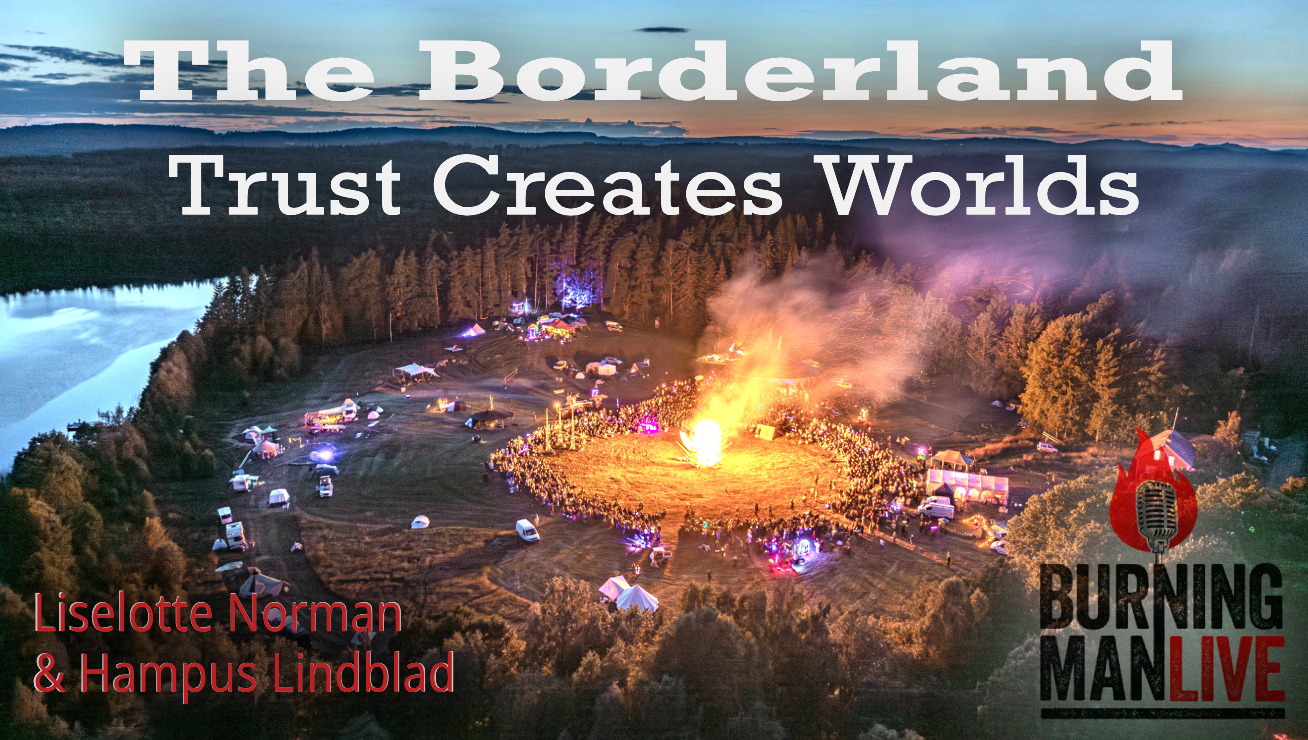
The Borderland is Scandinavia’s largest and longest running Burning Man Regional event. It’s “working out loud” culture fosters radical trust, allowing the community to create its own world where no one is in charge.
The community also crowd-funded land that serves as the permanent home for their Regional event, and year-round collaborations of all kinds.
How does the Borderland commit to the risk and reward of community buy-in?
How does trust lead to resiliency and communal wisdom?
How do the 10 Principles balance aspects of Scandinavian culture differently than US culture?
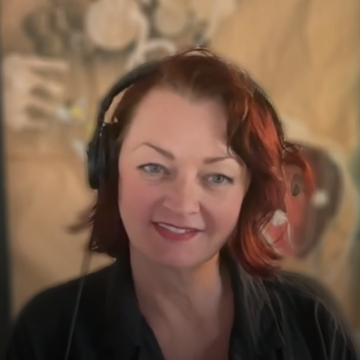
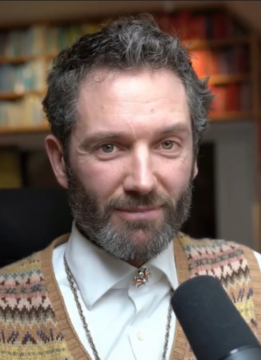
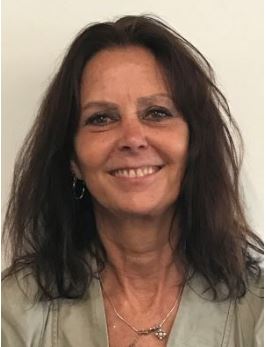
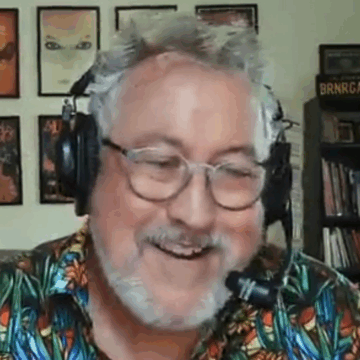
Hear Andie set it up. Hear Stuart talk with Liselotte Norman and Hampus Lindblad.
Hear about letting go to stay together.
Photo: Annie Locke Scherer
burningman.org/global-events-groups/burning-man-regional-network
burningman.org/global-events-groups/burning-man-regional-network/sweden
burningman.org/global-events-groups/find-a-burning-man-event
Transcript
HAMPUS:
Well, it’s a very strong “working out loud” culture. Anyone is free to opt in to discussion and share their wisdom. And you never know who sits on the answer.
It’s really trust-based. I would say that’s the one factor that separates Borderland from a lot of other Burns, organizations in general, the general level of trust between members is very high, and it’s designed that way. It’s very, in that sense, risk-taking, but I wouldn’t say it’s taking a risk because it works really well. It also creates resiliency because there’s so much also loyalty among the members, and the actual belief that their opinion matters. And then you get so much good will and so much buy-in from the community.
ANDIE:
Welcome back to Burning Man LIVE. I am Andie Grace.
The foundational magic of Burning Man culture started in dust and ephemerality. We gather together in harsh environments, we build magnificent metropolises of art ,and fire, and then we leave no trace. It’s a radical act of letting go every time. Burning Man teaches us that nothing lasts forever, and that the keepsake is inside of us.
But what happens when the urge to gather outlives the days we’re together at those events? As our global community matures, more of us ask the same question: How do we translate that evanescent inspiration of a Burn into a rhythm for everyday life? What happens when a temporary autonomous zone decides it wants to put down roots?
For 15 years, The Borderland Regional Event moved from site to site across Northern Europe. But when the world stopped in 2020 and their sold-out event was cancelled, they didn’t just pack up their dreams of being together. They leaned into a radical trust. They asked each other to ponder: What if we bought our own land?
So what happens when that kind of pause becomes a catalyst? It’s a story of decentralized governance, where nobody is on the payroll, and decisions are made by a collective human intelligence. It’s a fascinating look at what happens when the communal context of Northern Europe melds with the Radical Self-expression and Immediacy of the playa.
Stuart’s gonna talk to two of the community leaders who helped guide The Borderland from a fleeting week in the summertime to a year-round home in the woods.
Here’s Stuart Mangrum.
STUART:
Well, hello invisible friends. You are listening to Burning Man LIVE. I am Stuart Mangrum and I am here today with two of the leaders from The Borderland, which is the Burning Man event in Scandinavia. I’ve got tons of questions. I’m super interested in the fact that they have actually taken the big step, and purchased some land for their year-round operations.
Welcome Hampus Lindblad and Liselotte Norman.
HAMPUS:
Thanks for having us.
LISELOTTE:
Yeah.
STUART:
Let’s start with the big question, I guess, the cultural change. I know Borderland is a pretty mature event, 15 years or so. What was the impetus to go from the nomadic approach of the early years, where the site used to rotate between different locations in different countries, to having a permanent space, now? What does that mean to the community and the culture?
HAMPUS:
Well, I’m sure there are several answers you’ll find in community, but the way I experienced it was that we always had a conversation since the very first years of this dream to have our own land. And what if we can do that? And could we go from Leave No Trace to, leave a better trace?
But it was always a dream, something quite distant. And then in 2020, we had been in Denmark for the last five years at that point, and we had a sold-out event. People had booked flights from all over the world. And then Covid struck, and we were, of course, as everyone else in the world at the time, forced to cancel the event.
A member of the community just posted, I think it was a very spontaneous suggestion in the group: “How about buying land?” or something like that. And that became a catalyst for a big discussion.
We ended up suggesting to the community, in a sort of an Aikedo move, where we wanted to take the negative impact and energy of Covid and the cancellation of the event and basically asked the community: “Are you willing to meet us here and consider not reclaiming the ticket fee or what we call membership fee?” And 25% of the community agreed to that and did so.
So suddenly we had €100,000 on the bank account earmarked for this ‘Let’s buy land” dream. So a small group formed around that and started looking, and then this was a classical snowball effect. Originally we did not conceive it to be realistic to go for like an actual property large enough to host a main event. So we were thinking something along the lines of a summerhouse, like a small cottage with a garden, and we could hold these micro-Burns for small events, and nurture the community in that sense, indirectly, but not have the full event.
But then one thing led to the next. You find a place, and then you’re like thinking, well, this is great, but what if we just push it a little bit more? What if we had just €50,000? Then we can get another hectare of land, or we can get like two houses instead of one? And there was this, that iterative, just snowballing effect. And gathered momentum over several years.
STUART:
That’s pretty exciting.
Let’s hear about the land. I’ve seen a couple of pictures of it. It looks really beautiful. Liselotte, what’s the property like? And what kind of possibilities does it open up for your community?
LISELOTTE:
Well, first of all, we don’t have to deal with the hassle of renting anymore. That was also part of the picture why, why this whole process kicked off. Because we were pretty chaotic; like in ‘18 we didn’t have a place to hold it and all that. So for the community having Alversjö is pretty much like Hampus said, a dream that came true.
We were talking about it for years and it was like a massive project. And can we do it? Can we raise the money? And all the things that could go wrong and all that. But we have this core group of people that actually put in the work and the time and energy.
Well, it did happen in the end. And I think we came out after those two or three years of scouting for land, we came out pretty strengthened, I would say. Cause we managed to pull it off, kind of against all odds. So now having this land ties us together; we can go there throughout the year. People are building their projects.
It’s not like we don’t have to deal with authorities and the local regulations, but it’s like we very much have this feeling of “this place is ours.” And it is very beautiful up there. I like to go there even if nothing in particular happens.
STUART:
Yeah, it’s got water, right?
LISELOTTE:
Yeah, we have some beautiful wells with very good quality drinking water.
STUART:
And some infrastructure? What infrastructure was there? What are you thinking of building?
LISELOTTE:
Well, there’s an old barn that is really beautiful; a solid, beautiful wooden building. And in there we built toilet shower facilities and a kitchen that actually works, like a functional kitchen, which will also enable people to go there and stay for a bit longer, do some work on the property.
HAMPUS:
It’s an old farm. It was abandoned for multiple decades, and became a place where the local youth often had, like, these illegal parties. And there’s actually a burnt-down mansion on the grounds that was burnt down after one of these parties where kids brought grills inside and just, like, burnt the house down. But it’s a really special place where everything was left just abandoned. It was post-apocalyptic in the sense that going into a house where everything is just still there: The photos on the wall, a made bed, an old Steinway piano, and so on; but burnt down five years before we moved in.
It’s a hundred hectares, so that would be around 200 acres farm. And the land is named after…Alversjö, which means “the land of the 11 lakes.” Nowadays, six would be more accurate. So our land is bordering six different lakes.
STUART:
Amazing. So how did you put the deal together? I was looking at the Alversjö site and it looks like it’s another membership model, but it’s not the same as The Borderland membership model. It’s a separate membership. How does that work?
HAMPUS:
We offer The Borderland members to also become members of Alversjö. And then there’s huge overlap in the two communities, but they are separate communities. And Alversjö is also run under a different legal entity. It’s run as a limited liability company, a standard Swedish company, so far, where The Borderland Association has a large stake in the ownership of it, and over time, we’re going to create a foundation so it’ll be fully owned by the community.
STUART:
I see.
We should probably zoom out a little bit here, because I’m sure that a lot of our listeners are not that familiar with Borderland, and I’m fascinated by the way that you folks set up a very different sort of governance structure to most of the Burning Man events around the world. You guys are both senior leaders of that organization. Tell me about how that is structured, and how you built the infrastructure for decision-making and for governance around it.
LISELOTTE:
Yeah, from the very beginning, kind of the early founders were working a lot on this structure, like a Teal organization where it’s totally flat and the whole decision-making process happens in what we call advice processes. If you want to do something, you run an advice process where you seek advice and input and different perspectives from primarily the stakeholders, but also from the rest of the community.
So decisions to hold power should be decentralized, not a top-down approach, but more like the other way around, a bottom-up approach. So that’s how decisions are made, basically. The board is not supposed to run the business; they provide the legal and administrative framework for things, and take care of all that.
HAMPUS:
The last line of defense…
LISELOTTE:
Yes.
HAMPUS:
The last line of defense in case all other systems fail. It’s kind of like a resiliency model or redundancy model.
LISELOTTE:
Yeah. That’s true. The board does make decisions mostly in explosion cases. That ends up on the board’s table where you make the final decision and present it at the next AGM. But the whole approach is that the community makes the decision. And it works surprisingly well, I must say.
HAMPUS:
Yeah. If you go to the platform that we have dedicated for this, that we call “Talk.” It’s customized for The Borderland community in collaboration with Loomio, the creators of Loomio, which is like the basis of this platform.
STUART:
Which is a threaded chat application or…?
HAMPUS:
It’s a forum, like a classical internet forum. But this one is customized for decision making. So it has a lot of built-in functions for decision making. And we’ve been using this for a number of years.
The process is really designed to empower the person or the group of people taking the initiative to become the most empowered and most suitable people for that decision. It works really well and has actually been studied scientifically also, because it’s a highly efficient system, very adaptive to changes. You can pivot very easily when you’re running a model like this, and you can apply collective intelligence.
And we put this to the test in 2018 when we lost our venue (quote unquote), like we lost the land we were on in Denmark, six weeks before the event was due to take place. We managed to actually find and you know, sign all the contracts, get everything done, and move the whole event within a few weeks’ time.
And we did this by fully trusting the community, fully empowering decentralized teams to go scouting for locations, to negotiate on the behalf of the community, and so on. We did this all over northern Europe. And this was studied by a group of researchers studying organizational development and organizational theory and so on.
STUART:
Yeah, that would be a super interesting case study. You know, when I think about collaborative decision-making bodies like this, particularly large ones, I don’t think about agility as being one of the upsides. I know people who work, for instance, some friends at the Christiania community who complain privately that it’s just constant meetings. There’s so much work to talk through every single thing, that it takes forever to get anything done.
HAMPUS:
Yeah.
STUART:
What do you think is different about The Borderland community that allowed you to have that sort of agility?
HAMPUS:
Well, it’s very strong “working out loud” culture. Everything that can happen publicly happens publicly. So anyone is free to opt in to discussion and share their wisdom. And you never know who sits on the answer.
It’s really trust-based. I would say that’s the one factor that separates Borderland from a lot of other Burns, organizations in general. The general level of trust between members is very high, and it’s designed that way. It’s very, in that sense, risk-taking. But I wouldn’t say it’s taking a risk because it works really well. It also creates resiliency because there’s so much also loyalty among the members, and the actual belief that their opinion matters. And then you get so much goodwill and so much buy-in from the community.
LISELOTTE:
You need to trust the model. If you run an Advice Process properly, give it the time it takes, consider all the inputs and the perspective that people bring into the discussion, it’s quite often very wisely put.
I think you need to trust also that people are kinda loyal to the decision. This is what we do. Okay, so we do this until we make another decision. I think that works.
STUART:
Okay. Just to make this clear to everyone who’s listening: if I want to go to The Borderland event, I can’t buy a ticket. I can apply for a membership in the organization, and if I’m accepted, I join the 4,000 or so other people and become a stakeholder in the event. Is that a fair description of the process?
LISELOTTE:
Yeah, in principle. The reality is that not all 5,400 participants to the event partake in the decision-making process because you still need to know something about, you know, the community and how the whole event is run, and how the community functions. But in principle anyone can join.
HAMPUS:
Everyone is very invited and encouraged to do so. We have a history of people that are very new to the community, maybe they went to one Borderland and then the next year they take the decision on the whole rental price of the venue or, you know, the price of the memberships basically. Yeah, it’s very open like that. It’s a democratically run association. Very very strong history and tradition, also legal protection for these organizations in Sweden. So, yeah, like anyone is welcome to apply to become a member.
That has historically happened through a lottery, a lottery, the “plus one” system, so it’s kind of like a built-in, quote-unquote nepotism in that sense, because we do want to have some community cohesion. But yeah, this year we were trying out another model. Now we’ve sold memberships in two phases: One phase in November that allowed members that were so committed to Borderland that they would buy a membership, and not have the option to transfer it or get the money back. It’s like, all-in commitment.
And then there was another wave now, for the more normal memberships that are transferable.
This is an experiment running to just see if we can have the best of both worlds, in a sense of being open for new people to join, that rejuvenation that every event is need of over time, to avoid stagnation and so on, and the entitlement and all these things, but also to reward loyalty and make it possible for people to really commit early on so they can then plan ahead, and not have to go through the kind stress of not knowing.
STUART:
Yeah, because those repeat participants often are the ones who bring the, really bring the culture. We know this from Burning Man in Nevada. Ever since we first sold it out, we realized that a pure lottery would be really threatening to the culture if it was all anybody who wanted to come, and we didn’t give some sort of preference to the hardcore contributors. So. Finding that balance in the community on an ongoing basis, as numbers change and people change… It sounds like it’s something you guys are working on too.
LISELOTTE:
We had a lot of discussions around it also. Would it be fair for people who want to join for the first time? But I think this model is absolutely worth trying out because like Hampus said, you know, people need to have an idea of whether they’re able to go, so they can plan ahead and ah, “Yeah, I want to join the power team, I want to do this, I want to do that.” Yeah.
STUART:
At one point, I don’t know if you’re still doing this, but members were allocating funds, basically their membership ticket price, whatever you want to call that, into different projects that they wanted to support, infrastructure projects and art projects. How has that worked out?
HAMPUS:
Yeah, it still happens. We call it the “Dreams” platform. From the very first days of Borderland, we started out with a sort of classical conventional sort of art committee with a small group of people deciding what to do with the limited funds we had. And there was a reaction to that from the community, and this initiative was taken to come up with alternative.
So there was a very basic version of a Dreams platform, where members; everyone who had a membership that year, could log into the platform and then allocate credits from their account, sort of virtual credits, to different uploaded dreams; kind of like a community Kickstarter page where each project was presenting itself. And then that grew and grew; like it inspired some Burner from Midburn, 40 developers on that team, they adopted this platform and it was open source. They just adopted it, added a bunch of features, and we got it back the next year really upgraded. It was kinda like this “Pimp My Car” experience, you know, like, you come in with this thing and you get it back and…
Then it turned into this back and forth thing where we were iterating on it over multiple communities, and then a Bordering that you met, Hugi, applied for money from the Swedish Innovation Agency, got that grant, and that led to further development, like paid professional development on this platform. So today it’s called CoBudget, and it grew into like a larger project, but it really started as a Borderland specific project.
We’ve further developed it. Nowadays it’s connected directly to Open Collective, which is another platform that is a financial platform. We can do reimbursements directly to the artists through Open Collective connected to CoBudget and so on. So it’s also that the whole accounting bookkeeping aspect is also managed in a very efficient way, which of course allows us to also not have paid staff. It goes into the bigger picture of why Borderland can also manage to be this large and without having anyone paid on staff, which of course is also another cultural foundational kind of piece.
STUART:
That’s huge. You know, at all levels I have to say, that dichotomy between volunteering and being a paid staff member has put lots of stresses on the growth of the community for most events, at least those that were successful enough to be able to start paying people.
Let’s talk about the ethos behind this. I know that The Borderland is a 10-Principled event, and you mentioned before the evolution from possibly from Leaving No Trace to leaving a positive trace. I mean, do you see any other tensions on the Principles or conflicts? What’s that experience been like adapting the 10 Principles to very different kind of mode of operation?
LISELOTTE:
I think for now we struggle a little bit with the Radical Inclusion principle because there’s also this thing, when you try to include everybody, you also include people who might take out a lot of resources from the community. And it’s like an ongoing discussion right now, actually, on Talk that inclusion is great, everybody can agree on that, but is there a limit to inclusion?
We’ve had some not so pretty cases with people who were mentally unstable. How do we deal with that? We have incidents during the event where people were obviously not realizing what kind of context they were in. So that’s still running and I don’t know how it’s going to land, but it’s good to have the discussion I think. Because you can have this idealized idea that, yeah, we can… we can hold space for everybody, but maybe sometimes we can’t.
STUART:
I gotta say that’s a conversation that’s being held in a lot of Burning Man communities around the world. The tolerance paradox. You know, if you’re too tolerant, you will tolerate the intolerant people, um, and they’ll bring it down, right?
HAMPUS:
Yeah, exactly. So that’s one thing, but I would say technically we also call ourselves a 10 + 1 event since we’ve added Consent. Around the tension between being in a permanent place, the year-round community, and then the 10 Principles.
STUART:
I’m curious about that. I’m endlessly fascinated by how the Ten Principles do and don’t adapt as they evolve out into the world. So that’s certainly something interesting to me.
HAMPUS:
Yeah, I really appreciate them. I think they do adapt. I think they fit very well. There’s, I don’t think there’s single principle that isn’t valuable also in the year round activities at Alversjö. It’s more like the emphasis, the focus will shift. And I think that also goes for cultures as well. Like I’ve always been very appreciative of Burning Man’s principles; it sort of completes or balances aspects of Scandinavian culture that are a bit dysfunctional or that are unbalanced. So for example, I would say, I mean, historically Communal Effort is like second nature to Scandinavians for many, many reasons. It goes back thousands of years. We have to survive, have to collaborate to survive the winter, and so on.
But, that has come at the cost of Radical Self-expression, for example. So that more American, like “believe in yourself, express yourself, don’t be shy,” that’s really like an injection, like a vitamin injection into Swedish culture, I would say. But they balance each other out in a very nice way.
Similarly at Alverskjö, of course, Communal Effort is very present because we’re building together. We’re like barn-raising, literally. But you always have to keep that in mind, you know, like you always have to have Participation, Immediacy, like in these projects, so you don’t get bogged down in logistics and paperwork and things that can really suck the energy out of a project or a person. So it’s really very useful.
STUART:
If it’s not fun, who wants to do it? That is my, I’m not going to say my 11th principle, but my zeroth principle is, it’s got to be fun. Sense of humor, because why else would you do it?
So I understand that there is also an urban space, a makerspace associated with The Borderland community. Is that Blivande?
HAMPUS:
Yes, there are several places in various cities associated with The Borderland in different ways. I think the one you’re referring to is something that I founded called Blivande, which was very inspired by Borderland. And yes, that exists today in Stockholm, in the harbour district of Stockholm. It’s a makerspace, but it’s also a container village. It’s a co-working space, an event space, a nightclub. It runs different creative projects, E-funded. It’s also now becoming a hub for circus in Stockholm. So expanded into an old abandoned sports hall.
STUART:
How nice. Another long-term dream of Burning Man Project has been to have both rural and urban centers. And we’ve been creating the rural center out at Fly Ranch, but I look at something like that, like what you’ve done at Blivande, and my eyes go big. I think that’s a super exciting possibility for year-round engagement.
HAMPUS:
Yeah. And also we launched Urban Burn, which you probably heard of at one point.
STUART:
No, tell me about that. In Stockholm?
HAMPUS:
Yeah, that was in Stockholm in 2016. I ran for a few years, and the first year I think we were eight or 900 people. And there was at the time the world’s largest indoor Burn. So we basically just rented a big empty warehouse, sold tickets, and on the ticket it said like, expect nothing. You’re entitled to nothing. Everything is co-created. There was a small dream grants, art grant budget, and that’s it. Like everything else was just self-organized, know, spreadsheets, whatever.
Yeah, that was an amazing event. The same venue that we later on had the 2017 ELS conference.
STUART:
Right. That was pretty memorable.
Okay, I want to hear about how both of you ended up in this world, in the Burning Man world. Take me back, and tell me what your personal journey was like from the first time you went to a Burning Man event to where you are now, and why you keep doing it.
LISELOTTE:
Yeah. I came across the Burner community back in ‘15 when a friend of mine organized like a after thing, after Burning Man, and I had no idea what it was. So I went with the partner I had at the time, and just came across these people who did weird things. And we were like, “Yeah, this is cool!” And then we started joining the Burning dinners in Copenhagen. We had one each month. Back then we were only, say 40 people, maybe in Copenhagen, at the most.
And then I went to the first Borderland in Boesdal and the next one in Boesdal.
And then in ‘18 we had the big relocation crisis where we were like, kicked out from the venue of the site we would have, like Hampus said, we had like six weeks to move the whole thing to a different location in Denmark. A\nd that’s when I got involved, like, at an organizational level. Then it kind of took off from there. After that, I’ve been doing board work for like seven or eight years when I take on e-votes and all that, and it just ends up being a huge part of your life and your identity.
And why do we keep doing it? I do it because it kind of expands my world on so many, so many levels, doing this.
STUART:
Hampus, what about you?
HAMPUS:
I got involved with, nowadays a legendary techno event called Secret Island Nation that brought basically people from Berlin to the Swedish west coast, to an inhabited island. So we were 800 people on that island.
Three years earlier in 2010, I had joined the first group of Boardlings basically for the proto-Borderland. So we were 10 people on a beach in southern Sweden and we just met over a weekend to envision what we could do next year. That’s sort of the founding group, and Borderland next year happened with like 40 people or something like that. But at that time I was still, like I said before, involved in Secret Island Nation, so I didn’t really get back into Borderland till 2013. And we were then 150 people in 2013. And then I became a bit of a spider in the web.
STUART:
But it sounds like you had never been to Burning Man in Black Rock City.
HAMPUS:
No, I went later on in 2015, that’s the only time I’ve gone to Black Rock City.
STUART:
So how did the Burning Man DNA get injected into The Borderland cell?
HAMPUS:
Well, Borderland was actually supposed to be kind of like an online platform that 51 weeks of the 52, it would be an online platform where you would sort of develop an avatar. You would like sort of create a personality, and play that out in different ways in interaction with others. And then for one week, you would then take that character with you to The Borderland and interact physically with other players, so to speak.
STUART:
Wow.
HAMPUS:
Then that one week became the whole thing. And after a few years, people started going to Burning Man in 2012. Then there was this like, why don’t we just like combine forces? There’s a lot of overlap here. And that was how we got started. But Borderland has a lot of DNA, which you can still see today very clearly in certain namings, like our Clown Police, for example, that’s a direct transplant, direct heritage from a previous event called FutureDrome, that was a LARP that happened in 2001. It was an amazing event, a legendary event. Some of The Borderland founders participated there at the age of 15. It was kind of a very foundational event for them. But it was also a very top-down produced event, very production heavy and everyone was sort of burnt out. And like, this was amazing and magical, but we can absolutely never do it again. And let this rest for 10 years.
And then Borderland was 10 years after that. And they’re sort of like, okay, now we’ve regained some strength after that cataclysmic production, and then let’s see we can do something in a different way that doesn’t burn us out. Hence all the decentralized aspects and the Burning Man Principles and so on.
STUART:
So what’s ahead? Liselotte, do you have a long-term vision for the property, for the project? What does this look like five years in the future, you think?
LISELOTTE:
Wow. That’s a good question. I think we need to distinguish between the event and the Alversjö project. It’s not written in stone that Borderland event will happen on Alversjö. I would think it would, but in principle, we could move away from Alversjö. So maybe Alversjö has different dreams for the land. Maybe in the near future, it would not be possible to host the event there. But we don’t know yet. So far, it all works out because the two entities kind of agree on a lot of things. As I said, there’s a huge overlap of people being interested in both entities.
For the event, I see growing complexity. Everything is getting bigger, and more of everything; more participants, problems we didn’t have before, but also solutions we didn’t have before. I think that one of the main questions is: How many participants do we want?
STUART:
Yeah, always a big one.
LISELOTTE:
How many can we actually manage? You were gonna say, Hampus?
HAMPUS:
I would say, currently Alversjö is a child of The Borderland and it’s completely dependent on The Borderland as it is today. We could survive without Borderland actually already today, based on the membership we have and some other income streams, but it would be a very different situation where we would just cover the interest on our loans and very small investment, but we couldn’t really develop it and evolve it as fast as we can today.
But in five years this will be a radically different landscape because then most of the loans will be probably paid off, assuming Borderland continues on site for those years. And we will then have also renovated the barn, the machine hall. We have 15 different houses on the property. All of these are in various stages of disrepair and we need to save some of them before they go beyond a point of no return. So there’s a lot of investments that needs to happen in the coming years to really scale it up as we want to.
We of course we want to see other events there. We already have very, very different events. Like, for example, we also sometimes lend out the property to local… like an Orienteering Club wants to do something. Maybe the Boy Scouts will come there and do this big jamboree or something. All these things are very real and likely possibilities.
Another thing we’re working on that connects back to the leave a better trace thing is, to also enable the creation of a sculpture park there. So that some of the best art from Borderland can have like a longer, more drawn out life cycle of five to 10 years. And if we manage to do that and each year fund a few of these, and convince people to create them, and help them do so, then every year we’ll just add more and more like, and after five, 10 years of that iterative process, there might be five, 10, 15 large sculptures throughout the landscape. And that will be an attraction in and of itself.
This is something we’ve prototyped in Denmark. We did build a permanent temple, the Temple of Tokamak that Annie Locke Scherer was the mastermind behind, who is this year working with you guys at Burning Man with the temple as the main architect.
That temple still stands and has become a local tourist attraction. It’s mentioned on the municipality’s website. You can go to Google Maps and read really hilarious comments by Burners there. But yeah, it’s still a place that locals and tourists visit, and it’s just this, you know, strange thing on a hill. And yeah, and something like that could be done, but at a much grander scale at Alversjö. And we also want to invite other kinds of projects. Maybe wanna to keep animals there. Like maybe we want to grow vegetables or, like… It’s really a platform for participation of all kinds, not just about events.
LISELOTTE:
That was a strong wish for permaculture at some point. Yeah. And why not?
HAMPUS:
Yeah, for example.
STUART:
Do you imagine people living on the property or do people live on there now?
HAMPUS:
We have people staying there various lengths of time. There’s no one like a permanent resident there, as of yet. There’s various dreams and like, this is of course, one of the big questions. We want people, we need people that we need kind of, you know, stewards of the land, custodians. This is a very crucial role to fill. The question is more like how to fill it. There’s various opinions about this, and the different where you want to draw the line, and where you think something becomes a problem or not. The land is big enough and we also have these very peripheral cottages where something like a custodian of the land or steward could move in and group of people could adopt that house, renovate it, and stay there and take care of the land, take more responsibility, but without jeopardizing the sense of communal ownership and the sense of just open doors that is around this farm center.
Personally, I really want to safeguard the center of the farm to be always open. You should always be able to go there on short notice and not feel that you’re barging in on someone’s private space. So there should not be that sense of entitlement that is so easily created in places where people… that people make it into their own private homes. Really looking out for well-designed incentive structures and so on, so that this thing doesn’t really go down that path.
So it’s a very crucial discussion. It’s a big one. It’s a complex one, similar to the one about paid staff for the main event, for example.
STUART:
Yeah, and it’s one that we’ve been trying to work through with the Fly Ranch property too. We have people who live adjacent to it year round, but because of the weather there, and you probably have a little bit of this too, it is very much a seasonal property for most uses, because the winter is just too brutal for people to get in there and do much of anything except basic maintenance. Is that the same with Alversjö?
HAMPUS:
That has been the case, but we’re changing that, and we actually got a grant from a government body in Sweden called Kulturrådet, the cultural bridge. And they awarded us 160,000 euros as a sort of a creative infrastructure grant to renovate the barn and make it year-round. So we have insulated now, two big rooms in the barn and we’re putting in a kitchen..
STUART:
That’s huge.
HAMPUS:
We have running water, we have showers now, we have dishwashers and like the basic stuff that can make a prolonged stay feasible also during winter. And we’re also looking into, there’s people that keep caravans there slowly bit by bit, it’s becoming more and more year round. But up until this point, yes, it was very seasonal.
But we do have a monthly work weekend. So every month, even during winter, we have people gathering there. But of course it’s a huge difference in the November version might attract five, I think we were five, six, seven people there. Whereas in May and June, it will be 30, 40, 50 people. And then it sort of grows as we get closer to Borderland.
STUART:
So if any of my listeners are thinking right now, I have to go and see this property. I really want to check out this Borderland and see what it’s all about. Tell me what the path looks like for an interested person to join this community and get an experience of it firsthand.
HAMPUS:
Yeah, I would say just go for it!
LISELOTTE:
Well, you can join Alversjö at any time. You know, it’s open. And we have some locals from the nearby town called Akshos that was interested in the whole thing. And now they’re like part of the Alversjö community. So anyone can do that.
HAMPUS:
I would join Discord. We have a Discord server for Alversjö and another one, separate one for Borderland. So I would join both of those.
And I would recommend to come in the summer, half of the year, just because, I mean, it’s just more fun. can combine it with Borderland and maybe stay for a bit longer. I would come for a month and join build week, Borderland, stay a week after, whatever.
There’s also another very nice, also run by the community event called The Village that happens two weeks before Borderland. 150 people, a lot of kids. They have other principles: one principle is like, the kids rule the street.
STUART:
Oh, I like it.
HAMPUS:
Yeah. It’s very, it’s a different type event. You can go for this very nice arc of a stay where you come for The Village, you hang out with the kids, get to know the land. Next week is build week. You see everything come to life. Then you have Borderland with that intensity and peak experiences. And then you can, you know, drift out and then just decompress the week after.
STUART:
And what time of year do Borderland memberships open up, the possibility to apply for membership?
HAMPUS:
The last wave was sold just days ago.
STUART:
Oh, I just missed it.
HAMPUS:
And it sold out in 20 minutes, but don’t let that scare you. I’m sure it will change in the future, but so far I’ve never heard of anyone that really wanted to come that didn’t manage to come, even finding out very late.
STUART:
I see.
HAMPUS:
There’s this catch up effect where nothing happens and people get stressed. And then the deadline for transfers comes up and then three days before it turns from a seller’s market to a buyer’s market, so, yeah.
STUART:
All right, very exciting.
Anything else you want to talk about? We have a global audience.
HAMPUS:
I would say don’t hesitate to reach out, and don’t underestimate the knowledge that is out there in the global, the Regional Network.
And yeah, I sense a lot of frustration in the Burning Man community, and that you have a lot of big challenges. And again, like I said before, go back to the trust, dare to trust more. And then you will be handsomely rewarded.
LISELOTTE:
Yeah.
HAMPUS:
Trust the community.
LISELOTTE:
One line came to mind: “Dreams come true.” You can make it happen if you have a good group of people that actually go for it, dedicate their time and their energy, and that an awesome thing can happen. As that goes to for Alversjö project, and for The Borderland.
STUART:
Thank you so much for joining me.
My guests, Hampus Lindblad and Liselotte Norman. Best of luck with developing the Alversjö property, and many more future happy, happy, happy Borderlands ahead of you, I hope.
LISELOTTE:
Thank you.
HAMPUS:
Thank you.
VAV:
We got it, Stuart. We got the world of it.
STUART:
OK, great. Thanks, Vav.
VAV:
Burning Man LIVE is a passion project of the Philosophical Center, one of the six program areas of the public benefit nonprofit Burning Man Project.
To keep the lights on and the mics hot, and the cameras rolling, consider donating a dollar or a euro, or a krona, or a krone (or a krone).
Thanks to all who make it happen, Andie, DJ Toil, kbot, Martin, Stuart, and Vav (that’s me)… Thanks to the Regionals team, Iris, Raspa, Lara, and about 100 other people around the world.
And thanks Larry for starting this.