

Remember that whiteout in deep playa? That prepared you for a NASA mission to space, maybe.
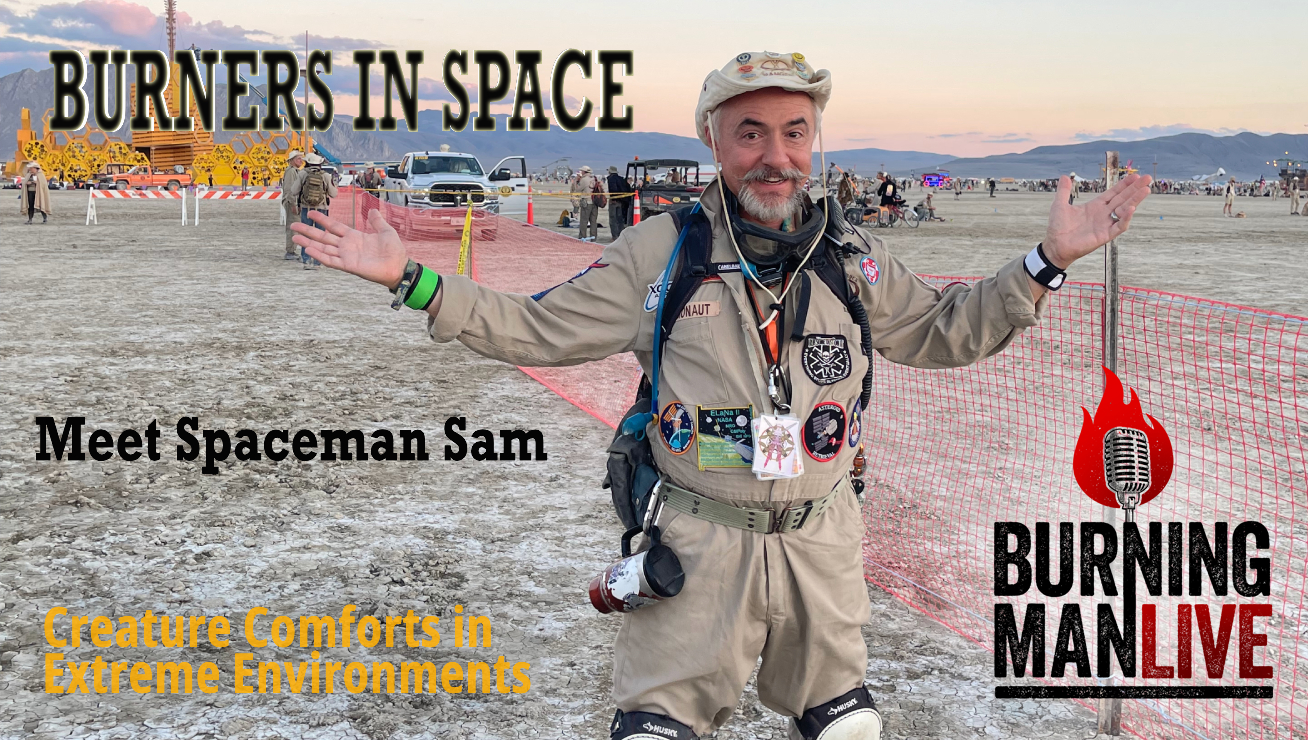
Andie Grace talks with Samuel M. Coniglio, aka Ranger Cosmonaut, and Spaceman Sam. He isn’t just a ten-year Black Rock Ranger and a veteran of the legendary Neverwas Haul (that three-story Victorian house on wheels)…
He’s a writer, inventor, and futurist who worked on the Space Shuttle and the ISS. From his Zero-G cocktail glass, to his book about making offworld living worth living, he studies creature comforts in extreme environments.
Stuart Mangrum opens the show with a look at the Lunar Codex, an ambitious project placing the art of 50,000 Earthlings (including Burners!) into permanent archives on the Moon.
Then, Sam and Andie spacewalk into why “civilizing a barbaric situation” is a human need, whether its serving fancy tea in a mud storm, or grilling chicken on a space station.
Hear about radical self-reliance, orbital infrastructure, and why—if we’re going to Mars—we’d better bring decent coffee… and a bucket.
“Burning Man is just like going to Las Vegas on Mars. You have to learn how to live on Mars first before you enjoy the parties. It’s survival first, party second… The Burning Man org learned we have to have toilets, roads, and support systems. NASA probably should learn from you guys.”
Transcript
SAMUEL:
Innovation. It’s like, okay, you’re in a strange new environment. It could be in the Black Rock Desert, and you’ve got dust storms and you’ve got heat. You’re dehydrating, you’re dying. What do you do? How do you make that environment more civilized, shall we say?
Humans are human, and humans like to human everywhere, whether it’s in orbit, whether it’s in Antarctica… I was with a group of people for a while there that served tea in fine china cups in the middle of nowhere, and suddenly we civilized a very barbaric situation.
ANDIE:
Indeed.
Meet the people who make Burning Man happen
around the world
the dreamers and doers.
the artists, freaks and fools
Burning Man LIVE
STUART:
Anyone who’s been to the Black Rock Desert will tell you that it can be otherworldly. And when you think about it, there are a lot of similarities between that big expanse of desert and space: its remoteness, the need to be both self-reliant and cooperative with the people who are going to help you stay alive; and of course, the environment being, let’s say, extremely hostile to your well-being.
Now, not too long ago, we were approached by the team behind the Lunar Codex, also known as the Museum of the Moon, to write a little something about that connection between the playa and outer space. The Lunar Codex is an ambitious project to create an enduring archive of human arts and creativity on the moon. So far, they have put up seven missions, both to the lunar surface and to lunar orbit, and they’ve included the work of—check this out—50,000 artists, writers, musicians, filmmakers from 262 nations and territories, including Black Rock City and the Burning Man world.
So here’s what I wrote for their book, which is called Manifest for the Moon:
“It’s not unusual for visitors to the Black Rock Desert to liken it to the moon. Since 1990, this vast expanse of ancient lakebed, 1200 square kilometers of blank canvas ringed by jagged mountains, has been the seasonal home to a temporary city of art and innovation that is like nothing on earth. For every Burning Man participant, but particularly for the artist, each year’s journey to the desert is something of a moonshot; logistically complex, not without its risks, but ultimately rewarding in countless ways.
Like the moon, just getting there can be a challenge. 200 kilometers from the nearest city of any size, accessible either by a two lane country road or light aircraft.
From the air, it resembles any number of the other dry lakes that were commandeered by the federal government during World War II, either for aerial gunnery practice for test flights, or as some like to believe, to reverse engineer alien technology.
If you run out of food or gas, or worse, out of water, there is no place to resupply. Like a space mission, you must plan carefully and take everything with you that you might possibly need on the journey.
Perhaps because of these complex logistics, the creation of Burning Man art has evolved into a highly collaborative endeavor. Building large scale interactive art in a remote and unforgiving environment is not a solo pursuit. Like space travel, it takes a team.
Whether you’re looking up at the moon and dreaming of installing art there, or standing on the moon and looking down on the art installations in Black Rock City, know that we are sharing a singular dream.”
Today we’re going to celebrate the space travelers in our midst. Our space entrepreneurs, space scientists. And, you know, there are a lot of them in our community. You may even have run into a few of them out there. And the plight of the Black Rock Desert.
If you’ve ever been to the Black Rock Observatory…
Or if you stopped by The Phage camp where all the science geeks hang out.
People like Will Marshall, who founded an Earth imaging company that’s putting microsatellites up in space to offer a near real time ‘living index’ of the planet.
Or Bill Halderman, who founded a space community called Life Ship that’s committed to sending DNA and seeds, stories and art out into the out into the skies, up to the moon and beyond.
Or how about Yasmine Elbaggari and Burning Man?
The artist and humanitarian is working to be the first Moroccan in space.
And Samuel M Coniglio, playa name Spaceman Sam. Sam is a writer, inventor, futurist, former vice president of the Space Tourism Society. He is also one of the mad geniuses behind the legendary Neverwas Haul, probably my favorite mutant vehicle of all time; a Victorian house on wheels. And if that’s not enough, how about a ten-year Black Rock Ranger? Sam has worked on the Space Shuttle, the International Space Station. He even reinvented the way we’re going to drink martinis in orbit with his Zero-G cocktail glass.
Our Andie Grace caught up with Sam to talk about living in space and his recently published book, Creature Comforts in Space: A Guide to Making Offworld Living Actually Worth Living.
Here’s Andie Grace talking to Sam Coniglio.
ANDIE:
Please welcome the retro futurist himself, Samuel M Coniglio. Hi.
SAMUEL:
Hello. Hello. Meow, meow.
ANDIE:
I just want to jump right in here because when we decided we were going to talk about space on Burning Man LIVE, you were the first person that came to my mind because space, and you’re also a Ranger and a veteran of the legendary Neverwas Haul.
SAMUEL:
Goodness gracious. Well, good morning, too.
ANDIE:
So I want to talk about a few things today. I’m going to start with space. You have said before that the Black Rock Desert is a space analog. For those people who haven’t been, what does a dust storm and deep playa teach about living in outer space that a NASA lab cannot?
SAMUEL:
So it’s all about comfort zones in extreme environments. I mean, we’re so used to just day to day using the bathroom and, you know, getting a snack from the fridge, and just cooking, cleaning, whatever, doing normal boring stuff. But all of a sudden, you yank yourself out of your suburban lifestyle and drop yourself in the middle of nowhere… where there are no conveniences, everything is inconvenient, and a number of these things are trying to kill you at any moment. And so it doesn’t mean you have to have the vacuum of space, per se, because you have to actually go up into orbit to deal with that fun stuff. But you know, when you’re in a place where there’s nothing out there, there’s no one out there, it’s you yourself and no one else, you have to figure out how to live, and rethink about the way you do things every day. One of the biggest things I learned about Burning Man is pulling yourself out of your comfort zone and adapting.
ANDIE:
And so has there ever been a moment at Burning Man where you looked at an art car or a camp and thought, we should be doing it this way in orbit?
SAMUEL:
Oh hell yeah. I’m a huge fan of a camp called the Alternative Energy Zone.
ANDIE:
Right on.
SAMUEL:
The AEZ folks, they’re generator-free. First of all, no generators are allowed. That’s the main precept there. They really focus on teaching you how to survive on the playa without generators, without making crazy noises, and be creative. How to innovate with random pieces of hardware to, you know, filter excess water, or to get power, or to create a misting fan shower out of just a bunch of fans, and stuff like that. Just finding ways to improvise and adapt to the environment you’re in.
ANDIE:
Full disclosure for everybody. I helped Sam with his book, Creature Comforts in Space and bringing it into the world. What was the labor like for your book? What was the hardest comfort to justify to skeptics?
SAMUEL:
First of all, thank you Andie. Thank you Actiongrl, for being such an awesome person, and supporting me during my time of trial. Trying to figure out, I have this idea now when I’d like to show it to the world, I have no frickin idea how to do it. And then you actually said, “Yeah, I’ll help you out.” And I was like, “Oh, okay.”
ANDIE:
Which one’s harder, surviving at Burning Man or writing a book?
SAMUEL:
Writing a book. It took me 30 years, like literally 30 years of iterations and variations, and I’ve written several drafts of this book over the years. And the world changed too, the space industry changed as well. And so new events were happening, new activities were happening.
ANDIE:
Right. Because it’s a very technical book. You are a technical writer by trade, correct?
SAMUEL:
I am a technical writer by trade. But I also call myself a retro futurist because I look at the past to help define the future. There’s many versions of the future based upon what we’ve seen in the past, and you learn a lot from it.
ANDIE:
So in space, you know, you’re focused on not dying and getting research done and that sort of thing; at Media Mecca in Black Rock City, we used to tell reporters that coming to Burning Man was like being on the surface of the Moon. But at Burning Man, we are also focused on radical self-expression. Then, frankly, we’re there to have a good time. What’s the middle ground for a space tourist who wants to feel like a human, not just a passenger?
SAMUEL:
Well, I tell everyone that Burning Man is just like going to Las Vegas on Mars. You have to learn how to survive on Mars first before you enjoy the parties. It’s survival first, party second. And you just have to get this through some of these people’s heads. And as you know, there are some folks, they jump off the bus with a bag full of whatever, doing what they’re going to do, with no water, no food, no camping supplies. And then all of a sudden, a few hours later, after doing whatever insane thing they just did, Oooooh….
ANDIE:
Yeah. 4000 foot elevation and desiccated, and… Yes.
SAMUEL:
Their heads get a little wonky, and eventually, of course, the Rangers come in and we have to help the person out.
ANDIE:
Well, and you, you go by Spaceman Sam and Retro Futurist, but you’re also a Ranger Cosmonaut. I believe. Space Cat.
SAMUEL:
I have lots of titles.
ANDIE:
You are a ten year Ranger. Tell me about that. How do these identities bleed together?
SAMUEL:
Yeah, I got my ten year pin this year. So ten year Ranger, 20+ Burner. Oh my God. And, yeah, actually, I met you my first year in 2002. I was like, “Here I am in the desert for the first time. What do I do?” And I heard, oh, they need volunteers. I was like, okay, I’ll just walk in this place called Media Mecca. Actiongirl over there talking to the camera people and the reporters saying, “Hey, you know, you fill out this form before you take pictures.” And anyways, yeah, ten year Rangering. What would you like to know about Rangering?
ANDIE:
How does your experience in the space industry relate to being a Ranger?
SAMUEL:
With the Rangering, it’s really, you know, use common sense, and always have backups. You know, just be careful out there. That’s the closest I can get with Rangering + space.
Burning Man + space, I can talk a little bit more about, but Rangering + space; it’s like, okay, just don’t do stupid things.
ANDIE:
That’s so straightforward. It only makes sense.
Well, let’s talk about your Zero-G cocktail glass. You’ve invented this way to consume a drink in space, which is fascinating, because all I think about when I think about a drink in space is that liquid floating around and damaging equipment. So, talk to me about the ritual of a drink. Why is it essential for a long term space settlement?
SAMUEL:
Well, humans are human, and humans like to human everywhere. And so whether it’s in orbit, whether it’s in Antarctica… One of my Cacophony friends, Sandwich Girl, she actually worked in…
ANDIE:
Sandwich Girl.
SAMUEL:
Sandwich Girl. Yeah. Cacophony 2.0. I was actually part of Cacophony 2.0 for a while there. That’s how I got involved with this madness.
She actually told me some of the stories they did to keep their sanity in Antarctica, because you’re stuck in McMurdo, the scientific base, while the scientists are doing their thing. There’s also the support team to keep the base running operationally. But they did a lot of wacky stuff as well. When you’re out there long enough, you know, you can run around naked out in the Arctic cold and not mind too much because you’re used to it, so…
But anyways, they did silly things to keep their sanity because the boredom, the loneliness, the whatever, you know. You gotta do stuff to survive.
I did some research on long term travels in extreme environments, such as the deep seas and the oceans and things like that.
There’s this story about the Titanic, and there was this baker who helped, supply all the boats, rescue boats with food and stuff like that, but he would be constantly drinking whiskey throughout the entire time. He was smashed. But yet the whiskey made him focused. He did his thing, even though the entire boat was listing and starting to sink into the water, he kept his cool throughout the entire time at the very end. And if you look at, watch the Titanic movie, he went up to the very, the stern of the boat waited for the ship to sink, and he was the last man in the water.
ANDIE:
Wow.
SAMUEL:
He like, knocked all the tables and chairs into the ocean. He jumped and he grabbed on to one of them. He was calm through the whole thing. This is actually his report in the deposition. They were trying to find out why the Titanic sank. He was one of the people interviewed. Everybody thought he was a laughingstock, they thought he was crazy. But a few days after the Titanic crash and he was rescued with everyone else, back in New York City, he got another job, just started working like normal, just another day.
Yah. So drinking, the psychology of drinking. I mean, some people get smashed just to say blyahhh, do whatever, but it definitely changes your personality. And it can go many different ways depending upon what’s inside of you. For some people, it’s just, I want to be stupid and do stupid things. For other people, it makes them relaxed and allows you to kind of like see the world in a different light, and have a little bit more calmness in a situation.
And so in that guy’s case, he figured out, okay, well, we’re all going to die, but let’s see what we can do to prevent that. And he just calmly, methodically tried to help people as much as possible. And when the time came, he said, okay. He didn’t scream. He didn’t yell. He didn’t freak out. He was like, oh, well, I’ll be last. And then hopefully I’ll just hop on a boat. And he did.
ANDIE:
What a guy.
Well, so tell me how a Zero-G cocktail glass keeps the drink in the glass.
SAMUEL:
So the whole idea of this cocktail glass, and this is for fun. I was inspired by astronaut Donald Pettit. He invented this thing called the zero gravity coffee cup. Water and liquids act differently without gravity. With gravity, we’re used to everything going down. Without gravity, they just kind of like float as blobs, and they stick to things. And so Donald Pettit, the astronaut, created this coffee cup. It has this very interesting little teardrop shape. Because of surface tension, the liquid likes to collect at the V, the pointy bit of the glass. And so you can naturally, in a weightless environment without gravity, have the liquids collect in one side of the glass and you can drink it.
So I took this idea as an inspiration to create my zero gravity cocktail glass, which gets really fancy with all these extra grooves. And all the grooves go to a single point. And so you can naturally sip on the drink, and then liquids would come into your mouth and you don’t have to worry about things getting like stuck, or hanging in the corner or whatever.
This is the wonderful thing about science, Donald Pettit was one of the best astronauts out there because he did pure science. He just played. He played with water. He played with liquids. One of my favorite scenes in one of the videos he did was he had chopsticks and a blob of coffee, like a blob of coffee floating around. He used chopsticks to eat his coffee.
ANDIE:
I want to try that!
SAMUEL:
Innovation. It’s like, okay, you’re in a strange new environment. It could be in the Black Rock Desert, and you’ve got dust storms and you’ve got heat. You’re dehydrating, you’re dying. What do you do? How do you make that environment more civilized, shall we say? And that’s the challenge here. And so I was with a group of people for a while there that served tea in fine china cups in the middle of nowhere, and suddenly we civilized a very barbaric situation.
ANDIE:
Indeed.
I’m curious about your thoughts on the soul of space travel right now. We have Space X and Blue Origin, and it’s becoming a little bit more commercial. Do you think the soul of space travel is at risk of becoming too corporate? How do you keep it edgy? How do you keep that play?
SAMUEL:
Ahh. A: It’s long frickin’ overdue. As someone who’s been in the industry for many, many years, we’ve been struggling for progress to allow people like you and me, regular folks, to buy a ticket and go. You know, we keep thinking of travel like airline tickets. You buy a ticket, you fly or train ticket you buy and you go. For space travel we’ve been waiting and waiting and waiting and waiting for the last 30, 40, 50 years for that opportunity to do that.
And just now we’re starting to have that moment with Blue Origin and Virgin Galactic and even SpaceX. If you have the money, you could do it. You can take a joyride to the edge of space. You can fly up there, have a few moments of floating around and see the incredible vista of the edge of the earth and the stars and everything, and come back down. Or, spend more money and you can go up with SpaceX on to one of their rockets, and you can go onto the space station, or you can do just a couple orbital flights on that starship, and you’re doing great.
Society is waiting for the moment where there are permanently manned space hotels and space stations for the rest of us, not just the elite, government employee to do the science. And they’re important, too. We got to have them as well. But it’s like, okay, we’ve been doing the space thing for a long time. When are we going to allow the rest of us to go play up there and work up there and do things up there?
I know about folks who are trying to build factories in orbit. You heard about the whole data center orbit thing, and that’s a whole other topic. AI and all that stuff. But it’s time to expand to the new frontier. And we talk about the frontier, it’s our analogy like the Wild West? You know, we’re standing out there. Imagine having settlements on the Moon and on Mars and in orbit and mining the asteroids for raw materials,so we don’t have to keep sucking our own planet dry of raw materials. There’s an entire frickin universe out there. Let’s work with that. Let’s move beyond our little spot to the rest of the universe.
ANDIE:
Let’s talk a little bit about your entrée into Burning Man, and that Cacophony 2.0. Tell me about your history there and how you ended up in the desert in the first place.
SAMUEL:
Well, I moved to, from the East coast to San Francisco Bay area around ‘99 / 2000 time frame. I first moved to San Jose because: jobs. But I’ll tell you what. San Jose and Silicon Valley is really boring when it comes to social life and activities. You want to date someone, but you can’t find anyone because everybody’s in their office working. I was like, oh, this is boring. And then I also realized, heck, if I gotta pay this ridiculous amount of money for rent, I might as well do it in San Francisco.
So, I moved to San Francisco. And I’ll tell you what, that was the most amazing time of my life, meeting all these cast of character, because, I mean, I don’t care what your day job is, once the after hours happens, people just let loose in San Francisco with their creativity and their wackiness and they’re like, oh my gosh, what are we doing here?
ANDIE:
It was a glorious heyday.
SAMUEL:
So, yeah. I discovered Renaissance Faires, the Dickens Fair. I was doing ballroom dancing for a while, swing dancing. I discovered these weirdos doing these shenanigans in the street in San Francisco. It was on Castro Street. It was like “Hippies versus the Man.” I was like, what the heck is that all about? You got these guys in suits, and you guys, guys looked like hippies and they’re trying to get ‘the thing.’ The thing was like, pot supposedly was pot. And they were doing these shenanigans in the street. I was like, what the hell are these guys doing? And then I eventually started a conversation with one person, and one thing led to another and like, boom!
So now I became Paparazzi Pooch. I had a camera with me and I had a funny hat with dog ears on it. And we’re doing the Urban Iditarod, and running around the streets as dogs, and, you know, ‘mushing them huskies,’ and doing silly things in the street. And then you had Urban Golf where we’re playing golf. I mean, I thought it was the best damn golf game ever. 18 holes. And at the end of each hole was a bar. So we had one drink per bar. 18 holes later: Oy.
But yeah, we had all sorts of crazy parties: Bunny Jam and other wacky underground events. And Chicken John had the Odeon Bar.
ANDIE:
I was a bartender at the Odeon!
SAMUEL:
Yeah, just ancient history, so us old farts here. You know, Odeon bar was, like, you know, you never knew who was going to walk in the bar. It was going to be Santa Claus, or it’s going to be a clown, or it’s going to be some other crazy shenanigans walking into the Odeon bar. That’s a San Francisco bar. It was awesome.
So yeah, I just stumbled upon these people having these crazy adventures. It was great. One of those adventures was going out to the desert. And so I discovered this thing called Juplaya. And so here I am wearing my spacesuit, you know, bright orange light suit wandering the desert. Then this white van pulls up and the door opens, and says, “Get in!” It’s like, “Oh, okay. So…” It’s people I knew! And we get in the van and we drive to the Frog Pond, and we’re all getting naked and swimming in the Frog Pond out there. Juplaya, just wacky…
For those who don’t know, Juplaya is what happens on the Black Rock Desert when it’s not Burning Man. You know? You know, right before the July time frame, people just go out there and do silly stuff because they can do silly stuff. And there’s no borders, no limits, no nothing. You know, last time I went there with my family, we were launching rockets. We had model rockets. We were launching rockets. And my son at the time was just having a blast as we were just launching the rockets. It was great.
And then the Burn happened. One thing led to another and I was like, “Oh, okay. What the hell is this place?” And there you go.
ANDIE:
So you actually, as a Ranger, I think you run the Ten Forward Cafe. It’s at Outpost Berlin. Is that right?
SAMUEL:
Yeah. I’m one of the instigators. I didn’t create it initially, but I’ve been one of the managers of it.
The Rangers have several different outposts. You got your Ranger HQ. You got your Ranger Tokyo. You’ve got Outpost Berlin. There’s also Moscow and a couple ther places, but, you know, they’re boring. They’re all workaholics, so leave them alone. Some Rangers, that’s all they do. They live and breathe Rangering. It’s like, dude, go play. Enjoy.
ANDIE:
Very important.
SAMUEL:
Get out there and play.
So anyways, Outpost Berlin, we’re 3:00 and C, and we’re a good place for information. And if you need help, just come on over. We’re always available. We always have somebody with a walkie talkie on.
I’ll tell you about the Mud Burn. We have a tiny little cafe that popped up, and it’s just a coffee shop, and I’m a tea guy, so I brought all the different types of teas: Earl Gray, cardamon tea, other teas. And then we have a couple other folks who are coffee fanatics, and they gotta do the pour over. So we try to find ways to be as efficient in making the hot water and making the teas and the coffees without MOOPing. We’ve got ways to filter the coffee filters and get the water out, and we have special bins to have the coffee grounds taken care of. Everything had to be either biodegradable or easy to manage, and they’re not going to make a mess in the playa. So we kept it really simple, very straightforward.
The funny thing was our first year of doing this was the 2023 Mud Burn. So we just had a couple of days of just doing our thing, and all of a sudden, you know, it rained. Mud happened. Everybody’s freaking out. Of course, us Rangers are like, “Yeah, we were trained for this! We can deal with survival situations. No problem.” And so we basically reactivated the coffee shop during the Mud Burn because, you know, citizens were coming in from all over the place like, “Help. What do we do? Ahhh!”
Once again, this is the issue of our comfort zone. Remember, you are going to Las Vegas on Mars. You have to learn how to deal with Mars before you deal with Las Vegas.
So people came to the Outpost Berlin. We put up a big poster that says: Here’s a list of camps that have supplies, and here’s a list of camps that need supplies. And people asked questions, interacted. We actually opened up our Wi-Fi to the public. And we were serving coffee and tea. It was like the crappiest Starbucks ever, I guess. You know, we had good coffee and tea, but the worst Wi-Fi ever! But people would show up and they felt better because,
A: They’re under some shade because the rain kept coming down.
B: They had people they could talk to.
C: They had coffee. That makes everybody happy.
ANDIE:
Right. Well, and in the Star Trek universe, the Ten Forward is the heart of the ship, right? So creature comforts are necessary. That connection is necessary as a human feature. So why is it that the community hub is kind of the last thing that they plan in space missions?
SAMUEL:
Uh. Mindset issue. NASA is notorious for this because they’re all focused on science, science, science, and not so much on the enjoyment of living.
In my book, I talk about the challenges of building a shower in space. And the last shower that was attempted by NASA was Skylab, which was back in the 1970s. Um, very poorly designed. It was like a collapsible tube that went up and down. You would, like, turn the water on and take a shower. And basically it’s like a couple of minutes in the shower and you spent like four hours cleaning up the mess because they didn’t have a proper drainage system. And like, I was talking about water bubbles earlier, the blobs were getting everywhere. It was like sticking to electronic equipment and wiring, and getting into sensitive areas. So they had to struggle with towels to mop up all this mess everywhere. Today on the International Space Station, there are no showers. They use baby wipes.
ANDIE:
Just like at Burning Man.
SAMUEL:
Just like at Burning Man. There’s a lot of similarities. If you think of long term camping, how do you survive when you’re off the grid? There’s some serious similarities to what’s happening on the International Space Station. You have very limited water. You have very limited food and resources, and ways of cooking things and maintaining things. So you have to be as super efficient as you can and try to recycle as much as possible. So baby wipes for the win for everybody, I’ll tell you what, here and up there. But the question is: Do you want to do that for years? Do you wanna do that forever?
ANDIE:
I love a hot shower, man. I would miss it so much.
SAMUEL:
NASA had the scientific mindset saying, oh, this is not very efficient for water use, just use a wipe or a towel. But psychologically, showers are nice. Psychologically, baths are really nice. Um. Baths are not safe, by the way, if you’re in a weightless environment because it will become one giant water blob that envelops your entire body. You can’t get out and you might die. So don’t take a bath.
ANDIE:
Yikes.
SAMUEL:
But there are ways to create a shower in a weightless environment, and there are ways to create showers in Burning Man, where you can be as efficient as you can with the water. You could technically create a shower that will recycle the gray water, or manage it in some way, on the playa, and you can do the same thing in space.
And in my book I talk about how you can take the waste water and send it to a garden and have a wastewater gardening system, and have the plants filter out the impurities and the dirt and the gunk. And guess what? You’re watering the plants, making them very happy. And oh by the way, those plants could have fruits and vegetables on them, and you can eat those! Yay! You just created a cycle!
ANDIE:
Well, now you got me thinking about food, and the infamous playa snack of bacon. Can you have bacon in outer space?
SAMUEL:
Not officially. Not officially, right now. The problem with certain foods… you have to worry about, once again, blobs and stuff like that. You don’t want a hot, boiling grease blob floating around. The challenge of cooking food and drink. Without gravity you don’t have convection currents for airflow to help cook things properly. So you can’t just simply stick something in the oven and hope it will cook, you have to have a touching; conductivity, basically. I use the analogy of the George Foreman grill, where if you want to cook something, you have to have two metal plates slamming on top of the food to physically touch it.
ANDIE:
Got it.
SAMUEL:
What NASA does right now is everything’s in a bloody plastic bag, and you have to heat the plastic bag, which heats the item that’s inside. Yay, smell of plastic. But they do a lot of outgassing management with that type of thing. But bacon is just a no bueno because of all the hot grease and all the waste in it.
But the Chinese are catching up. And recently there was a video of, on the Chinese space station… By the way, I hope you know that China has a space station.
ANDIE:
I know now.
SAMUEL:
Okay, great. So, China copycats everything we do now, they have their own version of NASA. They have their own version of a space station up there. And there’s a video of them testing out how to grill chicken. They basically have something that looks very similar to an air fryer. And they had a metal plate and a mesh grid on top of it. And they cooked the chicken just by having the physical connections there. And they grilled it. And it was open air. There was no plastic or anything. It was just, there it is. They grilled it and they ate it. Innovations like that. We need to experiment more with that.
CHINESE ASTRONAUT WO FEI:
Look at that! It’s sizzling with oil. Looks great, smells great, must taste great!
SAMUEL:
There’s a program called the NASA Deep Space Food Challenge, where a lot of scientists and innovators and inventors are working on alternative ways of cooking food, safely in a weightless environment and being able to manage the blobs and things floating away and stuff like that.
There is like a whole list of foods that are banned from going into space because of things that can float away and make a giant mess, because of crumbs. Bacon is one of those banned items, but if there’s a new way of cooking them, you might be able to do it without creating too much of a mess.
ANDIE:
No bacon. No cookies. Gosh, that doesn’t sound very creature comforting at all.
SAMUEL:
Yeah. And also, define what is a creature comfort? What is your creature comfort my dear?
ANDIE:
Oh, gosh. If I was going to go to outer space and I didn’t have sparkling water, that’s it. I like sparkling water a lot.
SAMUEL:
The bubbles in space separate into one area. So you have the carbon dioxide on one side and the water on the other side.
ANDIE:
Really?
SAMUEL:
Yeah. It just naturally separates.
ANDIE:
It makes sense.
SAMUEL:
What is your creature comfort on the playa, though? That’s the big question.
ANDIE:
I bring a ton of sparkling water out there.
SAMUEL:
Okay.
ANDIE:
I also change my socks twice a day and lotion my feet.
SAMUEL:
Lotion, lotion, lotion. There you go. Yeah. Yeah. Do you do the vinegar foot bath, and all that stuff too, or?
ANDIE:
Oh, yes. Yeah.
SAMUEL:
Okay
ANDIE:
Definitely bring the vinegar.
What about you? What’s your creature comfort on the playa?
SAMUEL:
Besides gin and tonics, and a good cup of tea? Proper shade, proper shade.
Lessons learned from Burning Man, learning about how to adapt to the environment. I learned about aluminet shadecloth. I learned about lag bolts to keep everything bolted down. Oh, my God, that’s amazing. I learned how to orient my vehicle against the wind so that my truck blocks most of the wind coming in from the west-southwest. That’s where typically it’s coming in, mostly; and being able to orient the shade structure so it’s blocking most of the sun. The different materials you might be using, obtainium.
ANDIE:
Obtainium!
SAMUEL:
Something we can acquire.
Yeah. I learned so much with that art group. You know, now we have a pretty good spaceship situation on the playa, so we can resist the storms, and resist the high heat, and have, you know, battery-powered fans and portable battery generators, not be too noisy, and be self-sufficient.
ANDIE:
So tell me about Obtanium Works and the Neverwas Haul. Can you describe that for us?
SAMUEL:
Dun dun dun!
I stumbled upon Obtanium Works way back in the day. One thing led to another. From 2009 on, I just was with the crew, constantly, building art cars and doing art. It was fantastic, you know, discovering a new world because like I said, when you move to San Francisco, it’s like, oh my God, these arts and these art studios and these art spaces and they’re making things, and so…
Before they were called Obtainium Works there were just the Neverwas Haul crew. And they were at this place called the Shipyard in Berkeley. The Neverwas Haul is a three story Victorian house on wheels. It’s a mobile theatrical set piece, designed and built by Shannon O’Hare, and a lot of volunteers.
Shannon O’Hare is a master of set design. He’s been building Renaissance Faire theaters. He was born and raised at the Oakland Children’s Fairyland Park. I mean, he basically, he is Children’s Fairyland Park; a master builder. You name a material, he’s built with it, just has done everything with it, and master theatrical guy. Just amazing.
He helped build the, uh, something called the Clock Tower back in 2005. And that’s where he met this guy named Kimric Smythe and all these other strange characters. He had this crazy idea of, like, “Let’s create a Victorian house on tank treads, it’s going to drive through the desert, and, it’s going to be, instead of British, we’re going to be Irish. And imagine the Hibernian Empire where Ireland took over the world instead of the British taking over the world. And..!” Stuff like that.
So that fantasy just kept going, going, going. And all of a sudden we had a huge crew of people in 2006 building this multi-story structure on this poor trailer that’s been carrying a lot of weight. I’m very impressed because they used, for example, they used door hinges to hold the different parts of the walls together. And the cool thing about that is simply if you pull the pin out and you can start taking down and collapse everything. And it was called the Neverwas Haul.
ANDIE:
Well, I thought it was a brilliant idea because it’s just a beautiful sight to see. And if you have not seen it before, folks, you should look up some pictures. It really is impressive: a three storey Victorian house on wheels.
All right, well, here’s one that’s kind of a controversial topic that people talk about often these days. Do you think we should go to Mars?
SAMUEL:
Um. We should learn how to live out in space before you even think about going to Mars. Or the Moon. Learn about the fundamentals of just basic cooking, cleaning, living, day to day stuff. We have a space station where we’ve learned a lot, and yet at the same time, we’re not adapting to the human experience. We need more practice just living, working, and playing in space. Mars: long drive to get there, long drive to get back. And unless you create what’s called an orbital infrastructure support system to help those people, they’re going to die, period. You need support.
And just like on the playa, we need to set infrastructure. We need porta potties, right? And we need Rangers, and we need fire support. We need other things to help people go. And unfortunately, you know, NASA hasn’t gotten that figured out yet.
We just barely scratched the surface of what’s going on here. Talking about the Neverwas Haul, talking about space travel.
ANDIE:
Right.
SAMUEL:
Long story short, going from discovering Cacophony and Burning Man back in 2002
and then me running off doing my space adventures from the years later, after that
working at the Kennedy Space Center and Space Shuttle and Space Station
working on a DC-X rocket project.
And then I kind of moved in this area called space tourism. And that’s where this whole crazy thing about the cocktail glass came in. I became a world expert in something called space tourism, private space travel for you and me, and how to make it enjoyable and comfortable.
So it all fits in with the idea of creature comforts. Tourists want to have some enjoyment. Yes, they want to go to Antarctica, but they also want to at least have a decent cup of coffee while they’re there. So you got to plan for the logistics behind it, looking at all the fundamentals of just living and survival, while we go to the Moon or Mars or whatever. And, I think Burning Man is more ready for going to Mars than NASA is for going to Mars.
They’ve been stuck in the past for so long. And that’s why you may have heard about the Artemis Project is being reorganized right now. Thank God. Uh. Don’t get me started, because there’s a lot of people who want to live in the past, and keep certain constituents financially employed no matter what, even though their projects are totally out of date. And meanwhile, the private commercial guys are trying to, like, build infrastructure in space to live longer.
The Burning Man org learned that we have to have toilets. We have to have the roads prepared. We need to have people to do MOOP patrols. You have to have people to be there for emergencies. You have a whole support system with Burning Man, which is amazing. NASA probably should learn from you guys, actually. Just get these fundamentals working before you expand and go beyond your environment.
And that’s the challenge right now is that, you know, a bunch of folks in my world with the commercial space field, they want to build the orbital infrastructure. They want to get rid of the old garbage space satellites that have been taking up space and is now creating a traffic jam out there. We need to have communication systems from point A to point B. We need to have resupply shells going back and forth constantly between the Earth and Moon and Mars and all that. That needs to be happening now before you send people to Mars. You can’t just say, “Okay, one big ship, go!” You’re going to run out of supplies. You need to have a constant resupply system, a support system to keep people alive.
Now, you got that going on with Burning Man. And there’s some folks who, they bring all the gear with them. They’re ready to go. Cool. But for the larger show, you have to have a support system. You have to have the logistics to keep people going and help people out and maintain support.
ANDIE:
We joke about ‘safety third,’ but it’s really ‘safety first,’ and then ‘have fun second.’
SAMUEL:
Oh, absolutely. You have to prepare for all sorts of contingencies. And yes, stupid is going to happen. People are going to do random crazy stuff… Once in a while, the random crazy stuff actually becomes very innovative and it’s really good. For the most part, no, and people get hurt.
ANDIE:
What’s the most common question people ask you about as far as creature comforts in space?
SAMUEL:
Well, besides going to the bathroom, that’s number one. Um.
ANDIE:
Number one and number two! Haha.
SAMUEL:
Number 1 and number 2, which, by the way, is one of the most embarrassing things to do because of the lack of gravity. When you go to the bathroom, where does it go? It floats. And you may move away from the toilet, but it may follow you, so…
ANDIE:
That doesn’t sound pleasant. That makes a porta potty sound like a walk in the park.
SAMUEL:
And that’s why you need to innovate and invent a new kind of toilet in a weightless environment. No one wants to talk about it because, ewwww! Well, guess what? We have to talk about these things.
ANDIE:
Right? Yeah, that’s one of the first things you got to handle, I’m sure.
SAMUEL:
Well, not literally handle, but, I mean. There are other ways.
ANDIE:
We’ve made two bathroom jokes in the last minute. Go, us!
SAMUEL:
Imagine what happened with the porta potties dealing with the mud apocalypse in 2023. The porta potties were filling up and there was no cleanup crew because you have those trucks coming in all the time trying to clean up the porta potties. But when there’s mud, nothing moves. So now all of a sudden, people had to innovate. It’s like, well, how do I go to the bathroom? What do I do? What do I do? That’s why you always have to have a bucket as a backup.
ANDIE:
Yes, indeed.
Final set of questions here.
Why Burning Man?
Why do you keep going back?
And what is Burning Man’s relevance in the modern world beyond teaching NASA how we could do better?
SAMUEL:
Good question. Why do I keep going back? I just do. It’s family. It’s friends. It’s awesome, weird shit. It’s one of those places where I can actually just play and be myself, you know, wear whatever costume I’ve got, and just do silly shenanigans, and see stunning, stunning, stunning art and people doing amazing things with sculpture, and creativity, and fun.
And I get to manage fires. I get to run around and make sure that people don’t die! I get to run around and say, “Hey, you’re all beautiful people, but you’re all incredibly flammable. Please step back!”
ANDIE:
Yes. “Don’t get crispy.”
Is there anything that I didn’t ask you about yet that you wanted to make sure we talk about?
SAMUEL:
Talking about Burning Man and space and Neverwas Haul and all that, I mean, for me, it all overlaps because I’m doing all of them at once. But for everyone else, it’s like, “Whaaat? Who is this weirdo?”
ANDIE:
Retro futurist!
Well, I’ve so enjoyed catching up with you again. It was a pleasure to work on your book and help bring it into the world; very, very complex and detailed, and I learned so much, so, thanks for sharing it with us, alright?
SAMUEL:
And thank you very much for everything you do, both of you guys. Thank you, Michael. Thank you, Andie.
ANDIE:
Alright. Vav?
Vav, you’re muted.
VAV:
Andie. Samuel. Is someone clicking a pen?
SAMUEL:
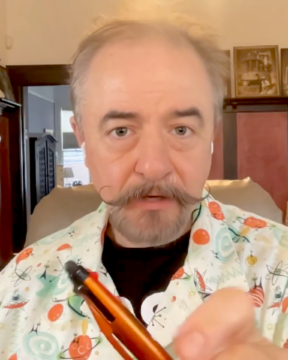
I have a rocket pen with four colors on it, so…
VAV:
Samuel, I’m going to need you to stop clicking the pen!!!
SAMUEL:
Yes.
ANDIE:
He’s a professional!
VAV:
OK. That worked!
Stuart, take us home.
STUART:
Burning Man LIVE is a production of the nonprofit Burning Man Project, made possible in part by donations by kind, generous souls like you who pop a few bucks into the slot at DONATE.BURNINGMAN.ORG. No amount too small or too big. Thank you very much.
You know it takes a village to put a podcast together, or at least a sizable camp. So please, please, please appreciate all the folks who helped make the magic happen:
- Our guest, Sam Coniglio
- Your host, Andie Grace
- Lead engineer and story editor, Michael Vav
- Quality assurer, DJ Toil
Thanks also to kbot and Martini of the Burning Man Project Communications team.
And if I forgot anyone, thank you too.
I’m Stuart Mangrum.
Thanks, Larry.