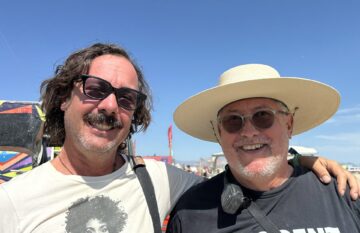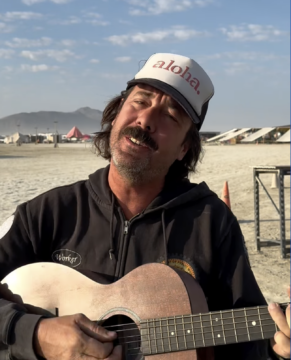


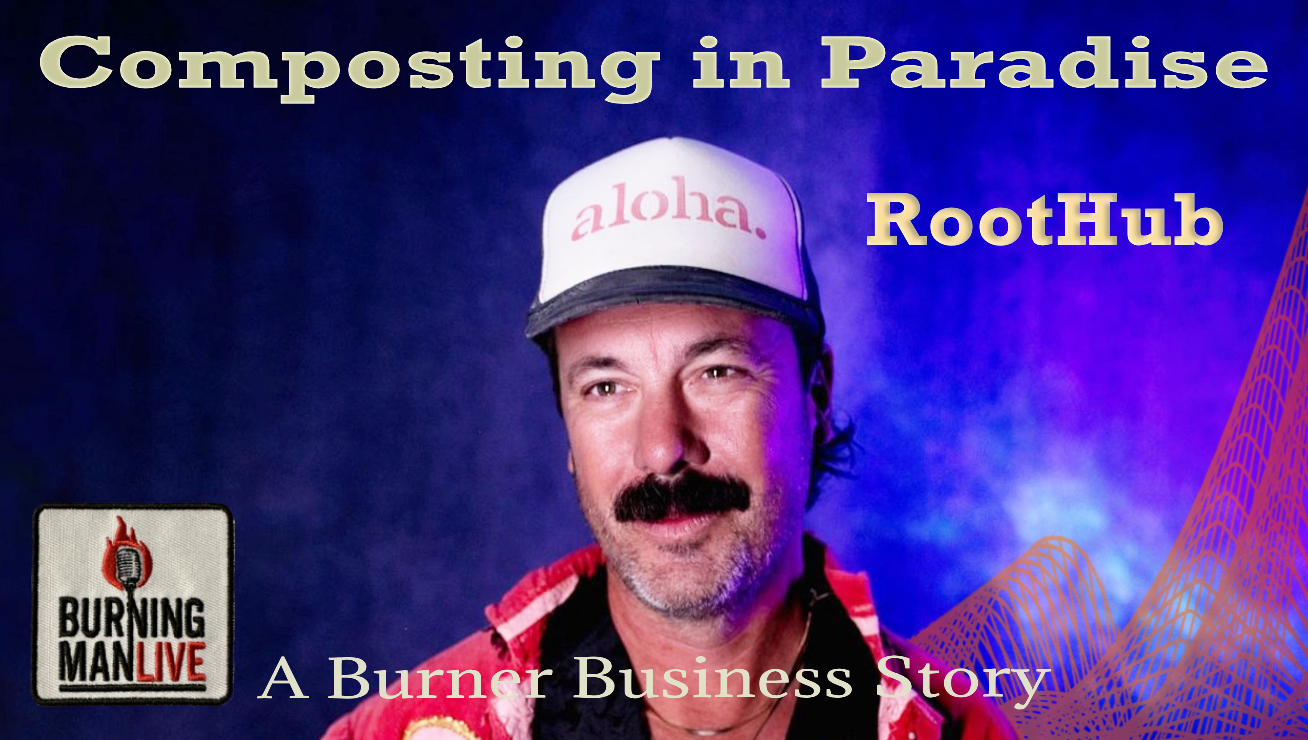
RootHub (aka Aloha) weaves the core values and shared struggle of building Black Rock City and his work in Hawai‘i. He draws inspiration from the Hawaiian people’s concept of kuleana (responsibility to the land and community).
When he’s not building BRC with DPW, or playing music to amplify people’s stories, he’s diverting food waste from landfills and incinerators into much needed, nutrient-dense soil for growing food. He does this through his companies. The names say it all:
· Full Circle Solutions Hawaii
· Leftover Love Company (“We love your leftovers”)
Hear how ingenuity learned on the playa—along with a sense of humor—allows him to overcome hurdles and create meaningful change in BRC and in Hawai’i, even with the naive tourists.
Through sweet story and song, he shares how to combine innovation with tradition, to lift the stone without lifting the weight of the stone.
burningman.org/black-rock-city/infrastructure/dept-of-public-works
Transcript
ROOTHUB:
This place can really activate parts of you that, even as you’re going through it, you don’t realize until years later. It’s like these frequencies, these seeds that start, and grow over time, the more you show up; the more you give without expecting some sort of reciprocity; the more you lean into struggle; the more you take care of yourself as you do all of these things.
That impact of community and my place in it, and my own value, has been exponentially grown through both my experience of showing up here in the city to build this place and then take it apart every year, and to show up in my community in Hawai’i. It has had such a meaningful impact on my own self-worth. As I’m saying it I recognize that it keeps on growing. It keeps on getting better.
STUART:
Here on the great playa of the Black Desert, you’re listening to Burning Man LIVE. I am Stuart Mangrum, and I’m here with… What’s your government name again?
ROOTHUB:
My government name is Gregory Allen Williams.
STUART:
Okay, well, we all know him as Aloha.
ROOTHUB:
And RootHub.
STUART:
And RootHub… You’ve got so many names. You got a rap sheet full of aliases.
ROOTHUB:
You gotta keep ‘em guessing.
STUART:
Keep on the move. Yeah.
Aloha is here because, well, because he’s just fun. And he is a long time staff member in the Department of Public Works. He has a super interesting life, and a really innovative business in his home in O‘ahu.
ROOTHUB:
Let’s clarify something. I’m not born there, nor would I ever be called Aloha in Hawai’i. That wouldn’t be pono. So the reason why they call me that out here is my name, RootHub, was too hard to say on the radio. They would say foot scrub, hubcap, group hug, so… I have a cap that says Aloha, so they started calling me that.
STUART:
So walk me through your history out here in Black Rock City.
ROOTHUB:
My first burn was 2002. I was dragged out here by a fellow named Buck Down, who is a tremendous writer and one of my closest friends. And, I worked with The Mutaytor on an Esplanade camp called The Island of Misfit Science, where a Burning Man legend named Doctor MegaVolt took me under his wing,
STUART:
Wow.
ROOTHUB:
and handed me a kill switch for a Tesla coil that shot like lightning bolts everywhere.
And back then, there wasn’t all of the light, so when that show started, everybody would just gravitate to it. I would be terrified because I’d see all these people on different kind of sensory experiences coming towards this thing.
But it was great. I really learned a lot about… what I learned in Hawai’i about community, and shared struggle was amplified out here, helped me with my music and what I do to amplify other people’s stories. And that was a magic year.
STUART:
Go back to the kill switch. Can a Tesla coil go critical mass and start frying people?
ROOTHUB:
For those of you that are listening that don’t know what MegaVolt did, he is a very brilliant double PhD man who also devised this Tesla coil that shot lightning bolts that were like, you know, 25 feet. And he would wear a metal chainmail suit, with metal boots and gloves and a giant bird cage on his head. And he would be shot by these lightning bolts.
That lightning bolt would hit either his suit or his bird cage, and it would, the energy would pass through down to his feet and to the metal we put downstairs. So he was safe, but if anybody else touched that thing, he told me it would at the very least, blow their arm off up to their shoulder. And then most likely they would be un-alived.
So to be holding that kill switch, not really knowing what this city was, was quite an indoctrination into making sure that everybody’s taken care of, and it’s not your job, it’s your turn. So luckily we didn’t ever have to push that kill switch. All right. Yeah. That was my first…
STUART:
Good eye. Safety was there.
ROOTHUB:
… My first job here. Yeah. We had a very feeble little trash fence around the stage.
STUART:
And at what point did you get into the Department of Public Works?
ROOTHUB:
I took about 12 years away after that because I was touring, playing music, and then the opportunity to return here arrived, and it was just so needed. It was such a great experience to return here, and to – I think it was 2015 – and then my friend Romer brought me over to First Camp, which I didn’t know what it was when I got there and had no idea.
And I kind of have social anxiety sometimes around new circles. And I was just kind of sitting there, wallflowering, watching all these people do curious things. And, somebody there, Razzle Dazzle came up and said, “Hey, I heard you play guitar.” I was like, “Yeah, I do, but I don’t have one.” I was like heh heh.
And then she ran away and she showed back up and, it was this party and I had the choice to just keep shrinking away, or like show them what I do, and I did. When I first showed up, there was a little bit of like, “Excuse me, who are you?” And after I played the song, they were like, “Whoa, who are you?”
And I don’t mind
when you need to think it over
I don’t subscribe too tight
And I ain’t clockin’ you at all
I ain’t lockin’ you up
at all, at all, at all
ROOTHUB:
And then I connected with Tom Sawyer, who was a DPW legend.
STUART:
He used to lead the First Camp build.
ROOTHUB:
Yeah. Yeah. And we became close. And he passed away from liver cancer the following year, but we became close, and there was that gap, you know. He wasn’t there. And him and Dust Bunny used to do the job of like six people at that camp. And so that became… I started carrying his water in 2015, and working with Starchild on that build and just trying to navigate being liaison between First Camp and DPW, and how much that has taught me.
STUART:
What is First Camp? How do you describe it to people? I’ve heard many different descriptions of it.
ROOTHUB:
Right. First Camp is a legacy camp that has gone through some evolutions since Will first started it. But now it’s a place where Will and Crimson still live, and Jackrabbit lives. And um, it’s a place where a lot of people that help grow what we’re all doing out here from levels that I do comprehend and levels that I don’t comprehend.
And a lot of interaction comes from, you know, people all over the city from, people in DPW to people that build massive art projects to people that are in government work, the people that help us continue to have this giant kegger in the desert.
STUART:
That’s a good description. Originally it was literally the first camp on the playa because Will Roger would park his trailer and…
ROOTHUB:
Yeah, that’s the funny thing about that name is that it gets contended about what it is, but you’re exactly right. It was just the first one around. So yeah. Here it is! The first camp! Speaking of that, so I was working here for multiple years and I would always see Will and Crimson, and Larry Harvey sitting up in those chairs, as like this kind of iconic thing, of these people that I never thought I would ever interact with. And Coyote would come up there and he would tell them these stories. He’d be like, you know, “And then the Volare jumped this ramp…” and I would just be like passing by…
STUART:
“with a broken axle!”
ROOTHUB:
And I just lay here. He’s like “And Chicken John…” and I’d just be like, “What is this?!”
And eventually he asked me to come up and sit there with them. And I just sat and listened to all four of them exchange stories and got some more downloads from this whole thing. It was such a joy to get some time with them. And then he tapped me to be on what’s called the Survey Crew.
STUART:
Right.
ROOTHUB:
That was three years ago. So the Survey crew, for those who don’t know, is… There’s zero anything out here. It’s just nature doing her nature thing. And then we come out and put this Golden Spike in the ground exactly where the Man will stand. And we do a ritual with our people pounding that stake in slowly, as we talk about what we’re here for and what we’re doing. And the Paiute elders come and they bless that spot. And about 15 of us stay around, and we sleep out there under the stars, and wake at dawn. And we, through, I call it a spell of math skill and luck, we plant, like, 4000 flags in the ground that will become the city map from the gate, all the way to the Temple, to all the points and every single street.
Becoming part of that team really changed my relationship to this land, to this event, to my place in this event and the world. I’m really grateful because it just changed a lot for me about what I am willing to give, and how to say yes and no, and how to be more respectful.
And it’s also just so much fun because there’s like nothing here. And we work until the sun goes down, and then we play glow in the dark bocce ball, and sing songs around the one burn barrel, and those people have become more family to me, like really close family, even though we only see each other… I only do this once a year.
STUART:
Right, but you do it for a long time.
ROOTHUB:
And today’s 37, I think day 37 out in and doing that for that long time has also taught me how to take better care of myself. Some people in my life have helped me learn how to take better care of myself, and it’s impacted my time out here greatly.
STUART:
When you talk about, you know, finding your family out here, which I hear a lot, that kind of resonates – a lot of what I see out here resonates with what I understand to be traditional Hawaiian values; the place of the ohana, the emphasis on generosity and hospitality, and all that. Do you see some parallels in your own life between those two cultures?
ROOTHUB:
Yeah, absolutely. I feel like I was kind of front loaded to be out here. Out there my hānai family taught me, you give without expecting reciprocity. You kind of want to out stoke the other person. You want to give more, not to… It is a little bit competitive, you know, I’ll bring more food to the barbecue, or…
But when times really matter, like when things get hard or when there’s disaster, everybody shows up. Everybody lends a hand. There’s a lot of selflessness in a lot of those acts, and I’ve seen a lot of that out here. And there is a resilience of, you know what has happened with Kānaka Maoli and their kingdom. And, it’s a very different story than here, but we can learn from that resilience of being like, colonized and then subjugated and then still rising and keeping the core values alive, and amplifying and spreading them and sharing them and really holding them close so they can go out to the world again, like in the 70s in Hawai’i, there was the renaissance of like Herb Carney, a historian and painter, and Gabby Pahinui, who is a musician from Waimanalo who revitalized what real Hawaiian music was; and Nainoa Thompson, and the whole Hōkūle’a, the wayfinding nav – ancient navigation way. So those people kept doing that, not for any kind of stardom or for reward other than like, for community.
I do see that kind of thing out here, and I see a lot of play and music out here, which is also very much a very big part of things in Hawai’i, and yeah, just a spirit of, you see people out here waving. You wave to so many strangers out here, you, you risk just smiling and interacting with people that you might not out in the 52 weeks. So that’s also a thing because where I live, we all kinda wave to each other as we’re driving.
STUART:
Right. Among the traditional practices and other traditional agriculture probably got pretty suppressed. You know, Hawai’i has a… the colonialism of Hawai’i seems to focus entirely on these giant plantations for sugar, for pineapple. There have been people keeping the traditional agricultural methods alive, or bringing back, right?
ROOTHUB:
Absolutely. Pre-Western contact on O‘ahu they said there was plus 800,000 Kānaka Maoli.
STUART:
Hawaiian people.
ROOTHUB:
Yeah. They were able to sustain all those people for hundreds and hundreds of years because their system of how they worked with the land. They would divide the island from the center out and do these kind of triangle, from the mountain all the way to sea, Mauka to Makai.
And if those places got overtaxed by too much people taking from them, then they would shut it down for like a year or two. And give it some time to rest because nature’s so resilient it’ll snap back. We saw that during the pandemic. We saw these places because there was nobody like a lot of people weren’t there, we saw them kinda coming back.
So they could feed everybody, they didn’t have a concept of waste because everything was a resource. And that definitely got really impacted by colonialism and the sons of whalers and preachers, who saw their opportunity to extract, extract, extract — which is still going on so much to this day.
They started planting monocrops and doing everything opposite of the – in Hawai’i we call it the kuleana, is the responsibility, whether that’s with family, whether that’s with the land, whether that’s with your entire life and how you relate to everyone in it. So that kuleana was put in jeopardy by these people that didn’t understand how rare of a jewel Hawai’i was.
I’m fortunate enough to work with sustainability to where, in Waimanalo, there’s Hui Mahi‘ai ‘Āina, which is a place that Auntie Blanche, we call her Auntie Blanche, she just started… She saw people who were unhoused and was sick of bureaucracy, and she just started building a village on state land that was just sitting feral. On her lanai she started a little Salvation Army thing that grew into this little village, that now has been so successful at helping people have safety and security just for living – like the basic needs – that the state gave her, like 24 acres, I think, a lot of acres. And they have a food forest there.
So me and my business partners started the first — this is such a mouthful — the first pre and post consumer food waste compost facility that uses all ‘in vessel’ systems, is all permitted by the Department of Health. We make really good compost. And we bring trailer loads to them.
And then there’s the nation of Hawai’i, who is recognized by the U.N. They are sovereign. They’ve been in Waimanalo doing their thing for decades. And they have been, over the last few years, one of the basic foundations of that agricultural system was called the loʻi. And the loʻi is these terraced wetland, terraces that were built with stone that would be fed by the stream. And then the kalo, or people recognize as taro, is grown in there, in kind of muddy, wet space. And that used to be a huge staple.
And they have been working on restoring that for years now. And it’s been amazing to watch, as their goal is to restore that whole thing from the spring and the wall of the mountain in the back of the valley, all the way to the ocean. It’s through the work of so many hands, we integrate with.
When I think about the fence that gets built here, DPW and other departments, and the people that show up with each other to, at dawn, to pound nine miles of fence post ,and then tie nine miles of trash fence around so they can catch the trash. That ‘many hands’ mentality and that buy-in is what moves giant levers.
So now in Nation of Hawai’i, they are growing that kalo there, and they’re not stopping. So we try to give them as much as we can because my business partner Sean and I are, we’re not from Hawai’i, you know, and I will always be an outsider, even if I’m like, hānai-ed in, which is kind of adopted, and I’ve been fortunate enough to be in that situation. But we’re always outsiders, and we want to… One of our main goals of our business is to infuse as much as we extract.
STUART:
Yeah.
ROOTHUB:
It’s so inspiring to see that happening there, and them opening up to allowing other people who are not born and raised in Hawai’i. We worked in tandem for a volunteer day, once a month, and you’ve been watching these people…maybe they show up and they don’t know anything about what this is, and they get to get their hands dirty. And they get to see this, the results of it in real time.
And we feed each other, we share the work. And it’s like you can lift the stone without lifting the weight of the stone. If you ask the stone if it wants to be a part of the job.
STUART:
Whoa. Can you pound the t-stake without pounding a t-stake?
ROOTHUB:
I have definitely used that information that they’ve given to me, that I’ve received from them, to do some of the harder jobs out here. When we’re on Survey, because we have to put all these flags on the ground, I stop myself and ask the ground, can I put this flag in there? You know, it can be a very difficult job that I’ll rip your hands to shreds, and it did, the first year I did it, and I realized, oh, I’m not asking this place for permission.
A lot of that culture is permission in Hawai’i, like, you ask permission when you come up and you introduce who you are and ask permission to enter a place.
RootHub:
Let’s slowly approach this.
STUART:
Consent.
RootHub:
Yeah. It’s so crucial.
So I definitely have called on that learning when I’ve been out here doing really, really hard jobs. Yeah.
STUART:
As you said, you’re not from Hawai’i. You’re actually – I think we grew up probably about ten miles apart from each other in Southern California. But maybe that put you in a unique position to work between the two worlds because, particularly on O‘ahu, there is this huge tourist monolith, right? And God, the amount of food that goes through that. And I know it’s imported food, which is super expensive in Hawai’i, right? It all has to come in by air and I mean, before you started your business, it staggers me to think of how much of that bounty ended up in landfills.
ROOTHUB:
Yeah, there was a study. I think the last study was around 2010. And they said up to 1.2 million pounds of food waste a day was created. STUART:
“Day!”
ROOTHUB:
A day. A lot of luaus, a lot of overconsumption on a plate, but not like really filling, so…
STUART:
That’s right, because no tourist junket to Hawai’i is complete without the luau experience.
ROOTHUB:
Right. And convenience, you know, convenience is like maybe the death of us all.
So Hawai’i right now, on O‘ahu, has a power plant that’s a double incinerator power plant, and a lot of the food waste would go into there. And we worked with the city and the state, and all these entities, to try to figure out these solutions. Again, it’s many hands doing that work.
But back in the day, as they say, what used to happen with a lot of food waste was pig farmers existed on the island. And everybody would just put their can out their door because the community-minded community activated. You know, here’s the can, and pig farmer come around and pick it up for the different areas of the island. As tourism and sprawl, and that grows, less pig farms, so less of that being resourced as food for pigs and growing. So a lot more of it started going into that incinerator power plant. And there’s too much. So yeah, now it’s going into the Waimanalo Gulch landfill. It’s not a solution.
STUART:
It’s really just kind of a terrifying idea. You know, our vision of Hawai’i, oh, it’s the landfill!
ROOTHUB:
Absolutely. I have stood there so many times on different islands, imagining what it was like, like 200 years before — and I can see it, I can feel it — and maybe what it’s going to be like in two to 300 years from now. And I know I’m not going to live to see this vision fulfilled, but I’m pushing towards that, as much as we can. To, not only do this work and proof of concept, that it can be done with new technology, and revering these old ways, but that it has to be done. Cuz, it really does!
We view it as resource. We view these things as not trash, or waste. And it’s kind of a mentality. The people that lived in those islands before western contact there was no waste. It just didn’t exist. Now there’s so much, it’s so much rubbish everywhere. And you think of yourself like, what happens if… You know there’s a recent tsunami scare. Like what happens if the boats can’t land on O‘ahu? That’s a future I don’t know.
But it is terrifying to me to see, you know, to be standing in a Costco, in this place where it’s one of the furthest points of land, most isolated in the world, and just like the daily influx of people that mostly want to extract, whether they know it or not.
And the pandemic again, we got to see what that place might be like without that boot on the neck of tourism extraction. It was magic. Even though it was a scary, very difficult time, in many ways, there were some ways that I was like, oh, this is a glimpse of what could be.
And it was during that pandemic when my business partner and I, Sean, were able to start what we call Full Circle Solutions Hawai’i, which is a company where we basically take food waste – food waste and the chips from local tree trimmers – food waste is the nitrogen, the chips of the carbon.
And we use a thing called ‘in vessel’ composting. We had been doing regular row composting for years, and Sean started that before I did. He went to school for Regenerative Ag. I’m more of an operations systems person. But it’s really worked well together because we got this opportunity through some philanthropic support. Sustainable Coastlines Hawai’i tapped us to put… it’s called an Earth Flow. This machine’s called Earth Flow. And basically it’s built into like a 20 foot shipping container. And we add in 1,000 pounds a day of food waste and woodchips. And in there is like, imagine like a 3D printer access with this giant screw, which we call an auger, and it moves in a way that mixes that… We could spend all day on the tractors, trying to do this. It just expediates the compost making, where you can not only put fruit and veg in there, but you can put fish, bone, meat, dairy.
STUART:
It’s a hot, hot composting.
ROOTHUB:
Well, it’s hot and it’s ‘in vessel.’ If you do that outside then you’re going to get vectors like rats and bugs, and it doesn’t happen as fast. Usually it takes about nine months to go through that process. And with this technology we can do it in like five to six months. And it’s all run on solar.
This machine was supposed to go to Jack and Kim Johnson’s — Jack Johnson’s a musician — their farm up in Kōkua, but they had some permitting issues, so…
We had been diverting all the food waste for the major surf contest for a few years, and they tapped us. It was just a really magic alignment of like, “We have to put this machine somewhere and you guys are doing some really great work.” Again, community plugging into each other.
And so we started it, and we have been doing that since 2021. And one of the coolest things is not only that we’re keeping hundreds of thousands of pounds of food waste from entering those other streams, and also creating… the Department of Agriculture recently did a test from all the soil producers on O‘ahu, and ours was the highest nutrient availability, and the most biodiverse. Which we were absolutely overjoyed to hear. With the way we do this.
You know, there are other entities on the island that do it in much larger… But they’re like Budweiser. Nothing against it. A lot of people love Budweiser. We’re more like a micro brewery.
And so one of the most beautiful things that has happened is that we bring Hawaiian immersion schools, we bring public schools, we bring nonprofit organizations like Eco Rotary – all these people have come to the farm to witness this and to see it when we’re dumping these 300 pound bins of food waste into that machine, and they get a visual of like, oh my gosh, that’s way more than just a plate.
And then we bring it out on the other end and we can show the kids the microbes under the microscope.
And we start growing things with this soil and showing people… We started giving it away first. Here, try this. And different growers were like, “Wow, this is really great stuff.”
STUART:
Tell me more about your customers, you know, where this compost ends up. I know you have your own farm. Do you grow stuff, or do you mostly pass this out to other folks?
ROOTHUB:
Yeah, the farm that I live on, we have an orchard of all sorts of different fruit trees, probably like 40 different fruit trees at least, and garden boxes all over the place, like raised beds. And it was incredible to see the change in soil, because it also remediates the soil.
With the compost that we make, if you’re not going to use it to grow stuff, one of the beautiful things is you could just put it on a field, two inches of it, and it would sequester carbon for years. And it would also remediate the soil, because there’s so much biomass in that soil that’s going to make the other soil below it better.
So we use a lot of that. We donate to Kukaimanini, and the Nation of Hawai’i. We have a forward-facing brand called the Leftover Love Company. “We love your leftovers.”
Yeah, I was laying in bed on the farm when we were trying to figure out the name, and I texted Sean “the Leftover Love Company.” And within 30 seconds he texted me back, “We love your leftovers.” I thought “Okay, there it is.”
And that’s a membership, so a household membership, because right now, there’s no option for people to, like, compost their food waste from their house. So we started that. And a lot of that soil goes back to members as part of their subscription, their monthly subscription.
We also sell to not like large scale ‘ag’ yet because we haven’t scaled to that level yet, but we do to smaller farmers. And we also do some schools that are starting to do their own agriculture; and the Women’s Correctional Facility in Waimanalo.
So we’re working towards having that brand in the gardening stores and hardware store, on the island at first, so people can just get a little bit and feed their plants. And we also work in tandem with Green Mountain Technology, who are the makers of the Earth Flow machine. We are pretty much their consultant ‘boots on the ground’ here.
We’ve been pushing towards more of these machines for decentralization, because we’ve seen how much, like Recology in the Bay Area, the intention was good, but the impact was bad because there’s so much contamination in all of that food waste that all the farmers were like, “We gotta band together and say we can’t put this on our crops.”
And that’s the trouble with like, centralized municipality things can create those kind of problems, so…
And we put one of these facilities up at Mililani High School and Leilehua High School. And we finally put one at Kōkua Learning Farm, Jack and Kim Johnson’s farm. We’ve done all that work in the last like four months, so it’s really great. We’re stoked. We’re like, oh, great, now there’s four of these machines on O‘ahu!
I was just doing the metal fabrication on one of our machines that we’re going to put at the Kalaupapa National Park, which is on Molokai, which used to be a leper colony. And for me, that one of these machines is going there, and that we get the honor to go in and commission it and set it up and get to spend time engaging with that community is really amazing.
And just two days ago, I was talking about this with a Burner, and the Burner was like, “Bro, I’m from Molokai. I don’t live there full time anymore, but I’m going to be there. I would love to introduce you to my family and these friends, and let’s go deer hunting.”
STUART:
Fantastic.
ROOTHUB:
Yeah. Because there’s these axis deer that are invasive there, that are a real problem.
Just the way that stuff happens is incredible.
STUART:
So National Park Lands, State… It seems like you’ve getting quite a bit of cooperation from state and local governments?
ROOTHUB:
It took years to get the permit because of … just bureaucracy and there’s some larger entities there that have just been established longer. So…
There’s so much interest in it. And now that we’ve kind of got this whole system moving, and now that there’s more machines, there’s much more interest of like, okay, it’s working.
We did the followthrough of proof of concept, which is what we were initially tapped with, by Sustainable Coastlines Hawaii. Can this be a viable way to not only preserve resources, is it a thing that can be replicated on other islands, like as a business, as a way for us to create non-tourism jobs? As a way to be more reliant on what we do out there rather than people that are going to come there for vacation? And now that’s starting to happen.
We were part of the O‘ahu Compost Project, which tapped ten restaurants in Chinatown for about a year. It goes through the mayor’s office, and through Sustainable Coastlines, and through a couple other entities. Restaurants produce a lot of that stuff and so they are supportive. Everybody wants to find solutions, everybody. So it’s just a matter of going in like without ego. The focus is on the impact.
And that’s like so much I’ve learned out here as well. If you can go in here without ego and you can create, you can support things, you can help, every single person’s job out here and a lot of people go unrecognized. I was talking with another Burner about it. Like, “Wow, you guys, do you guys make all of that? We thought we built this city.” And I was like, “Well, we do, we all do. We just set the foundation.” So seeing that in the islands, like seeing more people be interested in more people getting this ah-ha moment of like, oh, this not only works, but it feels good. That’s a really exciting thing.
Everybody thinks that Hawai’i is like this lush, tropical place, and it is, but it’s not great for growing food. So we do need all of this really nutrient dense stuff.
STUART:
What about the plantations that have been like monocropping for decades; what’s their soil look like?
ROOTHUB:
Now it’s destroyed. They’ve taken so much out of it with those crops of sugarcane and pineapple, and the chemicals they used on it. There’s not much you can do with it. So there is like remediation that you could do with it, but we’re not there yet with state and county. It’s a heavy lift. It’s not like how you feed a village with that stuff, right?
STUART:
It’s how you make a fortune!
ROOTHUB:
Yeah. C&H. Dole.
STUART:
I mean, that’s really why Hawai’i was annexed, wasn’t it? Those guys were pulling the strings?
ROOTHUB:
Yeah. Stolen; is the only… You know, at least the other first person’s tribes had treaties in the US continent, even though those treaties were broken, that was not the case in Hawai’i. The provisional government just came up and straight up stole it. Yeah, tragic. But the end of that story has yet to be told.
STUART:
I’m really just… I’m endlessly fascinated by people who take what they learned out here, out in the world, and actually start a business or start a nonprofit or whatever it is. So any words of advice to the young Burners listening to this and going, “Could I do that?”
ROOTHUB:
Yeah, this place, and that place, this place being Black Rock City, and my experience with being welcomed in, because I have been on the peripheral of not feeling like I belong anywhere. The thing that keeps on growing about the value of welcoming, welcoming people without expectation, has informed me that you can learn a lot by just showing up. And showing up without, again, without an expectation of “This is what I’m going to get from that.”
What I learned out here has gone into – so many times when me and my business partner have been struggling or trying to find solutions on the fly. Out here you get a master class, PhD, in like, “What do we do next?”
STUART:
Right. Building the plane as we are flying it.
ROOTHUB:
Yeah, exactly, exactly. So we’ve applied so much of that to this business.
Also, this place has taught me: you can do, you can be, any kind of thing. There’s a lot of self-limiting beliefs that I’ve struggled with in my life, but this place has massively pushed those things into a place where they transform into something else. Where those self-limiting beliefs have transformed into a gift, where I could be of support to see somebody else that might be struggling with that same thing.
And for me, out here, I do a lot of it with music, and in my other life. I have a whole other life where I use music to help amplify other people’s stories and move energy. And so: shared struggle, improvisation, laughter. Me and my business partner, we have had to laugh through some really trying times. We do that a lot on a regular basis, and that’s been like a deep foundation of what has helped us continue doing this, even when… even when we can’t see through the whiteout, you know?
STUART:
You can’t do this without a sense of humor.
ROOTHUB:
Can’t do this… Yeah, yeah.
STUART:
It’s not the 11th principle. I always think of it as the zeroth principle. It’s the hub of the wheel.
ROOTHUB:
Exactly. Yeah.
I’m going to pick up my ukulele because I was thinking about that and made this chorus. And it goes…
You gotta laugh to keep from crying
You gotta live to keep from dying
You gotta find a way to keep that light on
Just so we can find a way
And that’s just like, that sums up so much of the experience out here; but for anybody listening that doesn’t think… I never thought I would, I never in my wildest dreams, in the decades that came before, thought that I would be a co-founder of a fully permitted pre and post consumer food waste composting facility on O‘ahu. And really impacting change; aving real impact of change. I never thought I could do that.
We cosplay out here, you know, you cosplay as the construction manager, or you cosplay as a Fluffer for a day to go bring ice and water to somebody. You cosplay as like, I’m going to go do some really weird improv theater in the street with a group of new Japanese, fully tanned men that only have really shiny Reeboks on, and the megaphones. Okay!
STUART:
Wait a minute. Which camp is that?
ROOTHUB:
Ah, it’s over by M*A*S*H.
Yeah. So this place can really activate parts of you that, even as you’re going through it, you don’t realize until years later. It’s like these frequencies, these seeds that start, and grow over time, the more you show up, the more you give without expecting some sort of reciprocity; the more you lean into struggle; the more you take care of yourself as you do all of these things.
That reflection, now I’m saying it, learning it out loud: That impact of community and my place in it, and my own value has been exponentially grown through both my experience of showing up here in the city to build this place and then take it apart every year, and to show up in my community in Waimanalo in Hawai’i. It has had such a meaningful impact on my own self-worth. As I’m saying it I recognize that it keeps on growing. It keeps on getting better.
STUART:
You’ve been listening to Burning Man LIVE, live from the Black Rock Desert. My guest: RootHub, Aloha
You want to take us out with another song?
ROOTHUB:
Sure.
Stronger and lighter, I’m lucky, lucky like that
Broken wing mending, I’m lucky, lucky like that
Trajectory calling to me, I’m lucky like that
Love is the code and the mantra, lucky like that
Love is the code and the mantra, lucky like that
So I can fly high and free
You’re gonna need a telescope to see me
Until I’m passing by defying gravity
Before your eyes
Oh, we’re all dreaming
With love as a code, come on now, let’s go
You know who you are
You know that you can
on this cosmic frequent flyer program
Oh, it’s scary to jump, but freedom to fly
Freedom to fly come with courage to stay on the ground
Freedom to fly comes with courage to stick around
Know who you are, know what you do
Know what you’re aiming for
Freedom to fly come with courage to stay on the ground
So I can fly high and free
You’re gonna need that telescope to see me
‘til I’m passing by defying gravity
Before your eyes
Oh, let’s take a ride
Love is the code, love is the code
Love is the code and the mantra, lucky like that
STUART:
Thank you so much.
All right, take us, Vav.
VAV:
Yeah.
This podcast emits from the Philosophical Center of the non-profit Burning Man Project, in association with Black Rock City, the Burning Man webcast, BMIR (Burning Man Information Radio), our Communications Department, and everyone who supports that Venn diagram, expanding out to the entire staff, the participants — past and present — the donors, the community, the society, the civilization, the human race, and some other races, too.
If you’re ready to hear about the other races, email live@bmmainstage.wpenginepowered.com.
If you’re ready to share some funding, the lifeblood of this labor of love, pop on over to DONATE.BURNINGMAN.ORG.
Money is to be circulated, not stagnated. Please circulate a bit of it at DONATE.BURNINGMAN.ORG.
I’m the producer, Michael Vav. Thanks to DJ Toil, kbot, Motorbike Matt, Stuart Mangrum, and everyone we’re in association with.
And, thanks, Larry, for all of this.