

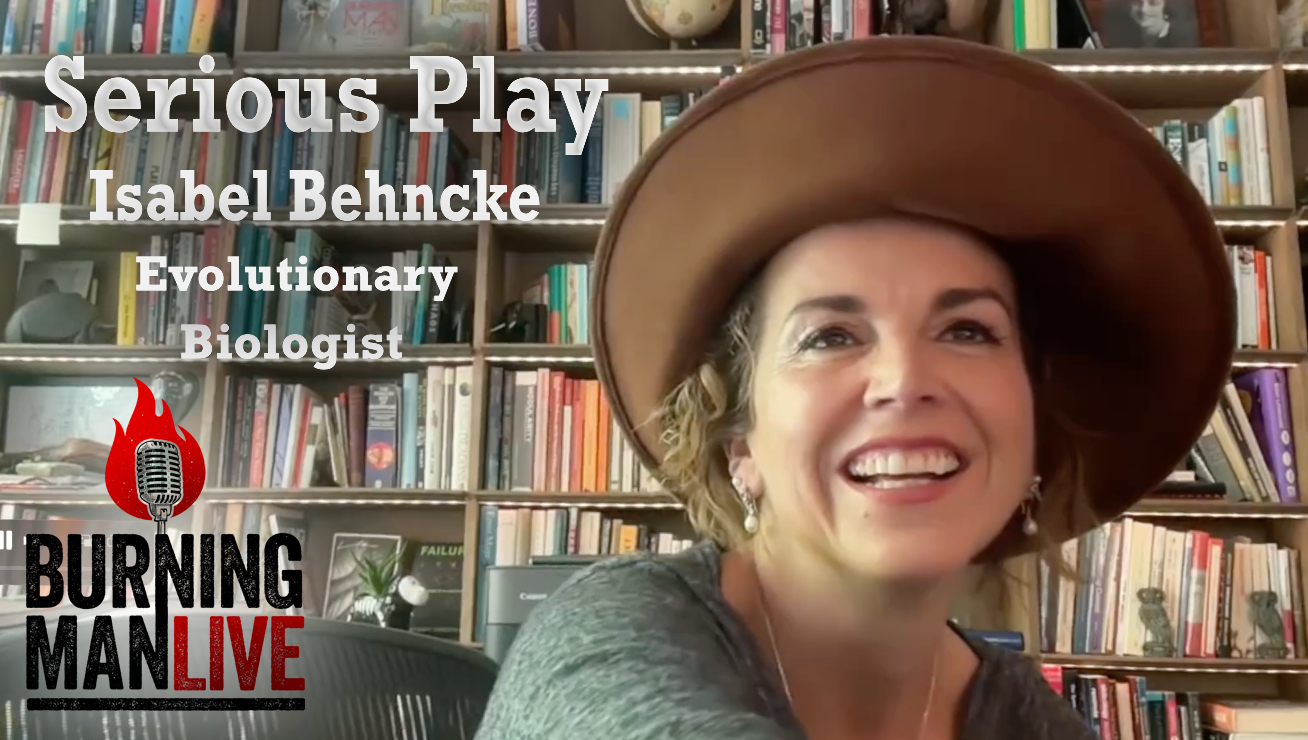
Watch it on YouTube here.
What happens when Burner behavior goes under the microscope? Sociologists, ecologists, and economists have been on this show. Now we’re looking at this culture through a new lens: primatology.
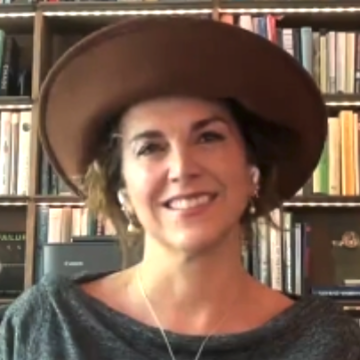
Isabel Behncke is an evolutionary biologist and a Burning Man Project Board Member. From tracking bonobos in the jungle to observing humans on playa, she shares her groundbreaking research on ritual and play.
In this mind-expanding conversation, she and Stuart explore:
🏕️ “Dunbar’s number” and how camp size matters
🦍 The evolutionary purpose of play for young and old
🤝 How risk, trust, and vulnerability build true community
🎁 The ancient, radical act of giving without expecting anything back
If you’re a social science fan, a camp lead of dynamic humans, or just a lover of wild stories about bonobos, humans, and other animals, get ready to understand your own playful nature!
Watch it on YouTube here.
wikipedia.org/wiki/Isabel_Behncke
burningman.org/about-us/who-we-are/board-of-directors
Transcript
ISABEL: Oh, there you are. Great.
I think Burning Man illuminates so much of the greatest aspects of human behavior. But also for me in particular Burning Man is not just like an answer, but more importantly, an open question. Personally, for me Burning Man, it’s a question. A question that asks
What is our human nature?
How is human nature expressed under different conditions?
And once you understand that, what do we really want to preserve, and what do we want to enhance in the world?
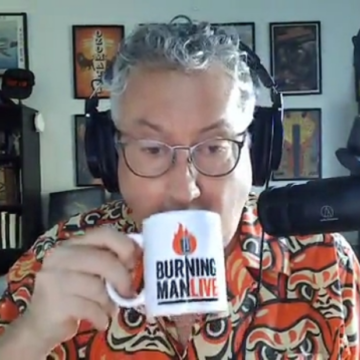
STUART: Since the earliest years in the Black Rock Desert, scholars have been drawn to Burning Man., Putting it under a microscope, poking at it with sticks; trying to understand what makes it go. We’ve had a lot of them on this program over the years. A few that come to mind are the psychology researchers Molly Crockett and Daniel Yudkin back in episode 60, the team from Burning Stories in Finland, or how about wildlife biologist Lisa Beers back in episode 73, talking about the biome around Fly Ranch up in northern Nevada.
Now, the amazing thing to me is how many different academic lenses people bring to these efforts. We’re talking everything, really, from comparative religion to sociology, sexology, urban planning, anthropology, economics, management science. But it wasn’t until last year that I met someone looking at Burning Man as a primatologist, and I knew in an instant that I had to get her on the program.
Isabel Behncke is a Chilean-born scientist who studies social behavior in primates. Ranging from a groundbreaking study of bonobos in Congo to observation of the dusty humans in Black Rock City, she holds degrees from Oxford and Cambridge, serves as an advisor to the Chilean government, and since 2025 has held a seat on the board of directors of Burning Man Project.
Welcome, Isabel.
ISABEL: Hello, Stuart. Thank you so much for inviting me today.
STUART: So I want to dive right in. You are best known for your very groundbreaking work on bonobos in the Congo. For our listeners who’ve not seen any of your TED Talks, or read Jared Diamond’s book The Third Chimpanzee, or know anything about bonobos, just in a nutshell, what does this close genetic cousin of human beings have to teach us? What can we learn from, from the bonobos?
ISABEL: Bonobos are our biological cousins. They are family, basically, our evolutionary family. We come from common evolutionary grandparents, grandmothers and grandfathers, that we shared this common ancestry. And so we have other cousins like chimpanzees, but chimpanzees and Bonobos together they are living closest relatives.
You know, it’s useful once you see the pattern of your family and you start seeing, you know, what is common, what is different, and there are certain traits that are, if they’re very consistent, you think, okay, that is kind of permanent, ancient in our family, so to say.
STUART: Now, from my understanding, bonobos and chimpanzees, though they look similar and are genetically very similar, they have very different social lives. That seems to be the most signature difference between them.
ISABEL: Yes. That is a great question, in fact, because as more science emerges and we have longer observation times, as usual, the picture gets more complex, especially with very intelligent animals. What I mean with that is that at the beginning we thought that they were very different, and now we’re seeing more similarities on one hand, and the other hand, also more variation in themselves. Which if you think about it, it is not an unexpected finding given that, like humans, they’re highly social, they’re very intelligent, they are long lived. So, and they have what we can actually call different cultures as well. So they’re both very social, they’re both very intelligent, but they differ, for example, in their use of technology.
You know, chimpanzees make, use, and modify tools and they also use them contextually, and different groups have their own ways of doing things. And bonobos might be less technological inverted commas [quote unquote] in terms of objects, but they have also shown the capacity to do so. So we’re not sure whether, for example, that difference is something due to environment or, um, or a cognitive ability. That’s one difference.
The biggest and most… there’re two biggest and most famous differences. One is sex and the other one is violence, which, I think obviously have called our attention. So first…
STUART: Yes, I would put an ampersand between them and make that the title of the episode, probably. But no, you’re right. Chimpanzees are known for being rather warlike, patriarchal, hierarchical, and ass kicking, right? And bonobos on the other hand, are a little bit more love, peace and love, right?
ISABEL: Yeah, I think that that distinction still holds. But we need to understand two things first: That when it’s, it wouldn’t be fair to either of them, nor to biology, nor to science to portray like, the good and the bad ape, the peaceful ape and the warring ape. Because, first of all, cooperation and conflict exists in all species and in all systems, and at all levels of organization. So that means that any species you look at will have cooperation and conflict, will have competition and cooperation. Um. Of course, it differs the extent. It also what’s different is: what are the consequences of conflict? So that’s why, you know, in chimps they are… famously they engage in proto-wars. So you know, Jane Goodall who unfortunately died last year first observed what she called the Gonga wars that lasted for four years.
STUART: Oh, wow.
ISABEL: And that has a, you know, a structure of, you know, an organized community versus community violent structure, in which males of one group eventually, um, killed the members of males of the other group. Um, and so in bonobos, we have not yet seen something like that, in the same way that the amount might be, but I’m not saying it could not happen again. I think we have to be super conscious, super cautious, because we have so much less of direct observation time in bonobos.
So what I’m saying is that I think the door for discovery is still there, but the difference, at least until now, holds. For example, with the amount of violent killing basically, again, not of fight, not of conflict, bonobos definitely have fights and conflict, but in general it does not result in lethal aggression.
Then the second difference is sex, and is linked to that.
STUART: And, tell me about that.
ISABEL: Um. Very famously, you know, bonobos are called, you know, the “hippies of the forest,” the “make love, not war” ape. And, and it’s, first of all, it’s true. It is very salient. And also, their sex takes many forms, and with other partners, so that makes them obviously – because humans project ,it has been very interesting for us. But it’s best understood I think not in the same way as human sex. But again, that’s difficult to say because human sex, like language when I was six, takes many forms and functions. But in bonobos it seems to be a very quick, effective mechanism for diffusing, diffusing tension as well as bond formation specifically between adult females.
And that it warrants a very careful attention, because one of the things that is very particular about bonobo societies is that females form coalitions, but different from other matriarchal systems in nature, where, for example, you have coalitions between females that are kin-based, namely mothers, grandmothers, sisters, aunts.
If you are a bonobo female, you will leave the group where you were born, when you’re just becoming an adolescent. So that means, if you think about it, if you leave the group, you know, the place where you were born, you know, your social belonging that you arrive eventually to a different group, you will not know anybody there. You will have to start bonding, making your relationships with adult females that you didn’t know previously. And as far as you know, you’re not related to.
So then how do you create the bond? And I think that question is obviously pervasive to, you know, whoever wants to understand social systems, whether it’s bonobos, or other animals, and obviously humans.
STUART: Right. Especially in these days when bonds are unraveling like crazy and people are increasingly isolated from each other, right? So which kind of brings me to Burning Man. I know that you have, you have studied gatherings like Burning Man and Carnival.
I just wondered, first of all, how did you get there in the first place? How does a respectable scientist end up at Burning Man? You’ve been going for more than ten years now, and last year, you became a member of the Burning Man Project board of directors. What was your personal arc to get to Burning Man? And then we’ll talk about what you’ve learned out there.
ISABEL: You want the real story?
STUART: Oh, yeah.
ISABEL: I guess so. Yeah. So it’s going to be almost 15 years now, by the way.
STUART: Wow.
ISABEL: which makes me very happy.
I had just come back from three years of doing my, the fieldwork for my Ph.D. in Congo. So just think of the frame of mind of one is, you know, you’re a young woman, you’ve been in the jungle, in the wild, in the heart of Africa, thinking very hard and being very stressed about your research question. And your research question is about adult play in social animals. And a friend through an academic network wrote to say, “Well, I think your research is very interesting. I know you haven’t written your Ph.D.,” I mean, “your results yet.” I had literally just come back from the field. So, you know, your notebooks… and not dust, but actually leaves and all sorts of twigs
STUART: Mud on your boots. Yeah.
ISABEL: Yeah. Mud on your boots, like, the head of snake and all these things in your bags. And she said, we would like to invite you to a festival, you know, San Francisco, so you can give a talk about your research. And I said, sure. This sounds really interesting. You know, as an academic I enjoy giving talks. You always learn something. And I told myself, surely giving, you know, giving a talk in this context, I would learn things different than what I do in academic settings.
But to be honest, Stuart, I had no idea what Burning Man was; no idea. And I said okay, a festival they meant…yeah, like some sort of I mean, I knew it was not a conference, but a festival of ideas. And so I did prepare a Power Point presentation, which is incredibly sad. And I missed the point completely. But we embarked,and they, we just, went like ten of us in an RV. And by then I thought, okay, this is not going to be a normal festival of ideas. And my first question was, “We’re spending so much time in this RV just queuing before they let us in”, because that’s it that, you see, we were in almost 24 hours at Gate.
And I said, I think this probably should be very interesting. And there’s something about human behavior that this is telling us, because everybody here could be doing something different, but people are choosing to wait for almost a day, you know, very high to me. So what am I going to learn?
So yeah. And then when we made it, I had to give the talk on the first day, and my mind was just blown. The first thing I saw was the pirate ship, coming in the background. And I thought, okay, as an academic speaker, you know, you have a choice here. Either you ignore it and pretend… continue with your presentation. You know, pretend you’re not literally seeing the pirate ship in the background, or you actually watch what’s happening, and you bring it in.
And that was the avenue to kind of the lifelong curiosity I have about Burning Man. I, basically, I had been studying adult play in the wild, and I thought, “What I’m seeing here is also adult playing in the wild.” I was watching bonobos play in the jungle, adult play in that wild, and now watching adult human beings play in the desert, which is also playing in the wild.
And to establish those parallels with their commonalities and their differences, became a journey in understanding the natural history of our behavior, in Burning Man, and wider, that continues to just give and give and give. In the sense that, you know, when you ask, when you are like touched by a great question, you don’t get a quick answer. The beauty is that it keeps giving. It’s the gift that keeps giving.
So yeah, I started observing Burning Man as a field scientist, observing Burning Man as how humans play, and how we cooperate. And how we, of course, compete and have conflicts.
STUART: I’m so glad to hear that play was central to your analogy of the two. I mean, when I first started trying to figure out what Burning Man was a long time ago, I ran across Huizinga’s famous book Homo Ludens, and I’ve just been fascinated with it ever since. But as an evolutionary biologist, I want to ask you, what’s the evolutionary role of play? It must have some purpose, or we wouldn’t do it, right?
ISABEL: Absolutely. The first thing is that play is a very ancient evolutionary technology, older than 200 million years. So that’s the first thing that, I think it’s just like, let that hang for a moment
STUART: Yeah.
ISABEL: because the age of something, and the pervasiveness of something, how pervasive play has been in nature. As far as we know, most of the juveniles and infants of homeotherm vertebrates, that means birds and mammals play; possibly some reptiles as well, and possibly, we will see.
But something that is so pervasive and so old means that it’s doing something. You know, evolution typically is not wasteful, typically. And so it has to have a function. That’s the first thing. I mean, I say that because there’s also been argued that play has no function. That is a sort of epiphenomena, you know, that arises: if you can, then you play and this basically not doing anything else. And of course, you know, that’s worth investigating. But we think play is definitely doing something.
And then what is it doing? Well in animals whose worlds are uncertain, the first things that play seems to have a really important role in training, and rehearsing, and testing for uncertainty ,under relatively safe conditions, and I score ‘relatively’
STUART: Right.
ISABEL: because nothing is ever perfectly safe. But play creates a kind of container of rehearsal, of training for the unexpected. And of course, humans and any other animal that is social and long lived, we have a lifetime of dealing with uncertainty ahead of us. Uncertainty is not new.
And ah, and play definitely seems to be a form of learning and training for uncertainty, a kind of, you know, gives you these tools for that you later deploy, that you don’t know how you’re going to deploy. And if you want to think about it clearly, then the question comes, how is it training you for uncertainty? How does it make you more flexible? So to say, that has three parts.
One is that play strengthens bonds. You know, play has a huge role in testing and creating trust. Animals that play together stay together. Burners that play together make friends. And so on.
You learn so much about another animal (human) by playing with them in a very, very short time is very quick. You’re already testing cooperation, innovation. Do you cheat? Do you bond? Are you able to follow me? Are you able to role switch? How do I play with you? How do you play with me? How do we both negotiate risk? Etc. So first that’s one element really important: the relationship of play in terms of social bonds.
Then the second element is the relationship of play to creativity, and the potential for innovation. Play breaks the elements of behavior and recombines them in novel ways. Not necessarily in a linear way, as inverted comma [quote unquote] normal behavior does. So, for example, if you are looking at an animal play, they will borrow elements from feeding, from chasing, from hunting, from, even aggression. You know, a dog will like, play bite. And so it’s that kind of recombination that results in novel sequences. And of course, you can think that the basic definition of creativity in humans is also that. Creativity is a result of the novel recombination of previously existing components.
Then once you have created the potential for innovation arises. Not always. You know, credit is something new, and innovation is something new that works, you know, like creativity that you can that can be useful, of course. Because not all play results in a kind of useful product, or not all play is useful. But some play results in innovations that end up being useful, some of it. And that is true for, you know, for animals. We have now a lot of evidence, whether it’s in whales, and elephants, or great apes, as well as birds, that many times play results in innovation, creative play. So that’s the second part of, you know, the trifecta of play.
And the third one, I think it’s the kind of aliveness and joy. When you observe animals, and by the way, you also notice that I’m using animals and humans indistinctively.
STUART: That’s okay. I should have had you on what we had, when our theme was ANIMALIA because we talked about that a lot. Yes. Hello everybody. Reminder: You’re an animal too.
But, please go on.
ISABEL: Yes. You’re a social animal. Um.
And so the third one is aliveness. When you see, when you observe an animal playing, there’s like a very deep presence, that we could actually think about in terms of, immediacy. That’s a principle that is very consistent with presence. And therefore the wanting to play is also wanting to live, because play is kind of a biological drive to go towards. You know, you are attracted to go towards the novel, novel social stimuli (novel ways of playing with other social beings), but also novel elements in your environment. You kind of add the joyful element to exploration. They’re similar, but different in important ways.
That’s why play and aliveness come together. And I think that is very important for us today, I think, we want to feel alive in this complex world.
Yeah, and in fact, now with it, there are several studies on depression that might suggest that play is both an antidote – this is like, it has to be said with a lot of care, obviously, because this is not true for all depression for sure. But this is true for rats, and I think for some humans. Play helps an animal to come out of depression, probably because through the engagement drive, in the same way that the experience of play appears to make animals more resilient.
These are generalizations, and they have to be taken with a lot of care. But, again and again, we see this happening, and it’s not a coincidence. You know, if you want to live, if you want to play, that drive will surely make you, you know, do things that are different, that if you lost the will to play, that if you lost the will to be curious, if you lost the will to go towards the other.
So yeah, those are the three elements of play that are crucial to keep in mind: creativity, social bonding, and aliveness.
STUART: Yeah. The last one, aliveness; trust and vulnerability, right? To encounter a new situation is something that people are not comfortable with, ordinarily. So anything that suspends that, that fear of the unknown unlocks the potential to experience awe, and joy, at the new, which is something I see a lot of from people playing their crazy games at Black Rock City, right? You see things that you never could have imagined otherwise. But to get to that place, you got to put some trust in the process, right? And maybe go through some uncomfortable moments of vulnerability, right, to get there.
ISABEL: Yeah.
STUART: Not as uncomfortable as the… as the ball squeezing game the bonobos play. I’m sorry, that doesn’t look like a game. That doesn’t look like a game, Isabel. To chase a male, around in circles by holding, keeping a hold on his scrotum. Um. Okay. You can call it play, but really, it just seems more like a bad marriage or something, I don’t know!
ISABEL: Yes. They do that a lot. The first time that I saw it I could not believe it. And I certainly agree with you. I was like “What? They’re doing this? And why?” It’s not forced, it’s actually voluntary. Why would you do that?” So, um, what Stuart is describing is that… Maybe you want to describe it. I mean, you know it quite well!
STUART: You take it from here. You’re the scientist! Haha.
ISABEL: So I was studying play behavior in the wild. And so one day I was in an opening of the forest around lunchtime, which is usually when you get very, kind of long forms of adult play. And there was… I observed there was one male going around a tree, you know, kind of ‘ring around the rosy’ fashion. And there was a female behind him, like grabbing him.
I was like, “What?” And then I realized that she was grabbing his testicles, and that appeared to be voluntarily and I suppose, fun. He had a play face. And then he would stop, and then they would do it again. Yeah, I mean, exactly. I’m thinking, my first reaction was to be incredulous. And the second reaction was to laugh uncontrollably because you go “What?!” This makes no sense whatsoever. And also it’s so dangerous. What is he thinking? How can this be fun?
STUART: But you know, I mean, come on, we’ve seen some pretty weird things in Black Rock City, too. Maybe not that weird.
ISABEL: Yeah. No, but I think it’s crucial because I think we get very confused as to the kind of… The role of risk and trust in play are, to me, clear. And many people want, you know, have a kind of almost like a ‘wishful thinking’ projection towards it, saying, “Oh, it’s just a matter of,” oh, “If only the the world could play more,” And many times I have observed, particularly amongst certain cultures that we shall not name, that they want to bring people into play very quickly. And that, that seems to backfire.
And I think it backfires for the same reason you hinted at, Stuart, because the trust and the relative safety that is required for, you know, ideal play is built gradually. But you don’t… Animals don’t tend to just play with the first novel stimuli that they encounter. So I think it’s a kind of unfortunate moralizing error to say, “Oh yeah, you have fear of the unknown. You should just start by playing with this.” Play has an order in nature. And you see this in kids, you see this in other animals. And the order is something like:
You first encounter something novel and you examine it, you just gain a kind of familiarity with it. So first say, this is a novel object and I grab it. And my first question is, “What is this?” Right? And then I go, okay, this is a cup. Then you ask “Okay, what can I do with this?” I mean, you know, you can drink tea or you can, I suppose, throw it to somebody else, or put flowers.
After you pass that exploratory phase and getting more familiar with the object, whether social or physical, you can go into imaginary play. So then “What can I do with this? What if? What if this was…?” Playing. What if this was a drumming set? Etc. And so that’s why I think play has stages.
I’m going back to Burning Man, and most social gatherings you observe a choreography of play, the orchestration that has elements of familiarity, that has elements of play signals, you know. Look at dogs playing in a park. They’re, you know, relatives of… They come from wolves, so they can do damage, and yet they play together. Dogs that are not, you know, brought together. What’s the first thing they do when they want to play? They do a play face. They do a play signal, you know, they put their paws down on their bottom up, and then look at other dogs like that. You know when the dog wants playing because they were like, “Okay, want to play?” And so play signals are really important because it tells another animal that, you know, what you intend is not aggression; what you intend is not mating behavior; what you intend is not to eat them. What you intend is to play, and that has different rules.
STUART: I guess there’s a stage in play where there’s a lot of trust between the collaborators and where they enter I guess what’s sometimes called the Golden Circle, right, where rules from the outside world don’t apply, and you start making up all of your own rules. I’m super fascinated by kids who can create their own games out of nothing, and change the rules as they go along, make them adaptive to the situation. That, to me, sounds like a survival behavior.
ISABEL: Yeah.
STUART: That sounds like a way of molding your behavior to the ever changing world around you.
ISABEL: Exactly. It’s a perfect technology for animals that are highly social, that learn very quickly, that are intelligent, but also that inherently their worlds are by definition uncertain. I mean, and I don’t mean just ecologically uncertain, in that we might have an earthquake or we might have like different amounts of rain, therefore different quantities of crops in the years. But if you are social animals, by definition you will always live in an uncertain world because you know, you depend on your partners with whom to cooperate with, which are the coalitions that you should be scared of, and so on. So that is an environment that is always changing.
Therefore, playing and like mocking up scenarios, and what rules we can create, and actually do you follow them, to play with somebody you actually learn so much about like, do you follow the rules that we have just created, or are you going to, you know, be aggressive with me suddenly, do not understand the inherent rules of play? Etc.
In a way that in that sense, I think is going back to your Huizinga question that play’s very good at creating cultures in that micro moment.
STUART: So it’s easy to think about evolution as something that happened billions of years ago, you know, last noticed by the guy with the giant 19th century beard named Darwin. But it’s going on all the time, still, isn’t it? If not through natural selection, through sexual selection, through societal evolution, and all that stuff.
I look around the world and I see a whole lot of change happening that humans haven’t really figured out how to deal with yet. I mean, the two that come to mind are: Our city life, being forced into smaller and smaller spaces. And I know you’ve done some thinking about, about urbanism, both on and off the playa. And the other is technology, right? You know, what does it mean to have all of our friends in the palm of our hand? So. How do you think people are adapting to those two huge trends? We can put another hour on this. I’d love to keep talking, but.
ISABEL: And okay. Think in terms of thinking tools because you open a magnificent can of worms and it’s not a can of worms, it’s actually essential to understand, you know, our present global moment.
First in terms of cities and human behavior we have to understand the importance of scale. Group size, group size, group size. Scale… scale matters. So group size matters. And think that now we live in a world that we’re going to be close to 9 billion. And our countries have 300 million people, 5 million people, 1 billion people.
That level of scale is wildly different than any other mammal, than any other primate, and only definitely any ape has ever encountered, but also a different level of scale that humans evolved in and with at least in the past, you know, until very recently. So what I mean by that, that is a useful thinking tool, is that our emotions were built in a system in which we are built towards engaging in small groups. And so we have moral emotions that were built kind of by this… our software came equipped for small groups. Right? And then suddenly we have to engage with extremely large societies.
And if you think you are often applying your emotions that were designed for a small group to a very large group. So you’re going, oh, I feel anger, I feel love, I feel jealousy, I feel like coalitionary competition. And these emotions, we’re obsessed. But it’s also exhausting because there’s like no group size limit, you know, it’s literally infinite.
So I find it useful if you think that you are an ape, you’re a social ape with social emotions that evolved in a small group setting, and you still hopefully have a small group that functions under that context, you know, kin and friends and community. But then you live also in a world at the same time, that is more similar to the one of social insects or ants, you know, huge, huge groups that operate in a different scale. And they coordinate and they also wage war and they also cooperate. Ants. And but you don’t have individual relationships in the same way that you have in a small group setting. So that’s the first thing to, I think, to notice and to ask whenever you look at urbanism: think of the scale and think also how the scale clusters.
Burning Man is very useful to ask this question because you can have 70,000 people, but it’s not an amorphous 70,000 people gathering. It’s highly clustered, because we call it camps, which are kind of again and again the number, the group size, it repeats itself and it has a certain range. And we were talking the other day, you know, historically, what are the camp group sizes that tend to work better? When a camp grows too much, it tends to fission, or just the conflict tends to go through a threshold that makes it likely not to, you know, be repeated the same year, the next year, and so on. And then within camps you also have this smaller, this smaller coalitions, whether it’s, you know, the five friends that you go with in an RV, etc., so we can go there. And that’s a big topic. But so that’s the two questions, two factors. First, single scale group size matters.
The second question in terms of technology, which is of course what’s keeping our minds and our eyeballs literally glued to the screen.
STUART: Spellbound.
ISABEL: Spellbound and addicted… The concept isthat we construct niches. We are niche constructor animals. I mean, technology is not just like, happening to us. We create technologies and the technologies shape us. That’s what in biology we call niche construction. This is a very common process. Once you know it, you know, go to the garden and you will sit there. You know, a woodpecker creates holes in a, you know, that tree, and then he’s changing its environment, and then that environment feeds back because, you know, a hole is now created. So then a parrot or an owl nest in it.
A cockroach goes through the mud and changes the pH through feeding and defecating and its metabolism, etc.
So humans, we create cultures, the cultures change us. We create technologies, and technologies change us. We domesticate animals, wolves to dogs for example, or many crops, and then they affect us.
So technology is very old. Chimps also use and make tools. But of course the scale at which we are creating the technologies and they’re changing us, it’s unprecedented. So I would leave you with a question of, once you know, that process of like iterative feedback is there, I think it’s useful to be more aware of not only what you’re creating, but also how that affects the selective forces that you are being, you know, thrust upon, how it affects you, how it changes you. And that hopefully gives us some agency, at least some awareness.
STUART: So I’m really struck by the notion of culture changing us, you know, particularly over time. I look… I’m lucky enough to now know a lot of multi-generational Burner families. And I’ll tell you what these kids, these second or third generation Burners, they just seem more evolved in some way. I don’t know what it is, but they’re extremely playful. They seem to be smarter and wiser, and more open to rolling with change.
ISABEL: Yeah.
STUART: It gives me a little bit of hope that…
ISABEL: That’s wonderful.
STUART: that this culture that we’re creating is actually having an impact down the line, I don’t know. You must feel the same way that this culture has a potential to make the world a better place, or you wouldn’t be devoting so much of your busy life to Burning Man.
ISABEL: Yes, for sure. I think Burning Man illuminates so much of the greatest aspects of human behavior. But also for me in particular Burning Man is not just like an answer, but more importantly, an open question. Personally, for me Burning Man, it’s a question, a question that asks, what is our human nature? How is human nature expressed under different conditions? And once you understand that, what do we really want to preserve? And what do we want to enhance in the world?
And so to ask that question of Burning Man, it’s so salient, it’s so evident. I think that thinking of Burning Man is a question, for me, as an individual that has gifted me so many years of thinking and being able to then identify behavior and patterns and structures, not only in the wild but in our permanent built environment. So, Burning Man as a question is incredibly fertile.
And then, of course, Burning Man as suggestion of different aspects of human behavior that we want in our societies is also very evident. You know, play and creativity and innovation. Huge.
Second, social bonding, community, gathering. As you… years and years, people say, why do I keep going back to Burning Man? Because I built a community, and I want to keep investing in it. I definitely could do other things, but these are my people. I think to build together, to experience also a certain duress, there’s something that starts to hint at ancient conditions of environmental difficulties, let’s say, because, let’s face it, it is difficult.
STUART: Powerless in the face of nature.
ISABEL: Yeah.
STUART: And so many people are cut off from nature. They don’t go outside, they don’t go camping out under, in the elements. Right?
ISABEL: For sure. And, you know, as somebody who has spent a lifetime in nature, in all different types of nature, I think whether it’s there in the jungle or the mountains, the point is that when you’re in nature, you are kind of a present, healthy animal. You have to be present.
And so more than mindfulness, for me as an individual, I’m very interested in like what kind of healthy, alive animal I become when I’m in nature. You have to be awake, aware, embodied, present.
STUART: Yeah, and aware of the larger reality that it’s not just you or not just humans. You know, which is why a lot of people regard it as a spiritual experience. Right? I’m wondering about that in evolutionary terms. What about that religious impulse, the desire to create rituals. Is that evident in any of our biological cousins?
ISABEL: Stuart, you ask huge questions. That’s a great one.
It is very difficult and dangerous to project, of course, to other species. But I think we can say a few things, understanding that we can’t be in their minds yet… yet.
First, what humans do in ritual is very ancient, and so it’s very true to the DNA of our species, before we start thinking of other species, I mean.
Ritual seems to have a very kind of common choreography or structure that repeats itself across time, and across cultures, that has an order and that has certain elements.
The elements include social gatherings; they include a time and a place; they include an order in which things are done.
It includes meaning conveyed by readings, by language, but also by visual display; visual display in, you know, art that is outside of us, but also in body art, like how people dress, how they modify their appearance, what especially around, you know, the kind of modification that happens with face, and hats, or just things that are above your shoulder level. This is very, very common in rituals across the world. Often, the visual display also comes with elements that will temporarily make you feel as you’re merging with a larger whole.
And there’s rhythm. There’s either music-making, or some sort of rhythm that helps synchronize the people that are participating in that ritual.
There’s also food sharing, and many times also you have sharing of other substances that help to disinhibit the prefrontal cortex.
So all of these things taken together, they appear to point us to, you know, a very highly social technology for a social animal in which, of course, we are individuals, but in the point, at the moment of the ritual, you become part of a larger whole.
And that eventually dissolves and you go home, you know, you go home after the Burn. You go home after going to, you know, a rock concert. You go home after a religious ritual. But that seems to be really important for a sense of meaning, for a sense of community, for a sense of belonging. That appears again and again throughout history, and throughout all different cultures. You can start looking at it, you know, today and in the past, you know, from medieval gatherings to mass, you know, football matches, live music, etc.
STUART: My favorite is the potlatch.
ISABEL: Yeah.
STUART: Let’s completely turn like commerce on its head, and I’m just gonna… we’re going to compete to how much we can give away. That is, to me, very essential to the nature of Burning Man.
ISABEL: Yeah, that’s, it’s just great. There’s so many things there. First of all, gift giving. Traditionally, you know, you give a gift and then there’s like this invisible, invisible bond that is created through the gift, And so to give a gift, and at least in your culture says, I’m not expecting anything in return. That is so radical.
STUART: Yeah.
ISABEL: That is really radical.
STUART: It takes a lot of people at least a year to figure that out. I tell people: Don’t worry about giving gifts to your first year at Burning Man. Figure out how to receive them without immediately going “What do I have for you?” Right? But we’re steeped in that…
ISABEL: Yeah,
STUART: Christmas gifts, birthday gifts, it’s all reciprocal.
ISABEL: Yeah,
STUART: Your good list and your naughty list. Right?
ISABEL: Totally. But I think we understand those, like, first year Burners who feel like that because, you know, it’s etched in our human animal DNA that if you give me a gift, then there’s something, there’s an expectation in return, especially, you know, in again, animals that are long-lived that have long term expectation of reciprocal interactions. And so if you give me a gift, I’ll go let’s, you know, what do you expect from me? And, am I just signing for something that I’m not sure if I can or want to do?
STUART: I don’t want to owe you. Whereas in smaller groups, that reciprocal debt is the glue that holds the community together. Right?
ISABEL: Yeah. You create bonds, you create alliances, you know, and, you know, in the future, you might support me in a fight or, you know, support me with food or, you know, mate selection, etc.
STUART: David Graeber’s book on debt. I don’t know if you’ve read that. It’s fantastic. He posits that money was invented so you could pay somebody without having an obligation to them, like a mercenary. That that’s specifically what the purpose of currency was. So you wouldn’t have them in your social circle and owe them anything. Right?
ISABEL: Yeah. And I think that that makes particular sense if it evolves in the context of, again, large group size. Because in a large group size you can’t afford to maintain, you know, 5,000 close relationships. There are time limits. You know, there are only seven days in a week and only a few hours of socializing.
STUART: And then there’s the… What’s the Dunbar number for most people?
ISABEL: So okay, so I have to disclose Robin Dunbar was my PhD supervisor at Oxford, so I worked with him many years. So one day, Robin Dunbar walks into the lab group and says “You know what, guys? Somebody has written a Wikipedia article quoting the Dunbar number. And there’s also an episode on The Big Bang Theory about it.” And he was so bewildered!
I say that because the Wikipedia article quoted Dunbar number to be 150. This means that he understands 150 to be a group, a group size within which you have, like close relationships, enough to kind of remember people, people’s names, to actually, you know… If you were to encounter them in the street, you know, like ask for $10 or for them to buy your coffee without feeling bad. Also, it’s the kind of… Imagine the amount of people you would write in the past a Christmas card to, or invite to a wedding, or that you would want in your funeral.
So the kind of rough group size of an extended community. Having said that, Robin himself would try to clarify this many times. It is not, you know, it’s not 150 in which 151 does not happen or 149… It has like most things in nature a little variation.
STUART: A little bit of flex.
ISABEL: And that variation depends, flex, that variation depends on personality, depends on age and context, etc. But also, more importantly, I think what’s useful to remember is the number in which you tend not to need external policing to enforce social rules. And I think that’s why it’s, going back to an earlier conversation, it’s so interesting to study group size and camp sizes in Burning Man because, you know, once you are below a certain number, and you know the point of Dunbar’s number is like everyone will know somebody else in, to a greater or lesser degree. So say Stuart does something that a group does not approve of, and instead of actually needing an external policeman to issue a ticket, we will tell Stuart’s mother or to Stuart’s brother, or to Stuart’s girlfriend because I’m actually friends of her brother. And so, you know, suddenly Stuart is being gently reminded, through many different nodes in his network, that that thing should not be done. Or the converse is also true, or that that thing that he did was wonderful. It so that kind of like triadic relationships, they’re very useful for maintaining cultures within a certain group.
But Robin’s point is also larger and more interesting. His point is that we cluster in, you know, clusters within clusters. So within 150 you have some other communities within, say, 50 people or so. And then within the 50 people maybe, well, there are 15 people or so that are like your kind of sympathy group. Then you have a group that we can call, you know, your inner trust core that is say around five people. And the converse is true on the scales at how it scales upwards. So 500, 1500, and then 5000, are numbers again super broadly understood with a lot of variability that come up again and again in humans, in humans in different cultures, and even in other animals as well. So real size matters. Scale matters.
STUART: In our pre agricultural stages of evolution, we must have spent millions of years evolving in groups of the smaller sizes.
ISABEL: Yeah. We evolved in small group sizes, but also those small group sizes were not just like a pack of say, 15 humans that always move together. We have what we call fission / fusion societies. Say you have a small foraging group, a small hunting party, a small campsite group, and that is inserted in larger communities. So the point is that this kind of like, encounter and fragmentation of your own larger community is something that is inherently human.
What is… You see what I mean? And that’s why, again, camps are really useful to think, in that respect. You know, you can have a camp that is, you know, 100 people, 150 people within that say you have three, you know, main areas of 40, 50 each within that say you have your like cooking shift role, different tasks, roll division. It’s something that I think talking with all Burners comes up again and again as, you know, determinants for what works and what doesn’t. We often learn through trial and error, to put it mildly.
STUART: Our camp broke at X number. Yeah. I know that one.
ISABEL: And then it’s like, you know that year… and then it rained! And then…
STUART: Well I look forward to sharing some of those disaster stories with you in person. Will we see you out on the, out on the big playa this summer?
ISABEL: Yeah. Oh, absolutely. Yeah. For sure. I wouldn’t miss it.
STUART: Okay. Well, I think that’s about the time we’ve got. I want to say thank you again. Our guest is Isabel Behncke. Hi, Isabel. And thank you so much.
ISABEL: Hello, dear Stuart. That was wonderful. I already enjoyed so much talking to you on playa, and I look forward to more.
STUART: Outstanding.
Burning Man LIVE is the one and only podcast of the one and only Burning Man Project, coming at you year-round from our imaginary studio high up in the clouds and dipping its sonicals into your, uh, ear-acles.
I’m your host and executive producer, Stuart Mangrum, and I am extremely appreciative of all the good people who helped make this episode possible, starting with my guest, Isabel Behncke. Thank you so much, Isabel), my good friend Vav Michael Vav on the board doing all of his production and post-production magic, and hell the entire production staff of Burning Man LIVE: Actiongirl, kbot, our QA maven DJ Toil, Mr. Martini on the socials.
Thanks also to all of you who make a donation of any size to the nonprofit Burning Man Project at DONATE.BURNINGMAN.ORG.
And of course, thanks, Larry…