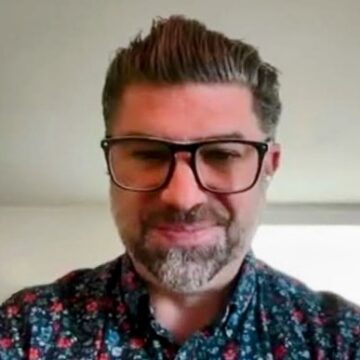


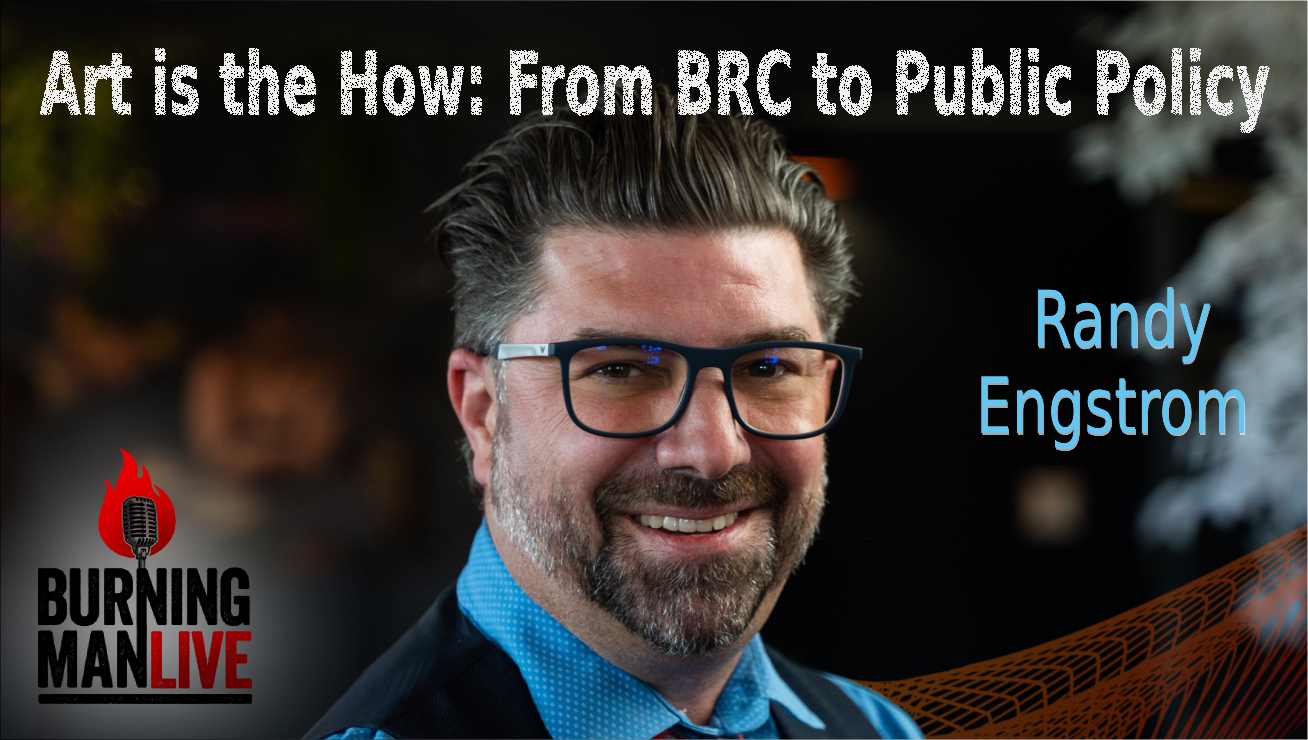
He brought theme camps and art installations to Black Rock City, and yes, he DJed!
Now he brings the spirit of kindness and collaboration (and Do-ocracy) into creating public policy.
He co-founded a Burning Man Regional nonprofit
He directed a cultural arts center.
He collaborated on cultural policy for racial equity, social justice, and creative sustainability.
He ran the Seattle Office of Arts and Culture.
He now creates affordable housing through community development projects
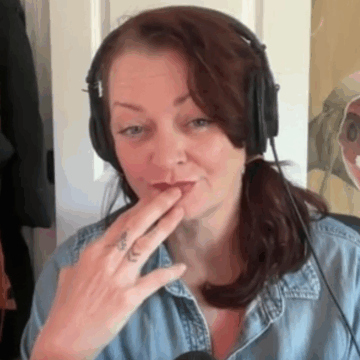
Hear Andie Grace ask him how we can make it work where we live.
“When you go to the playa and you’re in this decommodified environment, all you have is how you show up… I’ve learned how to approach community-building through those sort of principles of collaboration and kindness, and a real spirit of genuine curiosity. As long as you stay curious, a lot can be possible.”
Transcript
RANDY:
When you go to the playa, and you’re in this decommodified environment, all you have is how you show up. I’ve learned how to approach community-building through those sort of principles of collaboration and kindness. Whether that was building a theme camp or whether that was founding Youngstown or running the Office of Arts and Culture, I approach it with kindness and collaboration and a real spirit of genuine curiosity. As long as you stay curious, a lot can be possible.
ANDIE:
Hello, beautiful. Yes, you. That goes for all of you; welcome to Burning Man LIVE. We are the show that’s all about exploring how Burning Man moves around in the world through your stories and your actions. And folks, I am your girl of action Andie Grace. My guest today is a man of action: Randy Engstrom. He’s someone who really walks the talk.
Randy’s Burning Man story started back in 1998 on a graffiti-covered school bus. Like so many of us, he took the experience to heart and he brought it back home. And boy, I’ve been inspired by this guy for a long time; how he takes the ethos of the playa and the spirit of kindness and collaboration and do-ocracy and involvement wherever he goes.
And he has applied it with extreme force in his own town of Seattle, Washington. Randy went from co-founding the Ignition Northwest Regional nonprofit group, to becoming the founding director of the Youngstown Cultural Arts Center. He went on to spend decades working in Seattle city government, fighting for racial equity, social justice, and creative sustainability through cultural policy. This eventually led to him running the Seattle Office of Arts and Culture for almost a decade. And that’s just a sliver of this man’s resume.
These days, he’s tackling the affordable housing crisis through his work with a revolutionary civic project called Watershed. He’s a true innovator. He’s a community builder, and I’m so glad he’s here to talk to us today.
RANDY:
In 1998, my friend Eli said, “Hey, I bought a school bus, and we’re going to convert it and take it to Burning Man. And all you need to do is come up with 50 bucks for your ticket and 50 bucks for food for the week.”
And so 10 or 12 of us sort of graffitied up the bus, and built a roof rack, and took out seats. And, you know, I wouldn’t say it was a super nice bus, but it got us there eventually, although it was a very dramatic journey.
But yeah, I was at the Evergreen State College in Olympia. I was the program director of the radio station KAOS, and so I had to agree to do an audio documentary about my trip down there in order to be able to get out of that job for a week. And then later, my house got broken into and all the audio recordings got stolen, along with lots of other stuff in my house, so I don’t know.
ANDIE:
Oh, wow. How did that influence things for you? You had this experience and then you had some capture and then it went away.
RANDY:
I kind of like the impermanence. I think I could have done a cool documentary. It was a pretty life-changing experience, and one that would have been really hard to squeeze into an audio documentary. But I had some really incredible audio from the Burn and from different people I would just talk to on the playa, and musical acts that I saw. But in the end, I think being there and just experiencing it is better. It’s the moment that you’re in, and it’s hard to translate that to the default world, as it were.
ANDIE:
So then what happened next?
RANDY:
Well, I’d say that my friends and I that went certainly got the bug. And we decided that next year we’d come back and try to make a theme camp. You know, you don’t really know…well, maybe now you do, because there’s a lot more information about it available. But in ‘98, there wasn’t a lot to know to prepare for the event.
And so we’re like, okay, well, you know, we should definitely bring more shade structure. We should definitely have a different kitchen plan. ‘99 was really fun. Our camp wasn’t terribly successful, but we were right next to Zardoz. I don’t know if you remember, in 1999, these guys built, like, a 35 foot tall head of Zardoz.
ANDIE:
I do!
RANDY:
Which was really fun because I got to DJ there a lot, and I got to DJ at Bianca’s Smut Shack and all these, like, really big soundsystem camps. And it was super fun.
That was after my senior year of college. I came home and then I was like, what am I going to do with my life? And I continued to go every year. In 2005, we did The Machine Project, which was like one of the bigger art installations on the playa. We spent two years planning and fabricating and building, and like a month and a half on playa, which was a super cool experience.
So I took the next year off, and that was also the year I got appointed to the Seattle Arts Commission, and the Mayor’s Arts Awards, which is like the big civic art gathering in Seattle that was the same weekend as the Burn. And so I started sort of alternating between being in Seattle for the Mayor’s Arts Awards or being on the playa. I got appointed to run the Office of Arts and Culture. Then I really had to be at the Mayor’s Arts Awards, and so that precluded my visits to the playa for about nine years.
ANDIE:
Right. Can you tell me about, in the early 2000s, the Seattle Burner scene, such as it was? Who did you meet? What was going on there?
RANDY:
You know, the thing that impacted me the most, arguably, of going to the event was this whole notion of a theme camp; that you go with a bunch of your closest people a thousand miles away and try to build an experience for people. That led to developing a co-housing community that I lived in for 23 years here in Seattle. And, it also led to us creating a company called Static Factory Media in 2002. We helped to produce the first couple of SEACOMPRESSIONs, our local decompression events, and just started doing more organizing. We were really interested in how to bring the sort of ethos and values of the event into our larger civic fabric. How do you translate the ideological value of the festival into a civic space? Into a community space?
That was part of why we formed Ignition Northwest, ‘cause we thought we could have a regional, or we could have an organization, and that organization could produce events and can offer workshops and could give scholarships and could do all manner of things.
ANDIE:
Of course, Ignition Northwest is the 501(c)(3) nonprofit that you all founded up there that fuels community through arts and events and education, your regional group.
RANDY:
Yeah. I think we formed Ignition in like 2003, and that was also, I think, the first time Larry came to visit Seattle. He came and did the Town Hall and…
ANDIE:
I was there.
RANDY:
You were there!
Between 2003 and 2005 I actually visited the office a number of times and got to know Larry fairly well. And I remember hanging out with him at the Americans for the Arts conference in Las Vegas. And, you know, I think he shared that interest in bringing the event beyond the playa. The inspiration of building community at the event led to wanting to build community back home. In some ways, though I haven’t been to the event in a long time, those principles still sort of govern a lot of the work that I find myself doing in the world.
ANDIE:
Static Factory, I remember Static Factory in the early days. What emerged out of that? What happened next?
RANDY:
The idea behind Static Factory was it was an internet radio station. It was a recording studio. It was a record label. It was a bar and performance venue. And at the end of the day, it was probably too many different things, like “Jack of all trades, master of none.”
It led to a lot of really interesting things; I mean, we hosted the first Decibel Festival, the early years of the Decibel Festival. We hosted the Seattle Poetry Slam. We had like a Burner night every Monday night. I think a lot of the Ignition Northwest stuff was born out of those Monday nights. And people saying, what else can we do? You know, what can we do to do more than just have theme camp fundraiser parties? And what can we do to engage with our city and with our community?
So I left Static Factory because I was hired as the founding director of the Youngstown Cultural Arts Center. And I think, you know, at the end of the day, I am a better nonprofit and civic organizer than I am an entertainment and nightlife person. I’m kind of bad at capitalism, which is maybe also why Burning Man worked for me. And I’m just better at community work generally. And Youngstown was an incredible experience and continued to be a hub for a lot of Burning Man community events, the annual Halloween party and Town Halls. And in fact, when you were just recently in Seattle, we were at Youngstown for a conversation with the San Francisco folks. So, still there, still part of it.
ANDIE:
Right. I mean, it became a hub for like, youth, for artists, for neighbors to connect. What do you think has been the most lasting impact of Youngstown, and how did that affect your approach to culture and community building?
RANDY:
Well, I think the fact that it created permanent affordable housing for artists, 36 units, because I continue to believe that housing is the most foundational challenge behind so much of our civic need. If we could actually build the requisite amount of affordable housing – not just for artists, but for everybody – we could start to get at some of the larger social challenges, like income inequality and houselessness and mental health and public safety. All these things, I think, are tied to there not being enough places for people to live, to live affordably.
I think we created a place that will forever center young people in their creativity, because there are five tenant organizations in the building that all serve young people.
I believe really strongly in the power of arts education. Increasingly, arts education prepares you with the skills that you’ll need for a 21st century economy, where AI is going to come for a lot of the jobs that people do, but I don’t think the robots will be able to do human creativity and human empathy. At least not for a while. Or if they do, it’ll be real weird and I don’t know, I guess that’ll be its own lane of things.
ANDIE:
I agree.
RANDY:
Youngstown had a bunch of different spaces. You know, we’d be running a community meeting in the theater, a belly dance class in the movement studio and a and a and a poetry workshop in the classrooms. And so seeing the intersectionality of all these different community activities was really interesting, and seeing the mix of folks that would come in and out of the building, and I had a pretty wide aperture of what I considered culture and what I thought made sense to happen in the building. And we hosted a lot of stuff, you know, everything from political fundraisers to youth retreats and cooking classes, and all of it. It was really fun.
ANDIE:
Is that how the city became aware of you, and into your hire as the director of the Seattle Office of Arts and Culture?
RANDY:
Kind of. So I got appointed to the Seattle Arts Commission in late 2005. We opened Youngstown at the beginning of 2006. So my first Arts Commission meeting was right before the grand opening. And for five years I had this sort of bicameral view of this community arts center with a youth advisory board and all these great teaching artists, and artists in residence, and working really close to the ground and community.
And then at the same time, I go to these commission meetings and we’d be advising the city’s arts office on arts, education and space affordability and grant making and public art. So I think the combination of those two experiences was really helpful. I left Youngstown in late 2010, and spent a couple of years on a few different housing projects and a couple of national foundations. Anyway… The combination of Youngstown, the Arts Commission and the consulting projects that I did when I left that role, I think all kind of set me up to come into that role eventually.
And, um, October 2012 was when I got the call.
ANDIE:
Tell me about the call. What happened?
RANDY:
Well, I had cycled off the Arts Commission because you have three two-year terms. So I left. I actually had this crazy idea that I was going to try to run for City Council. So I was meeting with people and talking to political consultants and designing a framework to run for office, to try to center creativity, to try to center equity, to try to figure out how we interact and engage with our citizenry better.
And then I got a call on my birthday, actually, August 17th. And the person from the mayor’s office said that the Director of the Office of Arts and Culture has resigned effective immediately. And would I be interested in the job? And I said, “Can I still run for city council?” And they said, no, we’d like someone who would do this job long term. And I was like, alright, well, we’re going into an election year so I’m not sure what long term means.
But, I sort of approached it like an interim gig. You know, at the time I was interim director of an organization called Central District Forum for Arts and Ideas. And, you know, interim work can be really important. It’s an opportunity to say, like, what should we keep doing? What should we stop doing? What should we start doing? And having that opportunity to be on the commission for six years, I got to know the work of the office pretty well, I got to know the staff pretty well. And so I thought, at least I can come in and keep morale high and steward the office over the next couple of years and we’ll see what comes.
That turned into a nine year journey with five different mayors and 25 different city council members. So as much more than an interim gig, it lasted for a long time. But it was a pretty incredible experience.
ANDIE:
Did you find… Your motivation was to center creativity? Did you find that challenging in the bureaucracies of city government?
RANDY:
Not really. Everything is about relationships. And so if you can show up with competence and kindness and a genuine collaborative spirit… Not everyone is wired that way, but I found that the vast majority of the city employees that I met are there because they want to do good for the city. They care. And so we really positioned arts and culture as the enabling strategy. We would say arts is the how. How can arts help advance street level activation? How can it advance educational outcomes? How can advance transportation needs, housing needs? And so we would actually hire shared positions in different departments in the Economic Development Office, in the Transportation Office. In the Waterfront Redevelopment Office. And really position creatives and artists as engines of how the city does its work, not just like doing murals, but actually bringing creative practice into the way in which policy gets made, or programs get developed.
ANDIE:
What was the hardest part about balancing policy and community or creativity?
RANDY:
Ohhh! I mean, the bureaucracy is not a risk-taking enterprise generally.
ANDIE:
Right!
RANDY:
It can be challenging to get people to think outside the box. And, you know, the company that I would later found with two of my former colleagues from the city, Third Way Creative, we talked about the third way all the time because we get trapped in these binary, these like false binary choices: bike lanes versus parking, tall buildings versus single family homes.
And the truth is, in any policy space, there’s way more than two choices. There’s a lot more nuance that’s possible. And, you know, compelling people to see that was the work, right?
At the city, like 80% of my time was the block and tackle to get to the 20% of the work that we really wanted to do, because you have to have a pipeline memo and a briefing memo and a fiscal note, and you have to convince a critical mass of stakeholders to want to advance the thing that you’re trying to advance. And you have to show people how the work that you’re offering is helping them achieve their mission, and achieve their mandate as a civic agency. So getting people to take risks could be hard. But showing people what the upside was tended to be pretty effective as a strategy.
ANDIE:
Do you see this kind of work as a parallel experiment to your experience in Black Rock city? How does it weave together?
RANDY:
The thing that’s fun about Black Rock City is it is kind of a civic experiment. The infrastructure that’s required to accommodate, whatever it is now 70,000 people, that’s real work. You have to be able to navigate unknown conditions. You have to be able to create safe and predictable infrastructure and community support.
And I think how you govern something like that, for lack of a better word — I don’t know that Burning Man is governed by anything – but like… what is our social contract?
ANDIE:
Chaos!
RANDY.
Chaos. Right.
It’s a social contract. You know, the idea that everyone’s going to show up and they’re going to bring something to share. I’ve always appreciated that. And in a way, that was kind of how I would approach my colleagues in the cabinet. You know, I’d go to the housing office and be like, how can we be supportive of the work that you’re doing? How can we bring our something to the thing that you’re trying to do hopefully in a way that redounds to the benefit of the wider citizenry of our community?
ANDIE:
And so what has happened since then? I mean, you could tell me about the Watershed Community Development.
RANDY:
Yeah. I’ll walk you to how we got there, and we can talk about any projects that you want for whatever seems interesting. But…
I left the city January 2021. The pandemic was so devastating for the performing arts, and for arts and culture generally, so, I really wanted to advocate for the needs of artists and creative workers at the federal level. So I just kind of threw myself into the work with the National Endowment for the Arts and the Department of Labor, and I ended up working with at the time WestAF, Western States Arts Federation, and it’s now Creative West. Shout out to Christian, who’s a pretty consistent Burner. And I worked with them on a series of creative vitality summits, these conversations about the intersection of culture, creative economy, technology. That was pretty fun.
I worked with grant-makers in the arts, figuring out how we can advance racial equity through cultural policy. I did a lot of work with different national service organizations.
Then I did a creative economy strategic plan for the Department of Commerce, with WestAF, actually, which was a pretty cool experience.
And then I worked closely with Friends on the Waterfront, on the redevelopment of Seattle’s Waterfront Park, which is an absolutely stunning place that just opened, grand opened.
ANDIE:
In early September, yeah?
RANDY:
Yeah. I worked with them on a cultural master plan. We engaged about 150 of their partners to create a roadmap of how values could guide the experiences that you would have at the park. What would be the cultural tenor of your experience when you were there?
ANDIE:
How’d you do that? Wait, I want to hear more about… How do you do that?
RANDY:
We ended up writing a plan, and each chapter was based on a value.
So the first chapter was about belonging. And the metaphor for belonging was a home. There’s a quote from Seattle’s inaugural poet, Claudia Castro Luna that said, “Seattle is a house and everyone who lives here belongs here.” And so we really wanted this space to feel democratic — and inclusive of everyone. What does it look like to ensure that whoever you are and wherever you’re coming from, you can see your culture and your identity reflected back to you in the city’s signature public space?
The second chapter was about healing; recognizing the complex history that our waterfront has and our history with our indigenous communities, our history with Chinese exclusion. They have a very strong commitment to racial equity. And the idea is that none of us were sort of part of what happened throughout our country’s complex, racialized history. But you can’t treat an illness you’re unwilling to diagnose. If you can’t acknowledge that these things happened or that they exist, then you’re unable to actually deal with them. And so we use the metaphor of a body. How do you treat a body and keep it healthy and strong? That is what builds healing.
There’s a big commitment to environmental sustainability. So that was one of the chapters.
Neighborhood reciprocity was a big focus, and so we used a circulatory system as the metaphor for neighborhood reciprocity. The idea being, this park is going to see 15 million visitors a year from all over the world and all over the city. How do we ensure we can bring those folks back out into the rest of our city to see the rest of our communities and celebrate the culture?
Yeah, and then living culturally, every part of the park should be a cultural experience. And that’s where we talked about seasons; different kinds of programing, responding to different kinds of seasons of the year, literally and metaphorically.
We used a bunch of prompts like:
- What places in Seattle feel authentic and what makes them feel that way?
- What’s one thing you love the most about this city, and want to make sure is celebrated?
- Who else should we be talking to to ensure that we capture the full breadth of the city’s culture and identity?
I’ve often described Waterfront Park as like a love letter to the city. This is a place that belongs to all of us, and it’s a place where we can celebrate who we are and tell our story to the world.
So that was a really fun project. You should come to Seattle and check out Waterfront Park. It’s there, it’s open, it’s free every day. It’s beautiful. And I think they did a pretty good job of implementing those values. When you went to the grand opening, you can really see all the components of that plan operationalized and brought into a programmatic strategy, which I thought was great.
About half of my time is continuing to work on national organizing projects with the US regional arts organizations and Americans for the Arts, and grant makers in the arts and Creative West. Locally, I started working with a project that I’ve been a fan of for a very long time, called Watershed Community Development. Watershed began about 18 years ago as a group of scrappy artists who moved into, old warehouse manufacturing building in West Georgetown. You’ve been there. And over time, these enterprising artists – led by a guy named Sam Farrazaino, who’s amazing – they figured out how to purchase the building, how to leverage the equity in that building into purchasing the two buildings across the street, and taking over renting the space immediately next door.
So they have this campus of four buildings that in total is probably 150 units of artist studio space, about 250-300 folks. They created a social purpose corporation whereby all of the tenants became owners, and they collectively owned this campus of buildings. And then they did something really incredible. In 2019, they created Watershed Community Development, and they donated all of their equity in these buildings to the nonprofit.
So the nonprofit can bond against those assets, and purchase a bunch of land in this very unique zone of Seattle on Fourth Avenue in Georgetown, where you can build up to 85 square feet, and you can build residential and commercial development. It’s like this little strip, nine and a half block strip, in the middle of a sort of industrial area.
And through lots of very thoughtful community engagement, they’ve developed this concept called The Bend, a live work district. It intends to create 600 units of permanently affordable housing, on top of about 28,000 square feet of affordable commercial space, including a grocery store, a childcare center, lots of arts and culture space, lots of food, food space and hospitality space. They’re going to create a neighborhood of probably upwards of 2000 people in a space that has really nothing in it right now, which is remarkable.
I talked earlier about housing being that underlying challenge on which so many of our social challenges are built. And one thing I love about the project is we’re not using low income housing tax credits. We’re using municipal bonds, 501(c)(3) bonds, to finance the majority of the housing. Municipal bonds are often used to build, like charter schools, or universities, or hospitals, but using them to build housing is a fairly innovative intervention.
ANDIE:
Right.
RANDY:
We have two ways that we build housing in America. Market rate, and low income housing tax credits. And tax credits are great, I mean, I’m all for affordable housing, but they’re kind of a Rube Goldberg machine. They’re highly restrictive and there’s not enough of them.
ANDIE:
Certainly.
RANDY:
And so what if we introduced a third way to build affordable housing that could get at the same goal, but have much less restriction and much more flexibility? Why can’t we have like 20% area median income units and 80% area median income units? Anyway, that’s part of the intervention that I think is interesting.
And the part that I’ve been most involved with is this idea called community arts bonds. We as a nonprofit issue these bonds you purchase them from us, and in ten years we give you your money back with a 4.5% tax exempt return, about a 7%, taxable interest rate. So, napkin math: we give you 150 grand if you give us 100 grand.
And if we can harness and redirect the quite abundant resources that exist here in the Seattle region, we can actually advance the urgent need that we have around affordable housing. And at a time when the federal government is certainly not looking to collaborate with our local government, and in fact, is taking a lot of resources away, we’re going to need to find ways to be more financially interdependent, and we’re going to have to find ways to deploy latent capital in a way that can actually meet our civic needs.
And so right now, we’re trying to raise $16 million in community arts bonds in order to break ground on the first building. And that essentially will buy down the affordability of units. We’re hopefully going to close out that first raise of 16 in the next couple of weeks and then break ground on the first building. And then…
We own the land, so there’s also an opportunity to think about, sort of community wealth building. Can we create some first time homebuyer opportunities? Can we foster the ability to do condos or co-ops?
ANDIE:
Or co-living, co-housing.
RANDY:
Yeah. What are the other innovative ways in which we can explore housing people that haven’t been done for whatever reason?
ANDIE:
What kinds of principles are guiding you when you design living and working spaces for these populations when people are struggling with affordability, displacement, ability to form community bonds?
RANDY:
We have this list of 100 commitments that guide the project. Things like building a grocery store, investing in the arts, things like planting a thousand trees. You know, as long as we’re doing those things, and anyone who wants to do that with us is invited.
So there’s five imperatives that guide the commitments.
The first imperative is ‘art as the convener,’ which is kind of like, at the city, arts is the how. Because really, at the end of the day, this whole project was catalyzed by a group of scrappy artists 18 years ago who took on this warehouse, and built out studio space. And that has always been the heart and the catalyst of this project. And so, what does that mean to continually invest in art, not because it’s nice to have or because you should, but because it’s a strategic investment? And centering artists in their practice is important to this project.
The second is affordability. To your point, displacement is real. Part of why the tenants all committed to donating their equity was because they saw more and more of their studio mates being priced out of Seattle and have to live an hour away. And it’s not really practical to commute an hour to your art studio. We need to attack the housing affordability challenge in order to keep the community together.
The third is environmental sustainability. It’s not lost on us, this is a pretty industrial area. So what can we do to plant more trees, to put in a park, to create more healthy infrastructure? You know, there’s no grocery store in Georgetown, so putting in a grocery store is also a commitment to that.
There’s a commitment around livability, which means not just throwing housing onto a street and hoping for the best, but really thinking about the comprehensive community development. We’re going to close two one-block streets to be pedestrian streets. We’re going to do a lot of traffic calming. We are building a park, and through investments in arts and other things, we’re trying to create an environment that feels like all things you’d want in a livable neighborhood are there for you.
And then equity. We know that who has resources and who doesn’t is the result of generations of policy choices and other systemic factors. And so how do we lean into our values and ensure that everyone who needs a place to live, who has historically been sort of left out of those opportunities? How do we center those folks and prioritize that work as well? And not just in the housing, but also in, like, who we hire to build the housing and who we contract with to manage the buildings. We’re trying to, as best we can, walk our talk, and live our values.
And then, you know, there’s very, very specific commitments underneath those five buckets like: plant 100 trees and the first five years, and invest in this many art projects, and hire this percentage of contractors from the immediate community, and house this number of artists in the living units.
So, the challenge right now is raising a lot of money very quickly. The challenge over time will be, how are we doing against those commitments? And are we meeting what we told community we would do? And, you know, I think that’s the thing that we’ll have to hold ourselves accountable to over time.
ANDIE:
How do you feel about it so far?
RANDY:
It’s a mixed bag.
ANDIE:
How’s the feedback, I mean?
RANDY:
Oh, I mean, the feedback I’ve gotten is pretty overwhelmingly positive. It’s such an ambitious project. It’s such a sweet story.
I think figuring out what organizational infrastructure is necessary and what the sort of ongoing plan for organizational development is, is something that will need attention. But, you know, it’s pretty incredible how much has been accomplished through just sort of sheer grit and determination and creativity. There’s folks that have been on this ride for a very long time who deserve a lot of credit for that.
If we can really get this district built, it can be a model for development in the rest of the country. This is something that I hope people borrow generously from. That’s why I like doing nonprofit and public sector work because it’s open source.
ANDIE:
Right.
RANDY:
We’re all trying to do the same thing, I think. So take it, learn from it, use it, adaptively reuse it.
ANDIE:
Yeah, I mean, Burning Man principles, which evolved… During your time at Burning Man we began to describe what those are, and talk about them together. And it feels like a parallel experiment, and that a lot of those things are part and parcel of one another and very much related, testing how creativity and community can thrive under pressure like this.
RANDY:
Totally. And I think there’s a lot of… The Equinox watershed community has a big Burning Man contingent within it, there’s a lot of similarities. They developed social and civic contracts through a more community-based process. They kind of figured it out themselves, which I think rhymes with how Burning Man’s culture evolved over time. What was the term, Do-ocracy?; history being written by those who show up. So just keep showing up.
ANDIE:
Yep. Even earlier than that, “No Spectators.” Of course at a show somebody is going to be spectating. But when you break it down, that means get involved, participate — radical participation, you know.
RANDY:
Yeah.
ANDIE:
Are there ways that you found your lessons from Burning Man applying to public service overall?
RANDY:
Well, my approach to life is rooted in kindness and collaboration. When you go to the playa and you’re in this decommodified environment, all you have is how you show up. Maybe you have a big, giant, fancy theme camp, and sure, we’ve all done that too. But I’ve learned how to approach community-building through those sort of principles of collaboration and kindness. And I think whether that was building a theme camp or whether that was founding Youngstown or running the Office of Arts and Culture, or whether that’s trying to sell $16 million of community arts bonds, I approach it with kindness and collaboration, and a real spirit of like, genuine curiosity. As long as you stay curious, a lot can be possible.
ANDIE:
You mentioned decommodification. Are there any intersections with commerce and commercial organizations in all of this world building that you’re doing? Beyond government and grants and things like that are you interacting with anybody else to create funds to cause these things to happen?
RANDY:
Yeah, I mean, the audience for the community arts bonds, in my initial thinking, it was going to be like successful local artists, but the primary audience has actually been wealth management firms that have a bit of a social purpose.
When I was at the city, we worked with lots of companies and corporations. You have to, because your business community is the people that employ a lot of your citizenry; small businesses, large businesses, tech businesses.
If we could build a tent that had all of those folks together and not create that binary of like, TECH BAD, ARTS GOOD, I think there is a story of how we can all be part of something together, where we could create more of that circular economy and more of that sort of reciprocity. And all those things are possible, and new things are emerging all the time.
But much like I want to challenge, you know, parking versus bike lane binaries, I want to challenge business versus culture binaries. What does it mean for us all to belong? What does it mean for us all to see ourselves in the picture that is our city?
ANDIE:
It feels like you can’t have one without the other. We can rail against the existence of these things, but the fact is, it’s all of it that makes up the big picture, right?
RANDY:
Yeah. And, you know, as I said earlier, I’m a pretty poor capitalist. So my time is better spent on, like, the nonprofit civic side. And I don’t love the system of capitalism and the harm that I think it causes. I also accept that it is the system that we live in. I think it’s really interesting that I’m talking to, like a half dozen wealth management firms who have a social purpose, who aren’t just about maximizing their dollars. That gives me hope. I want to think about what the values and principles are that unite us, so that we can have a bigger tent and speak with a louder voice as a collective.
In some ways, what’s happening at the federal level is going to push us to do that, because I think we’re going to be a little bit more on our own than we have been in the past. So what opportunity exists in that? And how can we come together as a city and not be trapped in the sort of ‘good versus evil’ narratives?
ANDIE:
What are you most excited about for this, the future of Seattle and what you’re working on?
RANDY:
You know that there’s all these things that I really wish we had done ten years ago, and while, the best time to do it might have been ten years ago, the second best time is right now.
ANDIE:
Planting all those trees.
RANDY:
Planting all the trees! While it’s hard, it’s not too late. There’s still an opportunity to imagine and build the city that we want, and the city that our kids deserve. I love this city. It’s where my daughter was born. It’s where she’s going to grow up. And I care a lot about it, its potential and want to be part of supporting that in whatever way that I can.
ANDIE:
What would you say, anybody working in this sort of sector in other cities, what’s the biggest lesson that you want people to take away?
RANDY:
Adopt kindness and collaboration as a way of life. That’s one suggestion.
I’d encourage people to think about policy and systems change as creative mediums. They’re not just things that have to happen to you. But policy gets made by people, and people get to decide how interesting or creative or innovative that policy is. And, you know, low income housing tax credits were invented in the 80s, and that is the last time we innovated a housing policy.
ANDIE:
Right. So it’s been a while, but things don’t have to stay the same as they were. More can be innovated, especially as more people are innovating and making creative things, and people, real people, using systems are really what creates policy, right, not commandments from on high?
RANDY:
Right. So let’s think more ambitiously. Let’s think more creatively. Let’s take more risks. We need solutions at scale, and we need to think bigger, and I think we need to open the aperture wider.
ANDIE:
Do you still go to your regional event locally?
RANDY:
You know, I haven’t been in years, but…
ANDIE:
You’re a really busy guy.
RANDY:
Well, you know, I mean, I don’t festival as much as I once did, now that I’m in my late 40s and have a ten year old child. But a really dear friend of mine who was around during the formation of Ignition Northwest went. And she’s like, it’s all different people and it’s amazing.
I’m excited… to help build something that will continue without your presence is kind of exciting. It’s still going. It’s doing its thing. That’s amazing.
And so yeah, I haven’t been. But you know, it was fun to come to that Town Hall.
And being back at Watershed. You know, Kay Morrison, one of your board members, is like a dear old friend, also a co-founder of Ignition. And to be reconnected with her and to be sort of back in relationship with some of that world has been a lot of fun.
ANDIE:
How fun.
RANDY:
So who knows where the connections will end up…
ANDIE:
What have I failed to ask you about that you wish I would have asked you about? Tell me anything!
RANDY:
Yeah. The only other thing that might be interesting is:
I did this plan for the city of Seattle called Cultural Strategies for Downtown Revitalization. You know, every downtown in the world is like some version of Detroit in the 80s, except it’s not disused auto factories, it’s disused office space. And all of these cities have a version of a housing crisis or an affordability crisis and this massive inventory of disused space.
What are the ways to creatively unlock that space for either housing or other creative needs? How can we activate and animate our public spaces, our public realm? How can we cultivate a civic narrative to tell a story about who and how we are? That’s where the “world leader of culture, creativity, innovation” came from. And I think a lot of those ideas could be done by any city.
If you’re going to try to revitalize a downtown whose intended use is likely never going to return to what it was, what are the possibilities to reimagine the space; both the public realm and also the interior space?
You know, like in Seattle artists live work housing is the most flexible form of housing by code and is legal in light industrial and commercial spaces. Can we take advantage of that and aggressively push for a bunch of artist’s live-work housing? Can we do co-ops where we, someone, a group of people, could buy a floor of a building, and they could design shared amenities and shared assets? You know, it’s very expensive to turn a Class-A office space building into apartments. I understand that, if you’re doing it the traditional way.
ANDIE:
Right.
RANDY:
But what are the other ways that aren’t like Class-A apartments? What if you could do congregate housing? What if you could do co-housing, co-ops, or live-work housing?
So. Creative policy interventions should be a more mainstream conversation. There’s no bad ideas in a brainstorm, and we should be brainstorming a lot more. You know, we’ve been watching this crisis around houselessness, this crisis of income inequality grow in your city and mine, and many others, for decades. At some point we have to try something else, and I’d love to see us try a bunch of things, try a bunch of creative interventions.
ANDIE:
I like to ask this question of everybody: Why do you think Burning Man matters in the world?
RANDY:
It’s a really fascinating social experiment of what community can look like under different conditions. I learned a lot about myself, and the kind of communities that I wanted to be a part of, and I learned a lot about governance through a really creative experience. There’s not a lot of places where you can suspend so many of the things that keep us apart in the world.
You’re sort of in it together and you can’t, like, buy your way into anything, so you just have to show up with who you are and how you are. And I think that’s a pretty good model for how to show up in the world.
ANDIE:
in kindness and collaboration.
RANDY:
Kindness and collaboration.
ANDIE:
Randy, thank you so much for being here today. I really enjoyed talking to you and catching up. And it was great to see you in the spring.
Thanks to Seattle for hosting us for those community forums, and I can’t wait to come back and see what happens next.
RANDY:
Yeah, likewise. It’s always a pleasure to talk to you, and I hope we’ll see each other again soon.
ANDIE:
Okay.
VAV:
This podcast is a labor of love of the philosophical center, the chewy center, which is one of the program areas of the non-profit Burning Man Project.
If you liked this episode, consider helping us create the next one by donating a dollar, a fiver, a 10 spot, a sawbuck, a Jackson, a hundo, a grand…
DONATE.BURNINGMAN.ORG
Thanks to Andie, Allie, Kirsten, Molly, and Stuart, and Vav (that’s me).
And Thanks, Larry.