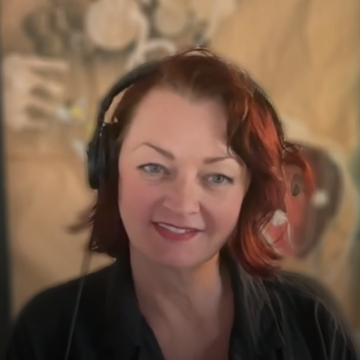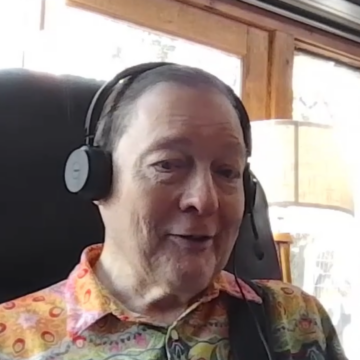


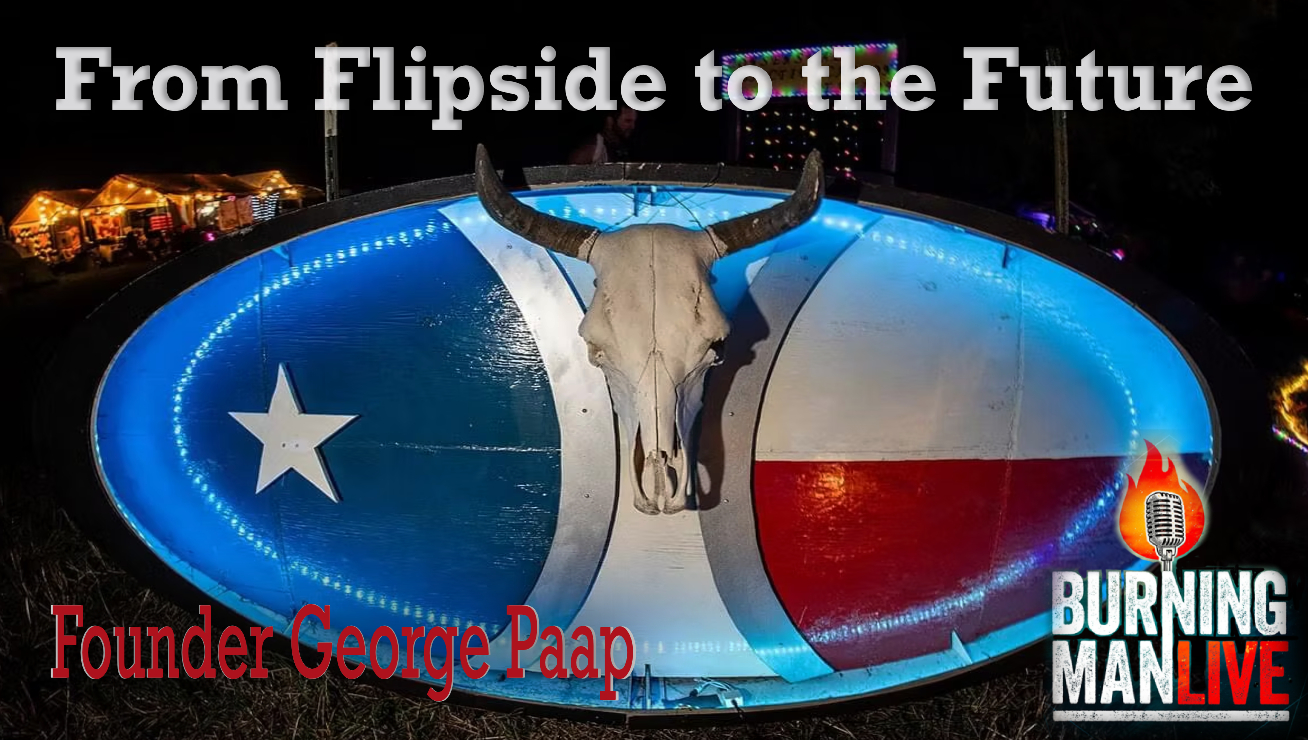
George Paap, a pioneer of the Burning Man Regional network, talks with Andie Grace.
He founded Burning Flipside in Texas, the first-ever Burning Man sanctioned event beyond the desert. What inspired him? Black Rock City 1997. He found freedom there, and it sparked a lifelong mission.
Hear his adventures of building a culture from scratch, and why, as a futurist, he believes Burners are steady & ready to handle the societal shifts ahead.
Collaborating to create local community without a blueprint
Celebrating Burning Man culture is a backstop for a polarized world
Finding resilience under pressure in the art of radical integrity
“Don’t wait. You have to jump in and do it. You can’t wait for something to happen. You’ve gotta provide the motivation… the inspiration… the vision, and bring people along.” — George Paap
Transcript
GEORGE:
Appreciate the ability to be able to do everything you can when you can do it. Don’t wait. You have to jump in and do it. It’s the same with whether you’re founding a company or founding a Regional event; you can’t wait for something to happen. You’ve gotta provide the motivation. You have to provide the inspiration, you have to provide the vision, and bring people along.
~Meet the people who
make Burning Man happen
around the world,
the dreamers and doers,
the artists, freaks and fools:
Burning Man LIVE~
ANDIE:
Get ready for a master class, and the beautiful, sometimes messy reality of building a culture from scratch, and organizing people to do amazing things together.
Welcome back, Earthlings to Burning Man LIVE. I am your host, Andie Grace. We’re going to trace the roots of the Burning Man global Regional movement with its true pioneer, George Paap. If you’ve ever been to a Regional event, you have George to thank for it.
In 1997, George came to the playa for the first time. As clueless as any of us, bringing little more than a pallet of blueberry muffins. But what he found was a sense of intellectual freedom so profound, he said it pulled him out of a deep depression, and changed the trajectory of his life. By the next year, George had founded the very first Burning Man sanctioned event outside of Black Rock City, which we now know as the legendary Burning Flipside in Texas.
George pulls back the curtain on the founder’s dilemma, and resilience under high stakes, and radical integrity.
George is also a futurist, so he brings a futurist perspective on why he thinks Burners are some of the most well equipped people on the planet for the societal shifts that we are experiencing. Whether you’re a community organizer or a longtime Burner, or are just looking for hope in a polarized world, get ready to reminisce, listen, and learn from the O.G. himself of the Regional Network.
George’s story is a testament to what happens when we stop waiting for permission and just start providing the inspiration ourselves.
Hi, George.
GEORGE:
Hi, Andie.
ANDIE:
Could you start by telling me about yourself?
GEORGE:
Sure. I was born in 1965. In ‘77, Star Wars came out. I got so enamored with lasers and Star Wars, I wanted to know how they actually worked, and that actually is what really encouraged me to go and get my degree in Physics at Berkeley was Star Wars.
And I even ended up my senior year at Cal, taking a graduate level course in quantum electronics with a guy that won a Nobel Prize. And that was pretty cool.
I ended up in Texas, had a lot of friends through work, and we went to the lake every weekend, and followed my friends’ bands around and stuff like that. In the 90s, that’s kind of what everybody was doing socially, was seeing music and being involved at South by Southwest in some way.
I first heard about Burning Man in 1996. My friend Tom Davidson, he was like, “There’s this big festival out in California. I think you’d really be into it.” And I was like, “Well, you know, I’m having my Tiki Fest, Extreme Tiki Fest party on the beach, that Labor Day.” Basically, it was dragging down a trailer filled with a bamboo hut, and a bar, down to the seashore with about 15 of my friends. And that was my first beginning, real beginning of like, Burning Man, because it was my theme camp. But I didn’t know it was a theme camp yet.
Well then the next year, the WIRED Magazine article came out about Burning Man being the new American holiday, and of course, I was tremendously upset about not going out and being there for ‘96. So I absolutely told myself I was going in ‘97.
And so I literally no idea… I had points, so I get this Lincoln Continental rental car. I didn’t know what to take. I know I bought three cases of beer and a big pallet of muffins, blueberry muffins, a bag of I think oranges and bananas, and probably like peanut butter and jelly sandwiches. That was it.
I got there, and I’ll never forget because it was after midnight. I arrived in this giant boat of a car. I drove down the center of Center Camp, and I opened up my window and I asked, “Where do I park?” That’s literally how clueless I was. Somebody could have been really, really sarcastic with me, but they said, “Oh, I think about two rows back on the right there’s a few spots you might want to check out.”
Sure enough, there was a spot, and I just camped there overnight and then set my tent up in the morning. In the morning I was just surrounded by these amazing people, one of which I still know, Jim Caldell out of Dallas, was in that initial group of like six people that I just happened to camp near by. The other were two grad students going out to grad school in the Pacific Northwest, and they were just kind of on their way, so they stopped by Burning Man. And then there was a film professor from NYU, and he was filming everything on eight millimeter and 16 millimeter film. So I never found out whatever happened to that film, but it’s kind of neat that exists somewhere out there in the ether.
That’s kind of my Burning Man origin story.
Once I went to Burning Man, I realized that, while I had outgrown my backyard for my party, the next logical step is to throw my own event, where I can have a camp and everyone else can bring their own camp, and then we can have like, a mini Burning Man. And the thing that really motivated me coming out of Burning Man, was an unbridled sense of freedom that I had never experienced before.
I mean, freedom, what does that really mean? You know, I had such a kind of loaded word, but it was really an intellectual freedom, a curiosity. It was all the playfulness of the Cacophony Society. But we really got that sense of freedom, and it’s like, I want to have that near me. I don’t want to have to wait and go out once a year to have that sense of freedom.
I got to go to the Burning Man office. Harley invited me, and I went to this thing. I was just blown away. I asked somebody, well, when did you know Burning Man was going to be successful, or this whole adventure would be successful? And they said when they had more events that they can see in a weekend, that’s when they knew that’s been successful because it like, to have so much stuff going on.
And, it didn’t take me long. It only took me two, three, four years before I had that feeling of like, oh my God, there’s, you know, the founder., I’m expected to go to everything, or everybody gets upset, you know. And then that’s also something I had to learn a little bit of being a leader, and suddenly you’re doing something that’s all volunteer from a leadership perspective, it’s all volunteer. And so that’s when I kind of realized that Flipside was a success, because we literally had stuff going on all the time, and I could go to a fraction of it.
ANDIE:
You basically just answered my first seven questions.
GEORGE:
It’s something that changed my life so positively and still does. I went back this year for my 14th Burning Man. Even though I’ve been disabled, I made that happen.
ANDIE:
It sounds like, though, that very early on you got a sense that this was going to become a big part of your life, that it was exactly right for you.
GEORGE:
Because that was all of a sudden, all my circle of friends was all involved in this activity. My wife Catherine, she really enjoyed Burning Man, and the community, but I actually dropped out of leadership after about ten years because she just finally told me, it was making her very nervous about being responsible for such a big event with so many people doing so many different things. It just stressed her out, because ultimately we’d be liable if something bad happened. Flipside’s still very fortunate we’ve never had a fatality.
‘97 was the year that the Sheriff impounded the gate money. I was there when Larry Harvey stood next to the Bone Tree and was saying, hey look, they’ve taken all our cash. If you can get 5 or $10, $20, that would be a huge, huge help. If you give $500, you can become a lifetime member of Burning Man. You just have to believe that it’s going to continue to exist.
Now, you have to remember at that time the tickets were $65. So $500 was, you know, substantial on investment. And that was the best investment I ever made, because I’ve had a Burning Man ticket—which if I can’t go, I obviously gift someone—ever since, which makes me regret the Burns I didn’t go to, but, it makes me appreciate all the Burns I did go to.
I literally got home, and I’m like, I couldn’t have gotten that much out of therapy for $500, there’s no way, because I’d been in a complete deep depression, you know. A lost love, that sort of thing. It really turned me out of the deep depression to basically almost a mania, which is pretty familiar to most Burning Man people, I think! They’ve gone through the highs and the lows, and it’s where a project gets a lot more complicated than you expect, and nothing works perfectly, so you have to adjust your own expectations on an ongoing basis.
Yeah, so I knew Marian and Harley had said, hey, we’re thinking about doing this Regional Network, and I basically had a benefit party on October 18th of 1997.
ANDIE:
Can you tell me about some of the other people? You started this thing. What was the need?
GEORGE:
The first year we only had 30 people, and I called it Burning Man at Austin. And I didn’t know how Burning Man org would feel about that. I didn’t know what else to call it, to be honest.
So the first year what I did to get people, is I went to Eeyore’s Birthday Party, which I felt was a very simpatico even—lots of hippies, lots of drum circles, lots of art— and I handed out fliers, hey, I’m having this event, you know, out in the woods. And I handed out to all the cool people I could find.
At that time, I’m not sure if I should say this or not, Burning Man actually gave me a physical list of all of the addresses of everybody in the Austin area, and I literally sent them out paper invitations saying, “Hey, I’m having this thing.”
So somehow I was able to get a core of 30 people that decided, well, next time, now we’re going to really organize. So we started having bi-weekly happy hours. I can’t quite explain how we went from 30 people to 300 people. That was just a lot of people talking to people, inviting their friends, etc.
What I do know is that ‘99, we’re like, we need to form an LLC. I don’t want to be personally liable for this event, because I actually put the first event on my credit card, I mean, you know, I paid for the whole fff thing.
So Prost, Allen Patman, and I were the first LLC for Flipside. After we had this fall out, we kinda decided, well, we need to open this up. And so we literally had an election of our second LLC. And that is when Pat Wheaton joined, and Jessica Porter, joined and Choppa joined, Chris Bird, Karen Pittman joined, and there was another guy, Charlie Spiegel, that was also there.
We still had interpersonal conflicts. We had different ideas about what the event should be, but we all came to solutions. We were all able to put aside our personal needs and wants, and get to kind of more of a collective.
We also took a bite out of the Burning Man Bible, in the sense that, what do you do once people start retiring and leave the organization? Maybe take a step back and go back to, you know, their waking life? Succession planning. And like I told you, my wife was getting worried about the liability. So at that point, it made sense to me because we were at 2500 people every year and walking around with 2500 people, doing a lot of dangerous stuff.
Around 2009/10 new people came on board that had the same passion and were there for ten years, and put in all of that work. I’m very proud of this fact – I can’t even remember all the LLC members, we had so many – and now it’s on to a Board. I think I counted, last counted, was 26 different LLC members. So that is a departure from Burning Man was very still, very closely held.
The other thing that forced us into that was, we couldn’t afford Austin anymore.
ANDIE:
Well, I want to hear about both Combustion Chamber and Catalyst.
GEORGE:
The Combustion Chamber, we formed around 2002, because I was getting feedback, personal feedback… the nice thing about when you’re our founder is everybody points their finger at you and they know who to talk to. And so I was getting a lot of feedback that the community wanted to have more input on the decisions we were making, particularly when it came to longevity of the event. Do we expand the event? How much to expand it, versus keeping it smaller?
Early on, there was this phenomenal Burning Man-style growth that we had, which I think a lot of the Regionals happened. And all of a sudden, you know, you’re at 300, and 500, and 1500, and you’re like wow, 2500; that’s a real amount of people.
We were forced to be more disciplined than a lot of Regionals, which I attribute to some of our longevity, because the state of Texas, back in the late 90s, passed the Rave Act. And everybody was worried that their events were going to be shut down by the Rave Act. And we were worried about it being shut down by the Rave Act. How that manifested in Texas was something called the Mass Gathering Permit, where if you had over a thousand people, you had to get a permit, and the permit had to have the sheriff, the county health inspector, and the chief of the fire, and they all had to sign off on this Mass Gathering Permit.
Fortunately, the people that were in charge at that time, they took it very seriously about basically putting plans together. What are our evacuation plans? What are our weather plans? And then we had to present them to the judge, and to the three first principles in many ways that brought the event above ground, so to speak.
But at the same time, we didn’t really advertise it. We weren’t looking for more people. Once we hit around a thousand people, we were kind of like, well, I don’t know; we can’t continue to do this, keep doubling every year. We have to have some structure around this. That’s where we are still.
We had an intermediate period that we went to a place called Flat Creek. It was a child nonprofit that would bring inner city youth out to camp and stuff in Texas. And so that was really cool, because here we are, the money that we’re paying to the people we’re renting the property from, it’s all going to a children’s nonprofit. So we’re like, well, that’s pretty sweet.
ANDIE:
Hard to argue with.
GEORGE:
Hard to argue with. Yeah. And they were very kind to us, very nice to us for many years. But the reality was I had the sheriff call me up, the elected sheriff, not the Deputy Sheriff or the Sheriff’s Department. I mean, the actual, the guy that’s on the election signs, call me up and say, “Well, we don’t want any of your kind in my county. I hear you all naked, and we know what’s going on. And I know my constituents, they’re good Baptist folk. They don’t want you around,” you know. And I respectfully disagree. It’s a free country. Thanks for your time. And that was it. And the next thing I did was call a lawyer. I got somebody on retainer, so we had somebody there that could be there within 30 minutes if the guy tried to shut us down.
So that’s when we kind of scrambled and we found this property that we’re still at, in Northeast Austin.
I don’t know how many other Regionals had to deal with that level of -– I know that Athena had to deal with a lot of protocol in LA and how they did that being in an urban environment. So I’m sure other Regionals have had to come through their own solutions for that sort of thing, but I think it made Flipside stronger.
We actually did have what we call Floodside. 2016. We actually had the tornadic event, and we had a tornado touchdown less than five miles from the event, and the whole… I was the last person out. The landowner pushed me out. I had a van, pushed my van out with this tractor. About 120 people were cut off, and basically had to just shelter in place until the following day.
The fact that we were able to handle that without any fatalities… I wish we had even had less damage, but that’s it. Nature does what nature does, and, you know, you have to work your way around it. That’s when the preparation really paid off because we actually had an emergency that required some level of sophistication and preparation to deal with.
I’ll be honest, I had a bit of survivor’s guilt for a little bit after that. Just, you know, I wish I had stayed there and made sure everybody was okay and all that because, I mean, I left and was like, literally they are closing the roads as I was out of there. But in retrospect, that’s not something to wish for. I’m glad I got out. You don’t want to be a statistic.
ANDIE:
Absolutely not.
GEORGE:
Especially at your own event.
ANDIE:
Doesn’t look good for leadership.
So I’m curious about, at that time, communication with other Regionals. Like, what happened to make sure that you were able to give your lessons to those other people in the Regional Network?
GEORGE:
Well, the Regional list was really ground zero for the Regional movement, I felt. In the early day, Canada was very active. New York was active. They had activity in Arizona.
ANDIE:
Phoenix, yeah.
GEORGE:
Phoenix, yeah. And then eventually it got up to SOAK and Ignition and all the others. The email list was very, very helpful for everybody.
Well, for one thing, I always wanted Burning Man to be a part of it, and so I set aside five tickets for Burning Man ever since the beginning. And Burning Man would gift that out to their people. And so we actually got, you know, Harley was at the very first Flipside, and then Danger Ranger made it out on his silver…
ANDIE:
Silver Seed.
GEORGE:
Silver Seed, that’s right. It was called Flipside 1999. We were never really apart from Burning Man. We had Burning Man in us the entire time. Yeah, it’s something that I did that was really positive towards mutual happiness. But the other was, in the early days, I actually reserved a fair amount of tickets for Regional people to come, wherever they’re from. And so a lot of people like the guy that started Apogaea here in Colorado, he went to Flipside. That’s where he got the idea. He went to his first Flipside, and he’s like, I could do this in Colorado. Our big community outreach was we… Transformus got in trouble and didn’t have any Rangers, basically; they had very minimal Ranger staff.
ANDIE:
Transformus is in the south east, right? Yeah.
GEORGE:
South east. That would be Asheville, North Carolina, and one year we sent 12 Rangers. I went along with them. And that was a very magical thing. The property itself was spectacular, and just meeting everybody, and…
ANDIE:
Do you remember any conflicts of opinion amongst Regionals that early on, before there was even a formal network, and an agreement?
GEORGE:
There were plenty of conflicts of opinion. There’s always kind of a tension between how formal and informal we make things. And the regions vary quite widely on how they do that. Is it really just one person and a few friends, or is it… What actually makes community? One of the things we always would talk about is, what is community,and how do we know when we have one?
You know, I already had my measurement from Burning Man, which was: there was more stuff to do than I could possibly do. So hey, we’ve reached community! Because it takes more than me going out there and evangelizing the event. It’s way beyond that. It’s out there, and other people do that, and it’s organic.
That’s a lesson that every Regional has to kind of go through, is that ‘founder’s dilemma’ kind of then, what do you do next? How do you keep momentum going? How do you deal with burnout? For the first few years, I took it very personally when people would step back or quit. I really took that personally, like they were letting me down. And then over time, I realized that there’s a real cycle, that you really can’t… This is where I get Burning Man a huge amount of credit. To do what they’ve done for so many years? It’s just just not an accident, it’s by design. And it takes a lot of commitment to make something last that long.
I think our relationship with Burning Man would have been very different if Burning Man had gone in a different direction, but to us, at least in Austin, it was kind of that North Star, so to speak. Would this fly at Burning Man? What would Burning Man do?
Now from a creativity standpoint, we really elevated the Regional effigy, I think. We’ve had some amazing effigies. I dare say we’ve spent more money and put more time into art than most, because it’s something that everybody expects now. Everybody expects something spectacular. Everybody expects big fireworks at the end. Everybody expects to be kind of overwhelmed.
The Regionals always became a little bit weird when you had Austin, but then we also have Freezer Burn, which is still Austin. We also have Myschevia, which is Dallas, and then we have Houston Burns. So we were pretty busy just trying to work Texas.
We had a lot of crossover in attendees, a lot of crossover infrastructure. And I helped start Alma Burn in San Antonio. There was about a 300 person event, but we were able to do that because we were able to leverage, like the fire equipment that Austin already had. We bought some hoses and some other equipment to support them. And so that’s kind of how it was very collegial. The Texan Burns could be pretty collegial. And we actually got together every once in a while. We would get all the Regionals together for Texas.
And one of the things I was most pleased with 2019, something like that time range… I was out at Burning Man. It was a year they had a giant Trojan Horse. I just remember that piece in particular that burned. It was a spectacular day Burn.
At night for the burning of The Man, I mean, the art cars were really in there that year, and I was standing next to this guy and he had a leather flame hat, really nice. And he was grizzled. I mean, he was… He looked like he had just grown out, come from the earth. And I started talking with him. His name was Louis Brill, and he was a guy that had convinced Larry, evidently, to go to the Black Rock Desert Somebody who was O.G. O.G. from the Suicide Club,and from Cacophony and from those old, old days. And so he told me all these early stories, and I’m like, “Well, I started the first Regional. Have you been to any Regional?”
“No, no, know, nothing about it.”
I’m like, well, I really want him to come, so I actually paid for him to fly to Flipside and go to Flipside. And I picked him at the airport and, you know, and took him… Everything. And there was about a period like about halfway through the event where he was just like to me like, “Wow, this is the same thing.” Like it really grokked him that we had created the same vibe,and the same kind of experience. He was just a very interesting guy.
Now, the other thing that I thought was extremely valuable for bringing Regionals together were the GLC, the Global Leadership Conference. And I know that Burning Man couldn’t support that forever.
ANDIE:
They may restart. We’ll see. .
GEORGE:
What they did, I thought, had a huge impact. It was the most direct impact you can have is getting those people together, hearing the same story like, “oh, well, we’re having trouble that, we’re having trouble with that too”. It’s just a collaboration. A lot of the strength coming out and realizing that you’re part of the global community, seeing what’s going on overseas is just inspiring, and it gives me that feeling of like, when I started. I mean, the fact that people are still able to put on little two, three hundred person events in the middle of nowhere, in countries, all with the same vision and the same idea. It’s interesting because for our Alma Burn San Antonio event, one of our members, she’d been to Burning Man Japan. Now, that was pretty damn cool as well, and some other Regionals. Suddenly that becomes a real asset having that level of expertise, people who have just been to lots of different Burns. You see that people, everyone’s different and everyone’s a little bit the same. The thing is, they vary in degrees. So there’s a real camaraderie that I think the GLC brought that I do miss. And I’ve been to the ‘Burn After’ events.
ANDIE:
‘Burn After Meeting.’
GEORGE:
Yeah, I went to the one in Chicago last year, and really got a good sense of community from that and seeing everybody, and I’m all for it.
ANDIE:
I want to go back in time and like when you talked about that, you could see that this was going to be a big part of your life. What inspired you to give so much of your time and energy for basically free? Like people weren’t getting paid, you were losing money. You were putting it on your credit card. Why?
GEORGE:
It was a sense of being a part of something much bigger than yourself, is absolutely part of it…that’s not a religion or the military, just civilian daily life. I mean, where do you find that belonging to a larger group?
My very first Burning Man, I was blown away by how international it was. In 1997, I was talking to some guy who had just flown in from India. And then another lady, I was like, “What do you do?’ “I paint the ski trail signs at ski lodges all over the world.”
Wow. Part of that was just, we want to meet more amazing people. And part of that is you want to show off amazing stuff to people, the effigies and things of that. It was being a part of something creative, because I had never really thought of myself as a creative person, and it took me a little while before I realized that was my creative gift, inspiring and organizing and helping make this happen. That was my gift.
This is my lesson on leadership. There was a time I want to say it was 2010, and me and my wife and Kip, my late wife Catherine, got to the Gate late. And the one of the LLC members who got in a lot of, a lot of shit, and didn’t let me in or anything, and I didn’t ask to be let in. We just camped outside the event that night. And the only thing reason I regret that is the fact that Catherine didn’t make as many Flipsides that I would have liked, and I regret spending an evening with her out, literally outside the event, and we didn’t get to enjoy it that night. It was neat because you could see it from afar, but I realized if I were to hop over the fence or just kind of, “Hey, I’m the founder, let me in”, I would lose a lot of credibility, you know? And then ultimately, I got a tremendous amount of credibility for following the rules, because everybody realized that I really didn’t have to do that. I could have pulled rank. I could’ve just walked in and done whatever. But the fact that I respected the rules that everybody else had made, it went a long way.
ANDIE:
Surely, definitely, other people showed up and volunteered. Can you talk to me about the role of volunteerism in this culture?
GEORGE:
The most important volunteer from our perspective was Volunteer Coordinator. They’re the engine that made everything else run. It was a job that people would keep for at least two or three years. Later on, they would do things… encouraging, networking and encouraging people to come out and encouraging people to play together and that sort of thing. There are many of them, and they’re literally one of the core reasons I think we were successful.
We always had need of Rangers, we always had needs of Medical. And that’s when you have to make those kinds of judgment calls of like, well, yeah, you’re right that probably it’s more important and we’re safe for the event. So there is some deliberate munging, if you will, to make sure that you have the necessary safety volunteers that you need. We never gave away free tickets. But I know for a fact we did let in a few people that you know, we’re doing safety volunteer work for us.
ANDIE:
How dare you!
GEORGE:
How dare me! Well, I know I literally had people saying “If you ever start paying yourselves, Im done. Or if you ever have a paid volunteer coordinator or paid LLC…”
ANDIE:
Okay, I remember some of that dialog on the Austin lists in those years.
GEORGE:
Oh yeah, that was a hard no. Like absolutely not. I think people are a little bit more flexible now just because, I mean, life has gotten a lot more complicated, frankly, I think, than arguing about the effigy size, but, from a consequential standpoint, the volunteer coordinator is really the key to making sure that we had a successful win every year. And we got up to like 60 leads. I don’t even know where we’re at now for Flipside, but it’s a lot of people. I mean, our volunteer corps is well over 200 people, for about 2500 people. So we’ve always had a good, I want to say, reputation for volunteering. I think people enjoy the volunteering experience. There’s a lot of feedback.
So the Combustion Chamber is one area. It’s around 2001/2 I was getting this feedback that I wasn’t being representative or, I needed more input from the community than just making decisions. Because I’ll be honest, it’s easy to be a little bit of an autocrat when you’re in charge of everything, and it’s harder to let go of everything in response.
So this Combustion Chamber was basically community members who wanted to be involved, who had opinions, who wanted to sit around and basically talk about effigies, and talk about other things, all ages, like we’ve always been an all ages event. That did come up from time to time. People would want to debate that. It kind of became a philosophical forum, a real communication. And so we had the Combustion Chamber get community input and get community feedback.
I can say I was very disappointed when I found out that one of my Alma Burn friends had been sexually assaulted at Burning Flipside, which is just something anytime you have 3,000 people or 70,000 people, that’s going to be a problem. I was pleased to hear that she contacted a Ranger and the guy was immediately thrown out. So, you know, the process worked, so to speak. I was just very upset that she had to go through that, to do that. So, the real challenge is: people have to behave themselves. People have to be at least somewhat aware that they’re not in a totally safe space.
ANDIE:
Yeah. One of the challenges of bringing people together. There’s no such thing as utopia, really.
GEORGE:
No there’s not. We’ve tried really hard, but. I thought we got pretty close.
I mean, I feel away from the Burning Man retirement commune somewhere. It seems like it’s out in Gerlach now, but it might move, it might move more central, I don’t know.
ANDIE:
Yeah.
I’m going to ask you another question and then I’m going to move into your kind of cultural view on Burning Man in general. But what are you most proud of, of your time participating in Burning Man?
GEORGE:
I’m most proud of being a known part of something that’s a worldwide movement. I’m a big fish in a big pond, not a big fish in a small pond. It’s good to be me. I mean, I’m happy about having a legacy. I can look, I mean, that’s probably the biggest thing is back in the cultural thing, I don’t have any sort of feeling like I need to complete anything to have had a fulfilling life. You know, I’ve pretty much embraced it and got all out all the way in. When you become disabled and all of a sudden you’re much more limited into what you can do, it really makes you appreciate the ability to be able to do everything you can when you can do it.
And that’s, I guess, my biggest lesson. Don’t wait. You have to jump in and do it, you know? And it’s the same with whether you’re founding a company or founding a Regional event; you can’t wait for something to happen. You’ve gotta provide the motivation. You have to provide the inspiration, you have to provide the vision, and bring people along.
And having done that with Burning Man, and which I think is doing the same thing, it’s like we all grew up together. I’m 60 years old now. I started this stuff when I was 34. I don’t think I could start it when I was 24. I wouldn’t have been mature enough for it, you know? I wouldn’t have been mature enough, I’m not sure, at 27 or 28 to do it. And so you have to also give young Burners a little bit of space because, you know, I didn’t know what the hell I was doing until I was really in my 30s. And even then, that’s questionable. I didn’t really feel like I really understood everything till I was in my 50s. And now in my 60s I feel very complete, having been a part of something bigger than myself and having had a big part in it.
ANDIE:
That really makes me reflect on… You know, obviously the social media image of Burning Man is probably involving more younger Burners. And there’s a whole bigger part of the story, and it’s okay for them to be experiencing that as their first exposure to it.
GEORGE:
Oh, it really is.
ANDIE:
Because maybe it takes them somewhere bigger.
GEORGE:
And that’s the other thing you realize as you get older, you can’t do everything. You can only do some things, so you have to kind of choose…
ANDIE:
Right.
GEORGE:
I don’t regret at all having put so much time and effort, and so much of my life into it because I’ve gotten so much out of it. I have a worldwide network of friends. It’s pretty neat. You can go to any big city and find a Burning… something happening, culturally.
One year I went to Asheville when I was working for Dell. I arrived there, I contacted the Regional contact and they’re like, “Oh, it’s so and so’s birthday tonight. Come on over.” And I went over and it’s everything you expect from a Burner birthday. There’s fire spinners and lights, and even though I was there for work, I fit right into the actual social scene, no problem at all. The ability to do that all around the United States and in the world is just pretty phenomenal. I would love to go to one of the small European burns. I’m going to go to The Other Side up in Victoria, Canada.
And that’s the other thing is, I’ve met so many amazing, cool people. Then they reach out and come visit me. They’ll add me to their, whatever their journey is. And that’s really meaningful. People will stop and visit.
ANDIE:
It just keeps growing in that way, like as it gets more awareness. It’s funny because there’s the exposure and people are like, “I liked it better when it was just me and my friends, and I was the only one who knew about it.”
GEORGE:
It’s not done.
ANDIE:
But on the other hand, like you said, it expands the network of what’s possible in such a huge way.
GEORGE:
And you see the art that’s out at Burning Man. There’s no other place on the planet for it. And I tell people — this is my tagline for Burning Man — It’s the most creative place on the planet, for a week. Wouldn’t you want to go there? I think I want to go to the most creative place on the planet, and experience a planetary event like that. This is a planetary thing. This is not a San Francisco thing or an Austin thing. It’s a world wide global thing.
ANDIE:
Yeah.
GEORGE:
And I actually, I’m very proud of this. I got my last job, USAA, to pay for me to get a Master’s Degree in Futurism or Foresight.
ANDIE:
That’s right. You’re a Futurist.
GEORGE:
I am a professional Futurist. And that was kind of the next step. I’ve kind of built something, I’ve been a part of something, and I’ve always been interested in the future. My future focus is probably what let me do all that. It was the most fascinating degree you could possibly get, because you look at everything from five dimensions: social, technological, economic, environmental and political.
And so whenever you look at the future, you don’t look at just a technology future. There’s actually a framework for how you go about and analyze the future across each of those dimensions. And if you’re not doing it across all of them, you’re not getting the full picture.
And so it’s the ultimate multidisciplinary degree, in my opinion, is Foresight. It’s almost too meta for people to realize that they need it.
And that’s a whole other community of thought that I’m now engaged in. I was on the email list for the professional Futurist. Well, that alone is worth the membership just to be on that email list, because you basically get this whole world of Futurists talking about the future; this study, and that study… It’s really fascinating. And I went to…
ANDIE:
I bet.
GEORGE:
Seattle for the they have a yearly conference. And it was neat. I mean, it was people talking about asteroid mining and what their plans are for how you get the asteroids back to Earth. And I mean, just all this wild, crazy stuff that’s going to happen in 20 years!
In a world where it’s looking like: do we have health care tomorrow? Do we have food today? Being able to step out of that and really look at like, well, where are we going in ten,15, 20 years? Especially now? I don’t have a crystal ball. I can tell you right now, I moved to the middle of nowhere for a reason. And that’s because I don’t think our society is going to be in good shape here and in the near future. I mean, in worse shape than it already is. The people around me know how to hunt. I have a creek behind my house. I’ll be fine. But, I am worried about society in general, and American society in particular.
But then again, the Futurist, the foresight background, you realize the big cycles that occur in history and technology and art and everything. It’s cyclical, obviously.
ANDIE:
Yeah.
GEORGE:
That’s part of it too. But Burning Man is part of the artistic legend of the United States. I mean, really, the cultural legend.
ANDIE:
I can’t disagree with that. I wonder how you think Burning Man’s vision, or place in the world, has evolved over time as you understand it?
GEORGE:
That’s a good question.
I think it’s gone from being very self-focused to more outwardly focused, is the best way to put it. And I think it has been a long journey, it didn’t just suddenly change all of a sudden, but then you’ve had the same leadership at Burning Man for a long period of time, so you wouldn’t expect sudden change. And that’s probably one reason why it continues to be successful.
I know Marian’s under constant heat, but I’m actually a big fan of hers. I think she’s done as well as you possibly can in her situation. Yeah, it helps that I’ve known her since 1997. So, you know, I feel like I know her more than just her public persona.
And actually that was something that was very special. I was invited and went to the Esalen Outreach Program 2019. It was right after Larry had died. And you can really sense that Marian was searching for some direction. I could see Burning Man really reaching out to, where is our place in all this, and what’s the animating force? I think there’s a lot of value in that. And it shows that Burning Man is really trying to understand itself and its future on its own terms.
ANDIE:
What do you think’s the biggest challenge for Burning Man ahead?
GEORGE:
Burning Man… I never talked about politics when I went to Burning Man or Burning Flipside, or most of my Burns, but now it seems like that’s all everybody talks about. And I always thought that Burning Man was apolitical. But I learned in my Foresight degree, there’s a whole theory of human development by Lewis Claire Graves, is his name, and something called a spiral dynamic theory.
And it’s about how societies evolve from a power focus, to a tribal focus, to a truth/justice focus to a kind of rationalist behaviorist, you know, make as much money as possible, focus to a green focus where it’s about the environment and whatever. Each of those five are completely incompatible with each other. They all think that the other four value systems are incorrect and only their value system is correct.
What happens beyond that, is something called the integral value set. So there’s a whole other cycle of value sets that sits on top of that, where you realize that all five of those core value sets are appropriate and are a stepping stone towards valuing them all. And so Burning Man itself is a next level, which is a kind of a global neo-tribalism. Burning Man is its own tribe. It’s got really its own technology, it’s got its own arc of art, it’s got its own art of…
ANDIE:
Morays and fashion and yeah.
GEORGE:
All that stuff.
These value changes, the green value set, you know is obviously is in the downswing right now, but that simply means that it’s being remolded into something else. The values will return as yeah, we all know that we care about the planet. We all need to care about our Earth. We all need to have care about the food we’re eating and all that.
It was neat to suddenly discover that I was already a part of the future. If everything goes to hell, I know where I’m going: with my Burner friends. Most of them are pretty sustainable in whatever situation they find themselves in. ‘Resourced’ is probably the best word, they’re well-resourced…
ANDIE:
Resourced, yeah.
GEORGE:
And we get to play apocalypse every, every year. You know, there’s always some challenge and it changes from year to year, but you overcome it and it just becomes part of that whole experience. I mean, that’s the thing is, Burning is… people who describe it as a party, it’s like such a non… it’s it’s the alternate of that.
ANDIE:
You can have a party anywhere. Why would you choose there?
GEORGE:
Why would you choose there? Exactly. And the reason is because other people that want to party there and are willing to buy in on your crazy idea of whatever, making a spaceship art car, I mean…
Where I think Burning Man is still going strong, is… the art behind it is. I mean, I hadn’t been in eight years, 2018, after my wife died, I went. Her name was on a remembrance wall, and that was very profound.
And I was extremely happy to see the level of the art and the level of the communication. And just it felt like Burning Man has always felt. And that was just a real affirmation that if I don’t go for another five years, it will still be, at least elements of it, similar to what we’re doing now.
And I say politics because we’re on public land too. And what to say if somebody says, “No, we don’t want you there anymore,” and then what do we do? And that is kind of where the Regional Network is kind of the ultimate backstop of Burning Man. As if Burning Man never exists, then the Regionals will take off even more, and the culture will continue, and it’ll probably be subsumed into something else. But we’ll still be a part of the cultural legacy.
I was so glad to see that we got that exhibit in the Smithsonian, because it just kind of legitimized our role there.
But I think Burners just need to reach beyond the politics and realize that the only way we move forward as a society is together, not separate. One of the lessons that comes out of Burning Man is that we have to work together whether we want to or not.
ANDIE:
As a Futurist, you must be an understander of history. Do you ever compare Burning Man to any other movements or events throughout history?
GEORGE:
I think Burning Man is an art and cultural event more than anything else. I find it fascinating even just looking at U.S. history going back. I mean, as dire as some things seem, you can go back… just put it on repeat. And it’s pretty textbook.
ANDIE:
Pretty textbook. Yeah.
GEORGE:
Yeah. There’s really nothing unusual here. I mean, we just go through our little bouts of authoritarianism every 100 years. And so in that sense, it is just seeing the flow, and that Burning Man is unique to its time.
Burning Man has a very direct kind of lineage from the 60s, I mean, from the Merry Pranksters and from that cultural time period, there’s a direct lineage into Burning Man, that timeline. It’s like the 60s did keep going. It just changed. The 60s didn’t stop, and that cultural movement didn’t stop. It just moved somewhere else and it became Burning Man. Really the history of art is where Burning Man belongs, in my opinion; cultural and art.
ANDIE:
Transformation. Do you think Burning Man is transformative for people? And do you think they take that home? It doesn’t have to be just the playa, but the experience of going to a Burning Man event?
GEORGE:
Oh, I think so, absolutely. It’s hard going, expecting transformation, I would say, because that’s part of the surprise. Part of surprise is the before and after, and seeing stuff that you never thought you’d see, and doing stuff you never thought you’d do.
That transformation may not come on your first Burn. My first Burn was, well, is Burning Man, but at that time it was 8000 people, which I thought was a lot of people. There were more cops in 1997 than there have ever been. There were like two police helicopters flying around. There were cops everywhere, everywhere! And yet, I went home. And what did I take away from it? Freedom.
Freedom? But there’s police helicopters flying around.
Yeah, man, it’s not about that. It’s the artistic freedom that people are feeling and doing.
Yeah. So it’s absolutely transformational, but it comes on its own time and it transforms in its own way.
ANDIE:
What are your favorite and your least favorite ways that Burning Man has evolved since you got involved?
GEORGE:
Oh, wow, that’s a good question.
Least is, like I said, introduction of politics, and people just, you know, bringing that into the whole equation.
Most is really the international Regionals. I just see the spirit in them as the same spirit as I had in Austin after seeing my first Burning Man. It’s like, I want to make this happen and I want to make it culturally appropriate, and I want to import this in.
It’s kind of crazy when you think about it. Burning Man’s an import at this point, in a way, that used to be an export, but at this point we have enough global coverage. The new stuff, the brand new thing is happening in Europe or South America. That’s where the new edge of Burning Man is. That doesn’t mean I don’t want to go back to Burning Man, or any of my other Burns that I’ve been to. If I was in my 20s getting into this, that’s where I would go, is I would go with all Europe and Burns, and maybe South America, and travel around and get a sense for how far out in the world have we actually gone? I don’t know, but it’s really impressive. It really is.
ANDIE:
It’s huge.
GEORGE:
It’s huge. It’s hard enough Burning Man being where it’s at, but to come from overseas and make that happen, it’s really almost beyond my comprehension. It’s almost inconceivable to be like “Oh, I’m coming from Buenos Aires.”
Okay, so… And yet there’s all this amazing international art every year. So that’s my two: Politics is a negative and internationalism is a positive.
The biggest takeaway for me is, I’ve got this legacy, and whatever I’m supposed to do in his life I’ve already done it. I feel very happy and very satisfied and very complete and…
ANDIE:
Fulfilled.
GEORGE:
Yeah. Self-fulfilling.
That is the one thing you have to realize: it requires sacrifice on many levels.
ANDIE:
So if somebody didn’t know what it was, how would you describe it?
GEORGE:
Burning Man is a big art and music festival in Nevada, is what I tell them. And if they have any questions about it, then we go further, and I’ve been really surprised by the percentage of people that have heard about it, frankly.
ANDIE:
Sure.
GEORGE:
People start asking you questions about: Why do you go? What do you take out of it? What does it mean to you? That sort of thing. Start with an appetizer before you give them the full buffet. Because they’ll find the buffet never ends. It just keeps going on and on and on.
ANDIE:
True because it’s such a big story. I mean, you could talk about any individual Regional group, or the global story, or Burners Without Borders.
GEORGE:
Absolutely. That’s where I think Burning Man’s got it right in branching out to things like that, and Black Rock Solar, and Burners Without Borders. I’d be remiss if I didn’t mention that, and my friends that have contributed to that.
ANDIE:
Austin’s been huge in that movement.
GEORGE:
Yeah, Austin’s been big.
ANDIE:
Here’s my last question. Why does Burning Man matter in the world?
GEORGE:
Why does Burning Man matter in the world?
It’s seeing it for what it is. It’s a time-bound artistic and expression movement that’s still going on. We’re not in the end phases of Burning Man. We don’t know where we’re at with Burning Man. Like I just said, if things really go south in terms of, if society and the planet and everything went south, we are some of the best prepared and most resourced people I know.
Burning Man could play a huge, huge impact on the future, if necessary, but I’m not sure it will be. We’re just gonna have to see what happens socially and societally.
I can tell you as a Futurist, you know, global warming is no joke. You realize, like people have been talking about a pandemic for years. And when Covid hit, there was not a single Futurist shaking their head and wondering what happened. It was just obvious that was going to happen, it just wasn’t obvious when. And so that’s the thing about the future is, as you look at all these potential possibilities, and you have to look at kind of the long arc of history on where you’re at in our timeline. And from my standpoint, Burning Man has an unlimited timeline because it’s still relevant. I don’t see it becoming less relevant. I see it becoming more relevant as people, as people evolve in their understanding.
As these… these value systems I talked about, the spiral dynamics.
There are large portions of the whole world that are at each of the three value stages. As those migrate or evolve into later value stages, there will be more aptitude for things like green policies and the environment, things of that nature. We’re just kind of in a retro loop right now, which happens. Like I mentioned, we seem to have this bout of authoritarianism every hundred years.
Burners and authoritarianism do not mix. And so in many ways I see us being a counterbalance. We don’t like being told what to do, and how to do it, and what to think and when to think it. I almost feel like we’re in, a mirage or an illusion or something, and something is going to jolt us back out of it. Burning Man still has a role to play in whatever future comes out. I think it has a vibrant role in changing the future of the world from where it’s at right now.
To think about what it takes to throw a Regional event in Russia right now? Wow. What am I complaining about?
ANDIE:
Or China.
GEORGE:
Or, yeah, or China or anything like that. And yet they’re doing it.
ANDIE:
Ukraine just did one two weeks ago.
GEORGE:
That’s where I see the fire. The fire is burning overseas. It’s still burning here. But there’s a fire overseas and it’s burning. And who knows, that might catch on more and more. My family, believe me, has wondered for 20 years why I put so much time and effort and stuff into it. They’re finally kinda coming around and realizing that it is something good to be a part of.
ANDIE:
I think you’ve won Burning Man at this point!
GEORGE:
Well, thank you!
ANDIE:
Is there anything I didn’t ask you about that you wanted to make sure to mention for posterity?
GEORGE:
Just how proud I am to have so many awesome friends from all over the world, now. I don’t know, I just, I felt more a part of Burning Man this year than I have in a long time. And, it meant a lot to me to be out there.
ANDIE:
It keeps offering lessons, doesn’t it?
GEORGE:
It sure does.
ANDIE:
Oh my gosh, what a fun talk. Thank you so much for…
GEORGE:
Yeah, yeah, that was really enjoyable.
ANDIE:
I really did too.
GEORGE:
All right.
VAV:
Alright, George.
Burning Man LIVE is a labor of love of Burning Man Project, a public benefit 501c3, fostering a more creative, connected, and thriving society by facilitating global, interactive, and community-driven experiences based on Burning Man’s 10 Principles.
But I don’t have to tell you that.
Please pay it forward by tossing some coins into the wishing well at DONATE.BURNINGMAN.ORG. No amount is too small, at least I don’t think. Test it out.
Also, check out our new website at DONATE.BURNINGMAN.ORG
Thanks to Action Girl, DJ Toil, kbot, Mockingbird. These are definitely not my imaginary friends or I’m not Vav Michael Vav. Thanks, George, for the lifetime of achievements. What’s next?
And, thanks to everyone all these years, and thanks, Larry, for all of this.