

For decades, Charlie has led some of Black Rock City’s monumental works of art. He isn’t just the prolific mind behind iconic pieces like Elder Mother, an illuminated storytelling tree; he’s an architect of human connection.
He co-created and develops:
· Illumination Village – an early and long running home-within-a-home at Black Rock City
· The Flaming Lotus Girls – the all-volunteer, women-led art collective
· The Box Shop – a collaborative workspace and art studio of 23 years and counting
Tune in as Charlie shares his artistic journey with Andie Grace. They explore the evolution from flame-thrown wind-sail paintings to steel trees of addressable LED leaves.
But this isn’t about him.
The Box Shop, home to hundreds of metalworkers, large-scale sculptors, and multimedia artists, has birthed thousands of artworks and taught countless volunteers to wire and weld. After 23 years, it’s facing displacement due to gentrification. Charlie shares the gritty details of reinventing this creative sanctuary into a nonprofit in a new location.
Hear why making beautiful things with friends matters more than maximizing shareholder profit, and why hands-on community hubs bring belonging as an antidote to modern loneliness and greed.
Transcript
ANDIE: Hello.
CHARLIE: The creative impact of making this art, building these permanent pieces of art that go out in the world, that talk about the values, it’s not all about just, you know, maximizing shareholder profit. There is so much more to life than maximizing shareholder profit. There’s just like enjoying each other’s company, making things that are beautiful, you know, making the world a better place.
I love to see people experience art. I think art is one of these things that empowers you to believe in the impossible and to believe that if I could do that, then they can do whatever they want to do. You know, everything is possible, and it brings people together and it makes the world a little bit more beautiful.
ANDIE: Charlie Gadeken is an absolute pillar of the Burning Man community. To begin with, you’re a sculptural artist. But, from your roots as a founding member of The Flaming Lotus Girls to building the legendary Box Shop in San Francisco, you don’t just make monumental art, you create a literal infrastructure that allows collaborative art to survive in an increasingly hostile, hyper-expensive, urban environment. So I want to just jump in and say, hi. Good morning Charlie.
CHARLIE: Good morning.
ANDIE: Yeah. It’s nice to talk to you.
You have been such a staple of the culture that is evolved in that dust out there. I’d love to hear about your world of art and getting to Burning Man, and how that became a spark that made you realize you wanted to devote your life to creating big experiences in our community.
CHARLIE: I originally found out about Burning Man through a Cacophony newsletter in 1992. Dave X and I hitchhiked a ride to Burning Man. We had like a tent and a gallon of water, I think. That began kind of a lifetime journey of attending the event. I’ve now attended 34 years of Burning Man. And it definitely, you know, changed my life.
I went there that first year, and I made a little tiny Burning Man out of sticks. And that was my first Burning Man art. And since then I think I’ve made over 100 works of art at Burning Man. I may possibly be the most prolific Burning Man artist there is. Haha!
ANDIE: I can’t argue with that statistic. I think you’re probably right.
CHARLIE: Burning Man has just been a big part of my life. And, a few friends of ours, we started the Illumination Village. That was probably my other big achievement.
ANDIE: Ill Ville!
CHARLIE: which has now been going on for 30 years and it’s probably what’s kept me most going back to Burning Man. We have this community of 200 people from around the world, and we all come and camp together at Burning Man and make art. Maybe, what was it, the second year of Burning Man, I made this life size figurative sculpture made out of hundreds of little bits…
ANDIE: That’s big out there!
CHARLIE: Right. And we strapped into the top of a car, and it ended up getting like, a, like they put it behind the Man and they let the Man fall on it. And I still have one of those little wire figures with the neon from the Man melted into the figure that we found the following day. You know.
ANDIE: Wow.
CHARLIE: And then, I started doing some paintings and I did like a little gallery of paintings, and they were pretty big at the time, I thought they were big, four by ten feet or four by six feet. And I had about eight of them. And but when you got out there, you know, they just weren’t that big. So then the following year, I started making the very large paintings: Five feet wide and 100ft long.
And then over the course of the next ten years, I made over 500,000 square feet of printed imagery that we stood up in the wind, you know, and these beautiful paintings that were like walls, when it was still in these kind of physical representation of wind, when the wind was moving, that we brought out there, silkscreen painted and lit them on fire.
And then I got really excited about how we lit them on fire and, and we started making flamethrowers to light the paintings on fire. And then we were like, okay, well, this is fun. Let’s just make flamethrowers.
So then we started making the fire art.
And then my wife wanted to make some giant flamethrowers. She got a group of women together, and they started the Flaming Lotus Girls. I just loved it that my wife wanted to come hang out in the shop with me, right? So I threw all my lot in with those guys.
ANDIE: So you’re a Flaming Lotus Girl, too.
CHARLIE: And I am a Flaming Lotus Girl. Exactly. Then we built art with the Flaming Lotus Girls for another ten years, some of the most amazing things ever; The Angel of the Apocalypse, the Serpent Mother.
ANDIE: I love the Serpent Mother.
CHARLIE: Yeah. Serpent Mother, 160 foot, stainless steel skeletal serpent with 50 flame effects and the liquid fuel egg. It was, it was amazing; probably one of the most seminal works of art I’ve ever participated in my life.
And working with the Girls was amazing. And I learned so many things; this giant collaborative machine. I think over the years with the Flaming Lotus Girls that I’ve literally shown 10,000 people how to use a screwdriver or an angle grinder. Haha.
ANDIE: You routinely take volunteers with like zero experience, and you teach people how to weld, how to grind metal, how to wire electronics, how to deal with flame effects. What is it like watching somebody realize that they’re capable of making big, enormous, monumental art?
CHARLIE: It’s one of my favorite things ever. I think I learned this like in The Flaming Lotus Girls, when you get somebody to push a button, right, they push a button and the flame effect would happen. And I would say, “Look, you’re now a Flaming Lotus Girl.” And this whole idea of like, instant acceptance, right. and then doorway to like, “And you could just come make this with us, and you could just be part of the team.” And to see people… to be given permission to do things right. They come in with this idea that like, oh, that’s just like, “I could never do that or I, this is something that’s impossible.” And then later, they leave with a handful of skills, and the ability to see past all those doorways. Those are just openings for me to walk through. Once you achieve a few small things, you can just see the… this world of possibility in front of you. I, you know, seeing some people’s lives just so dramatically transform, that they become absolutely different people, right? And I’ve also seen other people who just become, you know, slightly more interesting versions of themselves. And it’s great.
And I see some people who really find a sense of like, community you know, I think that that’s probably something that I have built, a lot of these small communities. People come in and they make friends for life who will get married. People have… All these people. The Illumination Village must have been like, five thousand people have camped at the Illumination Village, every one of those I required that they make a work of art. To be in the village you have to make a work of art. It can be the size of a postage stamp. You just have to be able to point at it and say, “Hey, I made this work of art.” And it’s amazing.
You know, the magic of Burning Man is that it’s this incredible art show where they have a curated body of work, where anyone is allowed to take their object, place it next to the other object and say, “Look, I’m part of the show. I am an equal player in this artistic experience,” which is what makes, in my opinion, Burning Man unique. And what makes it interesting, is this open forum where it’s really like the only art show of its caliber that has an absolute open call where anyone can be part of the show. And it’s very inviting and very non-judgmental.
And in the end, you know, lots of these whimsical first ideas can be some of the more powerful works of art that ever happened at Burning Man. It doesn’t always take years of experience and tons of money to be an incredibly impactful thing.
ANDIE: True. Or 3000 individually addressable LED cubes. I want to, haha, I want to talk about Elder Mother for a second. I want you to tell us, describe it.
CHARLIE: Sure. Here, we’ll work our way up there. How’s that?
ANDIE: Yeah.
CHARLIE: After a while for myself, the Flaming Lotus Girls also… I realized that I really needed to step away from it to focus on my own stuff, so that I could eat food, and pay my rent. I started doing my own fire art for a little while. And then I made Helix. Helix was great. It was like the big tree with the six spinning balls of fire.
After that, I looked at this and I realized that, you know, the thing about fire which is amazing and I love fire, is that it’s hard to stand it up in public for a long time. That the Serpent Mother itself, which was like one of the greatest works of art I’ve ever participated in, even though it’s traveled around the world, it’s been shown dozens and dozens of times, it has literally only actually been running for maybe… maybe two months. A couple of thousand hours it’s an entire lifetime in public because it’s burning 100 gallons of fuel an hour. And so by moving to LEDs, you could put a piece of art in front of the world for a lot longer.
I mean, I also lived through that whole progression of LEDs where my first work of LED art was like, seven green LEDs that blinked in seven different patterns for the Seven Ages of Man. And there were only green LEDs is all there was. And then there was red LEDs, and then eventually there were blue LEDs. And then we had all the LEDs.
And then that first work of art that I made was Aurora, which was the weeping willow tree with like the thousands of copper leaves. And we had tiny tea parties in the base of the tree for like little children. It was great.
And then there was Squared, which was amazing. It’s 50 feet tall. And now it’s found a pretty much permanent home in Reno.
ANDIE: And it’s interactive, right?
CHARLIE: It’s interactive. And it had this really fun table at Burning Man where people could use these RFID readers. And we had this table and cubes, and people could turn it on and off, and it was really fun.
And then there was ROSHANAI. That was an amazing work of art. I originally envisioned it as this piece of land art. It was going to be out of corten steel, and it looked like a mountain range that you kind of walk through with the lights in it.
And then the Charlie Hebdo experience happened, and there was just all this outlandish Islamic hate in the world. And I looked at this piece of art and I realized that I had this opportunity to make an Islamic piece of art, and bring it to a very, very tiny segment of Burning Man. It had all these poems by Rumi written in both Farsi and Arabic inside of it, it had the two maquianas on either side. It also had like the 100 piece robotic orchestra inside of it, that played these like, hand drums, hand rhythms, you know, that I worked with this hand drummer from all over, mostly Iran. The rhythms were from Iran, but there were a few other Islamic rhythms in there.
And it was made for like just this, a very small group of people, right. And I do remember, being out there at one time, and I met this older gentleman who was someone’s father who was not having a very good time at Burning Man. And he came out to the piece of art and he was just in tears, feeling like this work of art was made just for him. And it was, it was made just for him. The entire experience was made for that man to stand up there and read these poems written in his own language at this place that celebrated him. And so is always literally one of my favorite works of art.
That leads us through some more things. I don’t know, there was probably some other stuff I made. And we get finally to Elder Mother.
It started out as like a part of Entwined, which was, you know, built in San Fran, for San Francisco, for Golden Gate Park, which was built right at the pandemic. And so the year there was no Burning Man, I ended up building that and installed it in Golden Gate Park.
And that was like really one of the more monumental experiences of my life too, where you built this work of art in the park, and in San Francisco you couldn’t actually go to a restaurant because everything was closed. But people could still go out into Golden Gate Park and experience other people, and feel part of the world and feel this kind of joy and this light in the darkness. That piece was amazing. And then it ran for about four years in the park.
And then we developed Elder Mother. And then Elder Mother was, once again originally built for the park, but we showed it at Burning Man. And so it’s another weeping willow tree. It’s 2000 cubes. It told fairy tales. It had 2000 fairy tales from around the world in 23 languages. And I love that.
My mother, um, who is visiting me here at the moment, you know has this incredible photographic memory. And sadly, she is, you know, recently been diagnosed with some Alzheimer’s, right? So it’s been a very interesting experience. And I made this thing for my mother because my mother used to tell us all these poetry and stories as a child, because she had memorized a bazillion of them. And we just heard lots and lots of fairy tales as a child. And so this idea was this: My mom, she used to tell me a lot of fairy tales, and I wanted to share this with the world, right?
And then we also included all these fairy tales from all these other languages. There were some really neat moments where people could come out there and be like, they’d be like, “Oh my gosh, this is in Dutch (or this is in German or Chinese or Korean) and I understand it! And I’m the only person who understands it.” And you can just see those experiences which were really, really awesome.
ANDIE: Oh, that has to be an amazing feeling.
CHARLIE: I love making art, and art is great. I love to see people experience art. I think art is one of these things that empowers you to believe in the impossible and to believe that if I could do that, then they can do whatever they want to do. You know, everything is possible, and it brings people together and it makes the world a little bit more beautiful.
ANDIE: Couldn’t agree with you more. So that must have been part of the inspiration for you to decide you wanted to make the Box Shop where people could make art. Let’s talk about the Box Shop.
CHARLIE: You know, I’ve been in San Francisco for a very long time, and I’ve worked at a lot of art spaces, right? You know, I was at CELLspace for a long time, and then I was at Jim Mason’s Shipyard. And basically CELLspace eventually kicked me out because they wanted to teach children. Jim eventually kicked me out because he wanted to make gasifiers. And I was like, okay, I got to stop this, and I got to make my own space. And so the Box Shop at some level, I often joke, was like my studio and everybody else just paid for it, but in exchange for that, you know, I just made myself available to everybody to like facilitate their experiences and their art.
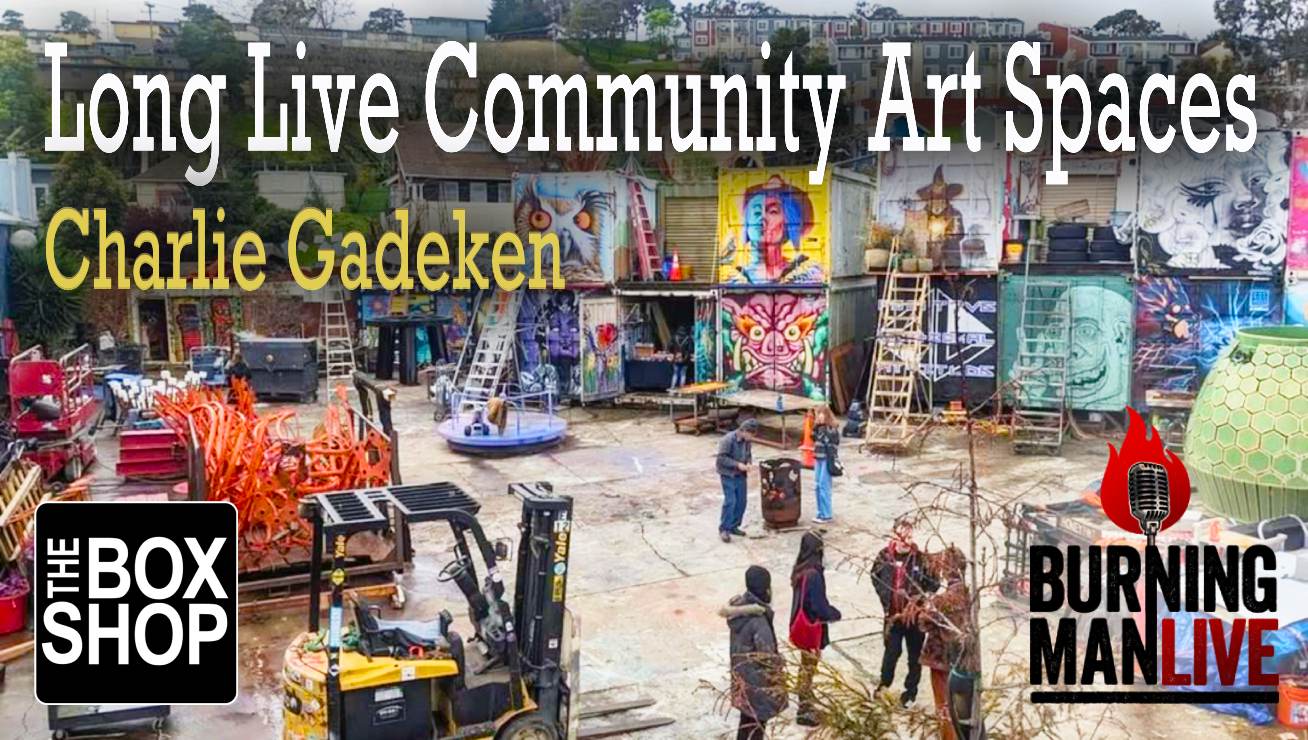
We created this amazing art space in San Francisco that has, you know I have about 60 full time tenants, serve about 100 artists a month, about 1000 artists a year. It’s been in that location for 23 years. You know it’s the home to myself and the Flaming Lotus Girls, Dana Albany, and Zulu Heru, and hundreds and hundreds of other artists. I mean we‘ve probably made… a thousand works of art have been made there and gone out to Burning Man.
You know the Box Shop also produces about six pieces of permanent public art a year. And so that art goes out into the world. And I think that, I think we actually have an impact of probably six million people a year experience the art created at the Box Shop, by all of this art that’s out there in the world and people walking by it on the street and experiencing and seeing it, you know, so somehow I think the Box Shop is one of the more impactful businesses in San Francisco, you know, maybe outside of the tech world, right?
ANDIE: Yeah.
CHARLIE: And we really affect a lot of people’s lives. And, you know, directly through participation, through the volunteer organizations, my art, I have a lot of volunteers coming in. Flaming Lotus Girls have a lot of volunteers.
ANDIE: Well, they must cross-pollinate there. There’s so many people right there in that little space. How is that?
CHARLIE: Exactly, it is. You have it all the time, you know, that’s like the whole idea of the Box Shop, is to create this environment where all these people come in, you know? And the volunteers are amazing because those people all have other jobs and other lives and other skills, and they bring all these amazing skills into the Box Shop—even the shop itself. You know, I have a few tenants that aren’t even artists. A guy who does like sheet metal, right? Because then he teaches everybody how to use, do the sheet metal stuff, right? We have some electricians, you know? Help everybody with their electrical stuff and teach people how to do electrical things.
And a lot of these tech world people, you know, they come in, they need some hands-on things. They need to make something real and they bring vast amounts of knowledge and skills, which is great. And it kind of elevates everybody.
Mostly, you know, Box Shop is a very female-oriented art space, right? It’s a very girl-oriented, transgender-oriented art space, which is really this, really this idea of positive collaboration. We’re not here to talk about how great we are. We’re here to like help each other be great. And so I’ve been having women come from out of state to build their first pieces of large-scale metal art, because it’s an environment where they can do that and that they can come there and feel safe, and feel like they’re going to be… they’re gonna be helped, elevated for their exuberance, right? That if they want to do it, we want to make sure they can do it.
And everybody there is super helpful. That’s been really a neat transition recently, like really bringing in a bunch of outside artists like that, you know, that we have… whatever, gotten that reputation that I love.
ANDIE: Well, it’s well-earned because I’ve been there, and experienced that, and watched other people experience it, and of course, seeing the many, many works that have turned out of that space, it’s an incubator like no other spot I’ve ever seen, honestly. It’s really an amazing spot. It’s really an amazing thing that you’ve done.
CHARLIE: I mean, I really love the Box Shop, you know? I mean, we just like, you know, with the, we have like, this big yard with this shipping container art studios and the big, large collaborative metal shop where we try to provide these like high-quality professional tools to artists. Things that you just can’t normally buy on your own, or operate on your own, or learn how to use on your own.
You know, we are in transition. It is very sad that, um, you know, we’ve been in our location for 23 years, but recently they built all these beautiful parks around us, and my current landlord has decided that he would like us to leave so he can build condominiums there. And so we have been fundraising for the past three years. We have fundraised a considerable amount of money, like $2 million. And we’re about, I don’t know, half of the way to our goal.
ANDIE: Yeah, you still need quite a bit, right? And you’re trying to purchase another spot.
CHARLIE: The biggest goal right now is we still need to raise about $800,000 this year to survive our transition. That’s the most pressing issue.
We were actually able to buy a very small building on the other side of the hill from us.
ANDIE: Okay.
CHARLIE: It’s sad because like, we like, moved into a terrible neighborhood and now it’s really fancy, and now we have to leave. And now we have to move back into a terrible neighborhood again.
ANDIE: This is the plight of the artist.
CHARLIE: The space is quite a bit smaller than the one we have now, so.
ANDIE: Oh, really? Okay.
CHARLIE: I moved into the first Box Shop for $15,000, right? I’m going to move into the next Box Shop and it’s going to cost me $6 million. But that’s the difference of 23 years in San Francisco. And the difference is, too, that like when I moved into the first place, it’s just… and for the last 23 years, I’ve been the sole employee of the Box Shop. I’m it. I do it all. I like, raise the tenants, take out the trash, clean the space; I’ve done everything. That’s allowed us to be very scrappy, right, and like really transition. And then I make money on my own art, and I fill the gaps and these kind of things. And it’s allowed us just to keep going.
But my goal now is to turn it into an organization that can live beyond me, and without me. And so we have now started a nonprofit. The new space will be taken over by the nonprofit. But already, you know, it’s just crazy cause only I am willing to work for free, so that I can have my beautiful art studio, right? All these other people, for some reason, they want to get paid. Haha. But hey, it is the reality of it, to be an Executive Director, to do the bookkeeping, to raise the money, the thing just costs, costs money, right?
ANDIE: Sure.
CHARLIE: Even like the tiny little building that I bought is going to be like $2.5 million.
And then our hope is also to like, improve the space, you know. I’ve built a wood shop in the new shop, which is something I didn’t really have before. We’re hoping to get a big fiber laser, maybe a water jet, kind of upgrade the mills and the lathes and things like this.
And the thing about the Box Shop is that we do make money and that we have supported ourselves for a very long time. So I think that once we raise that $2.8 million, that we become a financially stable organization that can pretty much pay its own way in the future.
ANDIE: Why is that important? This is a big uphill climb. That’s a lot of money. This sounds like such a hassle in your life, and so much fundraising, and difficulty.
CHARLIE: And the other insane part is I’m giving the organization away. Haha.
ANDIE: Right.
CHARLIE: Give it all away. I’m a crazy person.
ANDIE: Just to give it all away. Why is this important?
CHARLIE: Because people need access to this experience. Artists need a place to build art. I mean, all the artists are leaving San Francisco, and I mean these people talk about art, art, art. You know, we’re looking at like, what have we got left? You’ve got a lot of old ladies painting paintings. I mean, art has moved beyond that, right? And we need, like—you need mills and lathes and wood shops and big machines to make the art of the future.
If you want to make more public art… I mean, if San Francisco is a city that supports art, it needs to support this kind of art, and all the other art spaces are gone. There’s things like public let’s say human made, right? But you can rent a machine and you can have access to the machine for a couple hundred bucks for a couple of hours. And then you’ve got to get your stuff out of the building.
ANDIE: And they’re not going to teach you how to use it.
CHARLIE: But at the Box Shop, you can like, get there, and you build things, and spend time, and have people come and help you, and you can build and you can make objects and make wonderful things, and you can explore and you can like, fail and have time to start over again.
There’s also like all these amazing small businesses that come through the Box Shop. They come and they learn how to fabricate and make things, and they go on, and, and create successful little businesses in other places.
And you also need these things where like I said, we’re showing people how to use screwdrivers. You know, people are so afraid these days, these people are just taught to be afraid. They’re not thinking they can open up their phone and fix it. They’re not thinking they can fix their toaster or, or, do any of those things.
ANDIE: Yeah. Planned obsolescence.
CHARLIE: Nobody’s got a tool kit anymore. But they come in this house and they learn they can cut and grind and make things and fix things and all of this stuff. It’s just really important. And the Box Shop provides an environment for that.
It also provides just this alternative experience. Like people need community. We need something that isn’t a bar, and that’s not a church and it’s not… We need more of these places where people can gather. You know, people live in such deep isolation, that having these gathering places where people can find community, talk to each other without loud music pounding in the background. It’s really important.
ANDIE: Yeah. I mean, sociologists researching say that third places like this, third spaces, they’re pretty essential for our psychological well-being. And it’s where we exchange ideas, like you’re saying, and teach each other things, where there doesn’t have to be money exchanging hands. I’m not buying something from you at the store, and I’m not invited to leave as soon as that commercial exchange is over, it’s about bringing people together to share ideas.
CHARLIE: Yeah, exactly. And that’s what the Box Shop does. It is an essential service in the city of San Francisco to have a place like this.
ANDIE: I totally agree.
CHARLIE: The creative impact of making this art, building these permanent pieces of art that go out in the world, that talk about the values, it’s not all about just, you know, maximizing shareholder profit. And I think that the world has become wildly distorted over that concept that it is just so sad. And that there is so much more to life than maximizing shareholder profit. There’s just like enjoying each other’s company, making things that are beautiful, you know, making the world a better place. There’s nothing wrong with getting paid. We teach artists how to make a living, and how to have respect for themselves and ask people for money. But it’s not quite the same thing as the overreaching corporate greed that’s kind of, “If I’m not a billionaire, I’m not successful.”
ANDIE: Yep, yep.
CHARLIE: That’s something that the Box Shop really offers is just like, a look at a world like some other opportunities. You can make things with your hand and you can be successful and you can still eat.
ANDIE: Pay the bills. It’s an amazing idea. Who woulda thought?
CHARLIE: Amazing idea.
ANDIE: So we’ve got this global community of Burners who agree with you on all those points, I think. How can they help make sure that this little incubator in San Francisco survives for the next generation? How can they help you?
CHARLIE: At boxshopsf.org, you can sign up for our email list. You can tell other people about it. And you can also, you know, donate directly to our organization, right? There’s a link on the website, or you could contact somebody if you want to know about larger donations. You can come visit us, too. We have a lot of open houses.
One of the more interesting things about the Box Shop, too, is during the pandemic, when they started building the parks, I realized that the Box Shop had to stop hiding. So I raised about $80,000 personally, and I hired 140 muralists to paint 162 pieces of street art inside and outside of the Box Shop, making it one of San Francisco’s largest collections of street art from the Bay Area. It’s only there at this location for another three months. We’re having a Mural Fest. It’s free, open to kids. We’ve got a lot of art projects there. You can do your own little mural, do some mosaic projects. And we are trying to make a book about the mural project.
So you could come to events like that. We’re going to have a few more events and a few more parties at that location. And then in November, we’ll have moved to the new location, and we’ll begin doing them again, in a fresh with the new nonprofit at the helm.
And they could use volunteers. You can come volunteer your time. Give your money. Tell friends about it. Go make one in your own town! Give me a call, I’ll be glad to help you.
ANDIE: This is a time when it feels pretty important for society to have things like this. What’s next? Obviously, you’re moving, so I think you’re probably focused on getting to that transition.
CHARLIE: Long live the Box Shop! That’s what’s next. We’ve moved away from “Save the Box Shop” to “Long Live the Box Shop!”
ANDIE: There you go.
CHARLIE: In my life, my own career, I’ve been focused more on making more permanent public art. I have a couple of new pieces coming in in Los Altos, and I’m doing a thing for a cruise ship. That’ll be fun.
ANDIE: A cruise ship? Oh my gosh, of course. Yeah, they need art, too.
CHARLIE: They need art, too. Everybody needs art.
Making that transition of the Box Shop, we are going to begin tearing the Box Shop apart. A lot of the art is coming down in July 1st, and I’m going to start pulling containers out of the Box Shop.
We are working on the new Box Shop, which has been this incredible push. We finally finished all of our permits with the city, oh well, that’s not true. We finished our plans with the city. We are mid-construction, trying to clean up all the violations, because the reason I could buy this building for cheap was because it has a bazillion violations. And so we’re hoping to get through that process by August, middle of August. We’re going to start transitioning our artists into the new space in August, and then move the entire experience over there by November 1st.
ANDIE: Does that mean you’re not coming to Black Rock City?
CHARLIE: I don’t know. I’ll probably come.
ANDIE: Of course you will.
CHARLIE: I was trying not to come. I really was like, “I’m going to buy a ticket to Japan and this will be the year I don’t go,” but I don’t think that’s going to work out. I’m going to do a show in San Bernardino, which is now on September 7th, so it kind of ruined my vacation plans.
ANDIE: There are worse things.
CHARLIE: So that’s the goal, you know. Just keep fundraising, keep focused on finishing the construction on the new space, taking the old space apart. And then a little bit of a sad process of kinda deciding what percentage of my artists will be able to come into the new space. So it’s a little bit smaller than my existing space, so they’re going to have to do a little bit of choosing. And so that’s it.
But I don’t know. I mean, I feel like the goal of this now is to build this new space out, right, and then in five years, maybe the organization can sell this building and buy a bigger building. We really need a much bigger space. But I got this smaller space because I think it was, even though it seems like an insane amount of money, it’s a lot less money than the bigger spaces were going to cost me. It is the fiscally sound, responsible idea, the $6.5 million.
ANDIE: Words you never thought you’d say in your life, I’m sure.
CHARLIE: Never thought I would say in my life.
But I’m just happy, you know, just celebrating our community. And it’s great to see the new transition to build the nonprofit and all these people come together to keep the Box Shop around forever so that other kids can come to San Francisco, and have the opportunity to make public art, you know, get in there and weld and make machines and do crazy things, and change the world.
ANDIE: Love it.
CHARLIE: That’s what we do.
ANDIE: Is there anything that I didn’t ask you about that you want to make sure to talk about on the show?
CHARLIE: I want to thank all the people who have donated to the Box Shop, that has brought us to this distance. You know, you guys have really changed our lives, and I really appreciate it.
Everybody! Go outside, make some art, have some fun, be friends, be positive, you know, support your friends and community. That’s what I’ve got to say.
And thank you to Burning Man, you know, for changing my life and making the world a little bit more interesting.
ANDIE: Well, thank you for everything you bring to Burning Man, Burning Man culture, San Francisco, Black Rock City, and the world, with your art and the amazing space that you hold. I’m a big fan of your show Charlie Gadeken.
CHARLIE: Thank you very much.
ANDIE: Vav, how’d we do?
VAV: You did it how you did it and that’s how we want it.
ANDIE: Fabulous.
CHARLIE: Great. All right.
VAV: Burning Man LIVE is a labor of love of the Philosophical Center, one of the 6 program areas of the public benefit 501(c)(3) Burning Man Project.
If you would like to embrace indirect serial reciprocity, generalized exchange, pay it forward by gifting a bit of your game at DONATE.BURNINGMAN.ORG.
Thanks to the thousands of people who have been part of the Box Shop, and the millions of people who are part of community art spaces here, there and everywhere.
Thanks to the team here: Action Girl, DJ Toil, kbot, Martin, Stuart Mangrum, Vav Michael Vav (that’s me), many others… and those who are cross-contributing, indirectly, the sharing of stories.
And thanks Larry for starting all of this.