

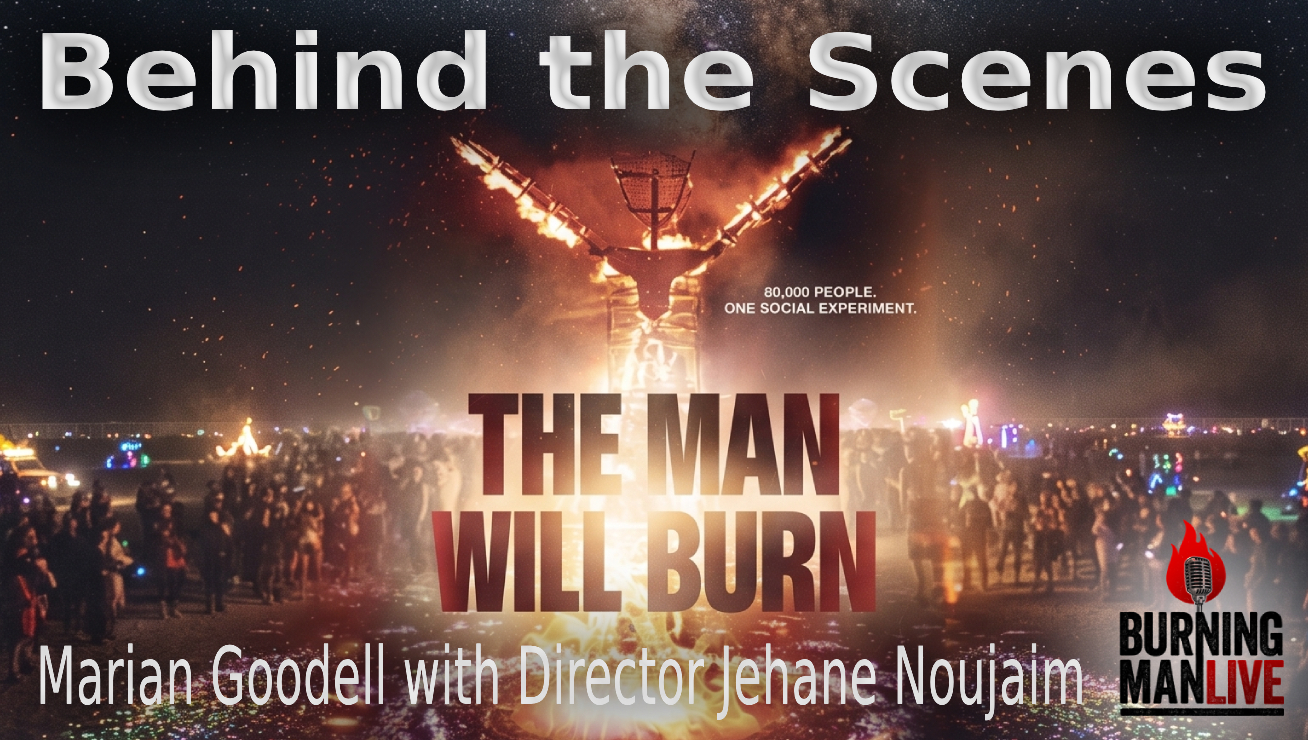
Watch it on YouTube.
No spoilers. This is the making of the docuseries The Man Will Burn. This is the context for what was filmed, who said what, and what got cut; the cameras and the chaos (and the quinoa).
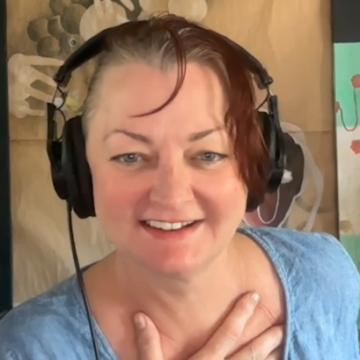
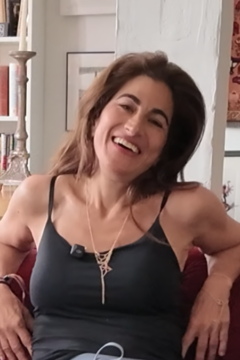
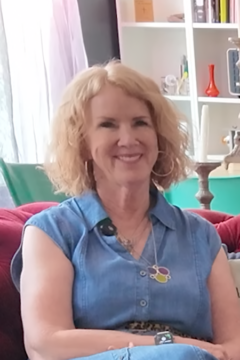
Burning Man Project’s CEO Marian Goodell talks with Jehane Noujaim Academy Award-nominated filmmaker and director.
Watch it here: https://burningman.org/about-us/who-we-are/board-of-directors/
They share the creative challenge of assembling Burning Man’s story from a mosaic of a million people’s stories. They dive right into the interweaving 35 years of archival footage with the personal journeys of a dozen participants from a dozen places.
Watch Marian and Jehane’s conversation, recorded the day after the premiere at Tribeca. Hit play on the dust and trust of the blank canvas that becomes a city year after year, and a 4-hour film about its start, its false stops, and its proliferating permutations.
Transcript
JEHANE: People are being asked to come on this blank canvas, and dream and imagine and create together in community, connected, this city that they would like to live in for ten days, and at a time when everything is commodified, and when you know you can’t do anything without spending money, and it just felt like a place where you’re just connecting with other humans.
How wonderful to be able to be there and to shine a light on that, and look at that as, okay, maybe not all of these 80,000 people think that the same kind of city should be created, but what an interesting petri dish to be able to go in and then see how people are thinking about it, and what is the conflict around it? And that could shed light on the issues that we’re dealing with in our world today.
And I think we did. I think that is what we found, this reflection, this interesting reflection, to think about some of the ideas, and some of the conflicts that were happening, in the organization, in the people that went; looking back to the archival footage and interweaving those, tells that interesting story of where we are now.
ANDIE: Hey everybody. It is Burning Man LIVE. Welcome back to the show. I am still Andie Grace. Welcome back to the show.
And I am here with our producer, Michael Vav.
VAV: Who, me?
ANDIE: Hello.
This is a big moment. It’s that time of year when many people’s thoughts turn to a certain thing in the desert, but lately, that’s also been to a certain docuseries. You may have heard of it, you might have binge-watched it…
Today, we have an exclusive interview that happened between the co-director Jehane Noujaim, and Burning Man Project CEO Marian Goodell. It was recorded in New York during the Tribeca Film Festival where it premiered.
VAV: Jehane is an Academy Award-nominated director known for high-stakes documentaries dealing with some pretty dark subjects; films like
The Square, about the violence and politics of the Arab Spring
The Great Hack, about data exploitation
ANDIE: And the one called Control Room, about Al Jazeera and war reporting.
VAV: And The Vow, exposing the NXIVM sex cult. So, I expected a dark take on Burning Man.
ANDIE: Right. But this was a different approach for her. She had been to Burning Man several times. She was a Burner before undertaking this project. And Vikram Gandhi was already a Burner, too.
VAV: Vikram co-directed the series. He directed Kumare, and Barry, and Batman v Superman.
ANDIE: Unsurprisingly he brought a lighthearted approach to the whole story. I think they were both determined to keep an optimistic energy for how they told the tale.
VAV: For decades now, documentarians have been bringing their cameras, trying to capture the story of Burning Man, the ever-expanding story of Burning Man.
ANDIE: Right. Catching lightning in a bottle. It’s not easy. Dozens of long-form documentaries have made the attempt. And some of the previous docs are really good. You can find a list of them on our website, some of our favorites. But at four hours long, this is probably the most in-depth, behind-the-scenes look at our history ever made. I’m really proud of it.
VAV: You and Stuart Mangrum actually worked with the filmmakers for years on this, right?
ANDIE: We did! We gave them access to our archives and our vaults, including elements that haven’t seen the light of day before until now. We helped them find those filmmakers for licensing on footage we didn’t own, tracing the earliest days of the event all the way to the massive community that you know today. But even with those introductions, these filmmakers chose their own story path. We introduced them to lots of people, and some of them they decided to go with… You will learn more about that in this interview.
VAV: It’s an epic span of Burning Man’s history, especially the last few years.
ANDIE: It really is. So, without further ado, and hopefully no spoilers, let’s roll the tape on Marian Goodell and Jehane Noujaim.
KANIZZLE: Would you please tell us your names?
MARIAN: I’m Marian Goodell, I’m the CEO of Burning Man.
JEHANE: I’m Jehane Noujaim, and I’m the person that followed Marian around for the last four years. And I’m also a filmmaker…
MARIAN: And the director…?
JEHANE: And the director of The Man Will Burn.
MARIAN: Which is a fabulous film. This is what we’re here to chat about. I love the film. I loved it all the way along the way. I’ve loved it as you’ve been working on it. I hated being followed.
JEHANE: I was going to say, ‘I loved it all along the way’; you hated me having a camera in your face.
MARIAN: Yeah. I had a conversation with a couple of people. They’re like, “Oh!” I was like, “You have no idea. I did not want to be a character.” Yeah, but you all pretty much convinced me.
JEHANE: You did not want to be a character. But I think we had this conversation where there was so much that the org was going through and the movement was going through, and you were involved in a lot of those decisions. And so without following you, we would be missing all of these huge changes within the organization and the challenges of the organization. So. I think that’s why you ultimately agreed.
MARIAN: No, it is. I think the vision I’d had of it originally, of course, was I thought we would tell Larry’s story, and then we would tell the story about Burning Man, the culture and the organization, sort of through his eyes and development. And when you guys started building character outlines and people, like what you wanted to do, initially it seemed gratuitous that I would have anything other than like filler – fill storyline. Who would want to follow me? Okay, you want to see me do my work on the radio, whatever. I just didn’t understand that the story and the narrative, including Larry, the building of it, the organization is its own entity, so the building of the organization and the fact that we survived, was a part of.
JEHANE: Was key. And initially when we first started talking, it was just an archival film. And it was Covid, which was… I was making a decision as a filmmaker, maybe I can only do archival films because are we ever going to be able to go out and shoot? But since there was, the stakes were so high at that time of whether Burning Man would be closed down forever, that’s when we had to really start following you guys and the people who cared so deeply about whether the movement would continue, whether the city would be built that year.
And it required verité filmmaking, which I know can be very difficult for the people that you actually follow. People have tried to follow me before, and I… it’s awful. You’re just kind of like…
MARIAN: People tried to follow, tried to follow you? They tried to do… Have you?
JEHANE: Not a documentary, but when I’ve, you know, if I’ve come out with a film, “Let’s just follow you for a day,” oh, it’s painful.
And I have so much appreciation and gratitude that you gave us and the world this gift of allowing us to follow you and in some way, at some point along the way, um, you slowly let some of the armor down. But that takes a lot of time, I think, a lot of conversation.
MARIAN: That’s why I like talking to you now, because you are part of why I decided that I wanted to. You’re very persuasive.
JEHANE: I’m coming to your house. Oh, you have a guest room? I’ll stay in the guest room.
MARIAN: We’ll follow you to Burning Man.
JEHANE: We’ll follow you to Burning Man.
But it’s gonna be so hard, Jehane. I mean, I don’t know when I’m leaving exactly. And I’ve got all these things to do…and we might even go at the crack of dawn. You’re not going to want to do that.
No, no, we want to do that.
But I only have one seat in the car, and that seat is reserved for my niece, actually. So there’s really no place for you to sit.
But you’re taking a big van there?
No, no, no, no, all my stuff’s in the van, and there’s two seats in the front, and there’s really no room for anybody else.
Okay, well, maybe what we’ll do is try to figure out a rig to put on the screen on the front windshield that can film you, and with all of the Burning Man stuff, and we’ll just follow in a car.
Oh my gosh. Okay, fine, fine.
MARIAN: No. Normally I get to Burning Man in six or eight hours. Do you remember how long it took that day?
JEHANE: I know. I know.
MARIAN: I think we stayed overnight in Gerlach.
JEHANE: Yes we did.
MARIAN: And the driver in the sound car got a ticket for speeding through Wadsworth.
JEHANE: Yes, that’s true, that’s true. But we met your friend who we stayed with at Gerlach, who was so special. And we actually ended up doing a wonderful…
MARIAN: Kiki.
JEHANE: Kiki, we did a wonderful interview with. And that’s really the depth of this, and everything that everybody has put into making this place happen. Even when there have been such disagreements about how it should happen? I think it’s very inspiring at this time in the world that people keep coming together to say, no, this has to happen. This is a good thing for the world that has to keep happening.
MARIAN: So I had wanted to do a film about Larry. I contacted David Greenbaum. He gave me a list of filmmakers to do homework with. Then I met you at Farhad’s birthday party, and I knew your work with The Square. I knew also because you had done the one about Cambridge Analytica?
JEHANE: The Great Hack.
MARIAN: The Great Hack, and the gal had filmed briefly at Burning Man at the Temple. And we talked on the phone about that footage, and there was like a whole moment. And I remembered those are the details. I remember when I met you, I was like, oh my God, she’s the woman that (yes, filmed the Burning Man event and then asked for permission later), but also she did The Square, and I’m such a nut for documentaries, and I was just at the beginning of that process. When we called you, you guys were busy. I would love to know… you were busy on something really intense.
JEHANE: Yes.
MARIAN: But you had a lot of pots on the fire at that point. Tell us what you were working on and why you changed your mind.
JEHANE: So I was working on The Vow, which was a very, ah, very, very intense project. And at that point, I had been to Burning Man numerous times, and I knew that it would be a very difficult story to tell, because it’s so experiential, and to truly give somebody a taste of it – it’s hard. And especially when there are so many people that also don’t necessarily feel like, should this be filmed? This is sort of a … something that happens in person and it shouldn’t be filmed. Right?
So I knew that it was going to take all of me to do it. And that was not available at the time that we were in The Vow, because that was taking so much from us. It was a film, a series, about a self-help organization that had become a sex cult. And there were people who were seriously traumatized that had been a part of the film. And so there was a lot of… It took a lot to be working with these, some of these incredible people, but people that had had all of their agency taken from them. And when you make a film about somebody that’s had their agency taken from them, you have to be very, very careful, because you don’t want them to feel like it’s being taken from them again.
So that was really why the initial response was something I really care about doing properly. And I, you know, I didn’t want to… So I think you said, well, give me a list of, again, give me a list of filmmakers of people that you like. And so I went away and started thinking about the filmmakers, and thought, you know, it actually really does have to be made by somebody who’s been. And so I started to think about a few people that had been.
I had asked you if you had archival. You said we had 35 years of archival. And that was really exciting. And then I started to think, well, A- I can’t really think of anybody that would, that I felt like I had complete trust in, this is going to sound egotistical, but I just felt like I should do it. And so if it was just a matter of timing and getting through finishing this film, then this would be a great thing to do.
Although it was still scary, it’s scary to make something about a topic that you care, that you care about, deeply. And I guess I haven’t really done anything else because it’s what interests me.
And it usually interests me to do a topic which I don’t fully understand. And when I went to Burning Man, I didn’t know there was an org, or a CEO, or an organization behind it, or how it started. Nothing! And so I was very curious about doing the research and finding all of that out and exploring that.
I was also excited about after being in a very dark place for five years, this place that I had found quite beautiful, quite a place of where my belief in humanity and what people can do when they work together and come together in a community, what can happen.
But it’s very much a story about ideas. And so making that happen takes time, especially when what you’re actually going to film, when you’re filming people in this place is only going to be filmed over ten days, right? I mean, we could go back to the people, and we went back to you during the year, but in the end, we’re ultimately wanting to film so much of it in this hostile environment, which is dusty and hot, and we had to get very specific cameras that weren’t going to shut down when it got very, very hot. You know, the batteries overheat.
I mean, they were just logistical things that were impossible. You make a film, you rely on things like, you know, location and time. Time and location are not necessarily things that work that well at Burning Man. So everything that allows you to practically make a film really didn’t exist in the place that we wanted to make the film.
So, you know, some people thought it was a crazy idea. I’m sure half of the people that I would have gone to that I do think are… It’s not that I didn’t trust these filmmakers. I think I’m surrounded by a community of incredible filmmakers. It was whether they would basically say, this is an impossible sort of job that you’ve asked me to participate in. So I wanted to talk with somebody as a partner who had been there before and knew what they were getting into. And that’s when I found Vikram through a mutual friend of ours, Dana O’Keefe. And we started talking.
And we also brought on Muriel, who was our producer, and she was the person that had never been. So we thought that was also very important because you don’t want… there’s a lot of positives, there’s a lot of negatives, there’s a lot of, you know, it’s a complicated place. And so we wanted some people to be able to come in and really be very clear eyed on, you know, on what they thought were issues that maybe we weren’t seeing anymore because we had been a few times.
MARIAN: I did not know about The Control Room, which was about Al Jazeera, and I knew about The Great Hack. So The Great Hack was certainly revealing a story that had to be told. And of course, The Vow was really blowing a story up that needed to be told. I think you guys were influential in him getting arrested and put into prison. So you’ve got Control Room, Al Jazeera, which obviously is a news… very well respected news organization, that has become more and more well respected over the time. So you’ve got these really interesting, almost political, very potentially gravitational, you know, stories. How do you, now that you look at your resume, how do we fit into that story? Like obviously you wouldn’t have done it if we were going to damage it, but how when you are quietly thinking about, wow, here are the stories I’ve done, and Burning Man fits into what part of my personality…? And in a way, I thought I saw you getting some personal stuff from it that maybe these other films didn’t have for you.
JEHANE: Yeah, absolutely.
I mean, just also, it’s visually stunning. So as a filmmaker, to be able to bring what happens on playa and that cinematic view you have, and of people coming together, it just, it was, that was a cinematographers dream. That was, that was incredible.
I feel like all the films that I’ve worked on are, you know, smaller stories that represent a bigger, ahhh…complex issue that we’re dealing with in the world, that shines a light on what we’re dealing with and thinking about.
So, for example, Control Room, you know, I made at the time when I had an American family, an Egyptian family, opposite sides of the globe, seeing the Iraq war from very different perspectives. And that’s ultimately where we were going with our little devices and Instagram, and we have all our own feeds and… But it was the beginning of that where depending on whatever channel you watched, that was your perception of the world. So it seemed like making this little story about this little, at the time—I mean, it’s gotten a lot bigger since then—but this little network, and how the journalists there were reporting versus NBC, CNN, was indicative of how divided the world was getting because their sources of news were completely different.
So in that way, we’re in this time when, you know, Covid’s happening; the world is both more connected than it’s ever been, physically connected through the internet, but also in terms of human connection; more disconnected than we’ve ever been; leadership that is not very inspiring around the world. You know, in terms of dictatorships happening and fascist leaders, and here is this place where people are being asked to come on this blank canvas, and dream and imagine and create together in community, connected, this city that they would like to live in for ten days and at a time when everything is commodified, and when you know you can’t do anything without spending money, and it just felt like a place where you’re just connecting with other humans.
How wonderful to be able to be there and to shine a light on that, and look at that as, okay, maybe not all of these 80,000 people think that the same kind of city should be created. People have a very different opinion on what that city should be created. But what an interesting petri dish to be able to go in and then see how people are thinking about it, and what is the conflict around it? And that could shed light on where we are in the world today, and the issues that we’re dealing with in our world today. And I think we did. I think that is what we found, this reflection, this interesting reflection, to think about some of the ideas, and some of the conflicts that were happening, in the organization, in the people that went; looking back to the archival footage and interweaving those, tells that interesting story of where we are now.
MARIAN: So obviously, from what I’ve learned, documentary filmmakers are, you’re sequential, but you might have something already you’re starting or that’s been interested, so you just keep going. If your job is to be a documentary filmmaker, you’re going to keep having a project in the can. Did this process influence what you chose to work on next? Did it change a little bit of… because leaving The Vow is, like, intense. You almost went from intense to SUPER FUCKING INTENSE. And now we have joy. It was probably harder, almost, than maybe the other stuff, because physically the demands on you personally and on the group. But where do you go from, from here? What then turns you on for your next couple of projects? And have you sought things that might have changed a little bit because of this?
JEHANE: I mean, the premiere was the day before yesterday.
MARIAN: Yeah.
JEHANE: I’m still, I’m still high from that. And it was amazing. And it was just so wonderful to see our team from all over the world come together. And everybody from Burning Man. And, you know, filmmaking is so much joy. And filmmaking is probably the most collaborative art form that there is. Besides building a city for 80,000 people. So, the reaction made me really encouraged because, I think in the industry, we’ve sort of been led to believe that it’s got to be true crime. It’s got to be about a famous person. It’s got to be about, you know, these three things is what’s going to sell. It’s got to be about a big sportsperson, which are all great, but, you know, I’ve for my whole life told stories that are about ideas.
And so, how can you find…you know, and you play with the curiosity because everybody’s curious about whether they love it, they hate it, whether they think they’ll never go, whether they’ve always wanted to go. People are curious about Burning Man. And so you in a way, you’re kind of using this stage or this, this promise of people seeing inside something in order to talk about our world. Right?
MARIAN: Mhmm.
JEHANE: And the same thing with Al Jazeera. People were curious to see it, but inside Al-Jazeera, because they thought that there’d be Bin Laden walking around the hallways, you know? Or something like that. And so then you use that interest, right?
So I think that you still have to do that in our world because people watch stuff because of curiosity. And it’s kind of like, maybe making the medicine a little bit more tasty because you’re showing something that people really want to see.
So what I was really encouraged by was the fact that it wasn’t about true crime. It wasn’t about a murder. It wasn’t about, you know, some hugely famous person. It was about people coming together, finding joy with each other and building something, and having conflicts along the way, yes, but I really, I felt people… we had a very good reaction to a film and people were excited to watch the end of it, and it wasn’t about something that was very dark.
That was exciting. So in terms of me thinking about what my next project is, I don’t know, I have a couple of things on the burners, but I’m not sure exactly yet what I’m going for.
I’m curious as to what you’re wanting to do next, and I’m curious about asking you all these questions about when you decided to let the armor down. Do I get to ask questions here, or am I like…?
MARIAN: You can ask questions. Well…
JEHANE: Because so many people film you and you have so many people that want things from you all the time, right?
MARIAN: Haha.
JEHANE: It must be very hard! It’s very hard to be in that position. It means that you constantly have to sort of be sussing out, well, what, do they… want something from me? Or is this really just a conversation or, you know, and if I say something, it’s going to go through the crazy game of telephone, and that was my experience following you, is: How do I keep with the values of what Burning Man is supposed to be in the principles of it, yet have it move forward, and welcome in, and bring in the next generation at the same time? And that was a, it’s a tricky balance.
MARIAN: I think the fact that you were weighing these things and it wasn’t… and at some point, it reminded me of when people used to come to Burning Man and I was overseeing the media, and they would ask right away for an interview with Larry. And we learned immediately in 1997 to tell them no, because we could tell that they hadn’t been before, and they just thought he was the, you know, he was a little gold ring. If they got the interview with Larry, they were good. And I think maybe even a person might have come from a news organization and interviewed him and then left, and we were horrified. So I think even on the fly we might have been… In that time, it was me and Candace, Steven Raspa, Petrina and Lady Merv. There were five of us doing the Media Team in 1997, and we were totally fresh, the whole group from ‘96 wasn’t part of it anymore, so we were dealing with what was also new interest.
It had been in WIRED Magazine, and I remember we had Playboy Magazine there, we had Nightline that ended up doing a show. We had Strange Universe, which was “The Secret Rites of Burning Man,” and we had… still, to this day, we’ve never had the media. We had Good Morning America, a bunch of the folks left from the big ones. Or we had CBS This Morning and they left when Lady Di was killed that Labor Day weekend in 1997. But what we learned that year, because there was so much demand and some of it was like us surviving and some of what was helping him was that you couldn’t interview Larry right away, and you had to go experience the event.
And I kind of felt that that was part of what I was responding to, when you guys first even said, we want to interview you, I was thinking, well, you haven’t been doing this long enough to know what you want from me.
And I also didn’t want to be… I don’t, I’m not Larry, I operate differently. I come from a different place, and what I produce and what I’ve brought to it is different than him. So I thought it wouldn’t hurt if I just took that same stance. I’m the figurehead. I’m also, you know, Chief Operating Player, not Chief Operating Officer, but the one that’s most visible in running the thing. And I thought, well…
JEHANE: Chief Operating Player. The COP?
MARIAN: The big, you know, the big kitty. They call me the Big Meow. I’m, you know, I’ve got all the plates in front of me. But I also really want it to be clear that it’s not alone that I do this. I think it is collaborative, like you said.
I’ve always wanted to do film. It’s what I was interested in in 1992, when I went to the Academy of Art College and saw photos of Burning Man there. And at that time it was 300 people. But I had just gone to photography school because I had missed a deadline to go to film school. So my storytelling self went to photography school, saw photos of Burning Man, and when I came to Burning Man, I came as a participant in ‘95 and ‘96, and I saw a creative environment I didn’t understand. And I went and looked up the stories. Like it’s in the film, that I went to the freaking library, used microfiche. So I was looking for the story. And when I had the opportunity to help manage the story and give people access to the story? I was so excited.
So now fast forward, I’m in this leadership position and I’m helping this really significant film with very talented filmmakers have access to the story. And I just didn’t think that my story would fit, that by interviewing me or following me, that you all hadn’t… There’s not enough context, just like the experience where people are like, “Well I only want to interview Larry,” okay, “Marian’s the CEO. We’re going to interview Marian.”
I only realized, though, that you all had been with it deeper and longer, and you had started looking at footage, and your argument with me was, like you said before, and I still agree with that I am fortunate enough to be in that leadership position, and have helped form that journey to be there. And if you left me out artificially because I got stubborn, I think that would look more awkward. I did. I was sort of like, well, what would you want them to do? Like, oh, she was here, she was here, but she’s not doing it now. We couldn’t take it. The cameras weren’t allowed in her camp because she’s being stubborn. That’s inauthentic.
Yeah. I started really thinking, well, let’s be authentic. What’s authentic here? What’s authentic is I really wanted you all to get…be in it deeper long enough. You know, you wanted to come to my house a couple of times, and I was like, you can film the meeting and I’ll answer some questions, but you’re not going to stand around while I’m doing phone calls, and you can’t watch what I’m doing. And it wasn’t until 2022 when we went to the event…we went in 2021, and you guys put a wire on me a couple of like one time I’m in the car and I was crying and then with my friends, but I was like, really… yeah. I mean, I remember running away and getting mad and and like, we had some moments where I thought you were going to hate me forever because I was like, no!
Because I really, I think I’m, I try to be humble, but in the context of this community, I don’t want more focus on me that would hurt the greater narrative.
JEHANE: Yeah.
MARIAN: And I didn’t know you all enough to be comfortable with the fact that you were developing the story while you were doing it, and you were learning about all of us, and the pieces were forming as you were doing it. And that if I resisted much longer, I would hurt the story. And so I was going to trust that I would allow for that following with my niece, which I thought was really intimate, and watching me with my friends at the Burn in 2021, being in the car with me and Chef when I got teary – that’s when I just decided I’m just going to try to be authentic and I’m going to trust that I’m not the only person in the story and I’m going to trust that. You had the, have the skill and there were other Burners involved, and there’s camera people and you respecting sound people and camera people, and clearly you guys all talk about what to do next. And I kept thinking, okay, I’m going to join in the fun. And I fought it still a couple of times. It was so embarrassing sometimes you guys would follow along with a golf cart and I was like, “What the fuck?” But you did, you did it to other people. It wasn’t just me, you know, I saw you did it to other people, and I feel like I really trusted you.
JEHANE: Thank you.
MARIAN: I really trusted you.
And I was so stoked to have a woman filmmaker doing it. Reading the list that I got from David was mostly men. And we love Larry. We have men and women. You’re women; you’re a bunch of women.
JEHANE: Our team is very female led. Yeah.
MARIAN: Yeah. I mean, come on! That is part of what I started realizing. Just trust in the process. Let it go. It’ll be fine. Don’t be overly, you know, modest in your humility, Marian. It’s a story. Join the party.
JEHANE: Yeah.
MARIAN: And really, it was you. Like, you’re funny. You’re like, you flirt with the world. You do. You laugh and you smile. And I’ve seen you at parties. You’re always saying hello to people. I’ve never seen you angry.
I know you had, you know, challenges. I even was around when you had your laptop stolen in San Francisco. And you were coming to my house to film me.
JEHANE: That’s right.
MARIAN: And I also fell in love with you because I thought it was also happening to you, the film was happening to you.
JEHANE: Yes Yes, it was definitely. It was a journey for me as well, in all kinds of ways. And we share mutual friends of Farhad and Nushin, who I think we both have such huge love and trust for. That, that I think, sort of initially opened the door, right?
MARIAN: 100%.
JEHANE: Yeah.
MARIAN: Because he stuck with you also. He helped support you in the process. I think he was an advisor when you needed you, you know, probably called and checked in with them in hard moments, and…
JEHANE: Yeah. Absolutely. And you don’t have, when you’re making a film like this where, you know the story, you represent the story, and I’m learning, right? And so unless that person is able to trust the process and trust the person, then you’re not going to be learning anything, so you’re not going to really make anything that’s very good. It’s just going to be the same stuff. So it really, you’re absolutely right. It needed you and a few other people that really opened up to this process in order to make something that would touch people.
MARIAN: I want to talk a little bit about the characters in the film. Do you know how many people you followed? Because there obviously aren’t all these people in the film. But I know someone the other night said to me, “Oh, you know, I’m in the film. They came to my house…” And I know in order to get the story, you had to film a lot of people, but they all fed it somehow. Tell me how many people you brought into your internal narrative?
JEHANE: We must have followed 20 people, in terms of following, not, I’m talking, not interviewing… interviewing many more. But like we were interviewed Raspa, interviewed, you know…
MARIAN: Rosie Lila’s in the film.
JEHANE: These are all incredible interviews.
MARIAN: Zach Bell and all those guys.
JEHANE: Yeah, yeah, yeah. So I’m talking about just people that we followed, like Ray, and Lindsay, and we followed Farhad and Nushin, which you see in episode three, four. There were a lot of people at the end and really it had to… They needed to really be coming a couple of times because we needed enough material with them. So if they came once and then didn’t come back, it didn’t really work. If we hadn’t built enough trust with them, then those moments when everything goes wrong at Burning Man, which it does, and which you have to sort of get out of, they sort of want the camera to disappear at that point. And so there were a couple few characters where, you know, whether it was questioning whether I should be alive right now, I definitely don’t want a camera around.
And that was what was also challenging about this filmmaking is that, you know, normally you, you are with the person month after month after month. So by the time it gets to that very difficult moment, they’re like, okay, this person, I know is not going to mess me up, you know, I trust them enough to let them in, during the difficult moments.
So yeah, there were some people that we followed that I think were, you know, we didn’t know them long enough or well enough in order for them to let us into those hard moments.
MARIAN: I thought the day that your laptop was stolen, because you guys were shopping for Burning Man clothes, which was so personal. Well, it was so personal. It was like, okay, now we need our clothes. But it had photos of your father and some letters which were so painful. That’s the moment I felt like… You couldn’t put yourself in as a character, but from where I’m sitting, you and your crew in 2022, filmmakers were a character to me.
JEHANE: Yeah, yeah.
MARIAN: What does that bring up for you? Like, there is a person in the camp. You had to remove someone.
JEHANE: There was a… No, it was a…
MARIAN: There was a food problem. You were eating quinoa for five days.
JEHANE: It was insane. I mean, probably the biggest insane thing was that there was somebody who we didn’t know very well that – I actually wasn’t there at that time – I think I was still with you off playa. And I got this call that, you know, there was an arsonist in our camp who had basically tried to set the whole thing on fire on the second day. They had had some kind of mental break. And, ultimately they ended up being escorted off of playa. But I remember calling Vikram and saying, this is, you should be turning the camera on our crew right now because this is part of it, right?
And it’s such a journey. I mean, Raspa looked at me, I think when I was filming him and talking, we were talking about what Burning Man was about, and he kept directing it back at me. “What are you going through?”
MARIAN: Did you end up getting some footage? Did he do a little bit of some storytelling somewhere?
JEHANE: Well, we did…
MARIAN: You guys had air conditioning problems. There was, I mean, the food, like the chef got sick.
JEHANE: Everything that could have gone… And Covid, and we had to send some people home because of Covid, who were really key people. Anything that could have gone wrong went wrong.
MARIAN: It was really fucking hard.
JEHANE: Yeah. It was very hard.
MARIAN: Like if something was going to break you, I was really, I really was… I actually thought, it’s possible the film won’t finish only because 2022, I thought, broke everything: cameras, people, spirit, shade structures, relationships.
JEHANE: Everything. Yeah.
MARIAN: And then you guys started I think looking at footage and that’s when you decided to come back to 2023, the fact that you actually… I remember being surprised. “You’re what?” And I think that’s… You end up even camping in my camp, right, somewhere ‘23 because we thought you were just coming for a little bit.
So talk to me about the recovery. Like because that’s again, as a character, your characters could have basically broken and left the scene, just like some of the characters that maybe you couldn’t follow to completion. But your group…, what took you from 2022 to 2023? And that’s a very, I think, it’s an important part of the film.
JEHANE: Well, one thing that is very exciting about having five different camera crews at Burning Man is—you know this experience—everything is going 24 hours a day, and you constantly feel like you want to be in ten places at the same time. I’ve never been able to make that happen, obviously, until we made a film there and we had these cameras in different places following these stories.
So after 2022, which really did break us. I mean, I lost, yeah, so much, um. You know, my computer, my marriage, my everything, like everything went out, really went out the window. And I lost, just lost my dad, too. So that was really, it was an intense time.
But we went back and we started going through the footage, and just to be able to see these random connections that were happening between people, and where the story could go? I think it was really seeing that, that resuscitated me to say, “No, no, no, we have to keep going. We have to do this.” And there are other little magic moments that happen where you’re basically like, how is this possible? The gods of filmmaking are looking down, or the gods of the playa. Because people always talk about these moments of synchronicity that happen, which are obviously very difficult to capture on film because you don’t have your camera rolling 24 hours a day. But there were some moments that we captured.
We captured, there was a moment, remember when… we filmed you and we filmed Ray for the four years, and you had never met each other. And that was a completely random moment, when he comes wandering into your camp, and you guys met for the first time. That was a beautiful moment that could never have been planned, because we never would have been able to figure out how to find him and to find you and to put you both together in the same place. It just happened.
MARIAN: I remember it. I had wanted to meet him. Well, in the same deciding that I wanted you in my camp would allow you in my camp was the same thing. Like, “Can we put a wire on you?” It was like, I think we need to be with you. We have some things that if we’re not with you guys, whether it’s you, or even Grover or somebody else, there’s a lot that comes out of First Camp. And I remember going, oh my God. And I had to tell, you know, the campmates. You know, there was drama and some moments with the campmates, but ultimately everybody got through it.
I’m thinking of you still as a, you know, a character in all this. Was there a moment that you came… I was supposed to meet you one morning at sunrise and I didn’t, and then you were out on your bike and it stopped, your chain stopped you, and you had to, like, totally just chill out and be contemplative.
JEHANE: Gosh, yes. Ah, you remember this story? I was rushing around – that’s so… I didn’t remember that story until you just reminded me. But, yeah, I was rushing around. I was supposed to meet you at, like, dawn, 4 o’clock in the morning. Because also, the dawn is such a stunning to film in, as this sort of the dusk hour. And I think you slept through it, or you canceled it, but I didn’t have my phone. I mean, that’s what I mean. It’s like you don’t have your phone, and so if somebody cancels on you, you’re just biking around wondering what’s going on. And I was kind of like, oh, let me try to go to this other place. And I was like, rawr, rawr, rawr, I gotta get this done, and I gotta this and this, this, this, this.
And I’m biking, biking, biking, and I’ve got this long coat on. And of course, the coat gets completely stuck in the wheels. And I’m in the middle of the playa. And I remember that moment. And it’s these little things that happen, you know, where you basically are forced to just stop. And there was no walking anywhere. It was a thick coat, I couldn’t… I wasn’t going to leave the coat and the bike. You can’t just leave the coat and the bike in the middle of it. You can’t, I don’t, you don’t have scissors to cut it off. Like, there’s really nothing you can do. Your tire is completely messed up. You can’t get anywhere. So I had to sit there and slowly turn it and slowly untangle it. And I think it took me about 45 minutes. But I don’t usually stop for 45 minutes just doing one thing, untangling.
And as I was untangling, I was thinking, okay, I’ve got to go back to the beginning. And I was thinking about the film and I was thinking about, you know, why are we here? and how are we going to…? And it’s these, these, these really very frustrating moments that force you to take a pause, which I don’t think we have in our life right now because everything is so easy. It’s when you get put into this location, which is the opposite of easy, that it can be so beautiful, and also it can force you to reckon with yourself.
MARIAN: Thank you. I love that story. It’s also what humanized you and your process for me. Like when you told me that, I remember being “I’m so sorry,” and you’re like, “You didn’t meet me!” I was like, “I’m sorry. I’m sorry. I slept through it. I didn’t know if I was really ready to wake up for a sunrise and have you following me.” And then you were like, “It’s okay. I had a moment. It was really worth the moment.”
JEHANE: Yeah. it was!
MARIAN: That’s why you’re a part and part of the story for me. And I’m really grateful to have this conversation with you, because I think as we continue talking about the film, I think it’s going to be fairly timeless. I think it’s going to stay fresh for a while. I personally want to amplify what you did and what your crew did because I’m deeply grateful, and I’m absolutely positive you were the right people to do it. And I think you’re really, very talented and you’re very introspective and you’re very kind, and never a gruff word out of you. And I don’t think it could have been made with any other disposition. And so when I hear each of your challenges and like, it paralleled… it’s part of, it’s a part of the fabric, Jehane.
JEHANE: Yeah. Thank you.
MARIAN: Thank you.
JEHANE: It was really, it was such an honor to be given this, and a huge responsibility. And we had an incredible team.
MARIAN: It’s going to keep going. Now how many hours of footage do you have?
JEHANE: Oh, I mean.
MARIAN: Like, thousands?
JEHANE: Yeah. Thousands.
MARIAN: A wild guess.
JEHANE: I think more in terabytes. We have, I, we have a lot. And also we organized the archive in order to look at it.
MARIAN: You had to organize the archive. Oh my god.
JEHANE: So that was 35 years of archive. And then, you know, and then the footage.
And I’ve never lost footage on a project before. This project, mysteriously, there were a few things that, very, very, very organized DPs just disappeared. Playa didn’t want it. One of them being when you went to the temple, remember? And you put your dad’s mouse with the hat in the Temple.
MARIAN: Well, a version of that was somewhere once, I saw an early edit of it, because I was with my sister, holding my hand. I saw an edit of that. It’s somewhere.
JEHANE: I was filming it, but it didn’t, it never showed up in New York.
MARIAN: Interesting. I think you’re going to discover it. We’re going to say it, and it’s going to show up.
JEHANE: I do feel like there is something to be made with… I mean, there’s so much incredible footage with sound, beautiful sound and music, could feel very immersive. And I think that maybe that is something that we should think about doing.
MARIAN: Great. That’s what I was going to ask you. You have more content you amassed. That’s why I’m curious. You know, and the story is still evolving. I hope that some… there’s some stuff in there that… It doesn’t have to happen tomorrow. But obviously filmmakers sometimes go back. But you’ve got a lot there. I’m glad to hear there might be things that you could play with in the future. Makes me happy.
JEHANE: I mean, I always loved watching Baraka and these films which really transport you into another world just with picture and sound. And so that’s, that is…
MARIAN: That’s cool.
JEHANE: Yeah.
MARIAN: Oh, my God, that’s…
JEHANE: So that we should, we should talk about.
MARIAN: We should talk about that. Yeah.
Okay. Well I think we’ve done a lovely chat.
JEHANE: I think we got a good chat.
MARIAN: I really appreciate talking about the film because I think people are going to want to know… you guys have done such a good job. It’s not going to just be, “It’s a great film,” but “who did it,” and “Tell us more about the story.” And so I’m really grateful to have spent some time with you answering some questions for me.
JEHANE: Thank you for making it happen.
MARIAN: Thank you.
JEHANE: Thank you.
MARIAN: I’ve been meaning to!
JEHANE: Oh my gosh.
MARIAN: Thank you for Kanizzle and Andie Grace…
JEHANE: Thank you Kanizzle.
MARIAN: …for bringing it to fruition.
KANIZZLE: We love you!
MARIAN: We love you, love you so much.
VAV: Burning Man LIVE is a labor of love from the Philosophical Center, one of the program areas of public benefit 501(c)(3) Burning Man Project.
Thanks to Vikram, Noujiam Films and The Othrs, and others, for the docuseries.
Thanks for this episode, Marian, Jehane, Andie, and Kanizzle, thanks for making it happen.
Do you want to pay it forward? Donate any amount, a buck, a fiver, a 20, a hundo, to DONATE.BURNINGMAN.ORG
We’ll keep making ad free video podcasts for you.
By ‘we’ I mean our team, Andie, DJ Toil, kbot, Marteen, Stuart, and Michael Vav, that’s me… and our Communications pantheon.
And, thanks, Larry, for starting all this.