

Watch on YOUTUBE.
Watch this adventure (recorded in Black Rock City) about how art is built, and how it finds its people.
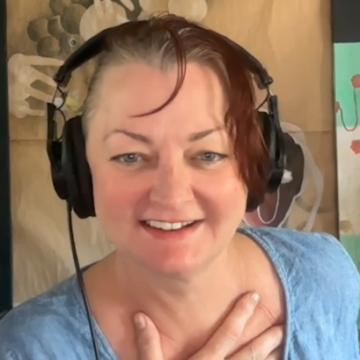
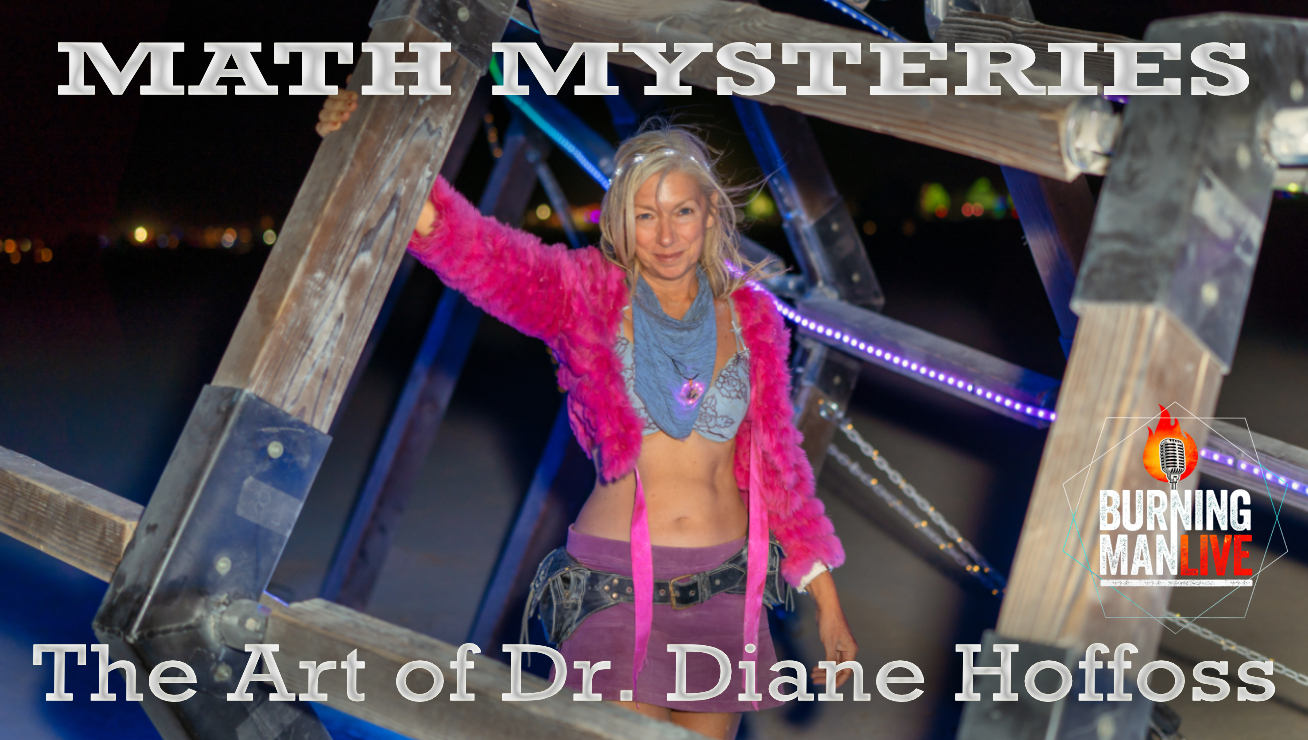
Dr. Diane Hoffoss designs, crafts, and finds funding for interactive art in BRC and out in the wide world.
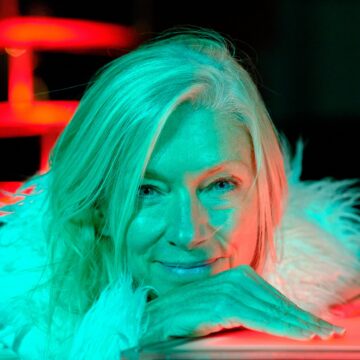
See the art and the conversation with Andie Grace about unsolved problems, lasers, and joy.
“Inspired positivity and joy, bringing all this happiness back. We need that.”
They decode the depth between interactive art, interactive math, and the universe.
They share stories about the art collective ArtBuilds, the nonprofit Makerspace CoLab, and
the Burning Man Regional event YOUtopia… and how Diane’s university funded her Burning
Man art as official scholarly research.
Watch all the way to the end for the best part: how building a laser playground in the dust might just solve the mystery of restoring faith in humanity.
Cover Photo: Frank Guthrie
Bio Photo: Ariele Baragona
Transcript
DIANE: When I came out here, I’m not used to the curiosity that the Black Rock City citizens have. Everyone wanted to know about the math. Everyone wanted to know, like, “What’s the meaning of this?” And I’m accustomed to in the real world saying, “Oh, it’s a math problem.” And people saying, “Oh, I don’t want to know about that.” But, in fact, they were like, “Oh, what’s the math problem?” And then I started to tell them a little bit. “How could this work? Could we..?” And they just engage. And so it would be delightful if people wanted to engage and ask. And already people are.
ANDIE: Ha! Okay, well, welcome back to Burning Man LIVE. I am Andie Grace, your host for this episode, and I am here in Black Rock City on “Event Monday” with Doctor Diane Hoffoss. You have brought a piece of art to the playa, and I want to hear about it. Let’s start with, tell me about your journey to Burning Man. How and when did you start participating?
DIANE: It’s one of those things where you think, oh, I’ll do it one year. And then, actually a friend was at my house. I’ve got all these sort of weird lights, weird colored lights and stuff, and he said, “You know, with all these lights, you might like Burning Man.” And I was like, oh, maybe this is the year.
And so about two weeks before a friend of mine sort of posted, “Hey, I’ve got a ticket I need to sell.” I’m like, okay, this is it. And so I just packed a few things and came, and it was just mind blowing. And I didn’t expect there to be so much mathematical art. I knew there would be art, but when I saw all the… Oh, I just really, it really just touched me. And so that made me feel like I need to start bringing math art.
ANDIE: Well, let’s get into your background a little bit. Tell us about, you know, who you are and what you do in the world.
DIANE: Mmm, well, I’m a math professor at University of San Diego, since 2001. And I just love teaching and I love math. It’s just, it’s ahh, it’s endlessly interesting and challenging, and stressful and rewarding, and all the emotions sort of come with it. And I love helping students through their growth through the discipline.
Mathematics is often misunderstood, not just in the…
ANDIE: Why?
DIANE: I think there’s a lack of exposure to what math is, lack of opportunity to know what mathematics is about, and so when I say I’m a mathematician, people will say things like, “Oh, what’s the biggest number you know?” And, uh… And, you know, it’s a silly question, right? Or they assume what I’m doing is like, I’m taking a very, very, very complicated equation and finding a solution to it, because that’s the mathematics that they have access to. But it’s just far more abstract and beautiful and encompassing.
ANDIE: What is math?
DIANE: Okay. Math… Math is the study of sort of connections, relationships, structures, understanding of how things fit together with other things. And so many people think it’s just sort of equations and formulas and plugging things in, and I think a lot of people think math is sort of done. It’s like we know all the formulas.
And they’ll say things like, like, oh, you know, “Do you know calculus?” as if that’s the pinnacle of… but calculus was new more than 200 years ago. You know, and we’ve done so much math since then.
Math is sort of going to the edge of the unknown and being like, here’s a connection that I think or here’s a, even if it’s just like here’s a situation I just want to understand. And then you play with it, you try things and you start to see, you start to see things that look like they might be related. And then you’re like, oh no. Maybe that’s not. And then you get some conjectures, and you start to sort of play with it. And, huge beautiful ideas can come out of it. And sometimes you can see how things work like, it’s all analogies and…
ANDIE: Sounds like jazz. I mean, I’m a musician and it sounds a lot like jazz, like improvising and figuring things out. And we were just talking about music and math and how they fit together.
DIANE: Yeah, it’s fresh and creativity. So I mean, I know there’s a low level connection with math and music in my mind, which is, you know, okay, so…
ANDIE: theory.
DIANE: the theory. And then the beautiful connection really is, the underlying structures. I mean, you know, so beautiful music sometimes will like pick up themes and explore them and then walk away and like, ruminate and then come back with a beautiful resolution at the end. And I think that does a great job of paralleling what we do in math, where we’re sort of exploring things, variations on a theme. And then we don’t know what we’re doing, and then suddenly, you know, suddenly, where’s the inspiration strike? And then you come with this grand reveal at the end, and that sort of willingness to just tinker around with things until it fits together right. I think that’s what connects us.
And yeah, that’s kind of why I started getting into doing art, as I wanted to communicate that.
ANDIE: And that was going to be my next question. Can you explain your field of study in a way that non mathematicians can understand?
DIANE: Oh yeah I love to do this. Yeah. So I’m a topologist. And topology is the study of the shapes of things. And so topologists ask: Let’s suppose we don’t care about distortion. Now what are all the fundamental shapes? And of course we know what they are in, you know, that live in 3D. But like what are all the fundamental three dimensional shapes and those can live in much higher dimensions. That’s what we study.
ANDIE: So let’s talk about Axion Seed which you’ve brought this year. Tell me what it is.
DIANE: It’s a piece I really love. It’s sort of a precursor to something I’ve been thinking about since 2019. Since after Unfolding Humanity. Which was just such a joy for me.
The next piece is related to this unsolved math question. So I would like to follow up with something called Axion Field. And so the seed was just like a little starter piece for the field, right?
Suppose I allow you to take as many circles as you want, any diameter circles that you want, place them wherever you want in the plane, as many circles as you want, billions, whatever, however you want. So imagine sometimes if you take a little point somewhere and you start firing off rays and let it bounce off the circles as if, you know, billiards or something like that. Sometimes it’s going to do a couple bouncing and then just escape forever. Every once in a while will do some like recursive path and come back where it was. And you can ask
How often does it come back?
How often does it escape?
And so the question is: Is there a choice of number of circles, location of circles, diameter of circles for which every single path in all directions stays trapped, nothing ever escapes?
It’s something that I can describe to you. I don’t know what your math background is.
ANDIE: I’m terrible at math, but I’m fascinated by mathematicians. I love people who love math.
DIANE: It’s a situation that I can describe to you with whatever math background you have. And you can say, I guess I understand what the question is.
ANDIE: That makes a lot of sense.
DIANE: But mathematicians and PhD mathematicians who’ve been in the field, you know, forever, we have no idea whether this is true or not, whether this is possible. This is what mathematicians do. They think about like, how do things work? How do things relate to other things? Is this even possible? Could we..?
So I wanted to find a nice way to illustrate, ah, you know, an unsolved math problem like this. And so my idea was, well, what if I have, you know, something that’s firing out rays in a bunch of different directions, and people can sort of move the rays around? And what if I have a whole bunch of these circles where they can sort of bounce off each other? And at first I was thinking you could move them around and let them see what the different patterns are but of course, once you start thinking about using lasers for the paths…
ANDIE: Gotta be careful.
DIANE: Everything has to be very, very stable. And I couldn’t have it moving and then tipping and so on. So, yeah, if I ever do Axion Field, everything will be very, very stable, but still in some sort of interesting configuration where some of them bounce sort of in the same fixed area forever, and some of them sort of escape off.
ANDIE: So what are you hoping people take away from that experience?
DIANE: Just curiosity and, and joy. One thing, one thing that I loved so much about Unfolding Humanity is, I mean, I started out wanting to bring mathematical art. So, this was another unsolved problem. I got really so mired down into the fact that, like, I don’t know how to make art and like, how am I going to bring this big thing, right? How am I going to learn everything I need to learn to bring it?
And when I came out here, I’m not used to the curiosity that Black Rock City, the Black Rock City citizens have. Everyone wanted to know about the math and everyone wanted to know, like, what’s the meaning of this? And I’m accustomed to in the real world saying, “Oh, it’s a math problem.” And people saying, “Oh, I don’t want to know about that.” But, but in fact, they were like, “Oh, what’s the math problem?” And then I started to tell them a little bit, how could this work? Could we? And they just engage. And so it would be delightful if people wanted to engage and ask. And already people are.
Axion Seed is just one cylinder with lasers firing out, and then a pentagonal boundary. The inside of the pentagon is lined with mirrors
ANDIE: Mirrors.
DIANE: So you can get lots of sort of reflections and patterns and that sort of thing.
Yeah, I also connected it to the theme, but we can talk about that in another time.
ANDIE: I mean, we could talk about it right now, it’s Axis Mundi. Tell me how that connects.
DIANE: Well, I guess I probably interpreted the theme in my own funny way. I didn’t think about trees. I, I was… maybe I leaned very heavily into the Axis part of it, and I just sort of imagined this, this sort of beautiful axis sort of connecting the sky, celestial heavens, straight down through the core of the earth, and this sort of maybe energy coming through each of us and grounding us.
ANDIE: I think that’s more what it means than just trees, right? Yeah.
DIANE: Okay, good. So that’s how it felt to me. And so then I saw the central cylinder as just being, you know, being just a being living in the world, sort of bringing this energy down and then and then radiating it out. We’re all radiating our own energies out. Like you, you’ve picked up on things about me and about how I move through the world, just with this time that we had together. And so and this is what we do. And when we’re younger, we just, we just react to things without any thought of what’s going on, you know, we’re just sending things out of the year. It’s bouncing around. It’s a bouncing around off the walls and like causing changes, and every once in a while, something that we do, it comes back to us. And, and then suddenly we see our effect on the world. We see our effect on our friends. We see how our behavior, the energy that we send out is touching other people. And it’s a moment of self-awareness and self-reflection.
ANDIE: You become more intentional of energy.
DIANE: Yeah. And so, sometimes the reflections of the lasers come back and strike the cylinder. And, and then that’s meant to be like the self-awareness part. And other times it just bounces around and causes chaos everywhere. And then at the top there’s like this, like there’s this really sort of charming sort of loop of fiber optic cables to look like, like new neurons making crazy pathways and like, understanding
ANDIE: Wow, I can’t wait to get out there and see it.
DIANE: I can’t wait for you to see it.
ANDIE: It’s already up?
DIANE: Oh, yeah. It’s up. It’s, we put it up. We sort of put up in one day, but we put the… So, you know, if you’re dealing with lasers, you have to be very, very, very careful about everything being incredibly level and flat. And like, I didn’t want it to escape off to the rest of the world, right?
ANDIE: You don’t want it blinding anybody, yeah.
DIANE: Yeah. So, it took us several hours, like half a day to get, just the base leveled well enough, and oriented and tamped down. And then weather was coming in and I didn’t want it to rain in case… it looked like it might rain a little harder on Friday than it did. And so I waited until Friday night and then Friday night with the rest up. So it’s been up.
ANDIE: And you’ve made how many other art pieces at Burning Man?
DIANE: Oh, um. Let’s see. Do we count the ones that I’ve contributed to, or the ones that I have led?
ANDIE: I mean, that’s part of your, you know, your experience of learning to make art here
DIANE: Oh, okay. Let’s see. There was 2017, The Journey Project.
2018 was Unfolding Humanity.
2019 was, was a little bit of this piece called About Time, but I did the lighting for Traversing Through Dust, with a person named Max Elliott. And oh, sorry, the leader for that was Romero, but I did the lighting with Max Elliott.
And then 2020 of course, I did not bring art to Burning Man, nor did I in 2021.
But 2022 was Re:Emergence
And ‘23 was a revisiting of Unfolding Humanity.
‘24 was Penumbra.
‘24 and ‘25. I worked with the Temple, which was just thrilling, and I learned so much.
And then there was this year.
ANDIE: You have been busy.
DIANE: I’ve been busy! It’s addicting a little bit. And it’s really fun, it’s a hard cycle though, to be honest with you; you get back and you’re elated and you’re so tired and you’ve got dust in everything. You have to figure out what to do with the old art piece, and then the new proposal has to go in, like at the end of the year. And so yeah, but it’s been fun.
ANDIE: Amazing. How do you feel about the interactivity element? Like what, why did you choose interactive art to represent these sort of abstract concepts?
DIANE: Oh, just engaging with something both mentally and physically, it just has a different effect on you, right, than if you just sort of stand there… And, and I don’t know, you understand things much better if you get to touch them. And it’s just different mental connections, I think.
And it’s playful, right? And if people, if they don’t understand anything about your piece at all, if they don’t ask about the math, which is totally fine, they don’t ask about the meaning, if they just get in there and play? It’s such, it’s so exciting.
Even last night I was at the piece and some people were… they keep thinking it’s Mission Impossible with like all the lasers bouncing around. And so they were racing. They were like time doing time trials, like who could get a lap quickest. And some people were doing like these big like, weird, un, you know, like monster hops like this. And some people were doing bunny hops. And then some people would run in and kind of spin it in the middle to try to mess them up. And everyone was giggling and running around.
ANDIE: That must have been so satisfying.
DIANE: It’s so satisfying. It’s so satisfying just to feel like, I did a thing that other people are feeling joy from, like, we need more joy in the world. And so even just a moment of that, just it’s thrilling.Yeah. It’s blissful. It really is.
ANDIE: I love that. Tell us about ArtBuilds. What is ArtBuilds?
DIANE: So that’s an art collective, nonprofit collective. So after my first year in 2016, I was like, I’m going to bring some math art. And then I had even an idea of the math I wanted to represent, but it turns out like, it’s hard to bring art if you don’t know any…
ANDIE: It’s hard to be here at all!
DIANE: It’s hard to be here and it’s hard to, it’s… I just wasn’t ready. And so I, I got on Dan Reeves project, The Journey Project, and it being a sort of software lead and lighting artist.
So the next year I was like, I’m ready, I’m bringing my thing and I wanted a new idea for what kind of unsolved math…I wanted to bring some kind of unsolved math problem. And so I had a colleague in the university who was teaching a geometry class at that time. So we signed this, this problem, team problem, like “Of all the problems that we’ve heard in this class, pick one of the unsolved math problems and design a, and come up with what you think would be a good sculpture.”
And anyway, so yeah, so it was really cool. So we had a panel just me and Seth and David panel, and we listened to all the presentations. And then, then we decided we submitted two of them for the LOI. And we sort of, they both got accepted and we’re like, “We can’t do both. Dear God!” And so we picked one. And then lots of changes obviously had to be made. And I started working with some students, and some engineering students and so on, and, and I was thinking, how am I going to build this thing?
And, we had to submit a budget. And to have a budget, you need to know what you’re going to build it out of. And so this, unknown to me, this student that kept sneaking off to an engineering professor and like asking questions and then coming back to me and so on. And at some point, the engineering professor, Gordon Hooper, came to me and is like, “Hey, do you want me to just work on your project?” And yeah, so we started working together and somebody else named Nate found out. “Wait a minute. There’s Burning Man Project on campus? I want to get into this.” And so it sort of started pulling people in, right? And we just had a great time with Unfolding Humanity.
And after that, we were like, let’s keep going. And we had gotten a grant on the first grant, we sort of pulled through, I got a couple grants, actually, and I pulled it through the university, but then it started to be like, we actually are going to need our own nonprofit and like our own …because our universities are notprofit, right? So that’s, and they are accustomed to taking in grants and so on. But in fact, they were not very accustomed to the stipulations of the Burning Man. Yeah. So anyways, we’re like, we just need to run things. So that’s how our collective started. So that’s how ArtBuilds was born. And so we do a lot of projects together. And I do a couple of projects without them.
ANDIE: So you do art other than in Black Rock City?
DIANE: Two pieces actually. So one of them… this was during the pandemic. Well, I guess whether we’re out of the pandemic or not is debatable, but like during the start of the pandemic, there was this initiative called Park Social in San Diego. That’s where I’m from. And what they wanted was to bring people out of their caves, get them out into the parks, get them like just getting healthy again, enjoying what there is to experience. And so they chose, I think it was I think it was there’s eight or 11 Districts, something like it in San Diego, and they were going to put one piece in each of the districts. And so we’re like, let’s just apply for this. We can’t send anything to Burning Man. And we ended up getting the grant.
So yes, we made this piece called Reflection, which is one of my favorite pieces. And it had two installs in La Jolla right by the beach. You know, they gave you a choice of location, you’re in this district, like uh, pick a park in this district. And we’re like, well, we want to be right by the ocean. And so like, how can we reflect all the beautiful nature around? And so there’s lots of mirrors involved to sort of pick up on what was already there, and beautiful lighting. I mean, I did the lighting. So I think it’s beautiful. But…
ANDIE: You can say that.
DIANE: I can say that. Okay.
I wanted to, I actually took photos of the area at various times and pulled colors from that, and had these sort of pallets made of it where the color palette just sort of flowed up these towers of spinning mirrors. And sunset, it would pull sunset colors and have that palette go. And I just loved it.
Anyways, yeah, so that was there two times, it was on USC campus. It was at The Soap Factory. It was at these are all the San Diego locations. It was at Liberty Station, which is a sort of an art and shopping district, sort of a combination of those. For about eight months. It was at the Wow festival in La Jolla, which is Without Walls by Ja Jolla Playhouse. And now it’s in a private collection, which is our first purchase. Very, very exciting.
ANDIE: Wow. Nice.
DIANE: Yeah. So yeah. So there’s one that’s been not at Burning Man.
And then another piece is called Threshold Five.
ANDIE: Threshold Five.
DIANE: Yeah. And it’s in Escondido. And we were, we keep applying for city grants. And of course it’s easy to get rejected for all grants. And so we got, we got accepted to this one and it was amazing. So this is our first permanent piece in Escondido, and it’s in a park called Kit Carson Park. And they gave us this beautiful placement where, you drive in the entrance, and then it sort of goes around, the path goes around this beautiful lake. And we’re right there in front of the lake. And. Yeah, so there’s a couple of places, but…
ANDIE: Amazing!
DIANE: Yeah. And some for YOUtopia. But I think some people in my camp, or in ArtBuilds, are very happy to have it like at YOUtopia and places, but like Black Rock City’s where my heart is. I want to bring art here.
They love this to do, you know, but for me, this is the place.
ANDIE: This is a great gallery.
DIANE: Yeah, yeah.
ANDIE: So you’re bringing together, like, mathematicians, engineers, and artists with ArtBuilds. How it is an interdisciplinary team add something that you couldn’t get by working alone.
DIANE: Oh, that’s a great question.
I mean, we all… obviously we all have ideas that we bring. So but so for example, Gordon is an engineer and he’s able to determine whether… for Unfolding Humanity I really… It’s a dodecahedron that’s meant to unfold. And that addresses a different math question. And I wanted to unfold kind of like this beautiful lotus flower. And so like two faces sort of come down like that. And I was really, really fixed on that. And he modeled it and, and SolidWorks and was like, no, physics says no. Like we can’t. Unless you want to pay $100,000 for making things, you know, like this is not going to happen. And so we had to redesign it and I would have found out by doing a bad design that that didn’t work, right? And so having someone who’s got that knowledge and, and that skills.
Nate Party is from theater and they just build things all the time in theater. And he’s got a lot of like how to like, how to like fix stuff quick, how to like just… Oh my God, what can we, what’s the stopgap thing?
ANDIE: Theater kids are gonna make it go no matter what. Like, the show must go on, right?
DIANE: Yeah. For example, I was worried about there maybe not being enough dust to see the lasers. And I was like, oh gosh, what have I done? And what if you can’t see anything? And I’ll be so disappointed. And he’s just, he just like, five hours. I’m like, he comes back and is like, “What about an industrial vibrator?” I’m like, “What is that?” I guess there’s a thing that you can put on the ground on concrete that vibrates the concrete at a low level. He’s like, maybe that’ll just kick up the dust enough. But he’s the guy who knows there exists industrial vibrators and knows there’s so, so yeah. So everybody brings, everybody has a deep background in something that the others do not have. And, it’s a really great collaboration.
ANDIE: Oh that’s beautiful.
DIANE: Yeah.
ANDIE: How does ArtBuilds have an impact on your local community?
DIANE: We love to hav…e bring other people in to sort of help. And initially we had a lot of open buildis. Actually before we were ArtBuilds for Unfolding Humanity the internal supportive structures was being built by Gordon and some students on campus. And the external, like visible, beautiful, interactive LED whatever parts was led by me at San Diego Co-Lab. And so I just had open build days, Monday nights and Saturday days, like a, “Come one, come all.” And people would show up with all their different, like, skills or lack of skills. And I’d just like, you know what, what can you do?
I remember one guy named Nam. He was like, “What’s the worst job here? What’s the job that nobody wants to do? I’ll do that.” And so it’s it’s just, it’s been delightful to like me to, like, include too many people.
By now ArtBuilds itself has a pretty stable group of people that we’ve pulled in that way. And so it’s often the case that what we really need is another person that’s very special… skilled in a special way. But we have a really great wealth of people who want to just sort of help build with us.
But with Axion Seed. So I did that sort of independently of ArtBuilds, and that gave me this, it’s what I miss. It gave me this opportunity to say, “Okay, who’s up for things?” And people just, people or people with the skills you need arrive when you need them. And so I feel like the impact is to bring people together to work together. And there’s something about I don’t know if it’s trauma bonding, right? But something about like working together on a hard thing, that just to solve problems that you’ve never known you would need to solve because, like, you know, it’s not like there’s another art piece that’s exactly like the one that you’re doing! And then you’ve got this deadline, you just can’t, you cannot be a week late, right? You have to be on time. And it’s like a really beautiful community is formed from that. So I think those are some great effects from that.
ANDIE: over and over out here.
DIANE: Yeah. Yeah, it’s really great.
ANDIE: That makes a lot of sense.
After six plus years of bringing art here, what keeps you coming back?
DIANE: Oh, man. So many things. But two main things. I mean, one is, the art is so inspiring. It’s just so. It’s just so… Where is it better? Where is it more fantastical? Where is it more creative? Where is it more interesting and, yeah, and it’s just, and especially like if you’ve built any art, you have so much appreciation of how, how much time and effort and like sweat-equity and tears and joy.
ANDIE: in a place that’s trying to kill you.
DIANE: Yeah! It’s just, it’s remarkably inspiring. So that’s one of the reasons like I just feel I just feel mentally and like somehow spiritually or something like refreshed from it.
And, the other thing has to do with the people. So, I remember, you know, I went in 2016 and then in 2017 I was going with this art piece, and I went all in. And so from February until like the day before we left, basically, I was working so hard and I’m a professor so, we really need the summers off to decompress from the school year. And I was like, I’m not going to have any time off this summer and I’m going to go to the Burn. I’m just come back exhausted and start teaching. And so I was telling my friend, I was like, “I don’t think I can go. I think I just need to stay home this year and take two weeks to catch my breath.”
And the friend said, “You need to go, because last time you came back liking people a lot better. And I think you need your faith in humanity restored.”
And so yeah. And so that’s what happens every year, is I come back and, and people are just open hearted and fun and sharing and silly and real, and it allows me to see that facet of people back in the default world, even if they’re hiding it a little bit. You’re like, oh, I can connect to that. I see that, and yeah. So it’s just to have a it’s just to like people again, it’s just to be refreshed about humanity and care about it. Yeah.
ANDIE: So true. That’s probably what keeps me coming back.
DIANE: Yeah.
ANDIE: after all this time.
How does your Burning Man experience inform or impact your work in the world beyond Burning Man?
DIANE: Well, I’m, I’m this amazing, amazing… I’ve somehow pulled off this major coup, if you ask me, where because at first, I didn’t, I didn’t want my university to know I was going to Burning Man. It’s a Catholic university. And that…it’s Catholic and interesting way. The students aren’t necessarily Catholic. Some of them are, of course. Some of them aren’t. The faculty don’t have to be Catholic. There’s no indoctrination. There’s no… they don’t even ask if you’re Catholic. Do you know what I mean? So but they do guide themselves along these principles, which I respect the principles. But anyways, I was like, I don’t really know what they’re going to think about Burning Man and I just want to keep it quiet.
And then for Unfolding Humanity got this grant from SDCAT, San Diego Collaborative Art Project. And my friend Stephan was like, well, you know, our university takes grants all the time. Why don’t I just talk to, you know, the person that deals with my grants and just see, like, is it possible to sort of bring it in through the university? And I was like, do not! I don’t want them to know.
He’s like, I’ll just keep it on the down low. I’ll just like…
So he did. And this whole flurry of emails goes out. It was something like three in the morning, Sunday night (How are we getting these emails?) around like “BURNING MAN!!!” They were just like… And I was like, “What have you done? You ruined my life! Oh, no!”
But everybody calmed down and, reasoned conversations were had. And luckily it just happened to be the same year as The Smithsonian, The Renwick, had the No Spectators, and so we could say things, “Well, you may not think it’s art, but the Smithsonian does. So like, you know, you can have your own opinion on whether it’s art.”
ANDIE: That air of legitimacy.
DIANE: Yeah. But it didn’t take long, to be honest. And the university came around and embraced it.
We actually had a, a story in our back pocket, just in case. We didn’t have to use it. I was ready to say, “Okay, suppose you’re right. Suppose that Burning Man is the absolute epicenter of everything that is evil, and depraved, and terrible in the entire world. Shouldn’t we, as educators, bring our light into the abyss and share the joy?” And, you know, how can they argue with that?
But they didn’t argue with it. And so now they totally embrace it. And I’ve had our art pieces… they put it on the front page of their, on their website. And they really want interdisciplinary work, and we’re doing interdisciplinary work. And they celebrate that. And we’ve had students involved in the projects, and they celebrate that. And they even changed their, the way they give students summer grants, because what we were doing didn’t fit into any of those categories. So they kind of added a new, like group category for it.
Yeah, and so here’s how I think I’m unique, I feel unique in the world. Is is Our university cares much about like you can do any scholarly activity and they’re happy with interdisciplinarity. They’re happy with any engagement. And so this is my scholarly activity. So this is treated as my research for the year. And I’m here using my conference travel money. And I paid for my Burning Man ticket out of my… because this is my, this is my creative contribution!
ANDIE: Absolutely.
DIANE: And yeah. So it’s just a delightful, supportive environment from the university. Yeah.
ANDIE: I have to make sure that you are invited to the Burning Nerds meetup.
DIANE: Okay.
ANDIE: Academics, anybody who’s studying, whether it’s Burning Man or not, but a lot of people who are studying Burning Man just come together and geek out. So.
DIANE: Okay! I can geek.
ANDIE: I’m just gonna throw that in there because I just love that that happens here in Black Rock City; there are so many people who are extracting the kind of things that you were just talking about, and using it to apply to their research in the real world. So please show up for that one.
DIANE: I would love to.
ANDIE: Why do you think Burning Man is important in the world?
DIANE: I love the experimental community about it. I love the… it sounds cliche, I guess, to say, but it’s changed me as a person. It’s changed all my Burner friends as people. And I mean, I’m a little bit sheltered in my sweet little San Diego Burner community.
ANDIE: Great folks down there.
DIANE: Great folks. Yeah, yeah. But it makes me a better person. I mean, just the principles are really lovely things to try to live by. And I think it’s… It helps me, I’ll just say for me, it helps me see the humanity in people, and it helps me treat people with more care and gentleness. And it helps me see us all sort of in this together. And I think…
ANDIE: And like people again!
DIANE: And like people again! Yeah. And all of these, all this sort of like inspired positivity and just joy, and bringing all this sort of happiness back. I think we need that. We need happiness and we need care, and we need silliness and play, and to like… And it’s so hard to generate that from scratch out there when things feel grim. But here you can just like, for a moment, you can just be mad about it and then giggle and then whatever. And then you can like have some of this energy to bring forth. Yeah.
ANDIE: Oh my gosh, I could listen to you talk all day. Your brain is fascinating.
DIANE: Thank you.
ANDIE: Well, thank you. This has been so fun.
DIANE: Yeah.
ANDIE: Doctor Hoffoss thank you for these office hours. It was really a pleasure to talk to you.
DIANE: It was a delight. Thanks for having me. Yeah.
Yay! That was fun.
ANDIE: That was really fun.
DIANE: Thank you for that.
VAV: Burning Man LIVE is a labor of love from the Philosophical Center of Burning Man Project, a public benefit nonprofit and a 501(c)3 public charity.
If you enjoyed this episode, or any of ‘em, consider paying it forward by lovingly typing into your search donate burning man to be taken to DONATE.BURNINGMAN.ORG.
The biggest event is over. The 100 Regional events are happening next, and then there’s next year’s big event. Oh, plus all the Decompressions, street fairs and urban gatherings, then precompressions, all around the world. Then there are the maker spaces, community art spaces, beach clean ups, happy hours, talks and panel discussions
oh, and all the affiliated events, sometimes called ‘principled’ events.
Heck maybe even some of the transformational festivals are adjacent to the experiment in temporary community called Burning Man.
Ask yourself this question:
DIANE: Shouldn’t we, as educators, bring our light into the abyss and share the joy?”
VAV: Then consider donating to DONATE.BURNINGMAN.ORG. Any amount counts.
Thanks to Dr Diane Hoffoss, ArtBuilds, Gordon, Nate, Seth, David, and the other people she mentioned.
Thanks to Dustin Fasman, and the Media Mecca team on playa.
Thanks to our team, Actiongirl, Charrrr, kbot, DJ Toil, Great Question, Ladyfinger, Martini, Mockingbird, and Vavalicious (that’s me).
And thanks Swordfish, for starting all of this.